📌 Key Takeaways
Store brand audio success requires engineering discipline, not just logo placement—quality gates and specifications protect brand equity before production scales.
- Fill Strategic Gaps First: Launch one SKU addressing an unmet performance tier or reliability standard, not copying existing bestsellers.
- Write Measurable Guardrails: Brand differentiation becomes real when positioning translates into documented pass/fail specifications factories can build to repeatedly.
- Golden Sample Controls Quality: An approved reference unit transforms subjective quality debates into objective production comparisons that protect brand reputation.
- Phase Before Scaling: Pilot batches (100-200 units) validate consistency against defined thresholds before capital-intensive production commits expose field failure risk.
- Partner QC Systems Matter: Verified IQC/IPQC/FQC processes predict manufacturing stability better than unit cost, preventing warranty exposure that erases margin.
Specification precision + Golden Sample discipline = controlled brand-building process.
Audio brand managers and private label decision-makers will gain actionable frameworks here, preparing them for the detailed implementation steps that follow.
A shipment arrives. You open the first pallet of your new house-brand subwoofers. In this moment, your brand’s reputation rests entirely on a 12-millimeter excursion tolerance and the integrity of a surround bond. Is every unit identical to the prototype, or are you about to face field failures that erode the brand equity you’ve spent years building?
Store brand audio—often called private label car audio—is the process of having high-performance equipment manufactured by a third party to your specific requirements and sold under your own brand name. Think of it as the “store brand” concept, but for professional-grade gear that you control from the voice coil up. It is the bridge that turns an audio distributor from a channel intermediary into a brand owner with a defensible asset.
Private label programs have shown strong growth trends across B2B brand partnerships, signaling that store brands are increasingly a mainstream brand-building strategy rather than a last-resort discount tactic. However, the transition from reselling to branding is fraught with quality risk. To move from the private label roadmap to a successful launch, you need more than a logo; you need an engineering-first strategy. This five-step launch plan outlines the decisions you must make, the documents you must create, and the quality gates required to de-risk your investment before you scale.
Quick Roadmap: The 5-Step Launch Sequence
- Identify the Assortment Gap: Find where a store brand adds value without cannibalizing winners.
- Establish Brand Guardrails: Define the performance and visual rules for your line.
- Codify the Technical Spec: Translate your brand promise into measurable engineering requirements.
- Lock the Golden Sample: Secure a manufacturing partner and a “Source of Truth” for quality.
- Execute a Phased Rollout: Prove demand and consistency with a limited batch before full-scale production.
Step 1: Pick the right gap to fill (where a store brand actually wins)
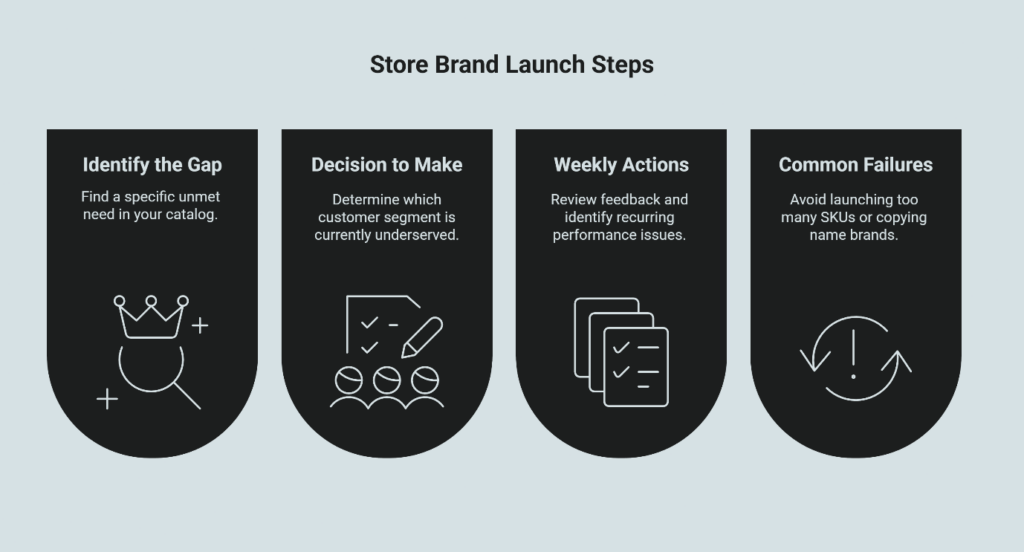
Your first SKU should address a specific “hole” in your current catalog—a price point, performance tier, or reliability standard that your current third-party brands are failing to meet.
A store brand shouldn’t just copy your best-seller; it should solve a problem. Perhaps your current mid-tier subwoofers have a field failure rate that erodes brand credibility with installers. Or maybe there is a glaring price gap between your entry-level gear and your “elite” lines. By filling these gaps, your store brand adds incremental revenue rather than just shifting dollars from one brand to another.
Decision to make: Which specific customer segment is currently underserved by my existing brand partners?
What to do this week: Review your last 90 days of “out of stock” alerts and low-rating product feedback. Identify if there is a recurring performance complaint (e.g., “not enough mounting depth for trucks”) that a custom-engineered solution could solve. Write a one-sentence “job” for the SKU: “This product exists to…”
Common failure modes: Launching 10 SKUs at once; trying to “out-cheap” a budget dropshipper (leading to unsustainable margins); copying a name-brand SKU without establishing a unique role in your catalog.
Step 2: Define brand guardrails (so your line doesn’t feel like a knockoff)
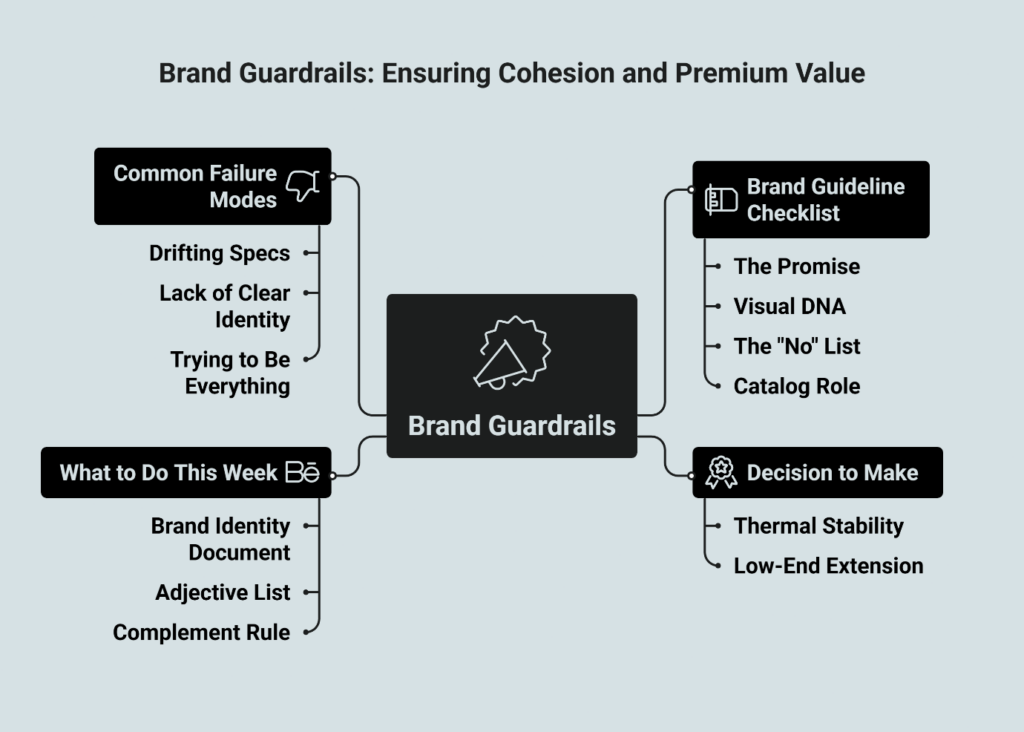
Brand guardrails are the written non-negotiables that ensure your product line feels cohesive, intentional, and premium.
“Sea of Sameness” is the primary risk in the audio market. If your product looks and performs exactly like an off-the-shelf white-label unit, you are competing solely on price. Guardrails define your “reason for being.” Industry research suggests private labels succeed most when they offer accessible premium value—matching name-brand performance at a more competitive price point through supply chain efficiency, not by cutting corners on components.
Brand Guideline Checklist
- The Promise: Are we the “indestructible” brand or the “audiophile precision” brand?
- Visual DNA: Standardized basket colors, terminal types, and dust cap materials.
- The “No” List: What claims will we never make? (e.g., “We won’t use inflated Peak Watt ratings.”)
- The Catalog Role: Does this SKU complement or confuse my current Tier-1 brands?
Decision to make: What is the one performance metric (e.g., thermal stability, low-end extension) that will be the “signature” of this brand?
What to do this week: Create a one-page “Brand Identity” document. List five adjectives that describe the brand and five that definitely do not. Write a “complement, don’t confuse” rule: where this brand sits relative to the brands you already sell.
Common failure modes: “Drifting” specs where every new SKU looks different; failing to give the brand a clear identity beyond “It’s cheaper”; trying to be everything to everyone without written rules.
Step 3: Turn positioning into a spec (your differentiation in writing)
If a performance requirement isn’t in the written specification, it doesn’t exist in the eyes of the factory.
Positioning is a marketing term; a specification is an engineering term. You must translate “powerful bass” into “X amount of Xmax at Y frequency”—this precision protects you from performance drift that damages brand positioning. This documentation is your only defense against quality fade. When engaging in OEM car audio production, precision in the BOM (Bill of Materials) is what separates a defensible brand from a generic import.
“Just slap a logo on something generic” is not a private label strategy—it’s commodity sourcing with your reputation attached. When quality drifts, brand partners and installers blame you, not the factory. You prevent drift by writing what “good” means in measurable terms, then enforcing it with Golden Sample matching and quality gates.
Decision to make: Which critical components require premium upgrades (e.g., OFC lead wires instead of CCA) to ensure long-term reliability and protect brand reputation?
What to do this week: Draft a technical requirements sheet. Include power handling (RMS), impedance tolerances, and physical dimensions—the specifications that define performance differentiation in your market. Do not leave “tolerances” to the manufacturer’s discretion. Pick your 1–2 differentiators and write them as pass/fail requirements.
Common failure modes: Using “vague” specs like “high-quality foam”; optimizing only for the lowest BOM cost while ignoring the “Quality Risk” price; letting the factory “recommend” the spec without your guardrails.
Step 4: Select the OEM/ODM partner and lock Golden Sample quality
Your manufacturer is your “backstage crew”—invisible when things go right, but capable of destroying your reputation if they fail.
Many brand managers believe that the lowest “unit cost” equals the highest profit. In reality, even a small spike in field failures can significantly impact annual margins through warranty costs and lost brand credibility. True profit comes from subwoofer manufacturing process stability and rigorous QC gates that prevent NPI failures from reaching your distribution channels.
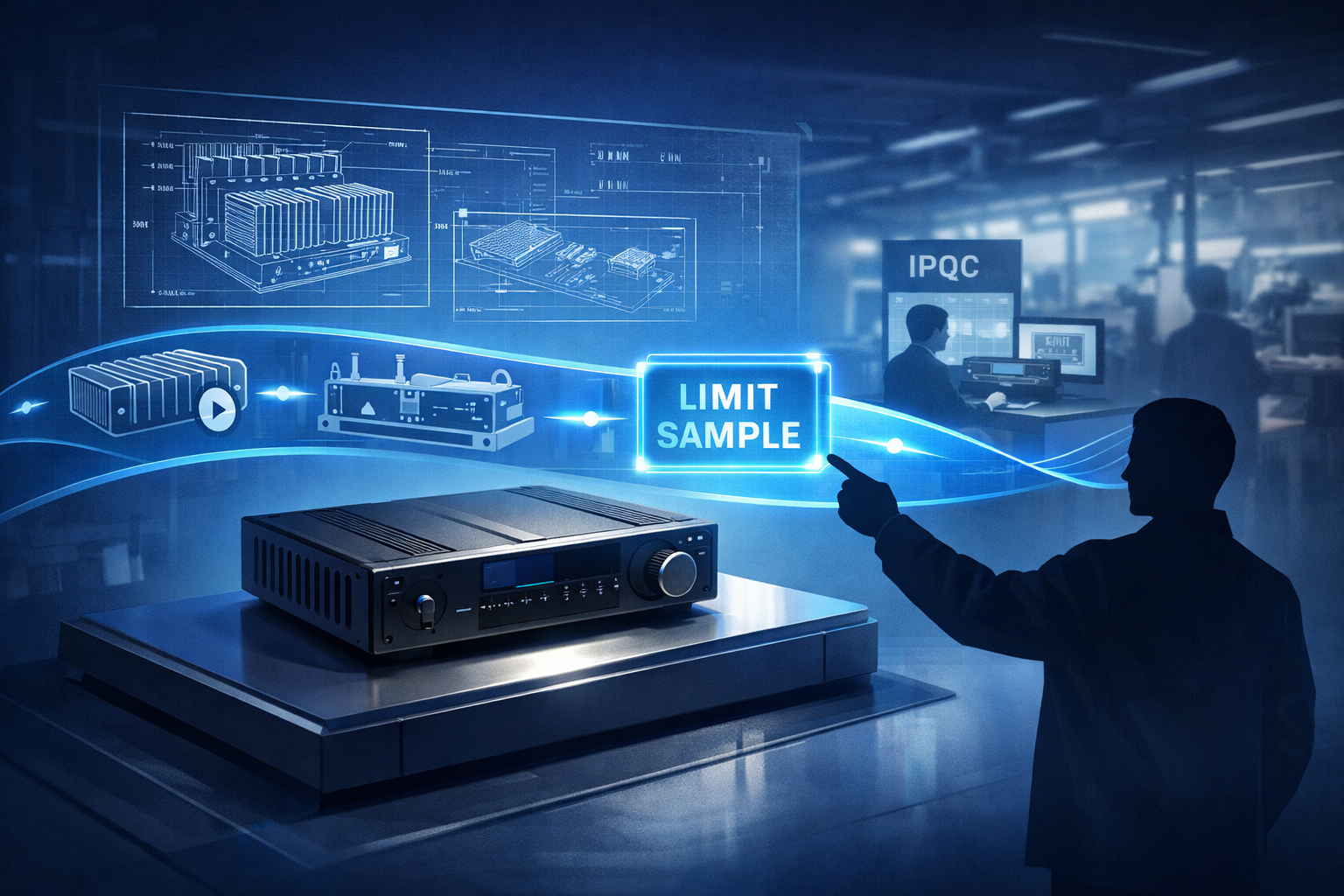
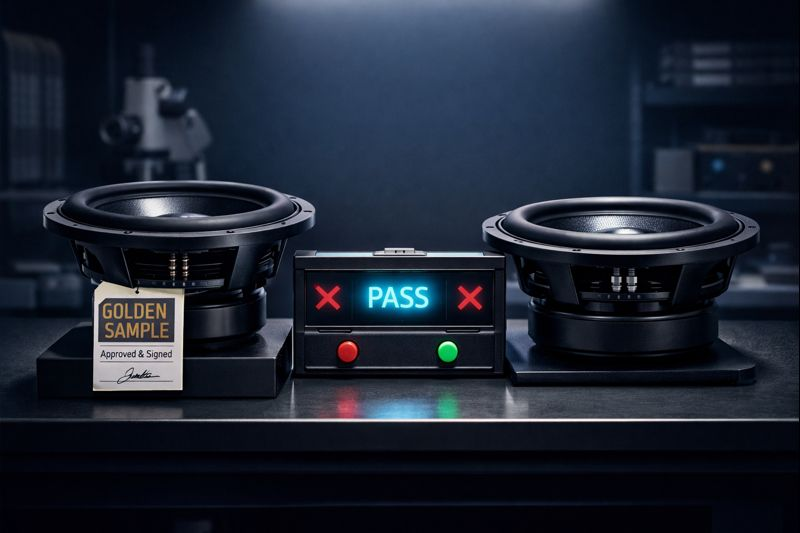
This is where the Golden Sample becomes critical. A Golden Sample is the approved reference unit that production must match—it turns “quality” from a debate into a comparison. This is a physical unit, tested and signed by both parties, that serves as the absolute source of truth for every unit that follows. This protocol is your primary tool for preventing late-stage NPI failures that damage brand reputation. Using Golden Sample QA protocols ensures that if the mass production run deviates from the prototype, you have a legal and technical basis for rejection.
Product Launch Timeline
- Month 1: Partner Vetting & Initial Spec Handoff
- Month 2: Prototype v1 Testing & Iteration
- Month 3: Golden Sample Approval & Signing
- Month 4: Pilot Batch Production (100–200 units)
- Month 5: Audit, Review, and Full Scale-Up
Decision to make: Does this partner have a documented IQC/IPQC/FQC (Incoming, In-Process, and Final Quality Control) system that reduces your brand risk?
What to do this week: Request the manufacturer’s ISO 9001 certification and a copy of their standard testing report for a similar SKU. Require a written Golden Sample plan before you place a meaningful order. This upfront discipline is what separates successful private label programs from costly quality failures.
Common failure modes: Skipping the sample iteration phase to “save time”; choosing a partner based on price without seeing their Klippel testing rigs; no written accept/reject criteria, so every issue becomes a negotiation.
Step 5: Launch in phases (prove demand and quality before scaling)
A phased rollout allows you to “stress test” your engineering and your supply chain stability with minimal capital at risk.
Never go “all in” on the first production run. A phased approach—starting with a pilot batch—allows you to perform a thorough brand-protection validation. You aren’t just looking for broken units; you are looking for consistency against established thresholds that protect your brand investment. National manufacturing standards emphasize that “statistical process control” is the only way to ensure 1,000 units perform exactly like the first one.
Go/No-Go Thresholds for Scaling
- Field Failure Prevention: If the pilot batch exceeds your defined field failure threshold (typically 1-2%), halt production and re-evaluate the spec.
- Consistency Check: Do 10 random units from the batch match the Golden Sample’s frequency response curve within +/- 2dB?
- Communication Baseline: Did the partner provide weekly updates and transparently report any material delays?
Decision to make: What is the maximum number of units I am willing to “lose” if the first batch has a catastrophic engineering flaw that threatens brand reputation?
What to do this week: Define your “Phase 1” SKU. Pick one product that represents your brand’s core values but has a manageable production volume. Write your thresholds on one page and share them internally. Build a “go/no-go” meeting template showing what data protects your brand investment.
Common failure modes: Scaling too fast based on emotional excitement; failing to set “hard” go/no-go thresholds before the data arrives; going big on the first order before you’ve validated that your quality gates prevent field failures.
The Strategic Summary
Launching a store brand audio line is a transition from being a spectator in the market to being an architect. By following these five steps—identifying gaps, setting guardrails, documenting specs, locking the Golden Sample, and phasing your rollout—you transform quality from a “hope” into a controlled process that protects brand equity.
If you are ready to move beyond “logo slapping” and want a low-pressure sanity check on your spec readiness or Golden Sample protocols, our team is available for review. Building a defensible brand starts with the right engineering partner and risk-reduction discipline.
Ready to de-risk your next launch?
- Subscribe to Our Newsletter for monthly insights on audio manufacturing and quality control.
- Get in Touch: hu@chinafuturesound.com | +86 139 6730 8635
Frequently Asked Questions
Q: Why shouldn’t I just use the manufacturer’s off-the-shelf design?
Off-the-shelf designs offer no differentiation. Your competitors can buy the exact same unit, forcing you into a “race to the bottom” on price. Customizing even 2–3 key components allows you to own the “sound signature” and build a distinct brand story that protects margin.
Q: What is the most important part of Step 4 (Partner Selection)?
Verification of their QC system. A factory that cannot show you their IPQC (In-Process Quality Control) stations or their reliability laboratory represents high risk for a private label brand program.
Q: How many SKUs should I start with?
Launch one high-impact product (like a flagship subwoofer) to prove your quality systems and supply chain before expanding into a full line. This approach minimizes NPI risk.
Q: How do I know when to scale volume?
When your go/no-go thresholds are consistently met across batches, not just once. Scaling before you’ve proven consistency exposes your brand to field failure risk.
Q: Can I do this without becoming a manufacturing expert?
Yes, if you treat the process like architecture: define requirements, choose a reliable builder, and enforce inspections at defined gates that protect brand investment.
Our Editorial Process: Our expert team uses AI tools to research and analyze complex topics in order to create helpful, well-structured content. Every piece is then extensively rewritten, fact-checked, and reviewed by our editorial team to ensure clarity, accuracy, and original value.
About the China Future Sound Insights Team
The China Future Sound Insights Team is our dedicated engine for synthesizing complex topics into clear, helpful guides. While our content is thoroughly reviewed for clarity and accuracy, it is for informational purposes and should not replace professional advice.