📌 Key Takeaways
Custom audio production succeeds when quality standards are documented before the first unit is assembled, not improvised during firefighting.
- Spec Package Prevents Drift: A detailed specification document with performance targets and acceptance criteria stops unauthorized component substitutions before they reach your warehouse.
- Golden Sample Anchors Consistency: Freezing an approved reference unit with documented test data creates the measurable standard that every batch must match.
- Ownership Maps Reduce Conflict: Defining who controls design decisions versus process parameters eliminates accountability gaps when quality issues surface.
- Pilot Runs Expose Hidden Failures: Testing 100 units reveals packaging drift and assembly inconsistencies that a single perfect prototype conceals.
- Weekly Proof Packs Build Trust: Requiring photos, test summaries, and trace IDs creates transparency that prevents silent quality degradation across time zones.
Decision gates before production beats damage control after shipping.
Online audio retailers launching their first custom production run will gain a risk-reduction framework here, preparing them for the detailed implementation steps that follow.
You can smell the fresh cardboard and metallic tang as you open the first shipping container of your own branded gear. But that excitement quickly sours if the first unit you pull out has a misaligned dust cap or a scratchy voice coil. For online audio retailers, moving from off-the-shelf reselling to a custom audio production run—an OEM audio manufacturing process where you commission a specific build based on unique performance targets—is a significant leap that requires more than just a logo slap.
Hypothetical scenario: It’s a Monday morning. Warranty claims quietly tick up after the last batch, and the defect rate crosses 3.2%. The real fear isn’t a single failed unit. It’s a pattern: inconsistent batches, slow supplier responses, margin-eating discounts, and reputational damage stemming from the “silent supplier” phenomenon where factories make unauthorized substitutions to hit a price point.
Think of manufacturing like architecture: no one pours concrete off a vibe. You wouldn’t pour a concrete foundation without a verified blueprint and a structural engineer’s sign-off. A build needs a blueprint, tolerances, and inspection rules before anything becomes expensive to change.
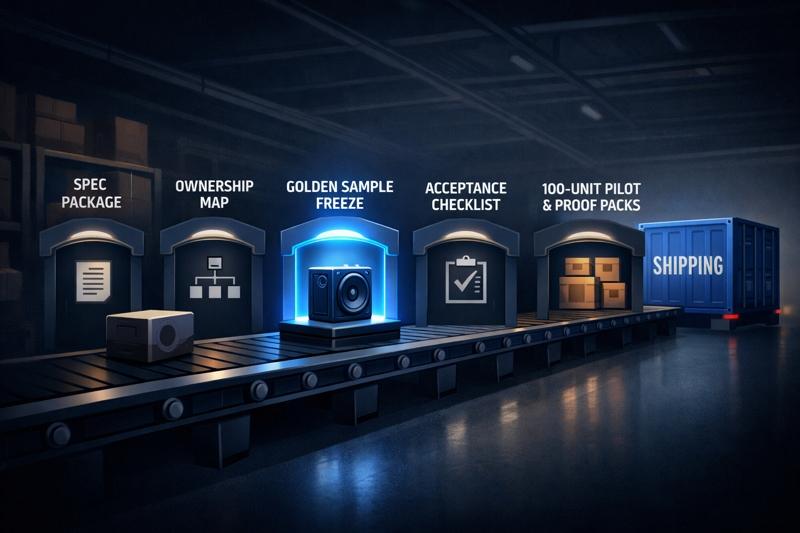
These five steps are decision gates, not factory-floor instructions. Each gate forces the right decisions and documents early, so the first run reduces risk instead of creating firefighting. In the “sea of sameness” found in many e-commerce marketplaces, this structured approach is how you build a defensible brand on professional-grade reliability rather than luck.
Step 1: Lock the “Product Definition” before asking for pricing
The first deliverable is a spec package, not an RFQ email.
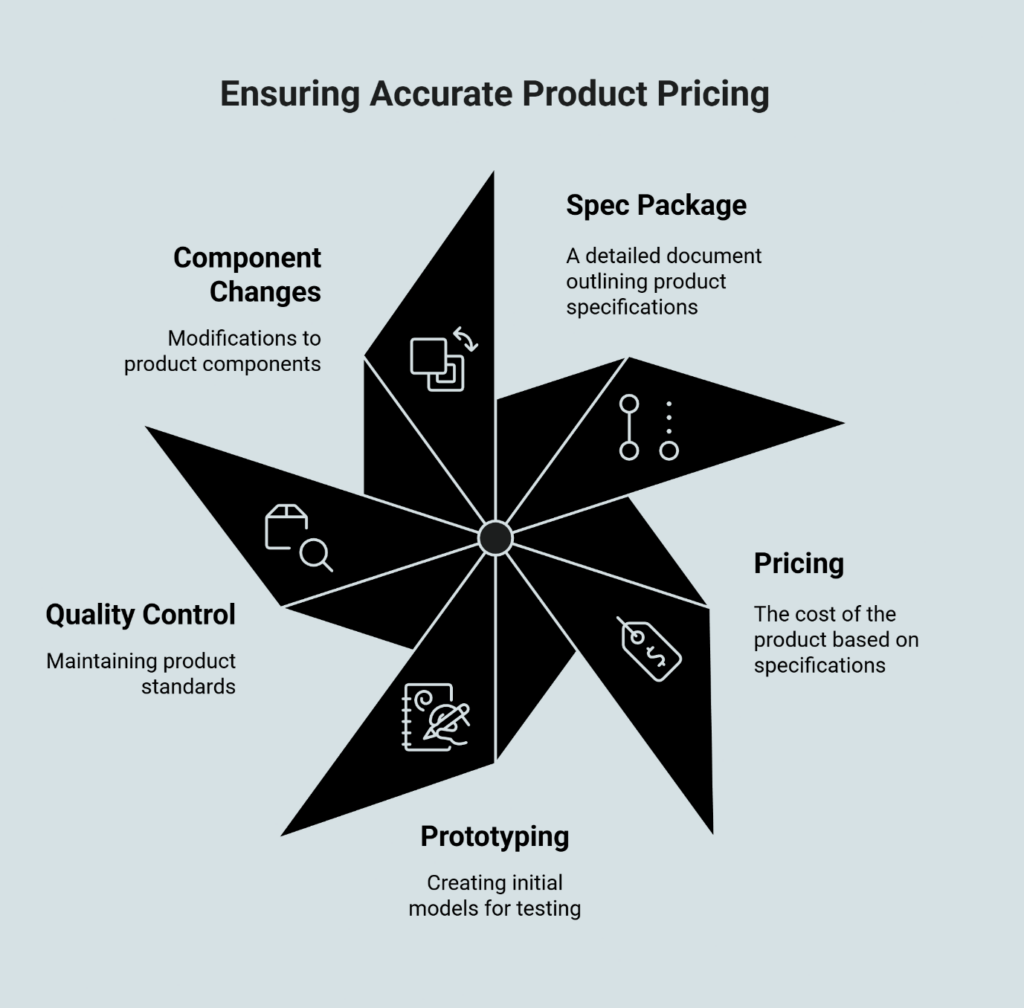
Pricing without a shared product definition is usually just a guess. The spec package becomes the anchor for quoting, prototyping, and quality control—your “single source of truth” for the factory floor. By defining parameters like RMS power, impedance, and frequency response early, you prevent the “silent supplier” phenomenon where manufacturers make undocumented component changes to meet your budget rather than your specifications.
Use a mini spec-sheet template and treat it as the source of truth. These specs align with the same fields commonly shown in catalogs—for examples of how specs are typically presented, reference the CFS catalog.
Mini spec-sheet template snippet (starter):
Target Category: High-Excursion Subwoofer Manufacturers
Performance targets:
- Power Handling: 1500W RMS / 3000W Peak
- Voice Coil: 3-inch, High-Temp 4-Layer Copper
- Impedance: Dual 2Ω
- Frequency Response: 22Hz – 180Hz
- Sensitivity: 87dB ±3dB variance across batch
- Target sound profile notes: Deep extension with controlled roll-off
Key component constraints:
- Voice coil size: 3-inch minimum
- Magnet type: High-grade ferrite or neodymium
- Cone material: Specify requirements
- Surround material: Specify requirements
- Basket/frame requirements: Define structural needs
Physical constraints:
- Mounting depth
- Cutout diameter
- Outer diameter
- Terminal type
Acceptance Criteria: Impedance within tolerance; no cosmetic damage beyond defined limit; packaging intact; +/- 3dB sensitivity variance across the batch
What to include: performance targets, constraints, and measurable acceptance criteria.
What not to include: DIY box build plans, retail onboarding mechanics, promotions, or store labeling requirements.
Step 2: Pick your manufacturing lane (OEM vs ODM) and define ownership
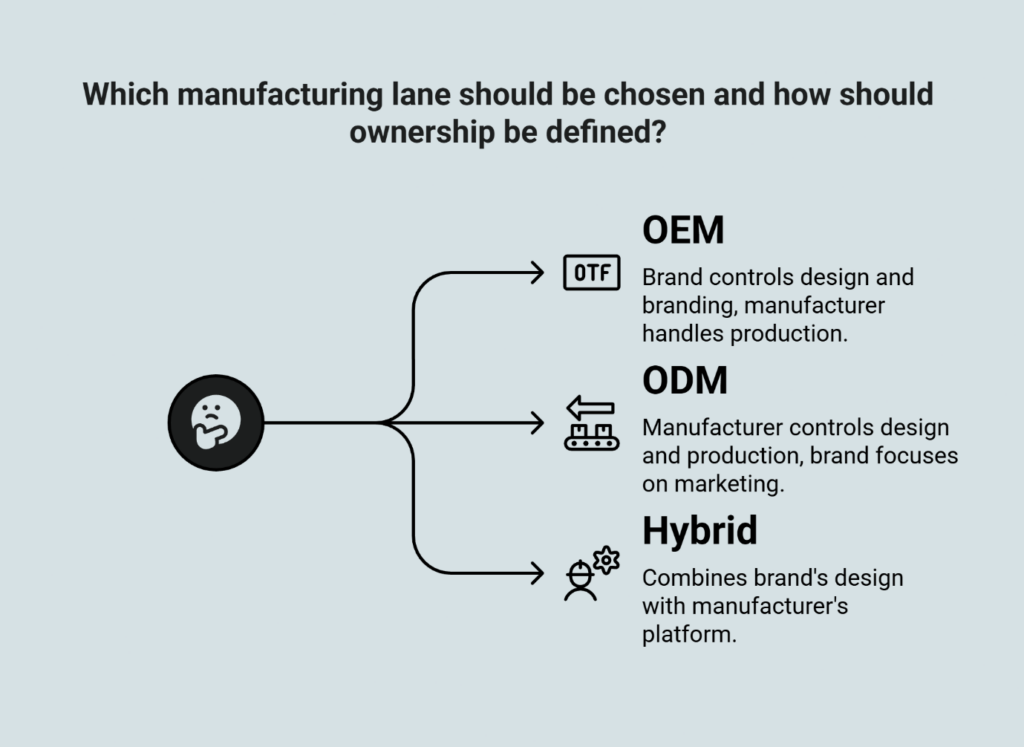
Decide what is controlled internally (design, tuning, branding) and what the partner controls (engineering choices, component sourcing options, process parameters).
This matters because OEM/ODM isn’t just terminology. It defines who owns the design decisions, who documents changes, and who is accountable when a batch drifts. This choice determines what you control—such as the unique basket design or a specific cone material—and what the partner controls, such as the internal motor structure or existing assembly jigs. For growth-stage brands, the goal is often a hybrid approach: using a factory’s proven platform while customizing the acoustic tuning to create a signature sound.
Create a one-page “ownership map” for the first run:
- Owned internally: brand requirements, target performance, final approval criteria
- Shared: prototype iteration notes, change log, Golden Sample approval, packaging rules
- Owned by manufacturer: production process controls, internal QC execution, batch trace IDs (with proof provided)
For a deeper baseline on these stages, use the internal explainer: Understanding the OEM/ODM Manufacturing Process: From Your Design to a Shipped Product
Consistent first-run execution is what makes private label car audio viable, because brand value comes from repeatable quality, not just a logo.
Step 3: Prototype to a “Golden Sample,” then freeze it
The prototype isn’t the goal. The goal is approving the manufacturing standard: the Golden Sample.
A Golden Sample is the physical anchor for quality control—the approved reference unit that defines what “correct” looks like. This isn’t just about making one unit that sounds good; it’s about validating a standard that serves as the manufacturing benchmark for all future batches. Once you approve the prototype’s performance—verified by tools like AP Audio Precision or KLIPPEL R&D—the design is “frozen.”
When you approve a Golden Sample, you aren’t just saying “I like this speaker.” You’re signing off on a set of data benchmarks. If the mass-produced units deviate from this sample, you have a documented baseline to stop production and demand corrections before the goods ship.
In general practice, this reduces “memory-based quality” (which changes by person, shift, or month) and replaces it with a stable benchmark.
Treat Golden Sample matching as the batch-to-batch anchor:
- Approve one specific unit (with a revision ID and date)
- Document the exact config that produced it (key components + settings that matter)
- Store references in two places (commonly: one retained by the factory, one retained by the buyer), with the same labeling
This prevents drift because any “small substitution” or process tweak is forced to answer one question: does it still match the Golden Sample under the same test method and tolerance?
Step 4: Write quality standards that survive translation and time zones
Quality must be measurable: test methods, tolerances, and defect definitions.
You cannot simply tell a factory you want “high quality.” Instead, you must define specific test methods, tolerances, and defect definitions that the factory’s IQC (Incoming Quality Control) and FQC (Final Quality Control) teams can follow. Most quality failures aren’t “bad intent.” They are gaps in shared definitions. Clear standards reduce ambiguity because they turn preferences into pass/fail checks.
Implementing recognized patterns like “first article testing” helps ensure the initial units from the production line match your approved sample. This objective approach reduces the friction of managing a partner across different time zones.
Use a one-page acceptance checklist that both sides sign before production.
One-page acceptance checklist (example structure):
Functional checks (define method):
- Acoustic Sweep: Every unit must pass a frequency response test within +/- 2dB of the Golden Sample
- Basic electrical verification (impedance check)
- Output verification method (state your method)
- No abnormal noise under defined test
Build consistency (define tolerance):
- Critical dimensions within tolerance
- Component substitutions require written approval
- Visual Inspection: No glue residue on the surround or scratches on the magnet structure
Cosmetic standard (define defects):
- What counts as unacceptable scratches/dents
- Labeling placement rules
Packaging standard (define pass/fail):
- Protection requirements
- Carton markings
- Packing list presence
Documentation required:
- Traceability: Every unit must have a unique barcode or QR code bound to its test data for future tracking
- Test summary format
- Batch/lot identifiers
- Photo set requirements
“First article testing/approval” is a widely used assurance pattern in manufacturing governance, including in formal procurement frameworks, where an initial article is evaluated before full acceptance.
Quality system signals can also matter as a screening lens (not a guarantee). ISO 9001 is commonly recognized as a QMS benchmark; it should be treated as one input among several, not a substitute for measurable acceptance criteria.
Step 5: Start with a pilot run that proves repeatability (not just one good unit)
Pilot success equals consistency + traceability + communication cadence, not a single perfect sample.
While a single prototype might be perfect, a pilot run of 100 units reveals if the assembly line is stable. Success here is measured by a high yield rate and clear traceability across the batch. In general, a pilot run is the quickest way to find the hidden failure modes: packaging drift, component substitutions, and “looks fine” quality gaps that only appear at small scale.
During this phase, transparency is key. Define a “weekly proof pack”—a simple, repeatable evidence bundle so there are no surprises:
- Photos: incoming materials, in-process checkpoints, packed cartons
- Test summaries: what was tested, how, and the results format
- Packing list + quantity confirmation
- Trace IDs: lot/batch identifiers tied to the proof pack
- Issue log: what changed, what was approved, what is pending
Traceability is widely treated as a formal risk-control concept across industries, and it becomes more valuable as volumes scale because it speeds containment when something goes wrong.
To align expectations on transparency and process evidence, reference the production workflow positioning: Car Audio Production
For partner-risk framing, use: When Choosing an OEM Partner Creates Supply Chain Risk: A Framework for Vetting & Securing Your Car Audio Manufacturing
Production Launch Roadmap
To help your team align on the journey from concept to container, use this linear roadmap to track your progress through the critical decision gates.
Production Launch Roadmap:
Concept → Spec → Prototype → Production → Shipping
- Concept: Clarify target application + performance intent
- Spec: Finalize the spec package and acceptance criteria
- Prototype: Approve and label the Golden Sample
- Production: Execute pilot with proof packs + trace IDs
- Shipping: Verify packaging standard + documentation completeness
“The success of your production run is determined before the first unit is even assembled.”
Positioning context for growth-stage differentiation: The “Sea of Sameness” Problem in Audio E-Commerce: A Guide to Creating Defensible High-Margin Products via Custom Engineering
Frequently Asked Questions
How long does the first run usually take?
It depends most on spec readiness and prototype cycles. In general, clearer specs and faster feedback shorten timelines, while unclear acceptance criteria and multiple redesign loops extend them. Allowing for a 4-week prototype cycle followed by a 6-week production window is a safe baseline for planning. Hard promises are rarely reliable before Step 1 and Step 3 are complete.
What documents are needed to start?
At minimum: a spec package, an ownership map (OEM vs ODM responsibilities), Golden Sample approval rules, and measurable acceptance criteria. You need a formal Product Specification Document that covers electrical specs (like voice coil layers and magnet weight), physical dimensions, and your specific quality acceptance criteria. The catalog is a useful reference for how technical fields are typically expressed.
What’s a Golden Sample and who keeps it?
A Golden Sample is the approved reference unit that defines the manufacturing standard. Common practice is keeping matched references in two places (buyer and factory) with identical labeling, revision control, and documented test methods. Ideally, two samples are kept: one at the factory to serve as the reference for the QC team, and one at your headquarters for independent verification of incoming batches.
For retailers building a defensible brand, the shift to custom production is the most effective way to escape the “sea of sameness.” By following these five steps, you move from simply selling boxes to owning the engineering standards that define your reputation.
About the China Future Sound Insights Team
The China Future Sound Insights Team is our dedicated engine for synthesizing complex topics into clear, helpful guides. While our content is thoroughly reviewed for clarity and accuracy, it is for informational purposes and should not replace professional advice.
Our Editorial Process
Our editorial process involves extensive research, careful writing, and rigorous fact-checking. We are committed to providing accurate and reliable information that you can trust. If you have any questions or feedback about our content, please feel free to contact us.
Purpose & Scope
This guide is intended as a comprehensive starting point. For decisions specific to your unique situation, we always recommend consulting a qualified professional.