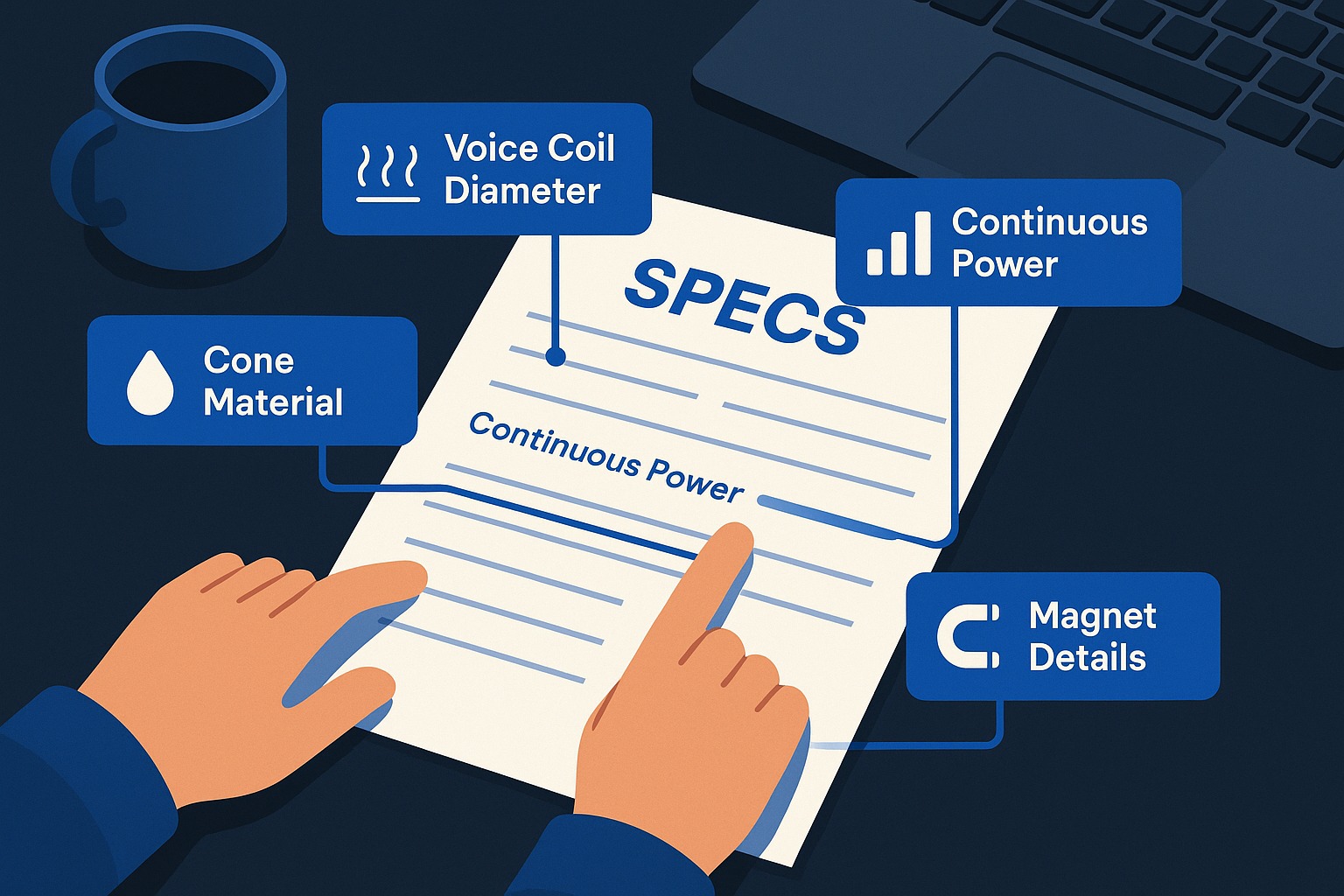
📌 Key Takeaways
Woofer construction determines whether your private-label audio line earns loyalty or warranty claims—and most procurement teams are making decisions blind.
- Voice Coil Diameter Beats Headline Wattage: A 1.5″ voice coil with honest continuous power ratings protects your brand better than inflated “500W max” claims on undersized coils that fail under real-world use.
- Cone Material Defines Brand Positioning: Paper delivers warm, natural sound for premium indoor products; polypropylene survives moisture and abuse in marine or outdoor applications; composites justify flagship pricing through measurable performance gains.
- Magnet Weight Without Context Is Meaningless: A 40-ounce ferrite motor poorly matched to cone and suspension will underperform a well-engineered 20-ounce neodymium system—motor design trumps raw mass every time.
- Spec Sheet Literacy Reduces Warranty Exposure: Cross-checking voice coil diameter against advertised power, matching cone materials to use cases, and treating 6.5″ drivers as distinct systems (not interchangeable parts) prevents costly field failures.
- Six Questions Separate Confident Buyers from Spec-Chasers: Asking suppliers about cone material rationale, voice coil-to-power alignment, motor design logic, lineup progression, environmental protection, and Golden Sample integration forces engineering honesty over marketing noise.
Component-level knowledge transforms supplier conversations from price negotiations into engineering discussions that protect margin and reputation. Procurement managers and private-label product leaders at online audio retailers will gain actionable frameworks here, preparing them for the detailed component analysis that follows.
You’re about to place a purchase order for 500 units. The supplier says their 6.5″ woofer has “premium construction” and “high-power handling.” What does that actually mean? More importantly, is it the right driver for your $149 Bluetooth speaker, or are you paying for specs that don’t match your product strategy?
A woofer is the low-frequency driver in a loudspeaker system, handling bass and lower midrange frequencies. Think of it as the engine of your speaker’s low-end performance. If the engine is mismatched or underspecified, the whole system underperforms.
Consider a common scenario: a procurement manager stares at three spec sheets for 6.5″ woofers. Each lists different cone materials, magnet weights, and voice coil sizes. One costs $8 per unit, another $12, and the third $18. The supplier can’t explain why the price differences exist beyond vague claims about “better sound” and “premium materials.” Without basic woofer construction knowledge, that buyer is forced to either trust claims they can’t verify or default to the cheapest option and hope for the best.
This guide acts as your translator. It will help you read woofer spec sheets with confidence, ask specific questions during OEM discussions, and align component choices with your price tier and brand promise.
Why Woofer Construction Matters for Retail Buyers
Understanding woofer basics isn’t an engineering hobby. It’s a risk management and margin preservation tool.
Component choices directly influence warranty exposure. A voice coil that can’t handle sustained power will fail within months, triggering warranty claims and damaging your brand reputation. Online reviews don’t distinguish between your product design and your supplier’s component quality. They just say “speaker broke after three months.”
Construction decisions also affect perceived value. Two 6.5″ woofers might have identical dimensions, but one uses a lightweight paper cone with a 1″ voice coil while the other features a polymer composite cone with a 1.5″ coil. The second driver costs more, handles power better, and sounds more controlled. If you’re building a $200 bookshelf speaker, the extra cost justifies itself in end-user satisfaction and reduced warranty claims. If you’re building a $50 portable speaker, you’re overbuilding and killing your margin.
The goal is matching construction to your product’s job. Not chasing maximum specs. Not defaulting to whatever costs least.
This article fits alongside broader resources including our in-depth guide to OEM audio manufacturing services
Woofer Anatomy in Plain English
Before evaluating specs, you need to understand what you’re actually buying. A woofer has six core physical components, and each one affects sound character, durability, and cost. Standard loudspeaker designs rely on these parts working together as a mechanical system where the surround and spider form the suspension that keeps the cone moving in a controlled path while the voice coil stays centered in the magnetic gap.
Cone, Surround, and Spider: How the Moving System Works
The cone is the visible part that pushes air to create sound. It’s typically made from paper, polypropylene, or composite materials. The surround is the flexible ring around the cone’s outer edge, allowing it to move in and out. The spider is a corrugated disc beneath the cone that keeps motion centered and linear.
Why buyers should care: cone material shapes the sound signature and influences cost. Paper cones are lightweight and often produce a warmer, more natural sound, but they’re vulnerable to moisture and physical damage. Polypropylene cones are more durable and moisture-resistant, making them better for marine applications or outdoor speakers. Composite materials offer a middle ground but typically cost more.
If you’re building entry-level indoor speakers, paper might be appropriate. If you’re targeting outdoor or marine use, polymer construction reduces field failure risk. Mismatching cone material to use case means either excessive warranty exposure or overbuilding that erodes margin.
Voice Coil: The Heart of Power Handling
The voice coil is a wire-wrapped cylinder attached to the cone. When electrical current flows through it, the coil moves within the magnetic field, driving the cone back and forth. Voice coil diameter typically ranges from 1″ to 4″ depending on the woofer’s size and power requirements.
Voice coil size is a primary indicator of a speaker’s power handling capability. Larger coils have more surface area to dissipate heat, which is critical because heat is what kills speakers under sustained use. A woofer with a 1″ voice coil might claim “200 watts max power,” but if the continuous power rating is only 50 watts, that headline number is marketing, not reality.
Professional loudspeaker engineering research treats voice coil parameters as central to power handling and reliability, not just headline wattage figures. When comparing suppliers, voice coil diameter and construction give you a more honest picture of durability and real-world abuse tolerance than peak wattage alone. A driver with a 1.5″ coil will generally handle more sustained power and survive end-user abuse better than one with a 1″ coil, even if both claim the same maximum wattage.
Magnet and Motor Structure: Strength vs. Marketing
The magnet creates the magnetic field that the voice coil moves within. Larger, heavier magnets typically indicate stronger motor assemblies, which translates to better control over cone movement. Common magnet materials include ferrite and neodymium-based alloys; neodymium magnets offer strong magnetic fields relative to their size and mass, making them popular in applications where weight matters.
However, a heavier magnet doesn’t automatically equal better sound. What matters is the complete motor design, including magnet size, gap geometry, and how efficiently the system converts electrical energy into motion. A well-designed motor with a moderate magnet can outperform a poorly designed system with a massive magnet.
Magnet weight is a strong indicator of motor strength when paired with coherent overall design and a clear use case. For bass-heavy applications like subwoofers, substantial magnets provide the control needed for clean, powerful low frequencies. For midrange drivers in component sets, magnet size becomes less critical than cone material and suspension design.
Basket and Frame: The Unsung Structural Parts
The basket is the rigid frame that holds everything together. It’s typically stamped steel or cast aluminum.
A rigid basket prevents unwanted vibration and long-term warping. Stamped steel baskets are cost-effective and adequate for most applications. Cast aluminum baskets are more expensive but provide better rigidity and heat dissipation, which matters in high-power or professional applications.
Why this matters for buyers: cheap, flexible baskets can develop rattles over time or allow the motor structure to shift slightly, degrading performance. If you’re building products with multi-year warranties, basket quality affects long-term reliability.
“Understanding the basics of woofer construction isn’t about turning you into an engineer; it’s about making sure you never sign off on a driver that quietly undermines your brand.”
How Cone Material, Voice Coil Size, and Magnet Design Affect Performance
Now that you understand the parts, let’s connect construction choices to practical buying decisions.
Cone Materials: Paper vs. Poly and Beyond
Paper cones are lightweight, which allows for good transient response and often produces a more natural midrange. They’re common in audiophile-oriented speakers and pro audio monitors. The trade-off is vulnerability to moisture, humidity, and physical damage. Paper is also typically less expensive, which makes it attractive for budget-conscious builds.
Polypropylene cones are significantly more durable. They resist moisture, don’t degrade in humid environments, and handle rough shipping and end-user handling better. The sound character tends to be slightly less warm than paper but more consistent across production runs. Poly is the standard choice for car audio, marine speakers, and any application where environmental factors matter.
Composite materials (carbon fiber, Kevlar, woven glass) offer high stiffness with low mass. This combination allows for extended frequency response and lower distortion at high volumes. The cost is substantially higher, making composites appropriate for premium product lines where performance justifies the price.
The material of the cone drastically affects sound character and cost. Buyers should choose cone materials that align with their brand’s sound signature and price tier instead of defaulting to whatever costs least. A $300 studio monitor with polypropylene cones will disappoint end users expecting natural vocal reproduction. A $79 portable speaker with carbon fiber cones is overbuilt and unprofitable.
Voice Coil Size: Reading Between the Watts
Headline wattage numbers are often the least reliable spec on a data sheet. “500 watts max power” sounds impressive, but that figure might represent a one-second burst that would destroy the driver if sustained.
What actually determines power handling is voice coil construction: diameter, wire gauge, former material, and thermal management. A woofer with a 2″ aluminum-wound voice coil on a high-temperature former can genuinely handle 200 watts continuously. A driver with a 1″ copper coil might fail at 75 watts sustained, even if it claims the same peak rating.
When evaluating woofer options, cross-check advertised power with voice coil diameter and recommended continuous power ratings. If a supplier claims high power handling but spec sheets show a small voice coil, that’s a red flag. Voice coil size signals real-world power handling and durability more reliably than peak wattage marketing.
Magnet Strength: When Weight Actually Matters
Magnet specifications often list weight in ounces. A 30-ounce magnet sounds more impressive than a 15-ounce magnet, which leads some buyers to use magnet weight as a proxy for quality.
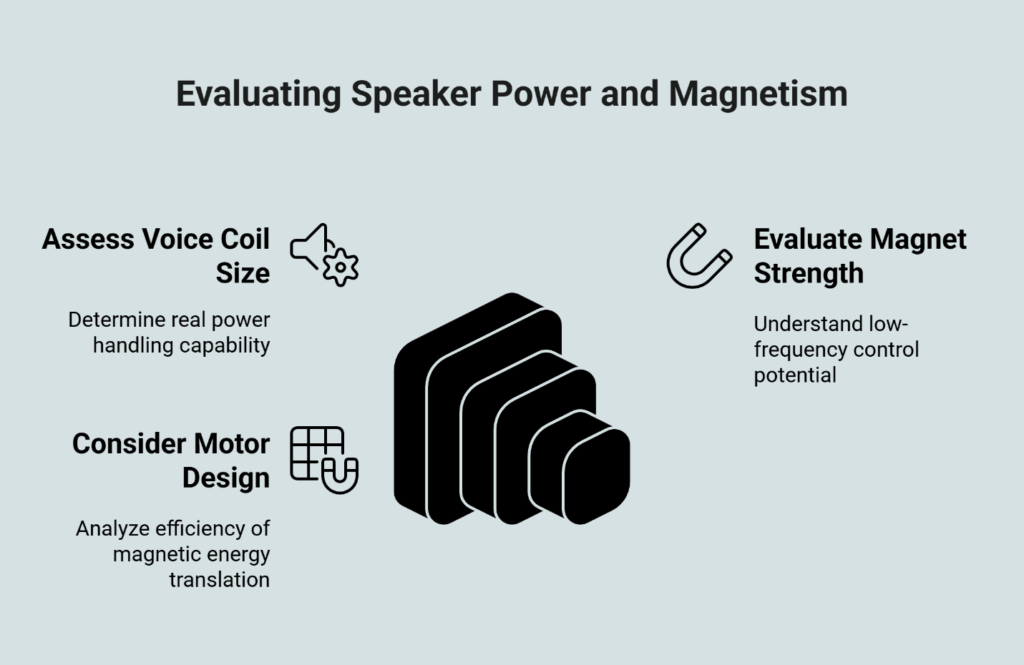
The relationship is more nuanced. Magnet strength influences low-frequency control and perceived performance when evaluated in context of overall design. A larger magnet provides stronger magnetic flux, which gives the motor assembly more control over cone movement. This matters most in bass-heavy applications where controlling large cone excursions is critical.
However, magnet weight alone doesn’t tell the whole story. Motor design includes gap geometry, pole piece design, and how efficiently magnetic energy translates into motion. A well-designed 20-ounce neodymium motor can outperform a poorly optimized 40-ounce ferrite motor.
Don’t chase magnet weight for its own sake. Evaluate it in context: what’s the application? What power levels will the driver actually see? Does the overall motor design support the magnet’s potential?
Reading a Woofer Spec Sheet Without Getting Lost
Spec sheets can list dozens of parameters. Most aren’t relevant to buying decisions. Here’s what actually matters.
The Shortlist: Specs That Actually Matter for Retail Buyers
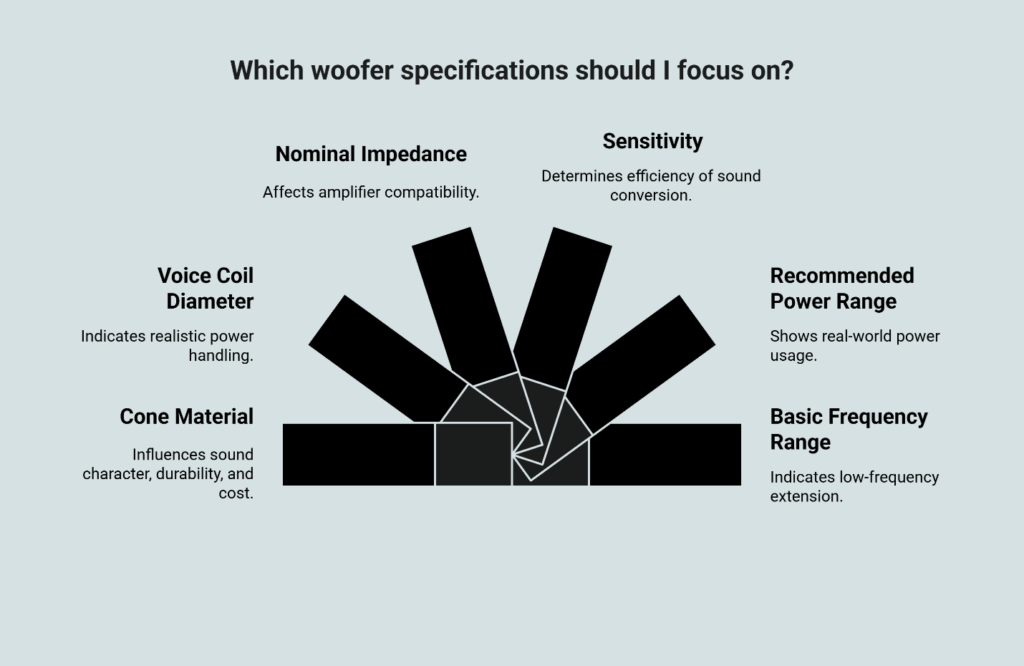
Focus on these six specifications:
Cone material tells you about sound character, environmental resistance, and expected cost. It directly influences durability and whether the driver fits your product positioning.
Voice coil diameter indicates realistic power handling. Cross-reference this with power specifications to detect inflated marketing claims.
Nominal impedance (typically 4 or 8 ohms) affects amplifier compatibility and power delivery. Most car audio runs 4 ohms. Home audio typically uses 8 ohms.
Sensitivity (measured in dB) tells you how efficiently the driver converts electrical power into sound. Higher sensitivity (90+ dB) means louder output with less power. Lower sensitivity (85-88 dB) requires more amplifier power for the same volume.
Recommended power range should list both continuous (RMS) and program power. Continuous power is what matters for real-world use. Program power and maximum power are marketing numbers that describe brief peaks.
Basic frequency range shows the driver’s useful operating range. For woofers, you care most about the low-frequency extension (Fs). A driver with Fs of 40Hz can reproduce deeper bass than one with Fs of 60Hz, but it requires larger enclosure volume.
For each spec, ask: what does this signal about the driver’s role in my product line? What goes wrong if I ignore this?
Match Specs to Use Case and Price Tier
Not every product needs maximum specifications. The right driver matches your price tier, expected use, and brand promise.
Here’s a practical comparison:
| Profile | Cone Material | Voice Coil | Power Handling | Best For |
|---|---|---|---|---|
| Budget Bass | Polypropylene | 1″ copper | 30-50W RMS | Entry-level bookshelf speakers, portable Bluetooth |
| Balanced All-Rounder | Treated paper | 1.5″ aluminum | 75-100W RMS | Mid-tier home audio, car door speakers |
| Premium Performance | Composite (carbon/Kevlar) | 2″+ aluminum | 150W+ RMS | High-end monitors, competition car audio |
The budget profile keeps cost down while maintaining durability. The balanced profile offers better sound quality without premium pricing. The premium profile justifies higher retail prices through measurably better performance and materials.
Choosing the wrong profile for your SKU creates problems. Putting budget components in a $400 speaker disappoints end users and generates negative reviews. Putting premium components in an $89 speaker kills your margin and adds features end users won’t perceive or value.
Myth & Fact: “More Watts and Heavier Magnets Always Mean a Better Woofer”
Myth: The driver with the highest wattage claims and heaviest magnet is always the “best” choice for any application.
Fact: Balanced engineering and appropriate construction for the use case beat spec-chasing every time.
This misconception drives poor buying decisions. A procurement manager sees two options: Driver A with “300W max power” and a 40-ounce magnet versus Driver B with “150W max power” and a 25-ounce magnet. Without understanding voice coil construction and intended use case, they default to Driver A because bigger numbers feel safer.
In reality, Driver B might be the better choice. If the voice coil construction supports genuine 100W continuous power and the magnet system is well-designed, that’s more reliable than inflated peak power claims on a driver with thermal limitations.
The audio market is flooded with inconsistent quality. True value comes from rigorous engineering and manufacturing discipline, not headline specifications. Lowest BOM cost rarely equals best value when warranty claims and brand reputation factor into total cost of ownership.
This connects to a broader principle: matching woofer construction to product use case and price tier is more important than chasing maximum specs. Your goal is building a product that satisfies end users, earns positive reviews, and generates profit. That requires thoughtful component matching, not maximum numbers.
Common Pitfalls to Avoid When Evaluating Woofer Construction
Even experienced buyers make predictable mistakes when evaluating woofers. Here are the three most costly.
Focusing Only on Wattage Marketing Claims
The mistake: selecting drivers based primarily on peak power ratings without examining voice coil construction or continuous power specifications.
Why it happens: peak wattage is prominently displayed and easy to compare. It feels objective. Suppliers emphasize it because it makes products sound impressive.
What it costs: unrealistic performance expectations, increased warranty exposure, and damage to brand reputation when drivers fail under normal use. A driver rated “400W max” that realistically handles 75W continuous will disappoint end users operating anywhere near its claimed rating.
Better approach: cross-check advertised power with voice coil diameter and recommended continuous power ratings. Ask suppliers: “What’s the continuous RMS power rating, and what voice coil construction supports it?” If they can’t answer clearly, consider that a warning sign.
Ignoring Cone Material to Chase Lowest BOM Cost
The mistake: defaulting to the cheapest available cone material without considering use case, environmental factors, or sound signature implications.
Why it happens: immediate cost savings are measurable and show up clearly in margin calculations. The long-term costs of wrong material choices are diffuse and harder to predict.
What it costs: mismatched sound signature that doesn’t align with brand positioning, higher field failure risk in harsh environments, and brand inconsistency when switching suppliers. A $200 bookshelf speaker with cheap polypropylene cones won’t sound as refined as competitors using treated paper, giving end users a reason to leave negative reviews.
Better approach: pick cone materials aligned with use case and price tier. Paper for acoustic applications where natural sound matters and environmental exposure is controlled. Polymer for durability-critical applications like marine, outdoor, or car audio. Composites for premium products where performance justifies cost.
Assuming All 6.5″ Woofers Are Interchangeable
The mistake: treating physical size as the primary specification and assuming any 6.5″ driver will work in any 6.5″ application.
Why it happens: size is the most obvious specification and the easiest to match. It’s tempting to swap suppliers based on price if the diameter matches.
What it costs: inconsistent performance across SKUs, unpredictable end-user experience, and potential compatibility issues with enclosure design. Even among 6.5″ drivers, mounting depth, magnet structure, and required enclosure volume vary significantly. A driver that works perfectly in one cabinet design might perform poorly in another.
Better approach: treat construction as a set of levers (cone material, voice coil size, magnet structure) that must align with your product strategy. Evaluate drivers based on complete specifications, not just diameter. When switching suppliers, test thoroughly before committing to volume production.
Putting It All Together: A Simple Checklist for Your Next Supplier Conversation
Use these questions to evaluate woofer options during OEM discussions. Copy this checklist and bring it to your next supplier meeting.
- “Which cone material are we using, and why is it appropriate for this product’s price tier and use case?” Listen for specific materials (paper, poly, composite) and clear reasoning about durability, sound character, and cost trade-offs.
- “What is the voice coil diameter, and how does that support our advertised power range?” The answer should connect voice coil construction to realistic continuous power handling, not just peak ratings.
- “How does the magnet and motor design support the kind of bass performance we’re promising?” This forces discussion of complete motor design, not just magnet weight.
- “If we step one level up or down in your woofer lineup, what actually changes in construction?” Understanding the progression helps you identify which upgrades matter for your application.
- “What aspects of this construction protect us against typical abuse and environmental stress in our key markets?” This addresses real-world durability concerns beyond specifications.
- “How will this woofer be documented and protected inside our Golden Sample QA process?” This question ensures component choices integrate with your quality control and consistency protocols.
Basic acoustic engineering understanding reduces the risk of overpaying for mismatched or overbuilt components. Component-level knowledge supports clear expectations with OEM partners and enables more effective supply chain stability assessments.
If guides like this help you feel more confident in supplier conversations, subscribe to our newsletter to get more practical breakdowns of manufacturing decisions for audio retailers.
Our Editorial Process
Our expert team uses AI tools to help organize and structure our initial drafts. Every piece is then extensively rewritten, fact-checked, and enriched with first-hand insights and experiences by expert humans on our Insights Team to ensure accuracy and clarity.
About the China Future Sound Insights Team
The China Future Sound Insights Team is our dedicated engine for synthesizing complex topics into clear, helpful guides. While our content is thoroughly reviewed for clarity and accuracy, it is for informational purposes and should not replace professional advice.