📌 Key Takeaways
Program governance reduces warranty exposure and lifecycle cost more effectively than chasing the lowest bill-of-materials price.
- Compliance Failures Compound Across Channels: Receiving holds, expedited rework, and distributor penalties often exceed any initial BOM savings because documentation gaps trigger cascading delays and channel relationship damage.
- Program Gates Compress Time-to-SOP: Structured validation checkpoints at EVT, DVT, and PVT stages surface technical risks before tooling commitments, preventing costly late-stage resets that can add 4-8 weeks to launch schedules.
- Change Control Prevents Silent Breakage: Firmware modifications without systematic re-validation can shift electrical characteristics enough to cause field failures months after launch, destabilizing warranty accruals and eroding brand trust.
- Platform Artifacts Enable Fast Derivatives: Golden-sample baselines and validated building blocks allow derivative SKUs to reach market with substantially reduced validation time because testing focuses only on deltas from proven designs.
- Five Metrics Quantify Program Value: Track warranty failure distribution trends, claim processing time, receiving holds avoided, approval cycle time, and derivative SKU lead time to translate governance discipline into financial outcomes Finance can model.
Governance overhead creates predictability in warranty reserves and protects launch windows.
Product managers, sourcing directors, and finance leaders evaluating private-label amplifier partnerships will find a decision framework here, preparing them for the detailed justification model that follows.
Program governance cuts compliance, warranty, and lifecycle costs—often by more than any small BOM delta.
A firmware update breaks electromagnetic compatibility. Your shipment sits in receiving for two weeks. Warranty claims spike in month three, but root cause stays unclear until month six. These scenarios share a common thread: they represent the hidden costs of treating amplifier development as a simple procurement exercise rather than a governed program.
For Product and Finance teams evaluating private-label amplifier partnerships, the conversation often starts—and sometimes ends—with bill-of-materials cost. That narrow focus misses the larger picture. A private-label amplifier program is a governance framework that spans specification through compliance, packaging, warranty, and change control. When structured properly, it functions as a brand-safety harness that reduces the financial exposure from field failures, regulatory holds, and silent specification drift.
The challenge lies in quantifying these benefits for internal sign-off. This justification model addresses the three most common objections Finance and Product teams raise, reframes them with operational evidence, and provides the measurement framework needed to track program value over time.
“Small per-unit savings vanish fast when non-compliance or silent firmware changes trigger warranty exposure.”
Executive Brief
A well-structured private-label amplifier program delivers three measurable outcomes:
Brand-equity risk decreases because pre-compliance gates and documentation standards prevent receiving holds and field recalls that damage channel relationships and end-user trust.
Lifecycle cost decreases because standardized test packs, golden-sample criteria, and traceability systems reduce the variance in warranty accruals and accelerate derivative SKU development.
Schedule predictability increases because program gates surface technical risks at EVT and DVT stages rather than during mass production ramp, compressing time-to-SOP and protecting launch windows.
What a Private-Label Program Actually Is
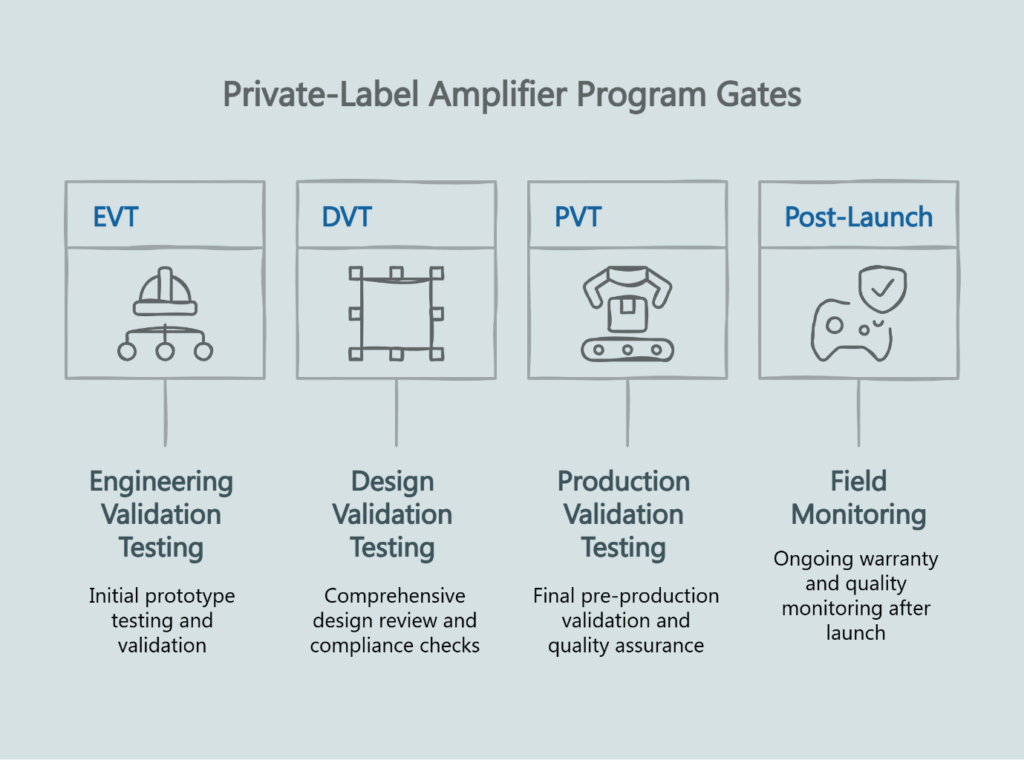
A private-label amplifier program is a structured governance framework that controls the entire product lifecycle. The framework establishes gates across specification, compliance verification, packaging and documentation, warranty policy, and engineering change control. Each gate requires explicit artifacts and acceptance criteria before the program advances to the next phase.
Think of it as a brand-safety harness for launches. The harness doesn’t eliminate technical complexity, but it prevents the most common and costly surprises from reaching production or the field. For example, a firmware optimization might improve efficiency by two percent but inadvertently shift the switching frequency enough to fail FCC Part 15 radiated emissions requirements. Without change control gates, that modification reaches production undetected. The program catches it at the Design Validation Testing (DVT) review, triggering a controlled re-validation rather than a field stop.
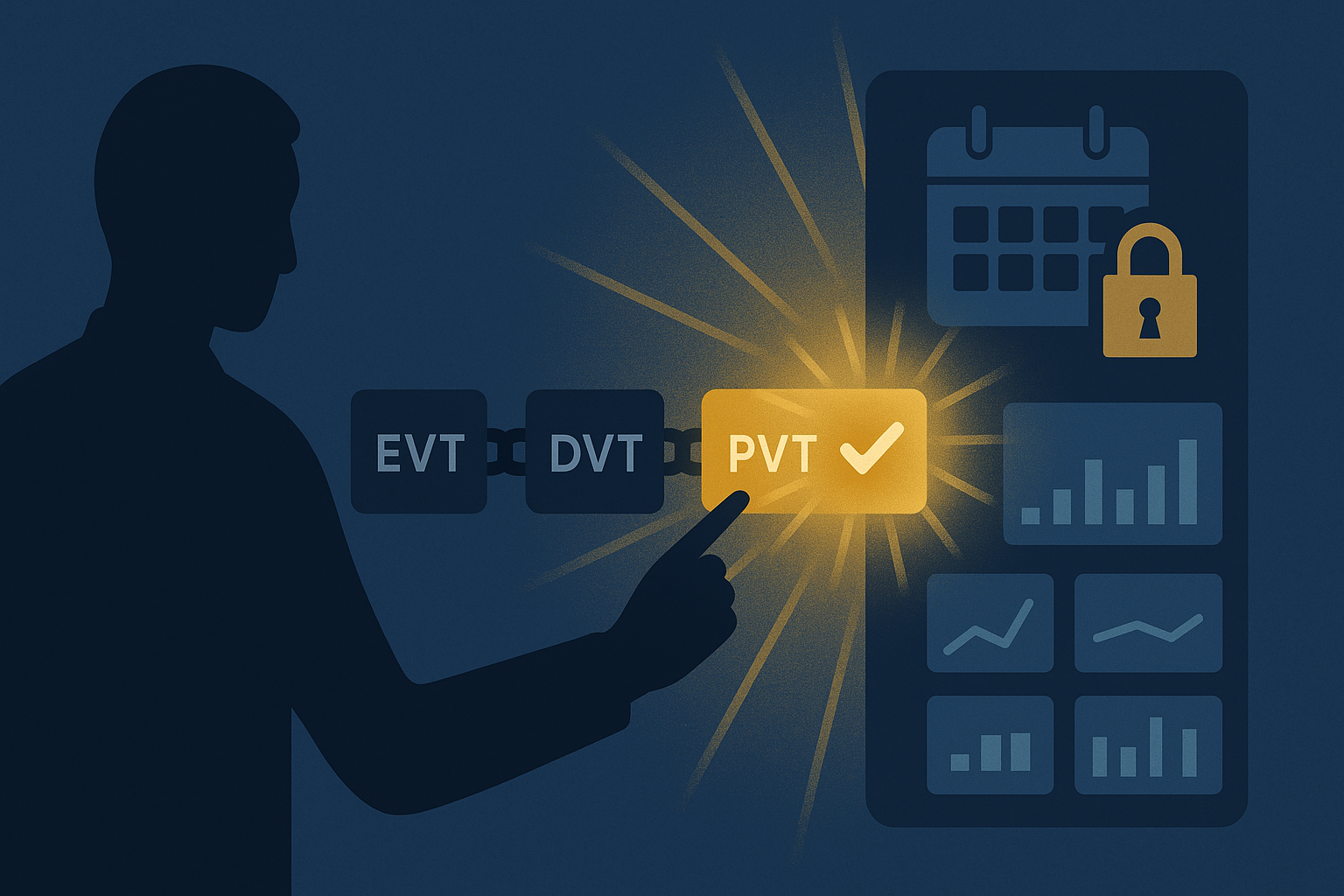
Program gates typically follow the Engineering Validation Testing (EVT), Design Validation Testing (DVT), and Production Validation Testing (PVT) model. At each stage, Finance and Product leaders should require specific proof of readiness: validated electrical performance, thermal margin documentation, protection circuit verification, and preliminary compliance evidence. Safety requirements follow standards like IEC 62368-1 for audio and ICT equipment, while environmental compliance addresses restrictions like EU RoHS for hazardous substances.
The difference shows up in financial statements. One scenario: Your engineering team discovers the issue three months after launch when warranty rates spike and distributors start flagging quality concerns. Another scenario: The issue never leaves your factory because the program’s change control mandate requires EMC review for any firmware modification, regardless of intent.
The Finance & Product Justification Model
Objection: “BOM ↑ hurts margin”
Reframe: Total landed cost includes rework, warranty exposure, recall risk, and channel penalties—not just component price. Compliance failures cost more than incremental BOM deltas because receiving holds, rework, and field failures compound across channels, which leads to margin erosion and delayed revenue recognition.
Evidence to show: Consider the actual cost structure when a shipment fails safety listing verification at receiving. The immediate costs include storage fees, expedited re-testing, and airfreight for replacement units. The downstream costs include delayed revenue (typically 30-60 days), distributor penalties for missed ship windows, and opportunity cost from the inventory capital tied up in non-conforming stock. A $2,000 container stuck in receiving for four weeks represents roughly $8,000 in total impact when these factors compound.
The following table shows how program governance addresses each major cost driver:
| Cost Driver | Typical Triggers | Governance Lever |
|---|---|---|
| Rework & scrap | Late spec changes, ambiguous test limits | Gate checklists; golden sample; change control |
| Warranty & field failures | Silent firmware drift, quality escapes | ATE coverage, reliability screens, firmware regression plan |
| Certification delay | Missing evidence, insufficient documentation | Pre-compliance, accredited labs, current test reports |
| Channel penalties | Incorrect labeling, missed dates | Compliance matrix; packaging/manuals review |
| Opportunity cost | Slotting missed, derivative delays | Rolling roadmap; artifact reuse |
Historical warranty data reveal similar patterns. Products launched without standardized acceptance criteria show 3-5x higher field failure rates in the first six months compared to programs with explicit first-article approval gates. The warranty accrual variance directly impacts quarterly financial planning because Finance cannot predict reserve requirements accurately. Organizations following ISO 9001 quality management principles demonstrate how systematic process control reduces this variance.
Finance takeaway: Program overhead (typically 2-4% of landed cost) creates predictability in warranty accruals and eliminates write-offs from receiving holds. Lower variance enables tighter reserves and more accurate quarterly guidance.
Objection: “Governance will slow us down”
Reframe: Program gates compress time-to-SOP by surfacing dependency conflicts and technical risks before tooling commitments. Standardized test and document packs reduce ambiguity so that approvals and audits accelerate, which leads to lower lifecycle cost and faster derivative SKU development.
Evidence to show: Gate reviews use explicit checklists and dependency maps rather than ad-hoc meetings. At each validation stage, Product leaders should require proof that critical risks have been addressed: electrical performance verified against specification, thermal margin confirmed, protection circuits validated, and preliminary compliance evidence documented. Each item has binary pass/fail criteria.
This structure prevents late resets. Without gates, teams discover mechanical interference issues during DVT (requiring mold changes), or they find that protection thresholds cause nuisance shutdowns under edge-case loads (requiring firmware rework after tooling). Each reset extends schedule by 4-8 weeks. The gate review catches these issues when corrective action costs hours rather than months.
Golden-sample criteria provide another compression mechanism. When derivative SKUs share a platform, the baseline electrical and acoustic performance is already validated. New variants require only delta testing for the modified elements. One amplifier platform can spawn 6-8 SKUs with 60% less validation time per variant because the program maintains validated building blocks. The approach aligns with practices outlined in Amplifier Manufacturing Services: A DFM-to-Ramp Framework for Reliable On-Time Launches.
Product takeaway: Fewer schedule resets means predictable tooling windows and launch dates. Derivative SKUs reach market faster because validation focuses only on deltas from the validated platform baseline.
Objection: “Compliance is a checkbox”
Reframe: Safety, EMC, and environmental compliance regimes differ significantly by target market. Pre-compliance testing and documentation discipline shorten approval cycles and prevent receiving holds. Firmware and change control discipline prevents silent breakage so that field failure distributions stabilize, which leads to predictable warranty accruals and protected brand equity.
Evidence to show: A compliance matrix tracks each requirement’s status across markets. For a North American launch, Finance and Product should verify: UL 62368-1 safety listing with current certificate, FCC Part 15 Class B radiated and conducted emissions with documented test evidence, California Proposition 65 verification, RoHS and REACH declarations with material composition data, and packaging marks consistent across master cartons and unit labels.
Each item requires specific artifacts. The safety listing needs the actual certificate with model number matching the shipping product. EMC documentation should come from accredited testing partners and show margin to limits (not just pass/fail). The environmental declarations need supply chain traceability to component level. Missing or inconsistent documentation triggers receiving holds that add 2-4 weeks to channel delivery.
Change control prevents a different class of failure. Silent firmware updates—even minor optimizations—can shift electrical characteristics enough to affect field reliability. One common pattern: A firmware change reduces standby current by 5%, improving efficiency specs. The change also modifies the protection circuit’s response time, causing intermittent shutdowns under specific load profiles that testing didn’t anticipate. Without change control, this reaches the field. With gates, the ECO process flags any firmware modification for electrical and thermal re-validation before release. Additional context on testing protocols appears in ATE & End-of-Line Testing for Amplifiers: Reducing DOA Without Slowing Ramp.
Risk takeaway: Consistent documentation and change discipline eliminate receiving holds and reduce field failure variance. This protects channel relationships and enables Finance to model warranty costs with higher confidence. Teams can reference Safety Listing for Amplifiers: UL vs. ETL—What Dealers Actually Check for additional receiving requirements.
What to Measure (So Finance Says Yes)
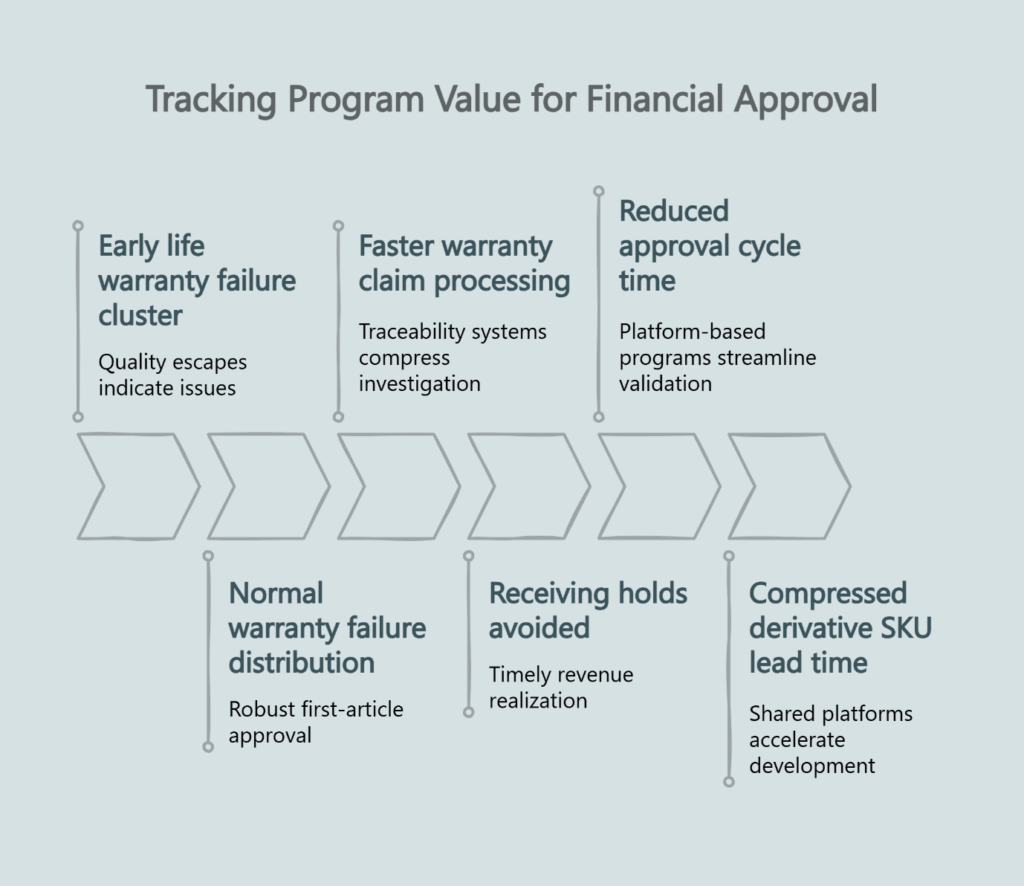
Track five metrics to quantify program value:
Warranty failure rate distribution trend shows whether field failures cluster in early life (indicating quality escapes) or distribute normally over the warranty period. Programs with robust first-article approval show flatter curves with narrower distribution and fewer extreme outliers.
Warranty claim processing time measures how quickly your team identifies root cause when failures occur. Traceability systems that bind serial numbers to test data and component lots compress investigation time by 60-80%, enabling faster corrective action.
Receiving holds avoided counts the shipments that clear distributor or retailer receiving without documentation or compliance issues. Each hold represents 15-30 days of delayed revenue.
Approval cycle time tracks how long it takes to validate derivative SKUs when working with accredited testing partners. Platform-based programs cut this by 40-60% compared to designing each variant from scratch.
Derivative SKU lead time measures time from specification freeze to first article approval. Shared platforms and validated building blocks compress this significantly.
For measurement cadence, monthly reviews during development and the first two full quarters post-launch provide sufficient visibility to detect trends and adjust program elements. These metrics translate program discipline into financial outcomes Finance can model and Product can use to defend development budgets.
The Executive Justification Summary: What’s Inside
The one-page Executive Justification Summary provides a decision framework optimized for committee review. The document uses a two-column layout that maps risk drivers to financial levers, making the cause-and-effect relationship explicit for stakeholders who need to approve program investment.
The header establishes decision context: which product line, target launch window, and key success criteria drive the evaluation. This frames the analysis around specific business objectives rather than abstract benefits.
The left column details the risk drivers that program governance addresses. Compliance risk includes market-specific safety, EMC, and environmental requirements that vary by geography. Firmware and change control risk covers the silent specification drift that causes field failures months after launch. Documentation risk encompasses the missing or inconsistent artifacts that trigger receiving holds and delay channel delivery.
The right column translates these risks into financial levers Finance can model. Warranty accruals become more predictable when change control prevents silent breakage and first-article criteria filter quality escapes. Rework costs decrease when gate reviews surface technical issues before tooling commitment. Delay costs—the revenue impact from receiving holds or missed launch windows—shrink when documentation standards ensure consistent compliance artifacts. Channel penalties from quality issues or failed audits drop when systematic testing and traceability systems enable fast root-cause analysis.
The bottom section provides a 30-day action plan with required artifacts that executives should verify: golden sample with documented acceptance criteria, compliance matrix tracking market-specific requirements, test pack index linking test results to traceability data, and change-control log documenting all modifications with validation evidence. This moves the conversation from concept to implementation, giving Product and Finance concrete next steps.
A footnote zone includes 3-5 citations to quality management standards, relevant safety and EMC testing requirements, and testing partner accreditation criteria.
The format is deliberately print-friendly and structured for easy social sharing. Section headers become slides for a LinkedIn carousel. The risk-to-lever mapping translates directly into a financial model. Product can use it to defend program investment, and Finance can use it to model the cost avoidance that justifies overhead. A 60-second explainer video can visualize the Total Landed Cost table and Program Gates comparison for broader internal distribution.
Next Steps
Build the artifact backbone by establishing your compliance matrix to track market-specific requirements and firmware & change control protocols to prevent silent breakage. Align warranty language with your warranty & returns policy to balance brand protection with cost control.
For detailed implementation guidance, review the strategic approaches in DFM Inputs for Amplifiers: The Eight Specifications That Most Affect Yield to align engineering and sourcing priorities. Cross-check factory capability using Factory Evaluation for Amplifier Manufacturing: A Shareable Thirty-Point Checklist before committing to a partnership.
If you’re evaluating how a private-label program fits within your broader supplier strategy, explore our OEM audio manufacturing partner category for additional context on partnership models and program structures.
Disclaimer: This guide provides a strategic framework for evaluating private-label amplifier programs. It is informational only and not a substitute for professional financial, legal, or technical advice. Program structures, compliance requirements, and cost models vary significantly by market, product category, and business context.
Our Editorial Process
We prioritize accuracy, clarity, and real-world usefulness. Articles are reviewed for structure, terminology consistency, and alignment with our B2B content guidelines before publishing.
About the China Future Sound Insights Team
The China Future Sound Insights Team distills complex manufacturing topics into clear, helpful guides. Reviewed for clarity and accuracy; informational only, not a substitute for professional advice.