
📌 Key Takeaways
Receiving holds aren’t inevitable disruptions—they’re preventable outcomes of predictable upstream decisions that teams can control through systematic labeling governance.
Lock COO Decisions Pre-Pilot: Country of origin determinations must be frozen before production begins, with substantial transformation analysis documented and filed with first-article records to prevent costly mid-stream changes.
Synchronize Systems First: The most common receiving holds stem from mismatched model numbers between MES systems and physical labels—align these identifiers across all platforms before any units ship.
Build Label Masters as Engineering Assets: Treat labeling specifications like controlled technical documents with exact strings, placement coordinates, and change control processes rather than last-minute export paperwork.
Create Evidence Packs That Travel: Every shipment requires a complete documentation package linking physical markings to regulatory compliance records, enabling instant verification during customs and receiving inspections.
Scale Through Templates: Convert one-off compliance efforts into repeatable frameworks that work across product lines, manufacturing partners, and market requirements.
Systematic preparation transforms labeling from recurring crisis management into competitive advantage through reliable execution.
For heads of product, compliance managers, and purchasing leads at audio brands managing amplifier programs, these frameworks eliminate the documentation gaps that create expensive delays and distributor relationship strain.
A missed label can stop a truck. Literally. Inbound teams see “COO?” flagged in the WMS, and the pallet sits until someone proves what should have been printed on the carton in the first place. Receiving holds cost more than demurrage fees—they trigger rework cycles, strain distributor relationships, and create warranty exposure when hasty relabeling introduces new errors.
The solution isn’t better crisis management. It’s preventing the hold entirely through upstream decisions and systematic labeling governance. Most receiving holds stem from three predictable gaps: inconsistent Country of Origin (COO) marking across units and cartons, model number misalignment between MES systems and physical labels, and missing or incomplete compliance documentation.
Below is an implementation-first guide designed for Head of Product, Compliance, and Purchasing teams. It focuses on risks, trade-offs, and the exact deliverables that clear receiving without drama.
Answer First: The Minimum Marking Package to Clear Receiving
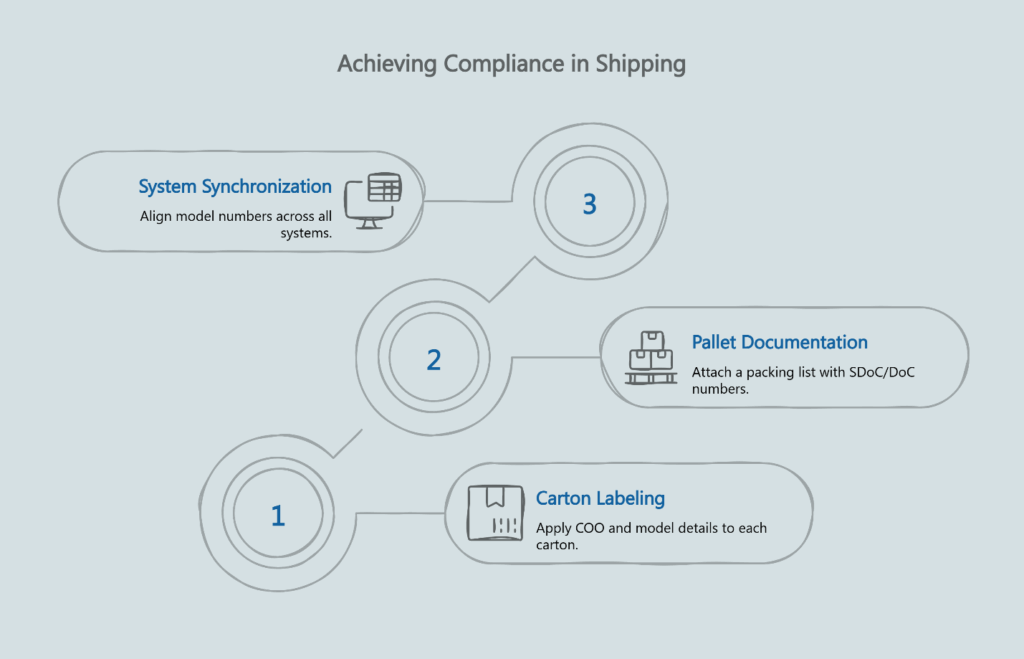
To reduce detainments and rework, ensure every shipment leaves the factory with a consistent set of marks and matching evidence. The essential marking package consists of three synchronized elements that must align across your entire supply chain.
Unit-level requirements: Every amplifier unit requires a conspicuous, legible, and indelible “Made in [Country]” mark on the product or a firmly-affixed label. Under U.S. regulations (19 CFR Part 134, §134.11), placement must be reasonably permanent and not easily removed. This marking cannot be a removable sticker and must remain legible throughout the product’s intended lifespan.
Carton-level specifications: The same COO text must appear clearly on the retail or master carton, associated with the specific model inside. If the unit is unmarked under certain exceptions, the outermost container reaching the ultimate purchaser must bear the COO marking. Beyond the COO designation, each shipping carton must display the exact model number as recorded in your MES system, UL file number if applicable, and a machine-readable barcode linking to your traceability database.
Pallet documentation: A master packing list attached to each pallet must reference the Supplier’s Declaration of Conformity (SDoC) or Declaration of Conformity (DoC) number, enabling inspectors to quickly verify that safety testing documentation exists and matches the physical products. The pallet label should include COO plus shipment identifiers that tie back to the packing list and Advanced Shipping Notice (ASN) for rapid warehouse verification.
Critical synchronization requirement: Model/part/SKU alignment across MES/ERP systems, label masters, barcodes, and shipping documents prevents the most common trigger for holds. When your MES system shows model “AD1500.1” but the unit label reads “AD-1500-1,” receiving software flags this as a discrepancy requiring manual intervention.
For EU-bound goods, COO marking rules follow more fragmented sectoral schemes. The European Commission’s “Your Europe” portal provides an updated overview of labels and markings obligations that may apply alongside origin rules.
Decision Framework: How COO Is Determined for Amplifiers
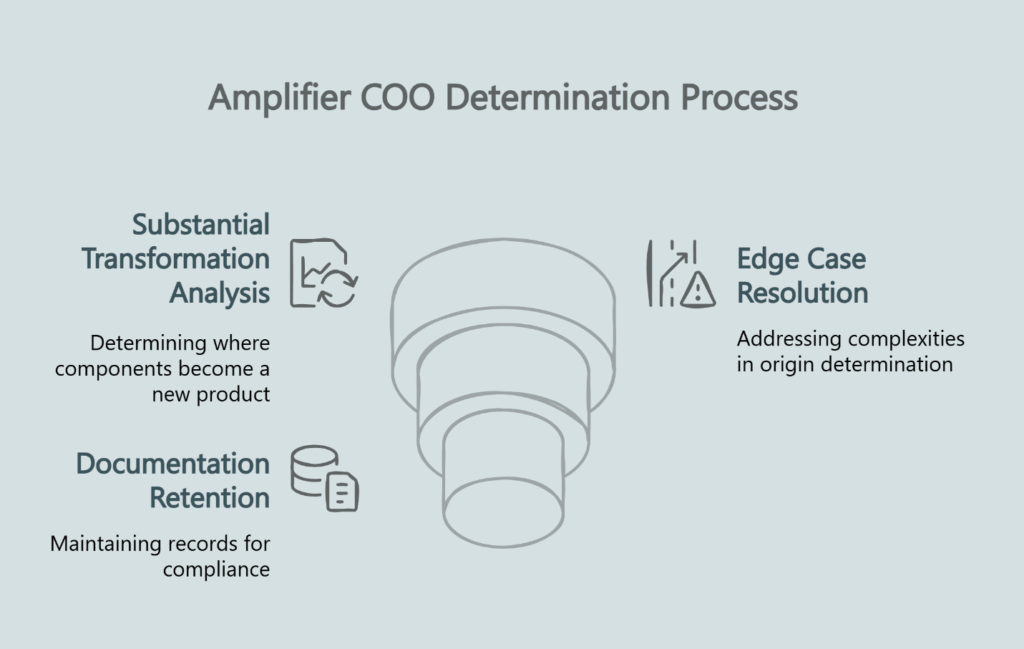
In the U.S., COO determination follows non-preferential rules of origin under 19 CFR Part 134. The core test is substantial transformation—the place where inputs become a new article with a different name, character, or use. For amplifiers, this analysis often centers on where PCBA population, programming, and final assembly with testing occur.
Substantial transformation analysis for a typical scenario: PCBA boards manufactured in Taiwan, aluminum chassis fabricated in China, and final assembly including testing and calibration performed at a Chinese facility. The substantial transformation analysis focuses on the final assembly location because this step converts separate components into a finished, functional product with a new commercial identity.
Edge cases requiring early resolution:
- PCBA vs. final assembly: If populated and programmed PCBAs are imported from Country A and final assembly and verification occur Country B, document which stage confers the essential character for the finished amplifier. The determination often hinges on where the product gains its primary functionality through testing and calibration.
- Mixed-origin kits: When enclosures, transformers, and boards originate from different countries, lock the COO decision pre-pilot and file the rationale with first-article records. Changes during production runs create label master inconsistencies and require new first-article inspections.
- Accessories with different origins: COO can differ between the amplifier and included accessories. Mark each item or its immediate container with its own COO to prevent misassociation during receiving. Warehouse teams rely on quick visual matches; ambiguity creates avoidable holds.
The EU applies similar non-preferential origin concepts. Teams should reference the Commission’s guidance on non-preferential rules of origin to align record-keeping with customs and market-surveillance interactions.
Documentation retention: Keep a concise COO determination memo with references to applicable regulatory sections and attach sample label art and photos. This memo belongs in the evidence pack and supports your defense during customs audits.
Implementation: Build the Label Master and Evidence Pack
Treat the Label Master as an engineering-controlled artifact, not a last-minute export form. This controlled document must specify exact text strings, font specifications, placement coordinates, and barcode formats for every product variant. Changes to the Label Master require formal engineering change control to maintain traceability.
Essential Label Master specifications:
- Exact strings: Model name exactly as appears in your ERP system, COO designation using standardized format (“Made in China” not “China Origin”), safety certification numbers with proper formatting
- Barcode symbologies and data maps: Code 128 or similar for model, SKU, serial, lot, and pallet identification with specified error correction levels
- Physical specifications: Fonts, minimum sizes (typically Arial 8pt minimum), contrast requirements, and placement diagrams with precise measurements
- Change control: Versioning tied to ECNs and pilot/first-article inspection gates ensuring factory and brand teams never work from different specifications
- Cross-references: Documentation of where COO appears on each physical layer and in each document (BOM, specification, packing list, invoice, ASN)
Evidence pack structure should align with ISO/IEC 17050-1 framework for supplier declarations:
- Safety compliance documentation: For audio amplifiers, the de-facto benchmark references IEC/UL 62368-1 testing and certification pathways
- MES/ERP alignment: Screenshots proving model/SKU/serial alignment with the label data map
- First-article validation: Photos showing unit/carton/pallet labels demonstrating COO and model alignment
- COO determination rationale: Substantial transformation analysis with regulatory references
Factory-to-brand handoff protocols define clear responsibilities. Amplifier manufacturing services typically prepare the engineering label pack and handoff matrix, while brand teams integrate these assets into packaging, translations, and downstream channel deliverables. This division prevents duplication while ensuring completeness.
Receiving-Hold Prevention Checklist (COO & Marking)
Use this comprehensive checklist at pilot exit and again before each mass-production release:
Regulatory Compliance:
- COO locked and documented with substantial-transformation analysis attached
- Unit marking present (conspicuous, legible, indelible per 19 CFR §134.11)
- Carton marking present and matches unit COO
- EU sectoral requirements verified where applicable
System Alignment: 5. Label Master version matches current production run 6. ECN change trail properly closed and documented 7. Barcode fields validated against MES/ERP extracts 8. Model/SKU/serial consistency verified across all systems
Documentation Package: 9. Evidence pack complete with SDoC/DoC references 10. First-article acceptance criteria documented 11. Label placement photos archived 12. Pallet label summary ties to packing list/ASN
This systematic approach transforms labeling from a recurring problem into a competitive advantage through reliable execution.
Frequently Unasked Questions
What happens when COO differs between the main unit and included accessories?
Each component maintains its individual COO marking per regulatory requirements. The cable marked “Made in Taiwan” remains separate from the amplifier marked “Made in China.” The shipping carton may list “Mixed Origin” or specify each component’s origin separately, depending on destination market requirements. Ensure the carton label doesn’t imply a single origin for mixed-content packages.
How do rework and relabel decisions affect warranty risk?
Field relabeling introduces traceability gaps that can complicate warranty claims. When original labels are removed or covered, the connection between the physical unit and manufacturing records becomes questionable. Archive the ECN, photos, and re-inspection sign-off in the evidence pack. Prevention through correct initial labeling eliminates this risk entirely.
How should mixed-origin BOMs be handled during engineering changes?
Treat the COO determination like any other critical specification. When an ECN moves a major assembly to a new country, re-evaluate the substantial-transformation analysis, update the Label Master, and refreeze the specification. ECNs that alter component sourcing may trigger COO reassessment requiring updated documentation and compliance review.
Is COO the same as “assembled in” claims?
No. “Assembled in” describes a manufacturing process; COO follows specific customs rules like substantial transformation under 19 CFR 134. Use COO language for compliance marks and other claims only when legally permitted and not misleading to consumers or trade partners.
Mini Case Study: The 48-Hour Hold That Didn’t Happen
A brand team preparing a new Class-D platform for seasonal launch faced potential receiving delays when their previous supplier had created inconsistent label formats. Model numbers in the ERP system used periods (“AD1500.1”) while physical labels used dashes (“AD-1500-1”). Receiving systems flagged every unit as a potential discrepancy requiring manual verification.
Two weeks before first shipment, the team froze a comprehensive Label Master with exact COO strings, model format specifications, and placement diagrams. The supplier aligned MES model IDs and serial formats to the same data mapping. At the port distribution center, the pallet label summarized COO information and the ASN matched all barcodes perfectly.
The result: The shipment cleared receiving inspection in one pass instead of the typical 48-hour hold for documentation review. Without that systematic preparation, the routine format mismatch could have triggered extended delays and overtime rework costs. Instead, receiving processing took minutes rather than days.
The key insight: treating labeling as an engineering deliverable rather than a manufacturing afterthought prevents problems that would otherwise require expensive field correction and relationship repair with distribution partners.
From One-Off Compliance to Scalable Label Governance
Individual product compliance creates isolated solutions that don’t scale across portfolios. Systematic governance establishes frameworks that work consistently across entire product lines, manufacturing partners, and market requirements.
Cross-program standardization begins with Label Master templates that define common field structures, placement conventions, and approval workflows. This template approach reduces setup time for new programs while maintaining compliance rigor across all initiatives. When labeling specifications follow standard formats, supplier onboarding becomes more efficient and quality expectations remain clear.
Quarterly governance reviews should verify that physical production matches controlled documentation. These audits catch specification drift before it creates receiving issues and ensure that ECNs properly update all related labeling requirements. The review process must include both documentary verification and physical sample inspection to maintain system integrity.
Portfolio-level frameworks enable brand teams to communicate consistent requirements to multiple manufacturing partners simultaneously. Rather than determining COO and labeling requirements for each new product individually, established frameworks provide tested templates that accelerate time-to-market while maintaining compliance standards.
This systematic approach transforms labeling from a recurring obstacle into a competitive advantage. Reliable execution builds trust with distribution partners, reduces program risk, and creates operational efficiencies that compound across multiple product launches.
Ready to prevent receiving holds through systematic labeling governance? Our engineering team provides Label Master templates and compliance frameworks that eliminate costly delays while supporting scalable growth across your product portfolio.
Explore our build-to-brand capability: Amplifier Manufacturing Services
See how we scale platforms: Amplifier Production
Ready to talk details? Contact CFS
Disclaimer: This material provides general, implementation-oriented information and is not legal advice. Country of origin and marking requirements vary by jurisdiction and product category. Consult with qualified compliance professionals and refer to current regulations from relevant authorities.
Our Editorial Process: CFS publishes benefit-led, decision-relevant guidance grounded in practitioner experience. We focus on the specific deliverables brand partners need—label masters, SDoC/DoC references, and first-article criteria—while linking to authoritative sources for regulatory compliance.
About the Authors: The CFS Engineering & Compliance Team operates manufacturing facilities with capacity for approximately 5,000 speakers and 1,000 amplifiers daily. Our senior technical staff averages over 20 years of industry experience, specializing in evidence-led handoffs that provide complete documentation packages to brand partners.