📌 Key Takeaways
Private-label speakers become differentiated products when customization extends beyond logos into materials, acoustics, and reliability engineering.
- Cosmetic Choices Drive MOQ and Timing: Custom grill shapes require 500-1,000+ units and add 2-4 weeks, while cone finishes start at 250 units with minimal lead-time impact.
- Acoustic Parameters Define Your Sound Signature: Voice coil size, sensitivity targets, and frequency response tolerances determine whether your speakers compete on output, efficiency, or tonal character.
- Reliability Gates Protect Warranty Budgets: EVT/DVT/PVT validation stages with defined sample quantities and accelerated life testing reduce DOA rates below 0.5% in the first 90 days.
- Golden Samples Lock In Your Specifications: Approved reference units with ±2 dB frequency response tolerances become immutable production standards, preventing drift across manufacturing runs.
- Budget Allocation Follows Strategic Priority: Visual identity changes cost $1-5 per unit, sound signature modifications reach $10-20, and durability enhancements span $8-15—align spending with your brand positioning.
Choose customization depth before negotiating MOQ—moderate changes justify 500-1,000 unit commitments while preserving margin.
Online audio retailers, e-commerce platforms, and private-label product managers will find actionable frameworks here, preparing them for the detailed customization decision matrix that follows.
When online audio retailers evaluate private-label speaker programs, many assume customization means adding a logo to an existing product. The reality extends far deeper. Private-label customization spans cosmetic, acoustic, mechanical, and packaging dimensions—each carrying distinct implications for brand identity, unit economics, and warranty exposure.
This guide provides a descriptive menu of speaker customization levers available in OEM/ODM programs, the business impact of each choice, and a practical framework for drafting product requirements. Think of it as spec’ing your brand’s “voice and wardrobe”—the visible elements customers notice and the invisible performance characteristics that define long-term satisfaction.
Consider a procurement manager preparing a private-label speaker program. Without understanding which customization choices affect MOQ thresholds, lead times, or unit costs, initial product requirements often trigger unexpected tooling charges or schedule delays. Worse, acoustic specifications left ambiguous create quality disputes when mass production units don’t match expectations formed during verbal discussions. This guide addresses those gaps by clarifying what can be customized, how each choice impacts program economics, and which decisions require explicit documentation.
Cosmetic Customizations: What They Are and What They Change
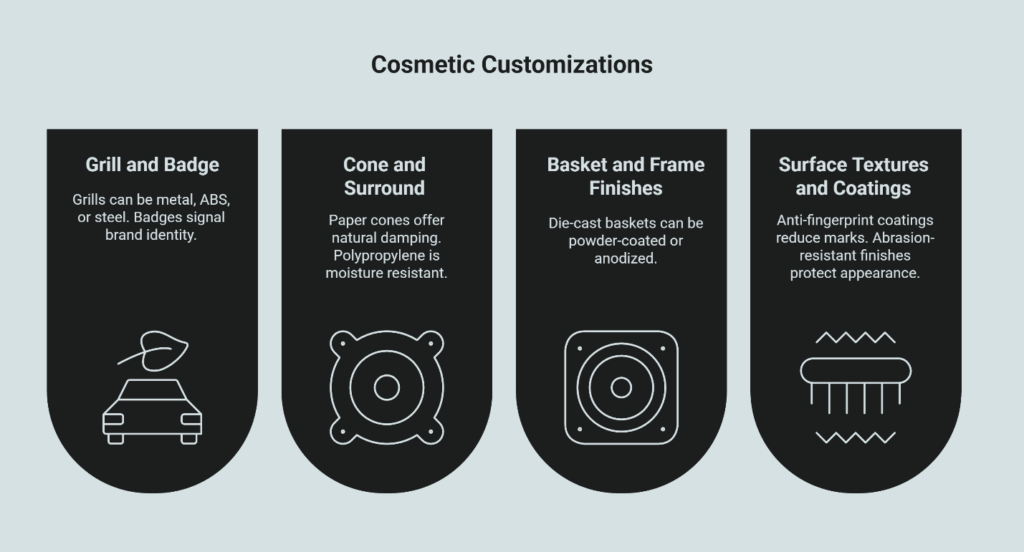
Cosmetic choices shape first impressions and perceived value. These decisions typically don’t require fundamental engineering changes but do affect tooling, minimum order quantities, and lead times.
Grill and Badge: Grills can be specified in perforated metal, injection-molded ABS, or stamped steel—each offering different aesthetic weights and durability profiles. Metal grills project premium positioning but add unit cost and tooling expense. Badge shapes (embossed, printed, metal insert) signal brand identity; custom badge shapes generally require dedicated tooling, raising MOQ requirements to amortize the investment. For outdoor or automotive applications, UV-resistant materials prevent fading, while marine environments demand corrosion-resistant finishes.
Cone and Surround: Paper cones deliver natural damping characteristics valued in vocal-centric applications. Polypropylene offers moisture resistance for marine products. Kevlar-reinforced cones reduce break-up modes at high SPL but increase material cost. Surround materials—typically TPE (thermoplastic elastomer) or foam—affect both aesthetics and excursion linearity. Glossy finishes photograph well for e-commerce but may show fingerprints in retail displays. Matte or textured finishes resist handling marks but require different mold surfaces, which impacts tooling lead time.
Basket and Frame Finishes: Die-cast baskets can be powder-coated in custom colors or anodized for a metallic appearance. Powder coating adds minimal unit cost but requires color-specific setup; minimum batch sizes apply. Anodizing provides superior corrosion resistance—critical for marine speakers—but limits color options and increases per-unit expense. Stamped steel baskets cost less but lack the resonance control of die-cast aluminum, a trade-off relevant for high-output professional audio applications.
Surface Textures and Coatings: Anti-fingerprint coatings reduce visible handling marks but add a process step. Abrasion-resistant finishes protect appearance during shipping and installation. Quality checkpoints should specify acceptable finish uniformity, color tolerance, and coating adhesion to prevent batch-level rejections.
Here’s how cosmetic choices typically impact program variables:
- Custom grill shape: Higher MOQ tendency (500-1000+ units), moderate lead-time increase (2-4 weeks for tooling), moderate unit-cost increase, improves durability and brand differentiation
- Custom cone finish: Lower MOQ tendency (250-500 units), minimal lead-time effect, minimal unit-cost increase, aesthetic impact only
- Anodized basket: Moderate MOQ tendency (500+ units), moderate lead-time increase, moderate unit-cost increase, excellent durability for harsh environments
- Anti-fingerprint coating: Low MOQ tendency (no minimum), minimal lead-time effect, low unit-cost increase, improves handling appearance
Acoustic Customizations: The Invisible Differentiators
Acoustic customization defines brand sound signature—the characteristic that creates repeat purchase behavior when customers recognize and prefer your tonal balance. Unlike cosmetic choices, acoustic modifications require engineering validation and performance verification.
Driver Parameters: Voice coil diameter directly affects power handling and thermal capacity. A 1.5-inch coil handles moderate power efficiently; 2.5-inch coils accommodate higher continuous output but increase magnet mass and unit cost. Magnet strategy—ferrite versus neodymium—represents a fundamental cost-versus-weight trade-off. Ferrite costs less but requires larger motor structures. Neodymium enables compact, lightweight designs at premium cost. Cone mass affects transient response; lighter cones improve high-frequency extension but may sacrifice low-frequency authority.
These parameters shift system-level performance: higher sensitivity (typically 88-95 dB @ 1W/1m) requires less amplifier power but often compromises deep bass extension. Lower distortion specifications necessitate larger voice coil thermal mass and tighter manufacturing tolerances, both increasing cost. Thermal headroom—the driver’s ability to handle sustained power without compression—depends on voice coil former material, venting strategy, and magnet flux density.
Tuning and Enclosure Design: Enclosure volume, port tuning frequency, damping material density, and passive crossover topology collectively create the brand’s acoustic signature. For example, a 12-inch subwoofer can be tuned for maximum SPL (port tuned to 35-40 Hz) or extended low-frequency response (sealed or port tuned to 25-30 Hz). The choice affects both subjective listening character and objective measurement curves.
DSP filters and limiters enable active protection and response shaping. High-pass filters prevent driver over-excursion below tuning frequency; low-pass filters control off-axis response. When specifying tuning targets, provide frequency response boundaries (e.g., “±3 dB from 50 Hz to 18 kHz”), maximum harmonic distortion tolerance (e.g., “<1% THD at rated power”), and intended use cases that inform trade-off decisions.
Golden Sample Lock-In: All acoustic choices must be approved and documented in the Golden Sample—the immutable reference unit that defines “correct” for mass production. Test plots showing frequency response, impedance curve, and distortion measurements should be signed off by both parties. Any subsequent acoustic changes require Golden Sample re-signoff, preventing scope creep and quality disputes. This single discipline prevents the most common private-label conflict: “The production units don’t sound like the samples we heard.”
Mechanical and Reliability Choices: Own the Warranty Risk
Mechanical specifications determine failure modes and warranty exposure. These decisions rarely affect first-impression appeal but dramatically impact long-term cost of ownership.
Fasteners and Gasketing: Terminal types (spring-post, binding post, solder tab) affect installation ease and connection reliability. Spring terminals suit quick-connect applications; binding posts accommodate larger gauge wire for high-current paths. Gasket material and compression affect weather sealing. For outdoor applications, closed-cell foam gaskets prevent moisture ingress; IP ratings should be specified by category. Ingress protection levels are defined in IEC 60529, which classifies dust and water resistance for enclosures.
Spider and Suspension Design: Spider material (cloth, poly-cotton blend) and corrugation geometry control excursion linearity and centering force. Multi-layer spiders offer higher power handling but increase mechanical compliance, affecting low-frequency extension. These choices interact with voice coil height and magnet gap dimensions—parameters requiring engineering validation, not procurement-level decisions.
Reliability Gates to Request in PRDs:
- EVT (Engineering Validation Test) checkpoints: functional verification, parameter measurements, initial acoustic validation—typically 10-20 samples
- DVT (Design Validation Test) checkpoints: thermal cycling, vibration testing, accelerated life tests—typically 20-30 samples
- PVT (Production Validation Test) checkpoints: process capability verification, cosmetic quality assessment, final Golden Sample confirmation—typically 50-100 samples
- Acceptance bands: specify measurement tolerances (e.g., “resonant frequency: 45 Hz ±5 Hz,” “sensitivity: 88 dB ±2 dB”)
- Target DOA/NPF rates: establish clear benchmarks (e.g., “<0.5% in the first 90 days”) to align quality expectations
The EVT/DVT/PVT validation framework structures reliability testing and production readiness across hardware development stages. These gates reduce DOA (Dead on Arrival) and NPF (No Problem Found) incidents—both of which generate warranty cost without identifying systematic issues.
Packaging and In-Box Experience: Perceived Value Meets Freight Economics
Packaging communicates brand positioning before the customer touches the product. It also determines damage rates, freight efficiency, and unboxing satisfaction.
Carton Specifications: Board grade (typically 200# test, 32 ECT, or 44 ECT for speaker applications) affects crush resistance and stacking strength. Higher grades prevent transit damage but increase dimensional cube and freight cost. Custom printing (brand colors, product imagery, compliance marks) adds per-unit expense proportional to print complexity—spot color costs less than full process printing.
Foam and Protection: Die-cut foam provides precise fitment and premium appearance but requires tooling investment. Generic foam corner blocks cost less but leave the product visibly less protected during unboxing. For heavy speakers, molded pulp or corrugated inserts balance protection with sustainability concerns.
Trade-Off Considerations:
- Dimensional cube versus protection: oversized packaging protects better but increases freight cost per unit; optimize for pallet utilization
- Unboxing versus cost: multi-layer packaging with printed sleeves elevates perceived value but adds $2-5 per unit
- Drop test standards: specify test protocols to align expectations between brand and manufacturer
Many brands reference industry packaging test protocols such as ISTA 3-series to simulate drops, vibration, and compression for parcel and e-commerce shipment conditions. Sustainability asks—recycled content, minimal plastic, reduced inks—increasingly influence purchase decisions. These should be specified as requirements, not preferences, to ensure compliance.
Budgeting the Customization Mix: How to Decide
Customization choices stack financially. Three lenses help prioritize:
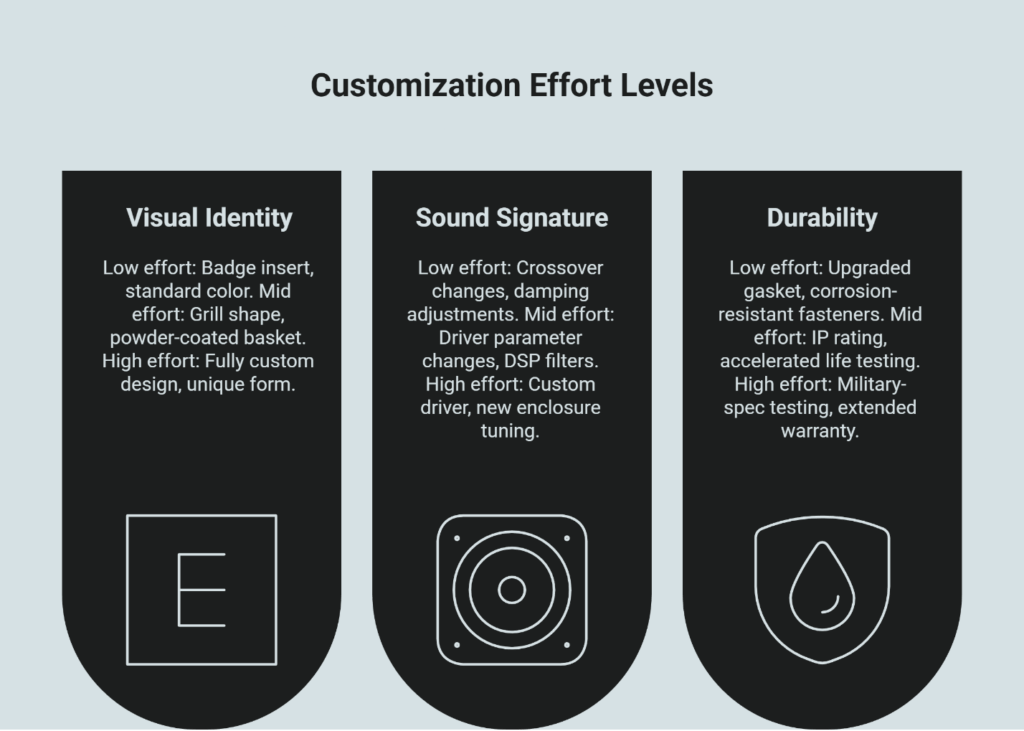
For Visual Identity Goals:
- Low effort: Custom badge insert, standard color selection (minimal MOQ impact, <$1 unit cost increase)
- Mid effort: Custom grill shape, powder-coated basket (moderate MOQ increase, $2-5 unit cost increase, 3-4 week lead time)
- High effort: Fully custom industrial design, unique form factor (high MOQ requirement, $5-15 unit cost increase, 8-12 week tooling lead time)
For Sound Signature Goals:
- Low effort: Crossover component value changes, damping material adjustments (minimal MOQ impact, <$1 unit cost increase)
- Mid effort: Driver parameter changes within existing platform (voice coil size, cone material), DSP filter adjustments (moderate engineering validation, $3-8 unit cost increase)
- High effort: Custom driver development, new enclosure tuning (significant engineering investment, $10-20 unit cost increase, extended validation timeline)
For Durability Goals:
- Low effort: Upgraded gasket material, corrosion-resistant fasteners (minimal MOQ impact, <$2 unit cost increase)
- Mid effort: IP rating compliance, accelerated life testing (moderate validation cost, $3-6 unit cost increase)
- High effort: Military-spec environmental testing, extended warranty backing (significant test investment, $8-15 unit cost increase)
MOQ, unit-cost deltas, and lead-time shifts should be weighted against brand positioning and margin requirements. Non-recurring engineering (NRE) charges for tooling and validation often exceed $5,000-15,000 for moderate customization—costs amortized only across sufficient unit volumes.
Drafting Your PRD and Sample Plan
Clear product requirements prevent ambiguity and reduce re-work. Use this checklist when requesting samples:
Copy-Paste PRD Requirements Checklist
- Product goal & audience: (one sentence defining market position and target customer)
- Target category & price band: (e.g., “bookshelf speakers, $150-200 MSRP”)
- Cosmetics: grill/badge, cone/surround, basket/finish, coatings (include color codes/finishes, durability notes)
- Acoustic targets: SPL/sensitivity goal, bandwidth, distortion tolerance, thermal limits, DSP filters/limiters desired
- Mechanical & reliability: fasteners/gasket, spider/terminal choices, environmental targets (e.g., IP rating), vibration/thermal test asks
- Packaging: carton spec, foam type, print finishes, sustainability asks, drop-test reference
- Regulatory & labeling: (brand handoff requirements only—compliance marks, country-of-origin, safety certifications)
- Golden Sample plan: measurement list, acceptance bands, sign-off owners, re-signoff triggers
- MOQs, lead time, NRE/tooling constraints: what’s acceptable/unacceptable for program economics
- Sample quantities & schedule: EVT/DVT/PVT checkpoints and dates
When submitting this PRD, also specify:
- How many Golden Samples are needed and where they go (engineering, marketing, key customers)
- Which internal teams will sign off on cosmetics, acoustics, packaging, and labeling
- The decision dates that drive launch schedule milestones
This checklist ensures both parties share identical understanding before tooling commits or mass production begins. Golden Sample sign-offs eliminate “quality drift” arguments and protect against “minor deviation” disputes that erode margin.
Private-label speaker customization extends well beyond logos into materials, tuning, and packaging choices that collectively shape brand identity and warranty risk profile. Cosmetic options affect first impressions and perceived value. Acoustic customization defines the brand’s sound signature. Mechanical specifications determine reliability and warranty exposure. Packaging balances protection, freight economics, and unboxing experience.
Understanding which customization levers impact MOQ, unit cost, and lead time enables realistic program planning. The Golden Sample remains the single source of truth—locking in all cosmetic and acoustic choices before mass production prevents the most common private-label conflicts.
Ready to discuss your next program? Contact our team to request a catalog, discuss sample plans, or schedule a DFM review.
Our Editorial Process
Our expert team uses AI tools to help organize and structure our initial drafts. Every piece is then extensively rewritten, fact-checked, and enriched with first-hand insights and experiences by expert humans on our Insights Team to ensure accuracy and clarity.
About the China Future Sound Insights Team
The China Future Sound Insights Team is our dedicated engine for synthesizing complex topics into clear, helpful guides. While our content is thoroughly reviewed for clarity and accuracy, it is for informational purposes and should not replace professional advice.