📌 Key Takeaways:
Manufacturing yield depends more on measurable acceptance criteria than perfect specifications on paper.
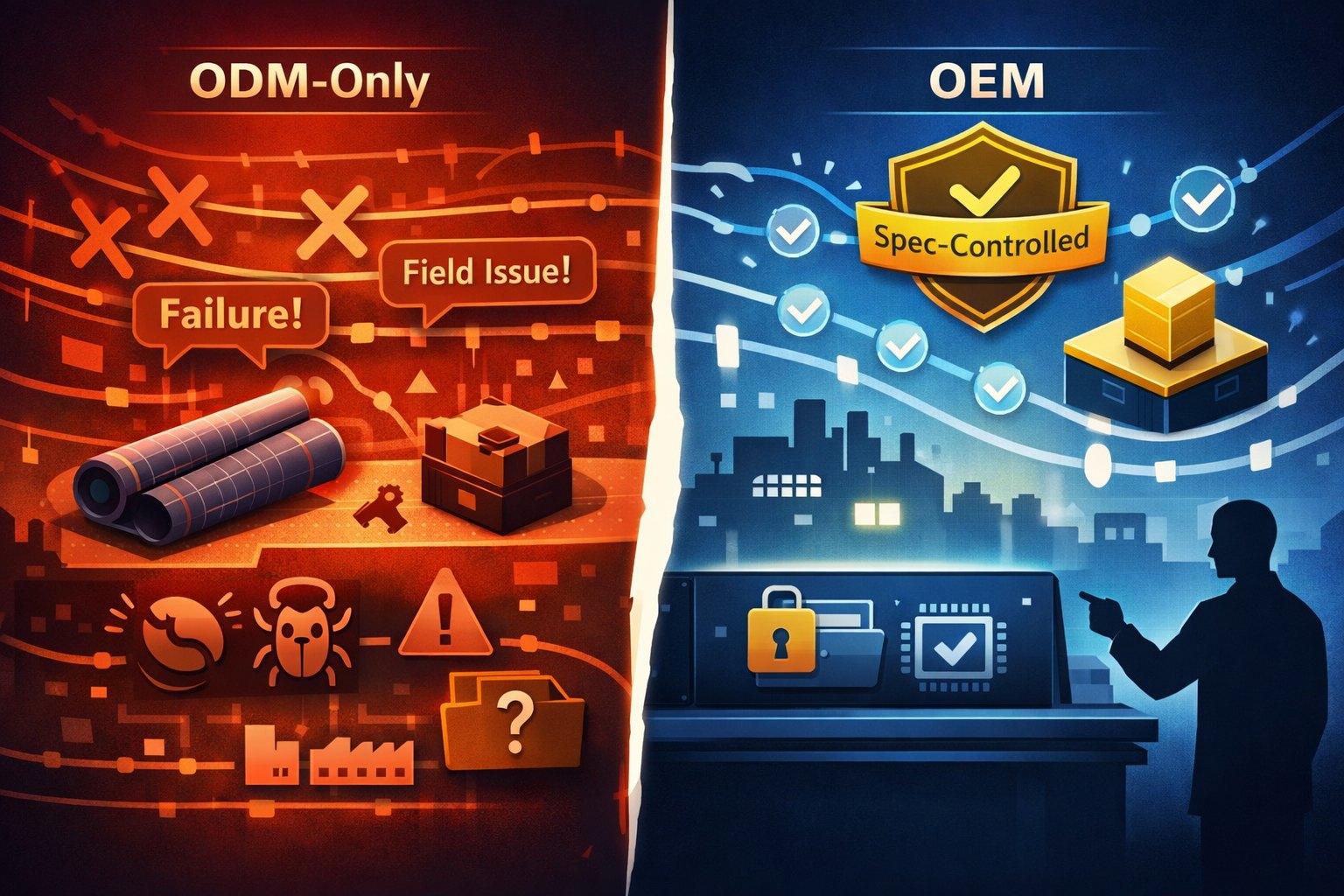
Operational Evidence Trumps Specifications: Repeatable test methods with clear pass/fail limits predict production outcomes better than theoretical spec sheets.
Focus on the Critical Eight: Thermal margin, power supply regulation, bias stability, THD+N repeatability, EMI margins, mechanical tolerances, soldering windows, and protection thresholds drive the majority of yield issues.
Three-Factor Decision Lens: Prioritize specifications based on tolerance sensitivity, process sensitivity, and test-escape risk to identify which parameters will actually impact first-pass success.
Golden Sample Protocol: Establish reference units with sealed settings, fixture correlations, and traceable test records to create accountability between development and production teams.
Evidence-Led Validation: Require capability studies, measurement system fitness, and lot acceptance criteria before committing to production tooling and processes.
Clear methods and limits eliminate opinion-based debates and create data-driven manufacturing decisions.
For purchasing managers and product leaders evaluating amplifier manufacturing partners, these frameworks separate reliable suppliers from those who deliver surprises during production ramp.
Yield starts with DFM choices.
The audit room is quiet except for the soft click of a relay in the test fixture. On one unit the heat sink runs five degrees hotter than the golden sample; on another, protection trips a second too late. Nothing is “wrong” on paper—yet the first-article pass rate is slipping.
If you purchase, manage, or approve amplifier programs, you live with this tension. Spec sheets look fine, but repeatability and first-pass yield tell the truth. The path forward is practical: focus on the handful of design-for-manufacturability (DFM) inputs that move yield the most, and insist on objective acceptance criteria and operational evidence—not just stated requirements.
Operational evidence predicts outcomes better than spec sheets alone. Acceptance criteria create shared accountability. Evidence-led sourcing shortens onboarding cycles.
Why DFM Decisions Drive Yield in Amplifier Programs
Amplifier yield is a program outcome, not a line-item component attribute. The most reliable programs translate engineering intent into things plants can measure the same way every time: clear limits, stable fixtures, and correlated tests. That is why the “DFM inputs” in this article emphasize measurability, process sensitivity, and test-escape risk. When each input has a defined method and limit, teams stop debating opinions and start comparing data.
Two practices anchor this approach:
Capability and variation awareness. Capability indices (e.g., Cp/Cpk) relate process spread to specification limits and help judge whether a stable process can meet requirements consistently.
Measurement system fitness. First-pass yield depends on the gauges being precise and consistent. Gauge R&R principles help quantify repeatability and reproducibility and are a common part of supplier development and lab correlation.
How to Identify Specifications That Impact First-Pass Yield
Use a simple decision lens:
- Tolerance sensitivity: Small parametric drift causes outsized customer risk (e.g., bias drift → distortion).
- Process sensitivity: The parameter moves with thermal, assembly, or supplier variation.
- Test-escape risk: The defect is hard to catch with quick-turn screens unless the method and limit are precise.
For high-impact specs, require three things:
- Named method + acceptance limit. Define exactly how it’s measured and the pass/fail boundary.
- Fixture correlation. Show agreement between development and production instruments.
- Lot acceptance approach. When appropriate, use attribute sampling anchored on AQL concepts so acceptance criteria scale to lot size.
The 8-Specification Framework
The following “spec cards” are the inputs that, in our experience as a manufacturing community, most often separate smooth ramps from DOA headaches. Each card notes why it matters, common failure modes, practical guardrails, an acceptance snapshot, and a sourcing note. Methods and limits should be tailored in your control plan.
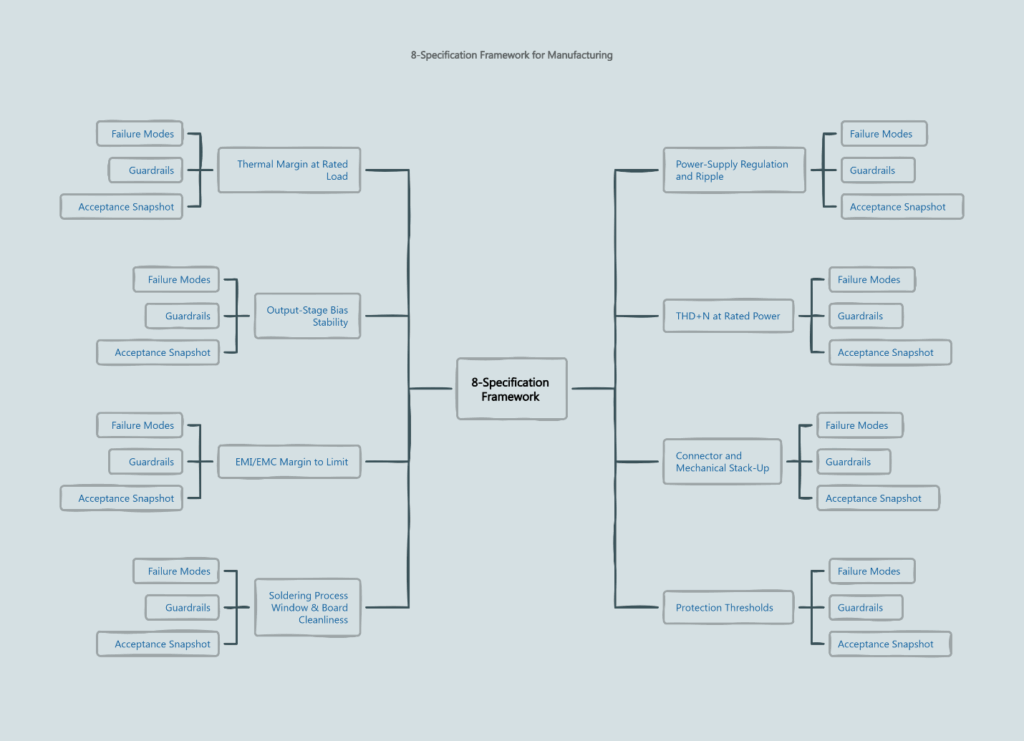
1. Thermal Margin at Rated Load
Why it affects yield: Thermal stress shifts bias, shortens component life, and inflates return rates.
Failure modes: Hot-spotting on output devices, heat sink saturation, throttling under high ambient.
Guardrails: Model for worst-case duty cycle; require heat-spreader flatness and paste pattern specs.
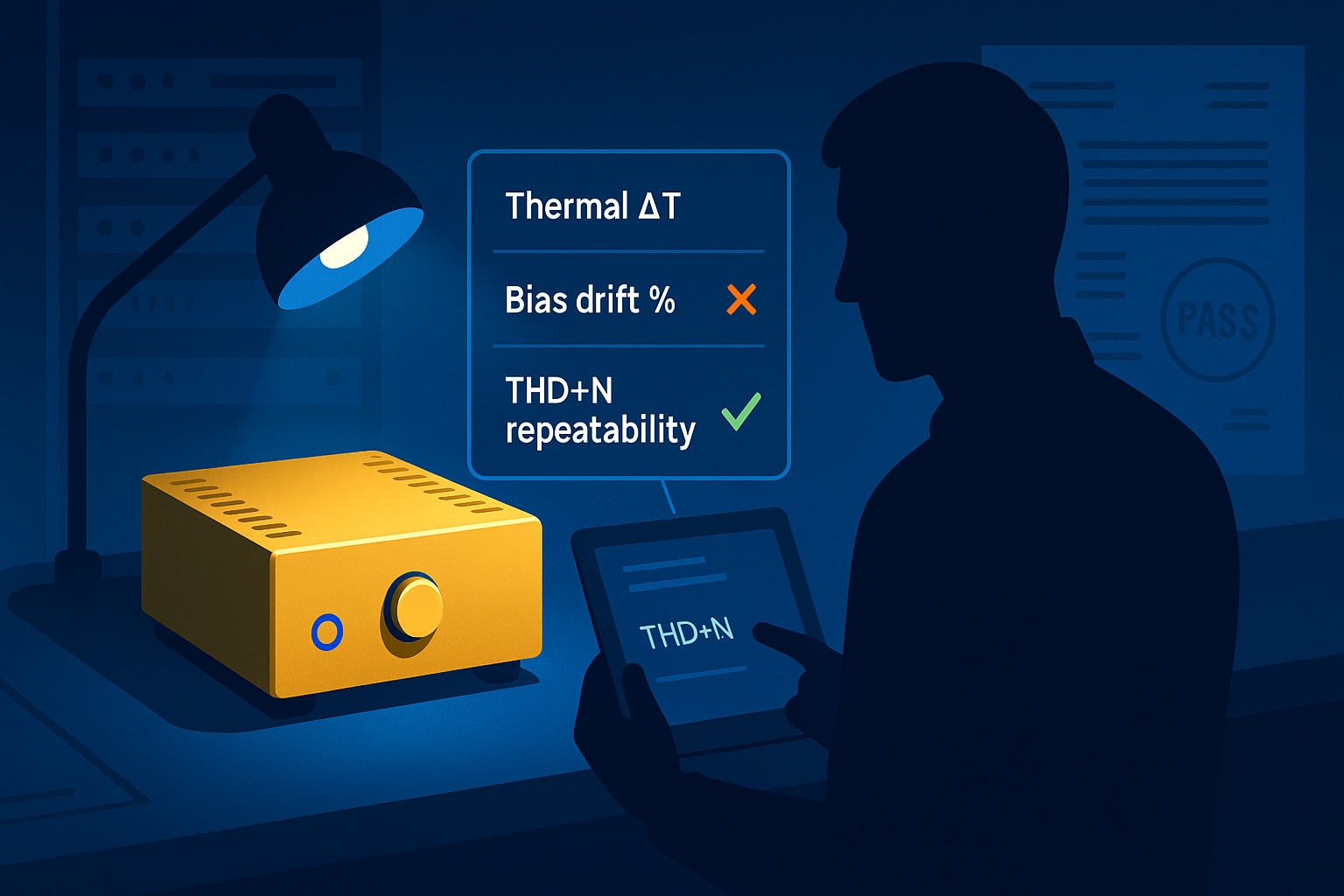
Acceptance snapshot: Chamber run at rated power to temperature steady-state; compare to golden sample with defined ΔT limit.
Sourcing note: Request thermal photos from FA runs and fixture details for repeatable placement.
2. Power-Supply Regulation and Ripple
Why it affects yield: Sag and ripple modulate distortion and trigger protection falsely.
Failure modes: Line dip dropout, hum under load, thermal foldback too early.
Guardrails: Specify line and load regulation across input range; include hold-up time at brown-out.
Acceptance snapshot: Load sweep with ripple and sag limits at each setpoint.
Sourcing note: Ask for PSU vendor test reports and BOM lock for magnetics/electrolytics.
3. Output-Stage Bias Stability
Why it affects yield: Drift changes crossover behavior and reliability.
Failure modes: Thermal runaway, audible notch distortion, inconsistent idle current.
Guardrails: Bias set method, target, and allowable drift over temperature.
Acceptance snapshot: Thermal sweep with bias drift ≤ defined % of set value.
Sourcing note: Capture torque pattern and pad stack-up influencing thermal contact.
4. THD+N at Rated Power (Repeatability)
Why it affects yield: Core performance indicator that can be test-sensitive.
Failure modes: Analyzer setup sensitivity, cabling, ground loops, warm-up effects.
Guardrails: Document analyzer model, filter set, bandwidth, settling time; require Gauge R&R on the setup.
Acceptance snapshot: Repeatability study across operators; production limit with margin to spec.
Sourcing note: Require traceable test results and analyzer calibration dates.
5. EMI/EMC Margin to Limit (Pre-Compliance)
Why it affects yield: Late EMC surprises stall ramps and cause rework.
Failure modes: Conducted noise from PSU switching, radiated emissions from layout or cabling.
Guardrails: Pre-compliance scan bandwidths and limits; harness/fixture definition.
Acceptance snapshot: Conducted/radiated pre-scans with minimum margin documented.
Sourcing note: Capture harness routing and LISN/spectrum analyzer settings for reuse.
6. Connector and Mechanical Stack-Up
Why it affects yield: Fit and torque consistency drive assembly yield and long-term reliability.
Failure modes: Cross-threading, misalignment, cold joints from stress, fretting.
Guardrails: Fastener torque windows, datum strategy, panel cutout tolerances.
Acceptance snapshot: Go/no-go gauges and torque audit on first-article.
Sourcing note: Include fixture drawings; specify approved torque tools.
7. Soldering Process Window & Board Cleanliness
Why it affects yield: Workmanship and cleanliness correlate with latent failures.
Failure modes: Insufficient wetting, voiding, ionic contamination.
Guardrails: Reflow/wave profiles with window; workmanship per IPC visual criteria.
Acceptance snapshot: First-article solder joint inspection against visual criteria; cleanliness limit per control plan.
Sourcing note: Capture paste lot, profile record, and inspection images in traveler.
8. Protection Thresholds (OC/DC/Temp)
Why it affects yield: Protection defines safety and perceived quality under fault.
Failure modes: Nuisance trips, late trips, non-latching faults.
Guardrails: Define trip points, debounce, and retry logic across temperature and line.
Acceptance snapshot: Fault-injection test plan with specified trip windows. For safety alignment in audio/ICT, see UL’s overview of IEC 62368-1.
Sourcing note: Require capture of waveforms at trip and recovery.
Cross-checking across platform variants helps. 4 Channel and 5 Channel models tend to concentrate thermal and harness risks differently than Monoblock single-channel high-current designs—plan acceptance accordingly.
Evidence to Gather for First-Article Approval

A first-article that passes on paper but fails to predict ramp behavior adds cost for everyone. Evidence that de-risks scale typically includes:
- Golden samples with sealed settings and ID photos.
- Fixture correlations showing agreement between lab and line instruments (use capability concepts to judge whether the method can separate good from bad consistently).
- Traceable test records with serials, dates, and operator IDs.
- Traveler sign-offs linking BOM lots, profiles, and inspections to the unit.
The key takeaway here is simple: prove that methods, not just numbers, will work the same way at volume.
Checklist: DFM Readiness Before EVT/DVT/PVT
□ Each of the 8 spec cards includes tolerance/variation notes
□ Measurement method and acceptance limits are defined and reviewed
□ Prototype-to-line correlation plan (fixtures, gauges, settings) is documented
□ Golden sample and traveler are established and controlled
FAQs
What is DFM for amplifiers vs. general DFM?
The general principles are shared—design for stable, repeatable processes—but amplifier programs add audio-specific concerns (bias stability, THD+N sensitivity, protection behavior) and safety/EMC interactions typical of AV/ICT equipment (see UL’s IEC 62368-1 primer). The emphasis remains on objective methods and limits.
How do we choose the “top 8” specs for our design?
Start with parameters that are tolerance-sensitive, process-sensitive, and prone to test escape. Then assign a named method and acceptance limit, and verify the measurement system is fit for purpose using Gauge R&R principles.
What counts as acceptable evidence in first-article approval?
Evidence that is repeatable, traceable, and correlated: golden samples, fixture correlations, dated test records, and traveler sign-offs. Where lot acceptance matters, align on an AQL-based approach for the general scheme description.
Subscribe to our newsletter for manufacturing checklists and yield-guardrails.
About China Future Sound
China Future Sound delivers premium, customized audio solutions, enhancing your experience with advanced technology and expert craftsmanship across industries. Our amplifier manufacturing services include comprehensive DFM support, from initial design review through production ramp-up.
Our Editorial Process
Our expert team uses AI tools to help organize and structure our initial drafts. Every piece is then extensively rewritten, fact-checked, and enriched with first-hand insights and experiences by expert humans on our Insights Team to ensure accuracy and clarity.
About The CFS Insights Team
The Insights Team is our dedicated engine for synthesizing complex topics into clear, helpful guides. While our content is thoroughly reviewed for clarity and accuracy, it is for informational purposes and should not replace professional advice.