📌 Key Takeaways
Retailer brand audio transforms margin erosion from a pricing trap into a product-structure advantage through exclusive SKU ownership.
- Exclusivity Stops Price Wars: Unique specifications prevent direct price matching, creating a defensible pricing moat competitors cannot penetrate.
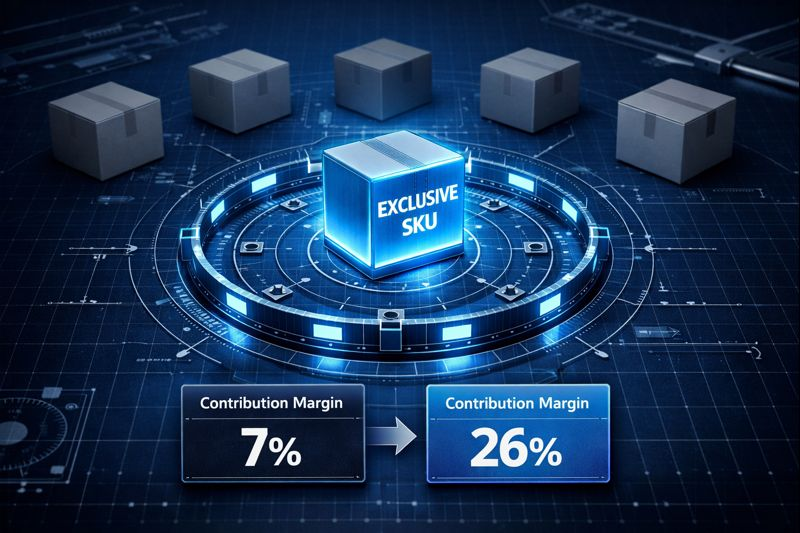
- Designed Margins Replace Inherited Caps: Private label captures the brand premium resellers give away, lifting contribution margins from 7% to 26%.
- Golden Samples Protect Reviews: ISO 9001 quality systems and Golden Sample matching ensure batch 5,000 performs like unit one, safeguarding five-star ratings.
- TCO Beats Lowest BOM: Slightly higher component costs that buy consistency reduce warranty reserves and protect long-term gross margin better than cheapest materials.
- 90-Day Pilots Reduce Risk: Testing one SKU with a small batch validates repeatability before scaling, requiring only 200 units to break even.
Own the SKU, own the margin—exclusivity converts commodity competition into controlled differentiation.
Audio retailers and e-commerce brands facing price-matching pressure will gain concrete implementation frameworks here, preparing them for the detailed margin calculator and pilot program guide that follows.
Margins shouldn’t feel like a leak. You stare at the monitor, watching the blue glare of the dashboard as another competitor drops their price by nine cents. If I match them, I lose my profit. If I don’t, I lose the sale.
E-commerce margin erosion usually looks like a pricing problem. In reality, it’s a product-structure problem.
Definition: Retailer brand audio (often called private label car audio) means products engineered and built by an OEM/ODM partner, then sold under a retailer’s own brand.
While resale margins are often capped by the brands you carry, retailer brand audio is a strategy where you own the product and the margin. It’s the difference between renting demand from a name-brand and owning the building yourself. By developing exclusive SKUs through a subwoofer manufacturing partner, you regain control over your pricing, your promotions, and your business future.
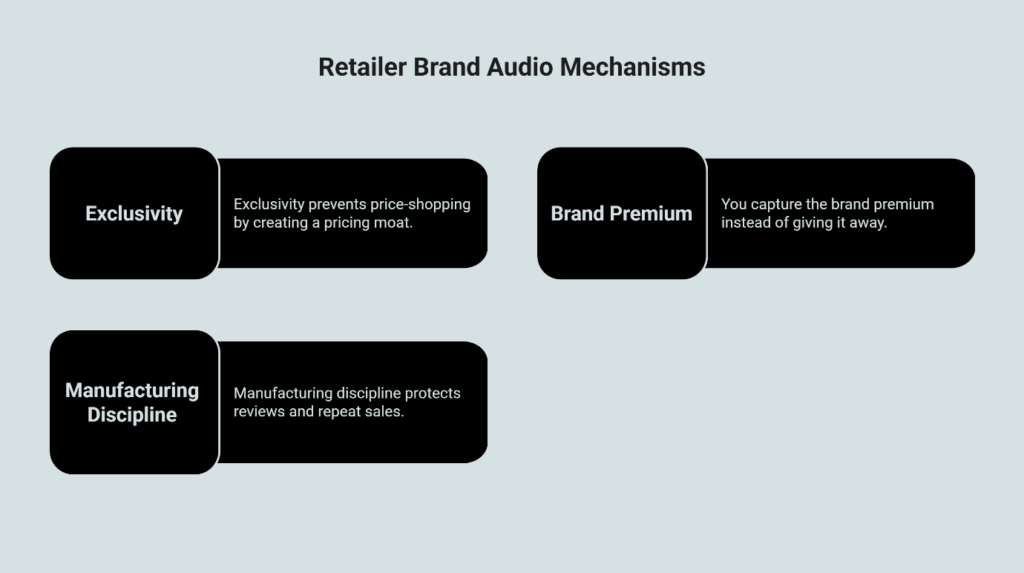
Retailer brand audio changes your business economics in three specific ways:
- Price Control: Exclusive SKUs mean competitors cannot undercut you on the exact same product, effectively neutralizing “price matching” pressure.
- Designed Margins: You capture the brand premium that you currently give away to third-party manufacturers, allowing you to reinvest in your own growth.
- Customer Loyalty: High-quality house brands built on consistent manufacturing discipline lead to better reviews and repeat sales that belong to you, not a third party.
Why e-commerce keeps eating your margins
Margins erode because price transparency turns widely distributed branded SKUs into commodities.
The audio market is currently trapped in a “Sea of Sameness”. When twenty different retailers all sell the same branded subwoofer, the customer has no reason to choose one over the other except for price. This price transparency turns specialized audio gear into a basic commodity.
Price matching tools and Minimum Advertised Price (MAP) rules often leave you with no room to move. If you follow the rules, you risk being undercut by grey-market sellers; if you drop your price to compete, your gross margin evaporates. You end up spending your marketing budget to “rent” demand for a product that can be found anywhere, leaving your business vulnerable to the next algorithm shift or competitor discount.
The hidden compounding effect of margin erosion
Margin erosion compounds because it creates volatility, which makes every inventory and marketing decision riskier.
When gross margins fluctuate wildly, making inventory bets becomes significantly riskier. A single bad quarter of price wars can tie up your cash flow in slow-moving stock, preventing you from investing in the very differentiation that would save you.
Furthermore, relying solely on third-party brands means you have no leverage when quality drifts. If a batch arrives with a high Defect on Arrival (DOA) rate, your reputation takes the hit through negative reviews, while the manufacturer remains insulated. You’re left managing the fallout without the manufacturing transparency needed to fix the root cause.
A strategic bridge from reseller thinking to brand-owner thinking: private label roadmap.
What Retailer Brand Audio actually means
Retailer brand audio restores leverage by turning a common product into an exclusive SKU that the retailer controls.
Retailer brand audio is the strategic transition from being a reseller to becoming a brand owner. Instead of buying off-the-shelf products, you collaborate with an OEM car audio production partner to create products sold under your own label.
Think of it as the architecture of your business. As a reseller, you’re paying rent in someone else’s skyscraper. When you launch a house brand, you own the building. You decide the floor plan, you control the access, and you keep the equity.
For example, a retailer seeing high volume in 12-inch subwoofers might spec a custom version with a specific motor structure and cosmetic finish. This exclusive SKU allows you to own the “Buy Box” entirely because no one else has that specific product. To begin, most successful retailers follow a private label roadmap by picking one high-volume category and developing a differentiated version that solves a specific gap in the current market.For readers new to OEM/ODM execution: how the OEM/ODM process works.
Mechanism 1: Exclusivity stops price-shopping
Exclusivity creates a pricing moat because it prevents direct apples-to-apples price matching.
When you control the specification of your audio gear, you remove the customer’s ability to perform an apples-to-apples price comparison on a search engine. Exclusivity doesn’t require extreme engineering—it requires specificity: clear specs and identifiers that create a product a competitor cannot mirror exactly.
By working with a subwoofer manufacturing partner to set unique performance targets or aesthetic features, you create a product that is uniquely yours. Consider these defensible differentiators:
- Cosmetic details: Cone finish, dust cap design, trim ring, branding execution
- Packaging and unboxing experience: Retail-ready packaging, consistent inserts
- A defined performance target: Communicated simply, not lab-level claims
This allows you to run promotions, create bundles, and manage your inventory without worrying about brand conflicts or a competitor dropping their price by 15% overnight.
Mechanism 2: You capture the brand premium instead of giving it away
Private label margin is designed, not inherited.
In a resale model, the brand owner designs the margin, and you inherit what’s left. With retailer brand audio, the margin is designed at the source.
While it might be tempting to pursue the lowest Bill of Materials (BOM) cost, the most successful retailers focus on Total Cost of Ownership (TCO). Lowest BOM cost does not reliably create the highest profit. A slightly higher BOM that buys consistency can protect reviews, reduce volatility, and support stronger pricing over time.
The question shifts from “What is the unit cost?” to “What is the margin outcome after ad costs, reserves, and quality risk?” A slightly higher investment in a more reliable amplifier or a more durable voice coil can actually protect your long-term gross margin by significantly reducing warranty costs and returns. True profitability comes from a product that performs consistently.
Private label growth and consumer acceptance are widely documented across categories; private brands can be positioned as value and quality, not only price-led alternatives.[^1]
Mechanism 3: Manufacturing discipline protects reviews and repeat sales
Margin only sticks when quality is consistent.
In the world of e-commerce, a single batch of subwoofers with poor glue joints or mismatched voice coils can destroy years of brand building in a matter of days. Quality drift is a predictable risk in manufacturing programs that lack clear standards.
This is why evaluating how the OEM/ODM process works is critical. You should look for partners who utilize disciplined engineering teams—including dedicated acoustics, electronics, and software divisions—to ensure every component is validated before it hits the line.
When evaluating an OEM/contract manufacturer, ask for evidence of:
- A quality management system: ISO 9001 is a common benchmark for QMS discipline[^2]
- Golden Sample sign-off and matching approach: The approved reference that production must match
- In-line testing and basic traceability: So issues can be isolated instead of repeated
Reliable partners maintain ISO 9001:2015 certified quality systems and use “Golden Samples” to ensure that the 5,000th unit off the line performs exactly like the first prototype. This traceability and consistency are what protect your five-star reviews and keep customers coming back for their next upgrade.
Margin Uplift Calculator
The simplest way to judge upside is to compare contribution margin per order before and after the switch.
Use this simple framework to visualize how transitioning a portion of your inventory to a house brand impacts your bottom line.
| Input Variable | Resale (Third Party) | Retailer Brand (Private Label) |
|---|---|---|
| Typical Gross Margin | 25% | 45% |
| Marketing / Ad Cost | 15% | 15% |
| Return/Warranty Reserve | 3% | 4% |
| Contribution Margin | 7% | 26% |
The 4-Step Formula:
- Determine Your Delta: Subtract your current resale margin from your expected house brand margin.
- Adjust for Risk: Add a small percentage (typically 1-2%) to your warranty reserve for new house brand SKUs.
- Calculate Net Gains: Multiply the resulting margin by your expected annual volume to see the total contribution to your overhead.
- Compute Break-Even: Divide one-time pilot costs by the contribution margin difference to find break-even units.
Worked Example:
Resale contribution per order:
- Selling price: $200
- Gross margin (20%): $40
- Minus ad cost ($20) and reserve ($10) = $10 contribution
Private label contribution per order:
- Selling price: $200
- Gross margin (35%): $70
- Minus ad cost ($20) and reserve ($10) = $40 contribution
Break-even calculation:
- Contribution difference: $40 – $10 = $30 per order
- One-time pilot cost: $6,000
- Break-even volume: $6,000 ÷ $30 = 200 orders
Illustrative Example: If you sell $100,000 worth of subwoofers at a 7% net contribution, you earn $7,000. By shifting that same volume to a house brand with a 26% contribution, you earn $26,000—a nearly four-fold increase in profit for the same sales effort.
Note: Illustrative only. Plug in actual numbers—pricing, ad costs, and reserves vary by channel and execution.
A low-risk way to start: a 90-day private label pilot
De-risk private label by controlling scope: one SKU, one variant, one small batch.
Transitioning your entire catalog isn’t necessary to see results. A targeted, 90-day pilot program is the most effective way to validate the strategy without overextending your resources.
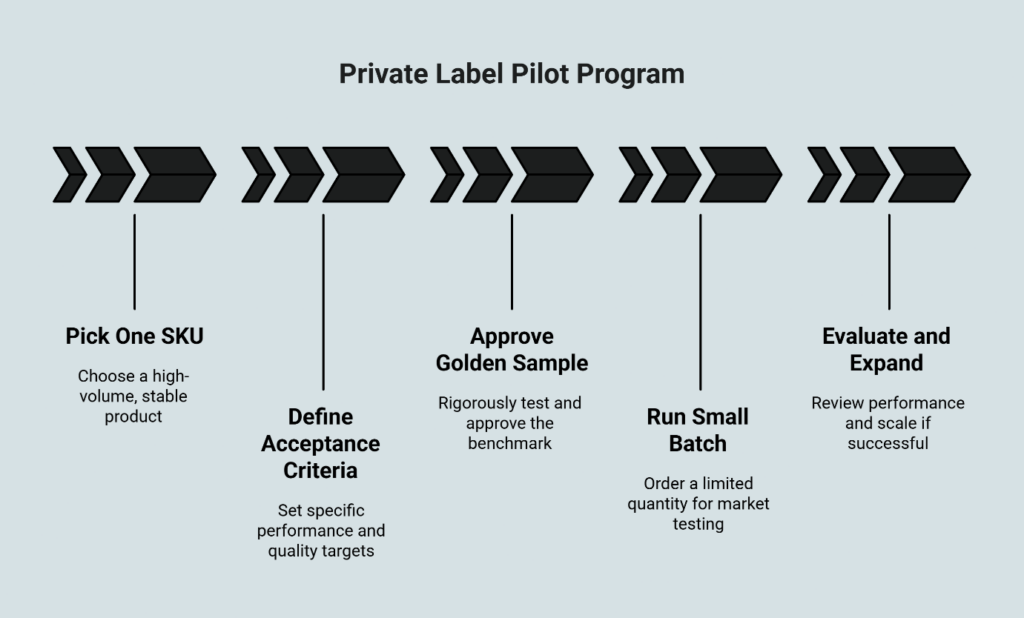
5-Step Pilot Structure:
- Pick One SKU: Choose a high-volume, stable product class—for example, a standard 10-inch subwoofer.
- Define Acceptance Criteria: Set specific performance targets, cosmetics, packaging, and QC checkpoints. Collaborate with your engineering partner to establish these markers that differentiate the SKU from your existing resale brands.
- Approve the Golden Sample: Rigorously test the initial samples and sign off on a “Golden Sample” that will serve as the benchmark for all future production.
- Run a Small Batch: Order a limited quantity to test the market response and monitor for any early quality issues. Validate consistency, not maximum volume.
- Evaluate and Expand: After 90 days, review the margin performance and customer feedback. Document learning and scale only after repeatability is demonstrated before scaling the program to other categories.
Legal Note: MAP Policies and Pricing Strategy
MAP (Minimum Advertised Price) policies typically constrain advertised pricing for branded products, limiting pricing flexibility. An exclusive retailer brand SKU reduces direct MAP-driven constraints tied to a third-party brand’s policy, but pricing strategy still needs to be managed carefully and lawfully.[^3]
For decisions tied to specific policies or enforcement practices, consult qualified counsel.
Your path toward defensible margins
Solving the “Sea of Sameness” problem in audio e-commerce requires a fundamental shift in how you view your inventory. You can continue to compete on price in a race to the bottom, or you can start building an asset that you control.
By launching a retailer brand, you stop renting your business from other brands and start owning the SKUs that drive your growth. It’s a path that replaces price transparency with exclusivity and turns margin erosion into margin control.
Next Steps
The next step is a consult-style alignment: define the pilot SKU, agree on success metrics, and request a sampling and QC evidence packet.
Action options:
- Review a target SKU and spec as a buying committee (CEO/owner, procurement, product)
- Request a sample plan, Golden Sample process, and basic QC evidence
- Align on TCO success metrics: contribution margin, review stability, and repeat purchase signals
If you’re ready to review your current product line and explore a sampling plan, you can view the product catalog or get in touch to schedule a manufacturing consultation.
Frequently Asked Questions
Will a house brand hurt customer trust?
Not if the quality is consistent. Trust is built through consistency, clear positioning, and predictable product performance. In many audio categories, customers value performance and reviews over a specific legacy brand name, provided the product meets their technical expectations. A retailer brand can earn repeat sales when quality is stable and the value proposition is clear.
What’s the minimum order quantity to start?
Minimum Order Quantities (MOQs) vary based on the level of customization. A pilot program using a standard platform with cosmetic branding often has a much lower entry point than a fully custom-engineered product. Minimums vary by manufacturer, design complexity, and component choices. A pilot approach focuses on learning and consistency first, then scaling after the program proves repeatability.
How do I avoid creating a ‘me-too’ private label product?
Focus on your unique data. Use your existing customer feedback to identify gaps—perhaps your customers want more mounting depth options or a specific aesthetic that name brands are ignoring. Define 1-2 defensible differentiators (spec, cosmetics, packaging, or performance targets), document acceptance criteria, and enforce Golden Sample matching so the differentiators persist across batches.
How do MAP policies affect e-commerce pricing and margins?
Minimum Advertised Price (MAP) policies are designed to protect brand value, but they can trap retailers in identical pricing. Launching your own brand gives you the freedom to set your own pricing policies without external constraints. MAP typically constrains advertised pricing for branded products, limiting pricing flexibility. An exclusive retailer brand SKU reduces direct MAP-driven constraints tied to a third-party brand’s policy, but pricing strategy still needs to be managed carefully and lawfully.[^3]
Disclaimer: This guide is intended as a comprehensive starting point. For decisions specific to your unique situation, we always recommend consulting a qualified professional.
[^1]: NielsenIQ (NIQ), The rise of private labels: A global perspective on growth and consumer trends (2024).
[^2]: ISO, ISO 9000 family: Quality management (includes ISO 9001 overview).
[^3]: Federal Trade Commission (FTC), Guide to Antitrust Laws: Price Fixing (general competition guidance relevant to pricing policies).
Our Editorial Process
Every piece is then extensively rewritten, fact-checked, and enriched with first-hand insights and experiences by expert humans on our Insights Team to ensure accuracy and clarity.
About the China Future Sound Insights Team.
The China Future Sound Insights Team is our dedicated engine for synthesizing complex topics into clear, helpful guides. While our content is thoroughly reviewed for clarity and accuracy, it is for informational purposes and should not replace professional advice.