📌 Key Takeaways
Your manufacturing model choice—OEM or ODM—should match your team’s engineering depth, not just your budget.
- OEM = You Design, They Build: When you bring complete specs, you keep full control over sound, firmware, and IP—but your team handles all the engineering work.
- ODM = They Design, You Brand: When you need speed over uniqueness, you buy into a ready-made platform and customize the cosmetics, branding, and basic tuning.
- Document IP Ownership Explicitly: Contracts must separate what the factory already owned from what they create for you—assumptions lead to disputes.
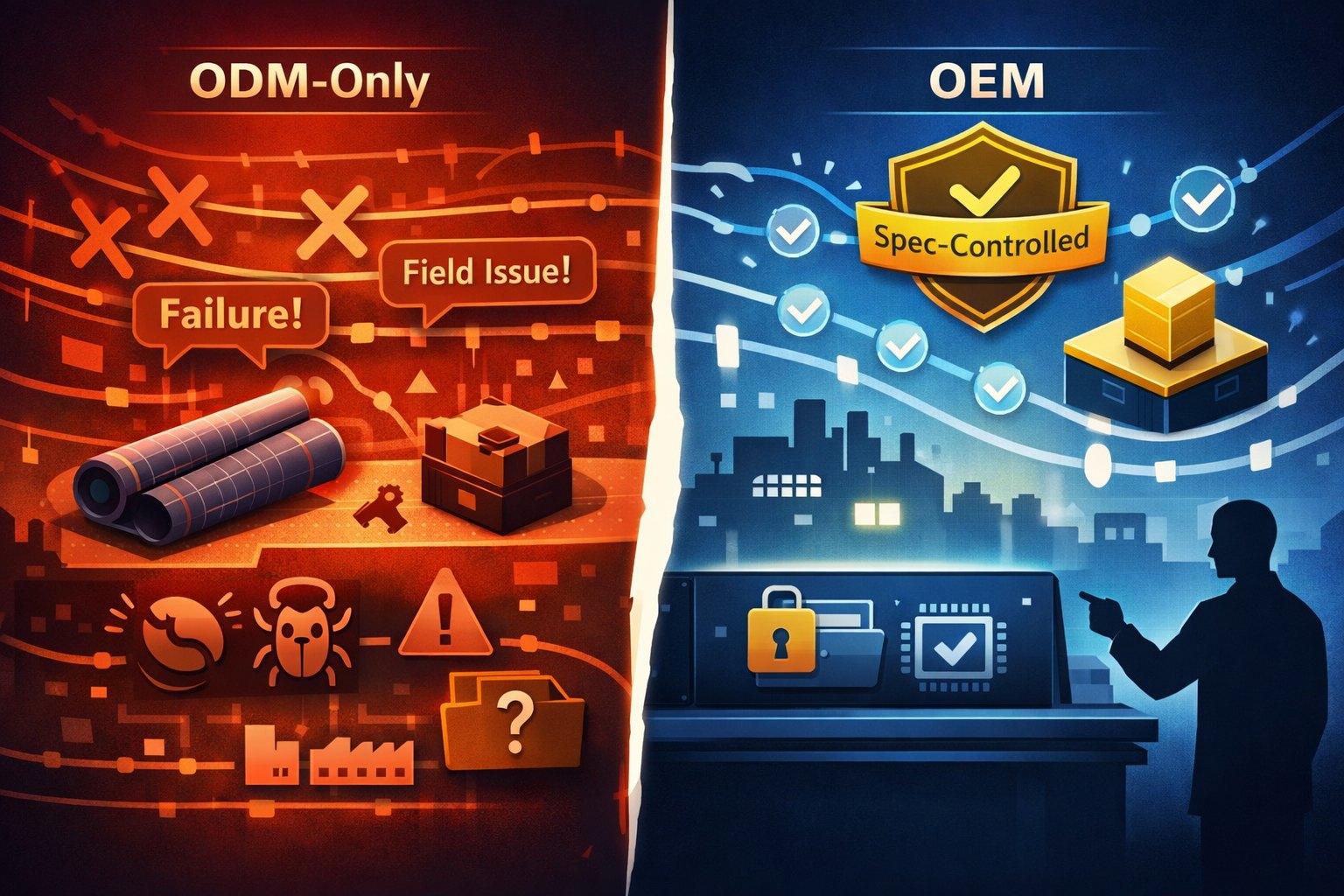
- Quality Governance Matters Either Way: Silent part swaps, weak reference samples, and poor tracking cause field failures regardless of which model you pick.
- Start ODM, Graduate to OEM: Many brands use ODM to test market demand first, then switch to custom designs as their engineering teams mature.
Match your manufacturing model to your actual capabilities, not your ambitions.
Audio product leaders evaluating manufacturing partners will gain clarity on which model fits their current reality, preparing them for the detailed framework that follows.
~ ~ ~ ~ ~ ~ ~ ~ ~ ~ ~ ~ ~ ~ ~ ~ ~ ~ ~ ~ ~ ~ ~ ~ ~ ~ ~ ~ ~ ~ ~ ~ ~ ~ ~ ~ ~ ~ ~ ~ ~ ~ ~ ~ ~ ~ ~ ~ ~ ~ ~
On the surface, choosing a manufacturing model appears to be a binary choice of cost versus control. You need amplifiers for your private-label audio line. A factory will build them. But six months into production, you’re fielding quality issues for units that don’t match your approved samples—and your engineering team can’t access the firmware to diagnose the problem.
This scenario unfolds when product leaders choose a manufacturing model that doesn’t match their internal capabilities or IP strategy. The cost isn’t just defective units. It’s brand erosion, stalled launches, and disputes over who owns what.
The right manufacturing model—OEM or ODM—depends on one question: Do you control the design, or do you need a partner who does?
OEM vs. ODM for Audio: The Core Distinction
OEM (Original Equipment Manufacturer) means you provide the complete design specifications and the manufacturer executes production exactly to your requirements. ODM (Original Design Manufacturer) means the manufacturer provides the design and technology while you customize, brand, and sell the finished product.
According to the Federal Acquisition Regulation (FAR) and related Department of Defense guidance, an Original Equipment Manufacturer (OEM) is specifically defined as an entity that retains the design rights to a product, even if the physical manufacturing is outsourced. Under FAR 52.215-23, an OEM is the entity that ‘designs, develops, and produces’ the item, or has it produced under its design control, to be sold under its own brand. This distinguishes it from a value-added reseller or a pure contract manufacturer. The NIST Computer Security Resource Center (CSRC) identifies an Original Design Manufacturer (ODM) as a vendor that designs and manufactures a product which is eventually rebranded by another firm for sale. Crucially, NIST highlights the supply chain risk inherent in ODM models, noting that the ‘underlying intellectual property and firmware’ typically reside with the manufacturer, necessitating robust third-party risk management (SCRM) protocols (see NIST SP 800-161).
The practical translation for audio leaders: ODM means you’re buying into someone’s existing engineering platform. OEM means you’re directing more of the engineering blueprint—and carrying more decisions and governance responsibility.
In audio manufacturing, this distinction determines who owns the acoustic signature, DSP tuning parameters, mechanical tooling, and the intellectual property rights that protect your competitive position.
| Factor | OEM Model | ODM Model |
|---|---|---|
| Design Ownership | You own core design and IP | Manufacturer owns platform IP |
| Engineering Burden | High (your team validates specs) | Low (partner provides ready designs) |
| Differentiation Potential | Maximum (unique product) | Limited (shared platform base) |
| Time-to-Market | Longer (full NPI cycle) | Faster (existing designs) |
| IP Risk Profile | Lower (you control documentation) | Higher (licensing boundaries apply) |
| Best Fit | Teams with R&D depth, flagship products | Teams prioritizing speed, line extensions |
OEM for Audio Brands: When You Bring the Design
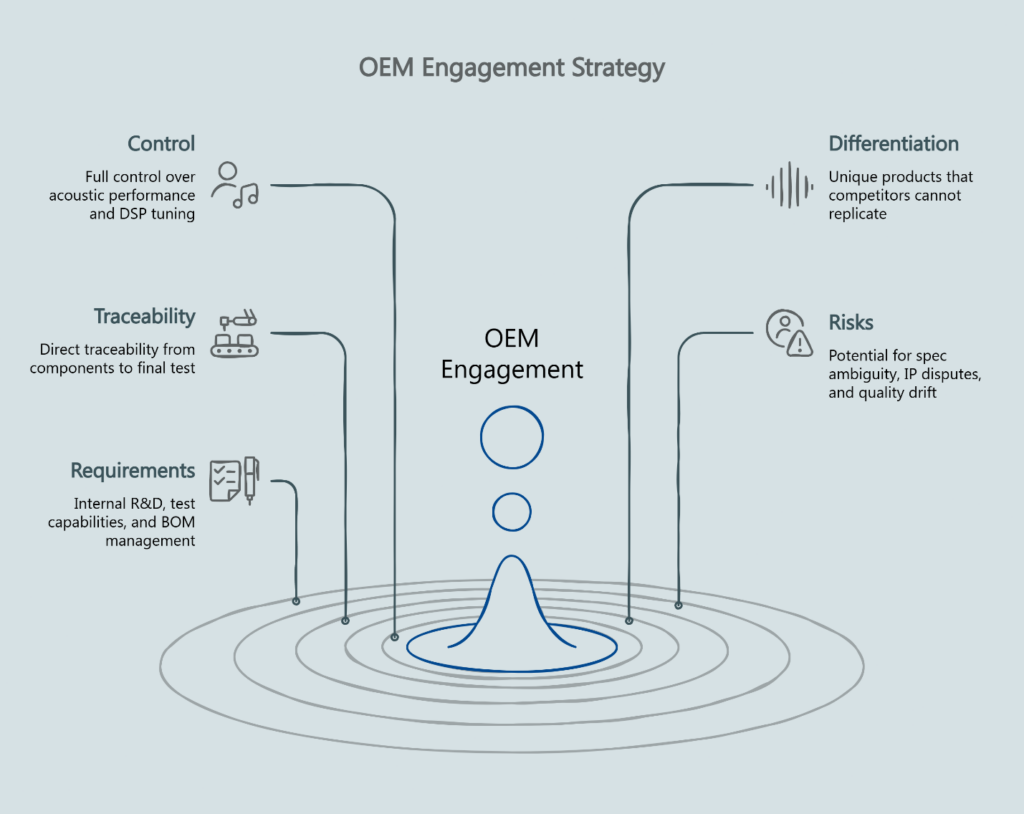
The OEM model suits brands with established engineering capabilities who need manufacturing execution—not product development support.
OEM delivers complete control over acoustic performance specifications, exclusive ownership of DSP tuning and firmware, differentiation that competitors cannot replicate, and direct traceability from component selection through final test.
The risks require active management. Spec ambiguity creates drift between your golden sample and production units. Documentation gaps expose you to IP disputes. NPI timelines depend entirely on your engineering team’s capacity. Quality can drift when process controls aren’t explicit in your requirements.
Your organization is positioned for OEM engagement when you maintain internal R&D resources capable of writing complete performance specifications, have test capability to validate incoming samples against documented requirements, and can manage BOM revision control and engineering change orders across production runs. If your team can answer questions about ECO/ECR ownership, what data you’ll receive at EVT/DVT/PVT milestones, and your escalation path when performance drifts, OEM alignment makes sense.
ODM for Audio Brands: When You Buy and Adapt a Platform
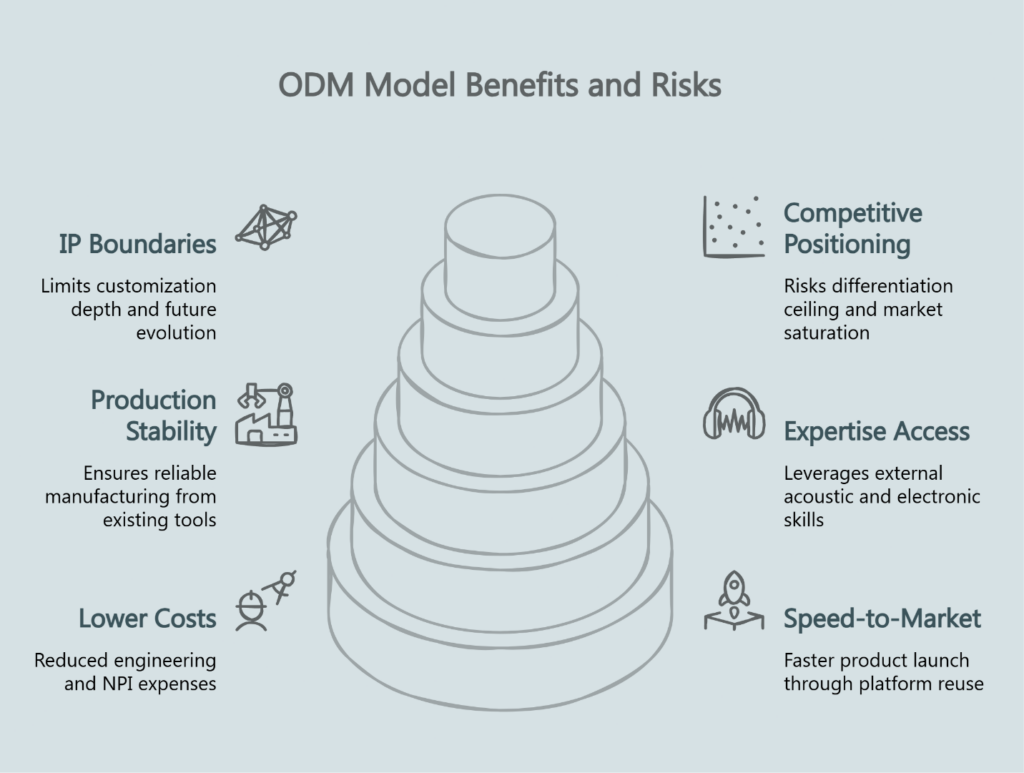
The ODM model serves brands that need proven technology delivered quickly without building internal engineering infrastructure.
ODM compresses time-to-market using validated platform designs, lowers engineering overhead and NPI risk, provides access to acoustic and electronic expertise you don’t employ internally, and delivers proven production stability from existing tooling and processes.
The risks center on competitive positioning. A differentiation ceiling constrains how unique your product can be. IP boundaries limit customization depth. Market saturation occurs when multiple competitors deploy identical platforms, leading to product commoditization. Licensing terms may restrict your future product evolution.
ODM alignment makes strategic sense when speed-to-market outweighs uniqueness requirements, your team lacks deep audio engineering resources, you’re testing market response before investing in custom development, or you’re building entry-level SKUs where platform sharing is acceptable.
IP Ownership in OEM vs. ODM Engagements
IP disputes don’t emerge from unclear intentions. They emerge from unclear documentation.
In audio, your defensible advantage often lives in specific files and decisions: acoustic tuning targets and crossover parameters, DSP presets and EQ curves, firmware source code and calibration utilities, BOM strategy including approved alternates and critical components policy, test limits and fixtures including golden sample thresholds and measurement scripts, and tooling and mechanical CAD where enclosure geometry can itself be a differentiator.
The WIPO IP framework offers a useful distinction here: separate background IP (pre-existing know-how and platforms the manufacturer brings) from foreground IP (assets created specifically for your program), then contract the rights to each explicitly.
What you typically own in OEM engagements: complete design files across acoustic, electronic, and mechanical domains; firmware and DSP code you provided or commissioned; tooling rights (often subject to amortization terms); test specifications and quality acceptance criteria; brand elements, packaging design, and user documentation.
What you typically license or acquire rights to in ODM engagements: access to the manufacturer’s platform design (not ownership); permission to brand and sell the product; limited customization rights within defined parameters; exclusivity arrangements if negotiated and paid for separately.
Contract artifacts that prevent disputes: Regardless of model, protect your position with explicit documentation. Execute non-disclosure agreements before any design sharing. Create detailed Statements of Work with acceptance criteria. Maintain controlled engineering drawings with revision tracking. Document complete BOMs with approved vendor lists. Establish firmware version control with change logs. Specify test parameters with pass/fail limits.
If you choose ODM, explicitly define what customization means—cosmetic versus acoustic versus firmware—and what deliverables you receive, whether the deliverables comprise compiled binaries or editable source code. If you choose OEM, don’t assume you own the design because you paid NRE. Ownership must be assigned and documented in writing.
For deeper guidance on protecting your designs, explore key intellectual property considerations for OEM manufacturing.
Quality Governance: Building Your Manufacturing Firewall
Think of governance as your manufacturing firewall: it blocks uncontrolled change from becoming field failures and brand damage.
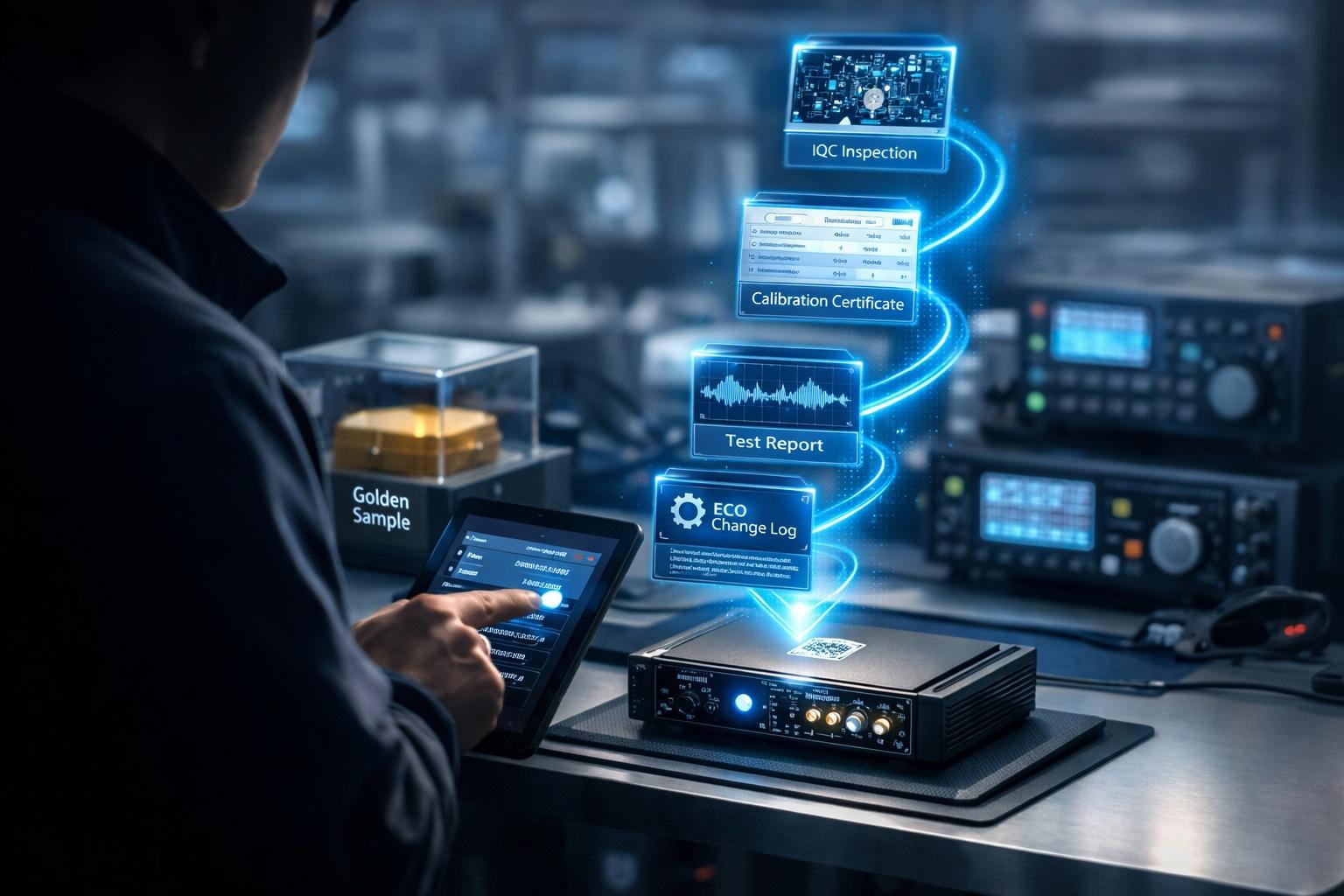
Whether OEM or ODM, quality failures typically stem from four sources: silent component substitutions made without your approval, weak golden-sample discipline that allows drift from your approved reference, poor traceability that prevents you from isolating bad lots quickly, and no closed-loop root cause process connecting field issues back to engineering.
When you evaluate a partner, ask for evidence of ISO 9001-style QA systems with documented IQC, IPQC, and FQC gates. Confirm barcode or QR traceability tied to batches and lots. Review reliability capability including thermal testing, vibration testing, and burn-in where relevant. Verify that the facility utilizes calibrated electro-acoustic measurement systems—such as Klippel R&D/QC Analyzers for transducer integrity and Audio Precision (APx series) for electronic signal analysis. These tools are essential for maintaining Statistical Process Control (SPC). Under ISO 9001:2015 Clause 7.1.5, the manufacturer must provide evidence that these monitoring and measuring resources are fit for purpose and traceably calibrated to ensure ‘Golden Sample’ consistency across high-volume runs.
This governance matters across categories—whether you’re building amplifiers, pro audio equipment, or car audio programs.
OEM vs. ODM Decision Framework
Use this framework to determine which model fits your current situation.
Start with your engineering reality:
Do you have in-house capability to write complete acoustic, electronic, and mechanical specifications? If no, ODM is likely your better path. If yes, continue.
Is product differentiation—acoustic signature, proprietary DSP, unique industrial design—a core competitive requirement? If no, ODM may deliver faster results. If yes, continue.
Can your team manage documentation control, engineering changes, and validation testing across production runs? If no, consider ODM until internal processes mature. If yes, OEM aligns with your capabilities.
Is speed-to-market the priority over product uniqueness? If yes, ODM delivers faster launches. If no, OEM protects long-term differentiation.
The hybrid path: Many brands evolve from ODM to OEM as their capabilities mature. Starting with an ODM platform validates market demand while you build the engineering infrastructure for future custom development. Strategic contracting ensures the retention of critical assets—such as EQ presets and validation scripts—requisite for future independent development.
If you’re exploring existing platforms and customization starting points, visit the catalog.
Implementation Roadmap After Choosing Your Model
Once you’ve selected your model, these governance steps protect your launch.
Alignment: Define scope, success metrics, and quality gates before engaging procurement. Establish who owns product requirements and acceptance criteria, who controls ECO/ECR and approves substitutions, and what the escalation path looks like when performance drifts.
IP documentation: Execute NDAs, confirm ownership terms for both background and foreground IP, and establish revision control protocols.
Pilot validation: Approve golden samples with documented test data before production authorization. Specify what data you’ll receive at EVT, DVT, and PVT milestones.
Quality requirements: Specify traceability expectations—lot-level, unit-level, or component-level—and confirm the partner’s containment capability.
Ramp readiness: Establish production exit criteria and containment escalation procedures before SOP.
The Business Case: Why Model Choice Reduces Risk
The manufacturing model decision isn’t about unit cost. It’s about total cost of quality—field failure risk, rework cycles, launch delays, and brand damage from performance issues.
OEM requires higher upfront engineering investment but delivers maximum differentiation and IP control. ODM compresses timelines and reduces engineering overhead but constrains your competitive ceiling.
The wrong choice creates friction at every stage: spec disputes during development, quality drift during ramp, and IP conflicts when you want to evolve the product.
The right choice matches your internal reality—engineering depth, documentation maturity, differentiation strategy—to a manufacturing partner equipped to execute that model successfully.
China Future Sound supports both OEM and ODM approaches, providing flexibility for brands at different stages of capability development. Whether you’re bringing a complete design package or seeking a proven platform to customize, our engineering team and quality infrastructure—including ISO 9001:2015 certification, KLIPPEL testing, and unit-level barcode traceability—deliver the consistency your brand reputation requires.
FAQ: OEM vs. ODM Questions Audio Product Leaders Ask
Is ODM just white-label manufacturing?
Not exactly. White-label typically means taking an existing product with minimal changes. ODM relationships often include meaningful customization—power output levels, cosmetic finishes, acoustic tuning within platform constraints—while the core design remains the manufacturer’s IP. “Private label” describes branding; ODM describes who owns the underlying design capability.
Can I start with ODM then move to OEM?
Yes, and many brands follow this evolution. ODM validates market demand with lower risk. As your engineering capabilities and market position mature, transitioning to OEM captures the differentiation benefits of proprietary design. Structure early contracts so you can retain the assets you’ll need later.
Does OEM automatically mean I own the design IP?
No. OEM describes the manufacturing role; IP ownership depends entirely on your contracts and clear delineation of background versus foreground assets.
How do I prevent my design from being reused by competitors?
Clear IP documentation is your primary protection. In OEM engagements, your drawings and specifications should be explicitly marked as confidential with contractual restrictions on reuse. In ODM arrangements, negotiate exclusivity terms if you need protection—and understand that the platform itself remains the manufacturer’s asset.
What should I ask to vet OEM vs. ODM partners for quality?
Ask for the governance artifacts: change control procedures, traceability systems, golden sample process, reliability testing approach, and what instrumentation and data you can review. Evidence of these systems matters more than equipment lists.
Our Editorial Process
Our expert team uses AI to research and structure our initial drafts. Every piece is then extensively rewritten, fact-checked, and enriched with first-hand insights and experiences by expert humans on our Insights Team to ensure accuracy and clarity.
About the China Future Sound Insights Team
The China Future Sound Insights Team is our dedicated engine for synthesizing complex topics into clear, helpful guides. While our content is thoroughly reviewed for clarity and accuracy, it is for informational purposes and should not replace professional advice.