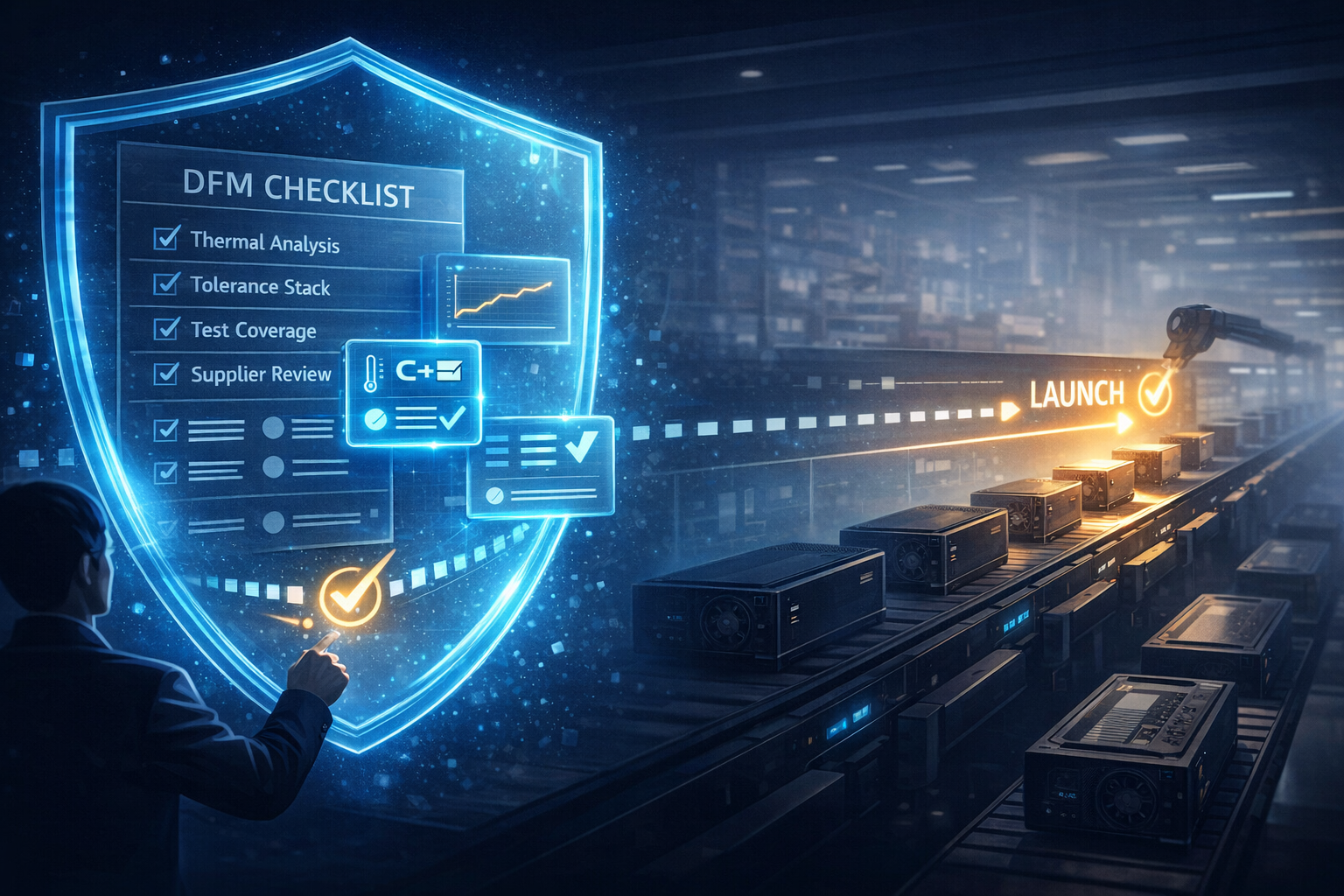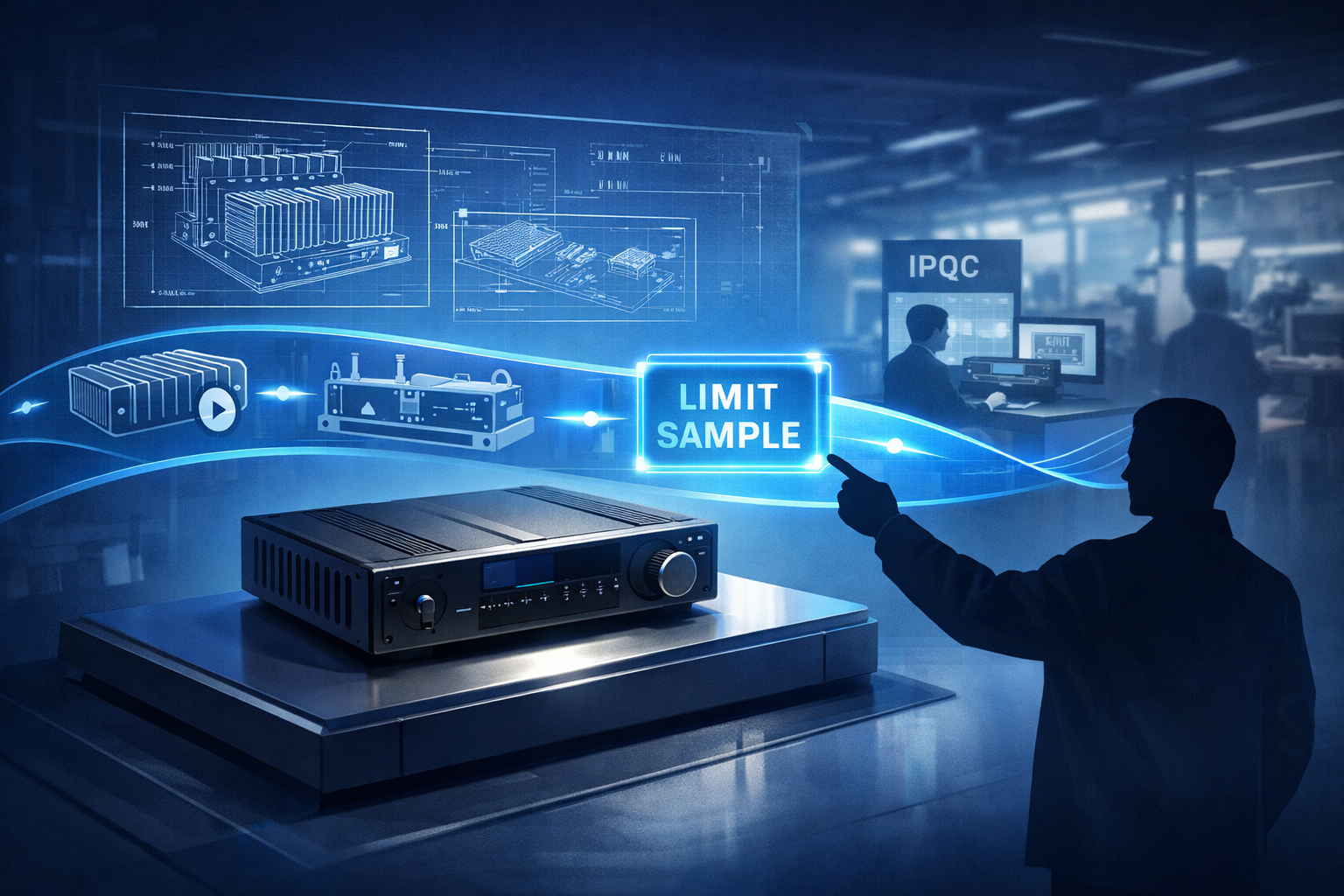
📌 Key Takeaways
Custom Drivers Create Defensible Brand Assets: Off-the-shelf components force brands into sonic homogenization, where multiple companies produce virtually indistinguishable products using identical drivers. Custom development transforms audio components from commoditized parts into proprietary brand assets that competitors cannot replicate, enabling premium positioning and customer loyalty.
Signature Sound Requires Engineering Precision: True brand differentiation emerges from translating subjective sound preferences into measurable technical specifications. Material choices—from Ferrite vs. Neodymium magnets to diaphragm materials—directly impact sonic characteristics and must align with target frequency response goals from day one of development.
Five-Stage Framework Ensures Project Success: Successful custom driver projects follow a structured approach: collaborative design and specification, material sourcing and component vetting, digital prototyping with FEM simulation, physical prototyping and performance testing, and assessing scalable production capabilities. Each stage includes critical vetting questions for evaluating OEM partners.
Production Scalability Trumps Prototype Performance: The most common pitfalls include under-specifying performance goals, ignoring production scalability requirements, and choosing partners based solely on price. Manufacturing capacity, quality control procedures, and supply chain reliability often determine long-term success more than initial prototype results.
Strategic Investment Builds Long-Term Competitive Advantage: Custom driver partnerships can reduce supply chain risk by eliminating dependence on commodity components subject to third-party allocation decisions. This approach positions brands for sustained market differentiation as the industry continues consolidating around fewer major suppliers.
The complete framework provides specific vetting questions, technical considerations, and risk mitigation strategies that transform custom driver development from a complex challenge into a manageable competitive advantage.
In today’s saturated pro audio market, brand manufacturers face an uncomfortable truth: choosing the same off-the-shelf drivers as your competitors guarantees you’ll sound like them too. The temptation is understandable—stock components promise faster time-to-market and lower upfront costs. But this apparent shortcut creates a deeper strategic trap that undermines long-term brand value and market positioning.
The path to true differentiation lies in custom driver development. Rather than accepting generic sonic characteristics, forward-thinking brands are partnering with experienced OEM manufacturers to engineer their signature sound from the ground up. This approach transforms audio components from commoditized parts into proprietary brand assets that competitors simply cannot replicate.
Table of Contents
- The Sea of Sameness: How Stock Drivers Dilute Your Pro Audio Brand
- Beyond the Catalog: Defining Your “Signature Sound” as a Technical Specification
- The Custom Driver Development & OEM Vetting Framework
- Common Pitfalls to Avoid When Commissioning Custom Drivers
- What If…? Planning for Supply Chain Delays
- Your Sound, Your Asset: Building a Defensible Brand
The Sea of Sameness: How Stock Drivers Dilute Your Pro Audio Brand
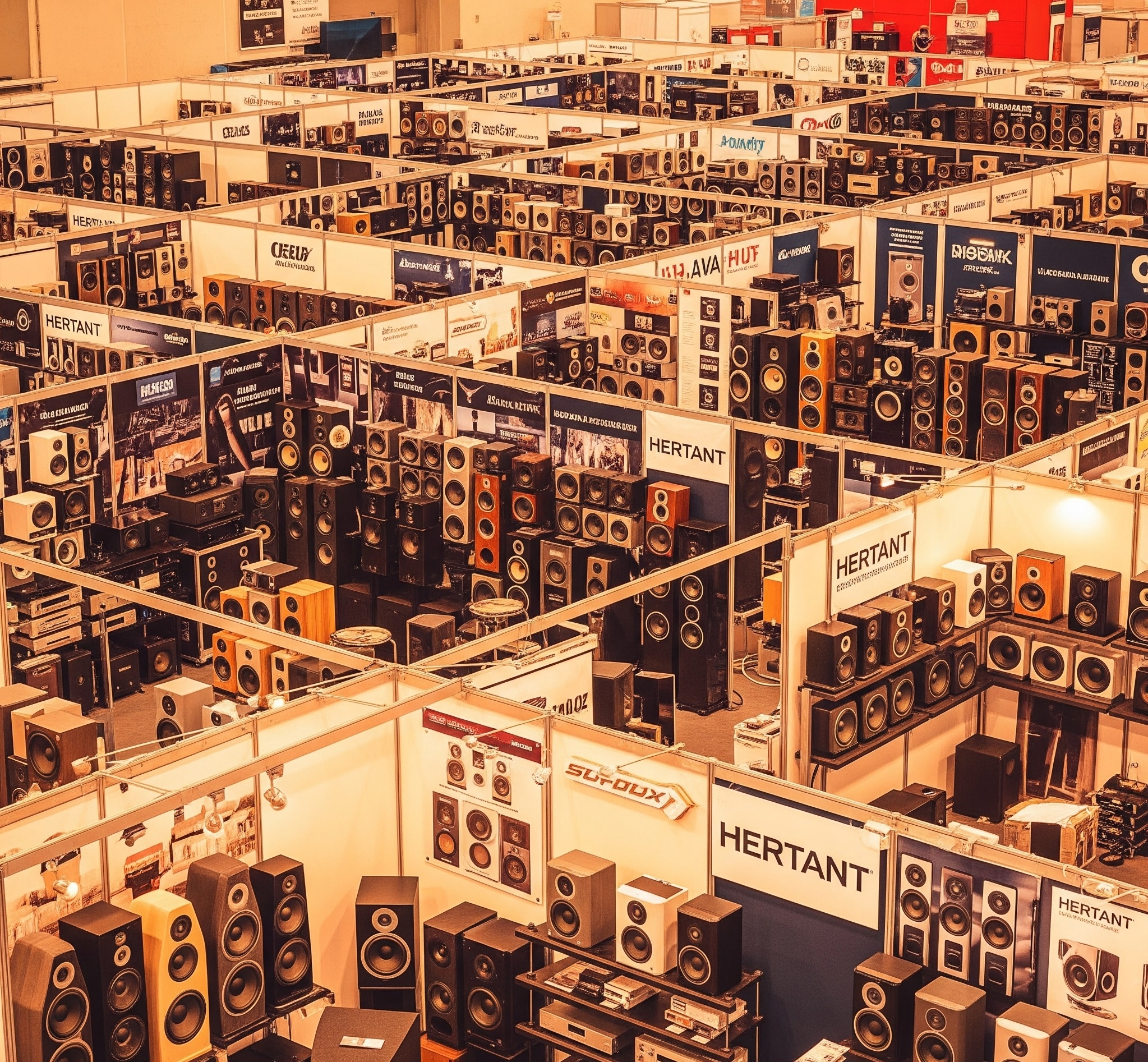
Walk through any major trade show and you’ll encounter a troubling phenomenon: dozens of “different” brands producing remarkably similar-sounding products. The culprit isn’t poor engineering—it’s the widespread reliance on identical off-the-shelf drivers sourced from the same handful of suppliers.
When multiple brands use the same driver components with identical specifications, the resulting frequency response curves become virtually indistinguishable. This sonic homogenization forces companies to compete primarily on price, potentially eroding margins and reducing their products to commodities. The engineering team achieves acceptable performance specifications, but the brand loses its most valuable differentiator: a unique sound that customers can recognize and prefer.
Consider the potential downstream effects of this approach. Marketing teams may struggle to articulate what makes their speakers special beyond aesthetic differences. Sales teams might resort to discounting to close deals. Most critically, customers develop no emotional attachment to a particular sound signature—they’ll readily switch to competitors offering similar performance at lower prices.
Myth & Fact
Myth: Choosing an off-the-shelf driver is the fastest and most cost-effective way to get a product to market.
Fact: While initially faster, relying on stock drivers can lead to price erosion, lack of differentiation, and higher long-term brand risk. A custom approach builds a defensible asset.
Business Impact
From a strategic perspective, the “off-the-shelf trap” can create several business consequences that finance teams should consider carefully. First, it may eliminate pricing power—when your product sounds similar to competitors’, price often becomes the primary differentiator. Second, it can increase customer acquisition costs because you cannot rely on word-of-mouth recommendations based on unique sonic characteristics. Third, it creates potential vulnerability to supply chain disruptions, as you have limited control over component availability or supplier relationships.
The hidden cost extends beyond immediate margins. Brands using generic components may struggle to build the customer loyalty that enables premium positioning and sustainable growth. Without a distinctive sound signature, even exceptional build quality and service can become insufficient to command market-leading prices.
Beyond the Catalog: Defining Your “Signature Sound” as a Technical Specification
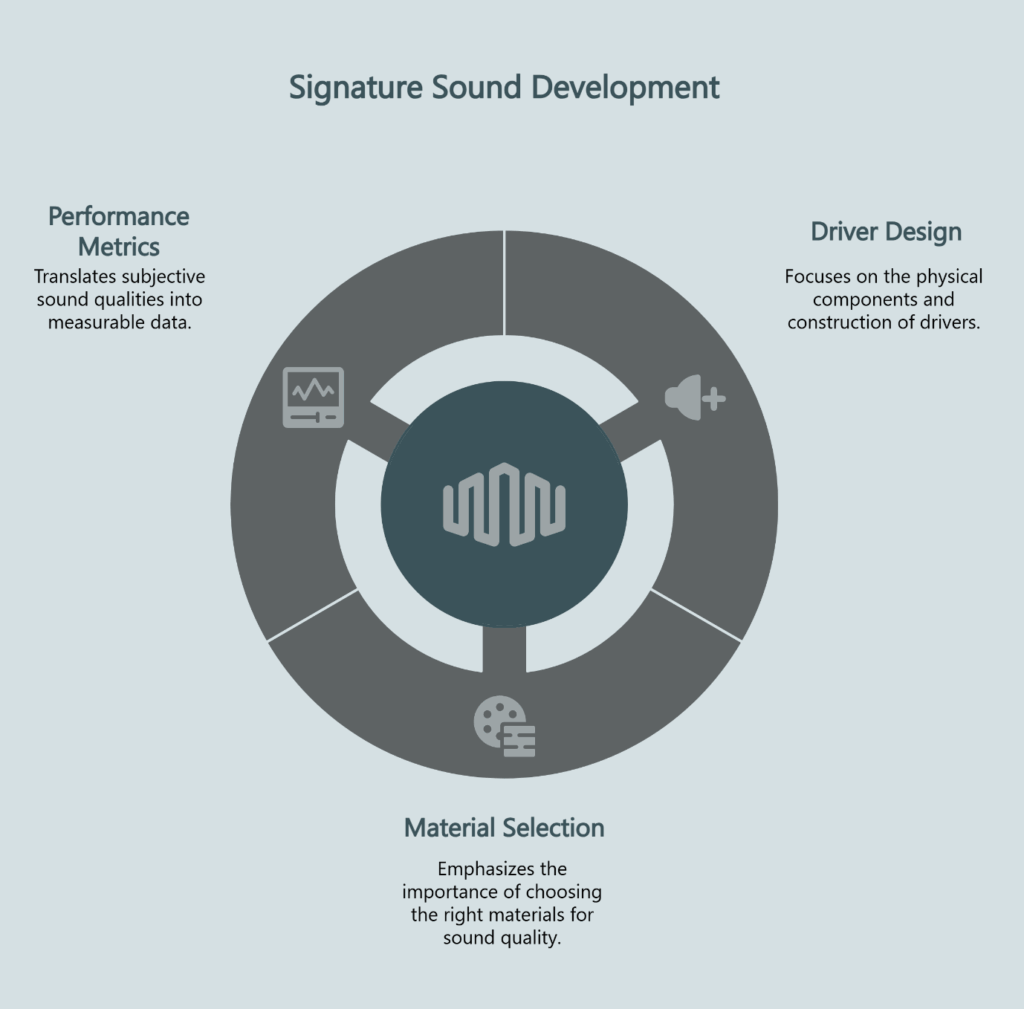
The concept of “signature sound” often gets dismissed as marketing hyperbole, but it represents something far more concrete: a repeatable set of measurable performance characteristics that create a consistent listening experience across your product line. Professional audio brands with lasting market presence understand that signature sound functions as both an engineering specification and a business asset.
True signature sound emerges from deliberate choices in driver design—decisions that stock components cannot accommodate. These choices begin with fundamental questions about your brand’s sonic identity. Do you prioritize precise midrange reproduction for vocal clarity? Does your target application demand exceptional low-frequency extension? Will your drivers operate in high-SPL environments where power handling becomes critical?
The engineering process transforms these brand positioning decisions into specific technical requirements. According to the China Future Sound development framework, the most critical factor is aligning material selection with the target frequency response from day one.
Translating Brand Adjectives into Measurable Performance Metrics like Sound Pressure Level (SPL)
Marketing teams often describe desired sound characteristics using subjective terms: “warm,” “crisp,” “punchy,” or “smooth.” Custom driver development requires translating these brand adjectives into precise engineering specifications that manufacturing teams can execute consistently.
These subjective preferences typically correlate with measurable acoustic characteristics. “Warm” might suggest emphasis in certain frequency ranges, while “crisp” could indicate extended high-frequency response with controlled distortion. These preferences directly influence material selection and motor design decisions, though the exact correlations depend on specific applications and listener preferences.
Technical Note
When specifying custom drivers, consider how material choices can impact your signature sound goals. Different magnet types (such as Ferrite vs. Neodymium) typically provide different characteristics, while various diaphragm materials offer different performance attributes. FEM simulation allows engineers to predict these differences before physical prototyping, potentially reducing development time and ensuring the final driver matches your specifications.
The Role of Driver Components: How Ferrite vs. Neodymium Magnets and Diaphragm Materials Shape Your Sound
The magnetic motor system forms the heart of any dynamic driver, and the choice between different magnet types creates measurable differences in both performance and character. Ferrite magnets, while heavier, often provide different characteristics due to their magnetic properties. Neodymium motors typically achieve higher efficiency and allow for more compact designs—important considerations for applications where size and weight matter.
Diaphragm materials contribute equally important sonic signatures. Different cone materials deliver varying midrange characteristics, while various metal diaphragms provide different high-frequency response patterns. These aren’t simply technical specifications—they’re the building blocks of your brand’s sonic identity.
Voice coil design also impacts character significantly. Different wire types and construction methods affect both thermal performance and electrical characteristics, influencing power handling and transient response. When combined with specific former materials and winding techniques, these choices create differences that contribute to your signature sound.
The Custom Driver Development & OEM Vetting Framework
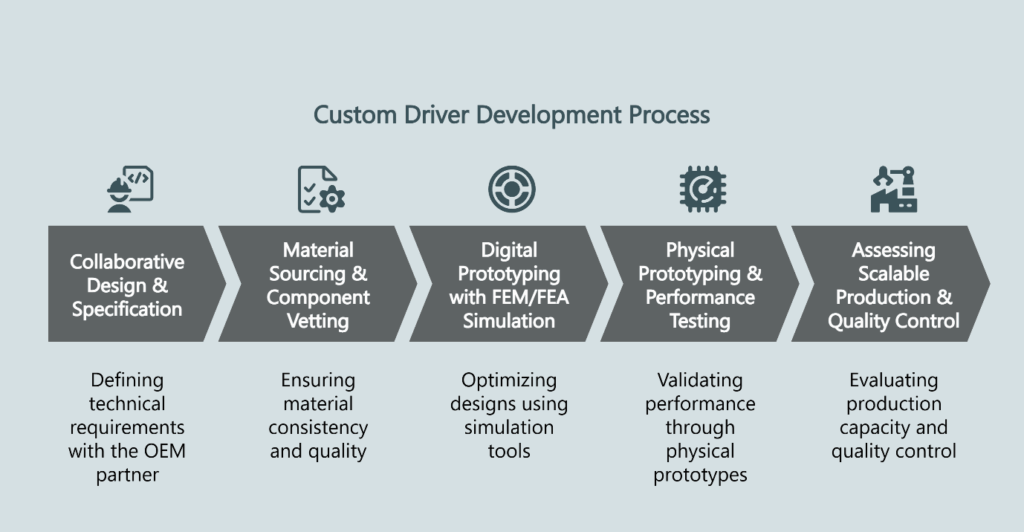
Successful custom driver projects require a structured approach that balances technical requirements with business realities. This framework provides the essential stages and key evaluation criteria for selecting and working with an OEM development partner.
“Your brand’s signature sound is engineered, not discovered. The right development partner becomes the custodian of that engineering precision.”
Stage 1: Collaborative Design & Specification
Key Questions for Your OEM Partner:
- How do you translate subjective sound preferences into measurable engineering specifications?
- What simulation tools do you use to predict performance before prototyping?
- Can you provide examples of frequency response modifications you’ve achieved for similar applications?
- How do you ensure consistency between digital models and physical prototypes?
The specification phase often determines project success more than any subsequent stage. Experienced OEM partners will guide you through translating your brand’s sonic goals into specific technical requirements: target frequency response curves, maximum SPL capabilities, distortion limits, and impedance characteristics.
Expect your development partner to ask detailed questions about your intended applications. Professional monitoring requires different optimization than high-SPL live sound reinforcement. Studio applications prioritize accuracy and low distortion, while touring systems demand maximum reliability and power handling. These application requirements directly influence material selection and motor design approaches.
Stage 2: Material Sourcing & Component Vetting
Key Questions for Your OEM Partner:
- What is your supply chain for critical materials like voice coil wire and magnet assemblies?
- How do you ensure consistent material properties across production runs?
- Can you provide traceability documentation for key components?
- What backup suppliers do you maintain for critical materials?
Material consistency directly impacts the repeatability of your signature sound. Professional OEM partners typically maintain relationships with verified suppliers and implement incoming inspection procedures to ensure component specifications remain within tolerance. This becomes particularly important for voice coil wire, magnet materials, and cone substrates where variations can potentially affect performance.
Day-to-Day Application
Working with a qualified custom driver partner can simplify your supply chain management compared to sourcing multiple off-the-shelf components from different suppliers. Instead of vetting and coordinating with separate magnet suppliers, cone manufacturers, and assembly facilities, you establish a single relationship with an OEM partner who manages these relationships internally. This consolidation may reduce procurement complexity and provides a single point of accountability for quality and delivery.
Stage 3: Digital Prototyping with FEM/FEA Simulation
Key Questions for Your OEM Partner:
- What finite element modeling software do you use for motor optimization?
- Can you show examples of simulation predictions vs. measured results from previous projects?
- How do you optimize magnetic circuit design for your specific requirements?
- What acoustic modeling tools do you use to predict system-level performance?
Modern driver development often relies on finite element modeling (FEM) to optimize magnetic circuits before physical prototyping. This simulation approach allows engineers to predict flux density distribution, minimize potential distortion-causing nonlinearities, and optimize motor efficiency. Experienced partners can demonstrate correlation between their simulation predictions and measured prototype performance.
FEM simulation becomes particularly valuable for optimizing designs where material costs make iterative physical prototyping expensive. The simulation process also enables optimization of mechanical parameters like suspension compliance and resonant frequency to achieve your target performance specifications.
Stage 4: Physical Prototyping & Performance Testing
Key Questions for Your OEM Partner:
- What measurement equipment do you use for driver characterization?
- How many prototype iterations do you typically require to meet specifications?
- Can you provide complete parameter measurements for your prototypes?
- What listening evaluation process do you use to validate subjective performance?
Physical prototyping validates the simulation work and provides the first opportunity to evaluate your signature sound in practice. Professional OEM partners use calibrated measurement equipment to characterize prototypes thoroughly, providing detailed frequency response, impedance, and distortion measurements.
The prototyping stage also reveals mechanical characteristics that simulation cannot fully predict. Voice coil behavior under high power conditions, suspension linearity across the full excursion range, and thermal power handling require physical validation. Multiple prototype iterations are typically necessary as the design converges on your specifications.
Stage 5: Assessing Scalable Production & Quality Control
Key Questions for Your OEM Partner:
- What is your daily production capacity for custom drivers?
- How do you maintain consistency between prototype and production units?
- What quality control procedures do you implement during manufacturing?
- Can you provide evidence of your facility’s testing capabilities and certifications?
Production scalability often determines long-term project success more than initial prototype performance. Evaluate your partner’s manufacturing capacity carefully—facilities with substantial daily production capabilities provide the scale necessary for serious market commitments. Geographic location can also impact delivery logistics and shipping efficiency.
Quality control procedures become critical when transitioning from prototypes to production. Look for partners with established testing protocols, experienced technical staff, and certified testing capabilities that ensure production units meet your specifications consistently.
Common Pitfalls to Avoid When Commissioning Custom Drivers
Learning from others’ mistakes can accelerate your development timeline and prevent costly missteps. These common pitfalls can potentially derail otherwise promising custom driver projects.
Pitfall 1: Under-specifying Performance Goals
A frequent development challenge occurs when brands provide vague performance targets rather than specific, measurable requirements. Requesting a driver that sounds “better” or “more musical” gives your OEM partner insufficient guidance for making concrete design decisions.
Successful projects typically begin with detailed specifications: target frequency response curves with specific tolerance bands, maximum SPL requirements, impedance characteristics, and physical size constraints. Include information about your intended applications, amplifier compatibility requirements, and any regulatory compliance needs. More specific requirements generally enable your partner to engineer a more accurate solution.
Pitfall 2: Ignoring Production Scalability
Some brands focus exclusively on prototype performance without considering manufacturing requirements for their projected volumes. A driver design that works well in small quantities may prove impractical or cost-prohibitive at production scale.
Discuss volume projections honestly with your OEM partner from the beginning. Manufacturing processes that work for hundreds of units annually may require significant modification for thousands of units monthly. Consider both initial launch volumes and growth projections—choosing a partner without adequate capacity could force expensive supplier transitions later.
Pitfall 3: Choosing a Partner Based on Price Alone
Custom driver development represents a strategic investment in your brand’s future, not simply a procurement exercise focused on minimizing unit costs. The lowest-cost partner may not provide the technical expertise, quality control, or supply chain reliability necessary for long-term success.
Evaluate potential partners based on their technical capabilities, production capacity, quality systems, and track record with similar projects. The right partner becomes a custodian of your brand’s reputation, making their reliability and expertise potentially more valuable than modest cost savings.
What If…? Planning for Supply Chain Delays
Supply chain disruptions have become an unfortunate reality in global manufacturing, and professional brands rightfully worry about their impact on custom driver projects. While no one can eliminate supply chain risk entirely, working with an experienced OEM partner may reduce your exposure compared to managing multiple supplier relationships independently.
The concern about delays is legitimate and deserves proactive planning. However, established manufacturers with substantial capacity and multiple supplier relationships often weather disruptions better than smaller operations. Facilities with diversified supply chains and local supplier networks—particularly those located near major shipping hubs—may maintain more reliable delivery schedules.
Build contingency planning into your product launch timeline from the beginning. Allow additional lead time for initial production runs, and consider maintaining safety stock of critical drivers for your most important product lines. Your OEM partner should provide regular supply chain updates and early warning of potential delays.
A key insight many brands miss: custom driver partnerships can actually reduce supply chain risk over time by eliminating dependence on commodity components subject to allocation and end-of-life decisions by third-party suppliers. Your custom drivers become a controlled asset rather than a variable dependent on external supplier priorities.
Your Sound, Your Asset: Building a Defensible Brand
The choice between off-the-shelf and custom driver development ultimately determines whether your brand builds a defensible market position or remains perpetually vulnerable to price competition. Custom development requires higher initial investment and longer development timelines, but it creates something competitors cannot replicate: a proprietary sonic signature that becomes synonymous with your brand.
This strategic advantage compounds over time. Customers may develop preferences for your particular sound characteristics, creating loyalty that transcends simple feature comparisons. Your sales team can articulate clear differentiation beyond price. Your engineering team can optimize entire product lines around consistent sonic goals rather than adapting to whatever components happen to be available.
The most successful pro audio brands understand that signature sound functions as intellectual property. Just as software companies protect their code and pharmaceutical companies patent their formulations, audio brands must protect their sonic identity through custom engineering partnerships that create proprietary assets rather than assembled commodities.
Consider the broader market context as well. As the industry continues evolving, access to truly differentiating off-the-shelf components may become increasingly limited. Brands that establish custom development capabilities today position themselves to maintain independence and differentiation as market conditions evolve.
For brands planning the next 3-5 years, custom driver development represents more than a technical decision—it’s a strategic investment in market positioning that may enable premium pricing, customer loyalty, and long-term competitive advantage. The knowledge and relationships developed through custom engineering projects become foundational assets for future product development and market expansion.
Ready to develop your signature sound? Request a custom OEM quote from our engineering team today.
Our Editorial Process
This guide was drafted with AI assistance and has been reviewed, fact-checked, and edited by the expert humans on our Insights Team to ensure accuracy and clarity.
By the ChinaFutureSound.com Insights Team
The ChinaFutureSound.com Insights Team is our dedicated engine for synthesizing complex topics into clear, helpful guides. While our content is thoroughly reviewed for clarity and accuracy, it is for informational purposes and should not replace professional advice.