📌 Key Takeaways
IP protection in private label audio manufacturing operates as an operational control system, not primarily a legal exercise.
- Operations Trump Contracts: File custody, change approval processes, and golden sample discipline prevent IP leakage more effectively than aggressive legal terms alone.
- Trademark Rights Are Territorial: U.S. trademark registration does not protect your brand in China; first-to-file jurisdictions require early local registration to prevent squatting.
- Define Platform Boundaries Early: Mapping which elements are factory platform assets versus your custom contributions prevents ownership disputes and focuses protection on true differentiators.
- Tooling Payment Doesn’t Equal Ownership: Custom tooling ownership, design ownership, and derivative work rights must be separately specified in manufacturing agreements to prevent ambiguity.
- Golden Samples Function Dual-Purpose: A signed specification package with physical reference sample simultaneously enforces quality consistency and proves your distinctive design elements for IP claims.
Clarity on ownership boundaries plus disciplined execution equals defensible differentiation.
Private label audio brand founders manufacturing offshore will gain immediate risk-reduction strategies here, preparing them for the implementation framework that follows.
~ ~ ~ ~ ~ ~ ~ ~ ~ ~ ~ ~ ~ ~ ~ ~ ~ ~
You’re a few months into a private label program. Samples look good, margins work, your customers trust you. Then a competitor launches something that feels… familiar. Same silhouette. Similar grille pattern. Even the packaging cues look close.
That copycat fear hits hard. What stops the factory from selling your design to someone else? If you invest in custom tooling, do you actually own it? And what about that carefully tuned DSP profile your engineer spent weeks perfecting?
These aren’t abstract legal questions—they’re the practical boundaries that separate a defensible brand from an expensive mistake. In private label audio, IP protection works best as a risk-control system: clear ownership terms, controlled file access, and disciplined change management built from operational habits, not courtroom tactics. This guide breaks down what you actually need to protect, what the factory typically owns, and the practical safeguards you can implement this week.
The Operational Definition of IP in Audio
Intellectual property sounds like a courtroom concept, but for private label brands, it’s simply the framework for answering one question: who controls what?
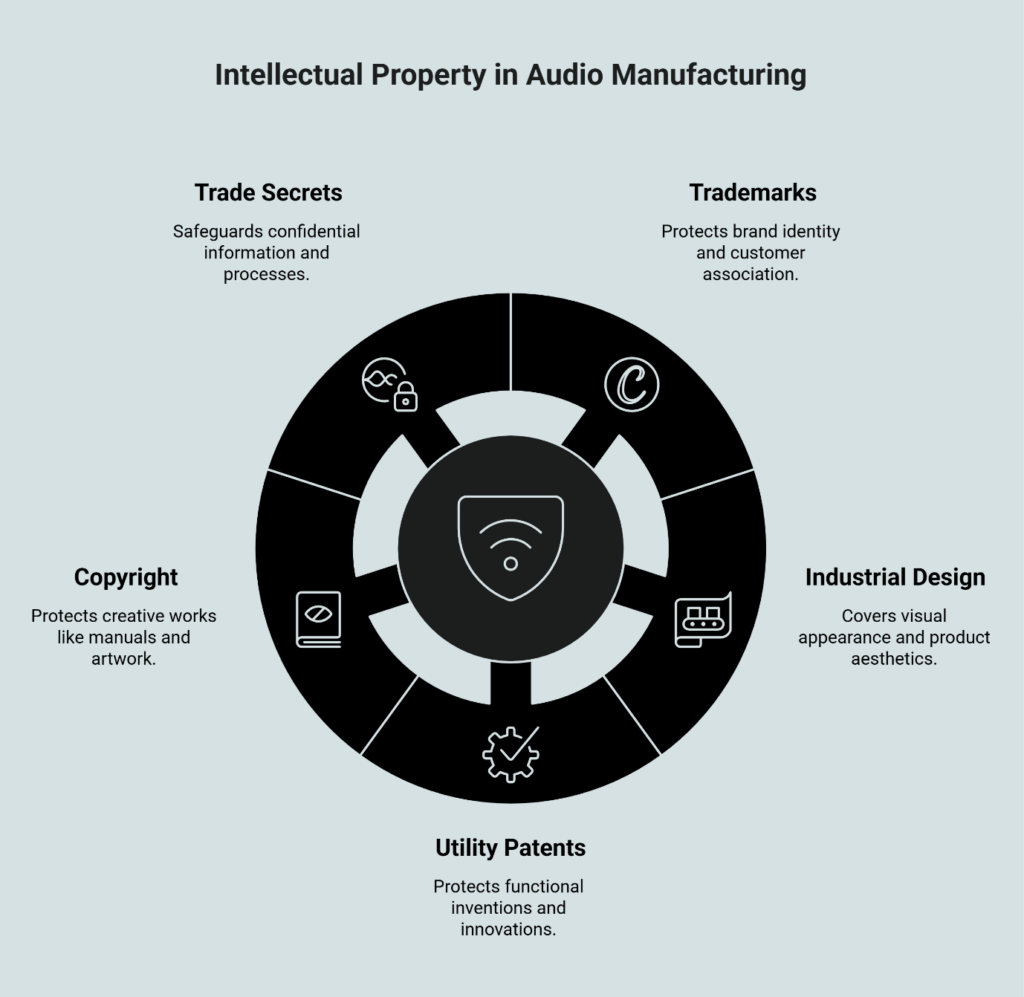
Trademarks protect your brand identity—your company name, logo, and any distinctive marks that customers associate with you. However, trademark rights are territorial. While you likely own your brand in your home market (e.g., the U.S.), you generally do not own it in the country of manufacture unless explicitly registered there. In ‘first-to-file’ jurisdictions like China, early registration is critical to prevent trademark squatting.
Industrial design protection covers the visual appearance of your product—the shape of the enclosure, the grill pattern, the control layout. Terminology varies by region: the United States uses ‘Design Patents’ to protect ornamental designs, while the EU and UK utilize ‘Design Rights’ (Registered Community Designs). Additionally, ‘Trade Dress’ can protect distinctive product appearances that consumers recognize as indicating source, provided they have acquired secondary meaning.
Utility patents protect functional inventions. In audio, this might apply to a novel driver configuration or a unique porting design, though most private label products use existing platform technologies rather than patentable innovations.
Copyright protects creative works like user manuals, packaging artwork, and marketing materials. Under the Berne Convention, this protection is technically automatic when the work is created. However, in practice—especially in China—recordal of copyright with local authorities (e.g., the CPCC) is often necessary to effectively enforce these rights or conduct takedowns.
Trade secrets are perhaps the most relevant for private label operations. These include anything you keep confidential: DSP tuning profiles, supplier lists, manufacturing process details, and custom engineering specifications.
The real challenge isn’t understanding these categories—it’s knowing which assets you control in a typical OEM arrangement and how to maintain that control through contracts and operational discipline.
Deconstructing Common IP Assumptions
Myth → “My Logo Protects My Product”
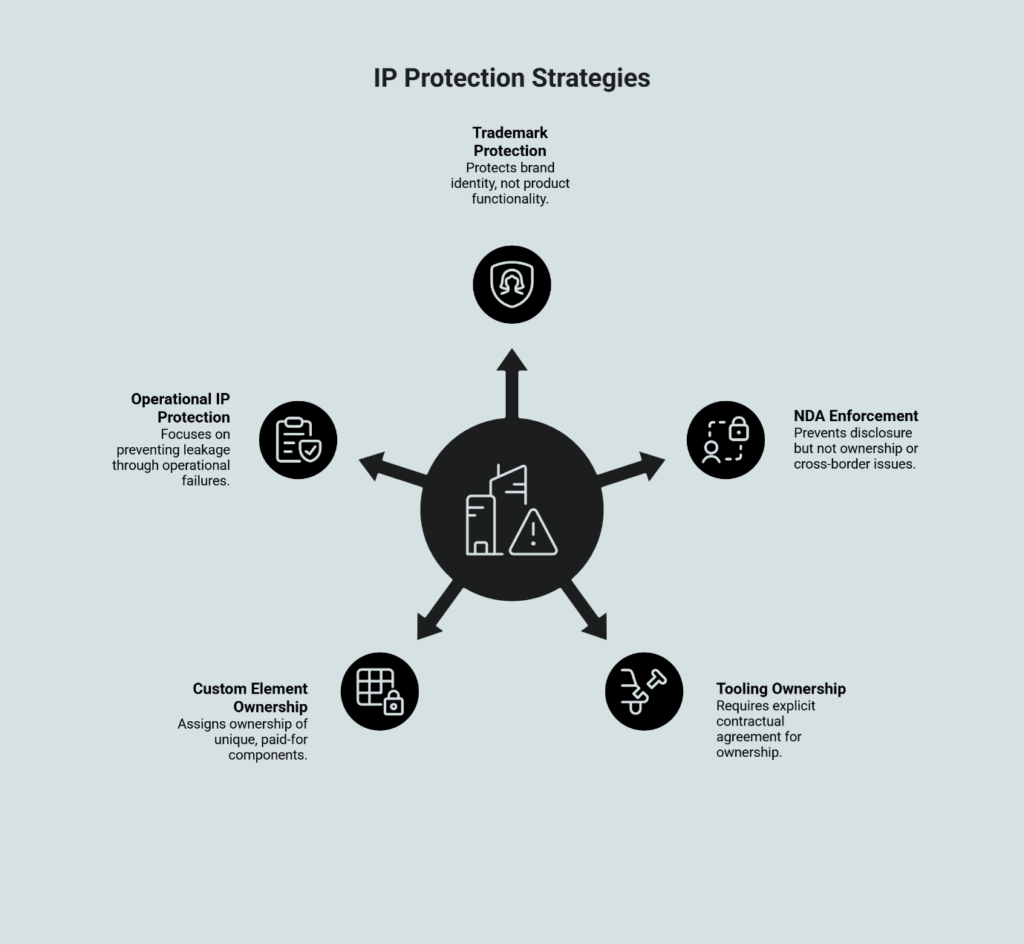
Reality: Your trademark protects your brand identity, but it doesn’t prevent someone from manufacturing a functionally identical product under a different name. If your only differentiator is the badge on the front, you’re vulnerable.
What to do instead: Identify at least one distinctive industrial design feature—a unique grill pattern, a specific curve in the enclosure, a particular control layout—and document it as part of your specification. Make it clear in your OEM agreement that this element is exclusive to your program.
Myth → “An NDA Solves the Problem”
Reality: Non-disclosure agreements are table stakes, but they only prevent disclosure of confidential information. They don’t define ownership, they don’t prevent the factory from using similar designs for other customers, and they’re difficult to enforce across borders.
What to do instead: Layer your NDA with explicit ownership terms in your manufacturing agreement. Specify that you own custom tooling, unique design files, and any derivative improvements to your specifications. Treat confidentiality like a process: define what is confidential (files, drawings, DSP, packaging), define who can access it, define where it can be stored, and define what happens at end-of-program (return, delete, certify).
Myth → “If I Pay for Tooling, I Automatically Own It”
Reality: Paying for tooling doesn’t guarantee ownership unless your contract explicitly states it. In many OEM arrangements, the factory retains ownership of tooling even when the customer pays for it, treating the payment as a deposit or amortization rather than a purchase. Tooling payments can be structured many ways, and paying for a mold or fixture does not automatically grant you ownership of the underlying platform design.
What to do instead: State explicitly in your purchase order or manufacturing agreement: “Customer owns all custom tooling upon payment. Factory will store tooling at no cost during active production and return or dispose of tooling per customer instruction upon program termination.” Separate these ideas in writing: tooling ownership (physical assets), design ownership (CAD/drawings/industrial design), and improvements/derivatives (who owns changes made during the program).
Myth → “The Factory Owns Everything Because They Build It”
Reality: While factories typically own their platform designs and standard processes, custom elements you specify and pay for can be contractually assigned to you. The key is defining the boundary between shared platform assets and your unique contributions. It depends on what is truly custom versus based on an existing platform.
What to do instead: Before starting a project, map out which elements are standard platform components (which the factory will reasonably want to reuse) and which are custom to your program. Focus your ownership claims on the latter. Build your plan around boundaries: What is platform (shared) versus what is custom (yours)? What must be exclusive? What can be non-exclusive but controlled?
Myth → “IP Protection Is a Legal Issue”
Reality: Most IP leakage occurs through operational failures: files sent to the wrong person, verbal approvals of changes, or unofficial “improvements” made during production. Your biggest risk is often not a courtroom—it’s drift and reuse: CAD copies floating to sub-suppliers, uncontrolled artwork revisions, firmware/DSP versions mixing in production, and incremental changes that erase your differentiation.
What to do instead: Treat your specification package—drawings, test procedures, approved samples—as the single source of truth. Require written approval for any changes, maintain custody of master files, and audit periodically to ensure production matches your controlled specifications. Combine IP thinking with change control and golden sample management so every build stays tied to an approved reference.
What You Can Own vs What the Factory Often Owns
Here’s a practical framework for understanding typical ownership boundaries in private label audio manufacturing:
| Asset / Item | You Can Own It If… | How to Lock It Down | OEM Agreement Intent |
|---|---|---|---|
| Brand name, logo, trademark | Always—this is yours | Register trademark; specify in agreement | “Customer owns all brand assets and trademarks” |
| Custom tooling (molds, fixtures) | You paid for it and it’s unique to your program | Pay separately, get ownership clause, specify storage terms; tooling ID tags; inventory list | “Customer owns custom tooling; factory stores at no cost during production” |
| Distinctive industrial design elements | You specified unique visual features | Keep dated design files; document design decisions; claim as trade dress; specify exclusivity | “Unique enclosure design is exclusive to Customer program” |
| Platform cabinet design | Rarely—this is usually factory IP | Accept that base design is shared; focus on distinctive modifications | “Factory retains platform design; Customer has usage rights during term” |
| Custom DSP tuning / firmware | You funded development and it’s specific to your model | Keep source code; versioning, release notes, checksum/version label; document as proprietary; limit factory’s reuse rights | “Custom DSP profiles are Customer property; factory may not reuse for other clients” |
| Standard driver specifications | No—these are commodity components | Not applicable; focus on what’s truly differentiating | Not typically addressed |
| Engineering drawings for custom components | You paid for custom engineering | Maintain master files; specify ownership in SOW; single source-of-truth repository; access list | “All custom engineering deliverables are Customer work product” |
| Packaging artwork / manuals | You authored or commissioned them | Keep source files; watermark drafts; limit sharing | “Artwork is your property; factory is a limited licensee” |
| Manufacturing process documentation | Rarely—this is factory knowledge | Not usually claimed; focus on output specs instead | “Factory retains process knowledge; Customer owns output specifications” |
The pattern is clear: you can own what you pay to customize and what distinguishes your product from others. The factory retains ownership of its platform designs, standard processes, and general manufacturing knowledge.
Critically, avoid claiming ownership of assets you do not need to control (like base platform designs) while failing to protect the elements that actually differentiate your brand—like that specific port tuning that gives your subwoofer its signature sound.
The Safeguards That Actually Reduce Risk
Contracts establish rights, but operational controls prevent problems. Here’s how to translate legal concepts into practical risk reduction:
File Custody and Access Control
Decide who holds the master version of critical files—CAD drawings, artwork, DSP code, test procedures. In many programs, the factory needs working copies, but you should maintain a secured master set. Specify in your agreement that the factory may not share your files with third parties without written consent, and audit periodically to ensure compliance.
Even basic rules help: named custodians, controlled folders, and a “no forwarding without written approval” standard. Simple cloud folder permissions can enforce this: grant view-only access to routine production files and require formal requests for any modifications.
Tooling Terms Beyond Ownership
Even if you own custom tooling, specify storage requirements, maintenance responsibilities, and end-of-program disposition. State clearly: “Upon program termination, factory will either return tooling to Customer at Customer’s expense, hold for future use at no cost for X months, or destroy per Customer instruction with photo documentation.”
If you’re paying for custom tooling, treat it like an asset: identify it (tool IDs), define storage and maintenance, define use limits (only for your program), and define end-of-program disposition. This prevents the common scenario where tooling is “lost” or “accidentally” used for another customer’s program.
Defining Improvements and Derivative Work
OEM agreements should address who owns improvements. If the factory suggests a design enhancement that reduces cost, who can use that innovation? A balanced approach: “Customer owns improvements specific to Customer’s product design. Factory retains improvements to general manufacturing processes. Parties share rights to improvements requiring contributions from both parties, with each having non-exclusive usage rights.”
This prevents disputes while encouraging collaborative problem-solving. You want a clear rule for improvements created specifically for your program, derivatives of your custom design layer, and what happens if you switch factories later.
Change Control as Brand Protection
Every unauthorized change—a different screw, a slightly modified grill, an “improved” tuning—is both a quality risk and an IP risk. Implement a simple engineering change order (ECO) process: factory must request approval for any change, describe the reason and impact, and await written authorization before implementation.
Define who can request changes (you, factory, or both), define approval steps, define when a change cuts into production, and tie each change to a revision level. This golden sample management discipline isn’t bureaucracy—it’s how you maintain consistency and prevent your design from morphing into something you no longer control.
The most defensible brands don’t necessarily have the most aggressive legal terms. They have the tightest operational controls, ensuring that what’s built today matches exactly what was approved yesterday.
A “Do This This Week” IP Starter Plan
You don’t need to become a legal expert to reduce your IP risk significantly. Here are practical steps you can take immediately:
Write Down Your “Own vs Platform” Assumptions
Before your next quoting cycle, create a simple document listing which elements you consider yours (brand, custom tooling, distinctive design features, tuning profiles) and which you accept as shared platform assets. Share this with your factory contact and ask: “Does this match your understanding?” Mismatches discovered now prevent disputes later. Most factories respect clear ownership claims if they’re presented early and reasonably.
Identify Your Single “Must-Own” Asset
If you could only control one element of your product beyond your brand, what would it be? For some brands, it’s a distinctive enclosure shape. For others, it’s a specific tuning profile that defines their sound signature. For subwoofer manufacturers, it might be a unique port design. Identify this anchor asset and ensure your manufacturing agreement explicitly assigns ownership to you.
Put Ownership Clauses in Your Next PO or Agreement
You don’t need a 30-page contract. Add a simple section: “Intellectual Property: Customer owns [brand assets, custom tooling, specific design elements]. Factory retains ownership of platform designs and standard manufacturing processes. Neither party may disclose the other’s confidential information without written consent. Custom tooling will be stored by Factory at no cost during production and returned or disposed of per Customer instruction upon program end.”
Create Your Golden Sample Package
Assemble a specification package that defines your product completely: approved drawings, test procedures, material specifications, and a physical golden sample. Store this centrally and treat it as your source of truth. When disputes arise—and they will—this package is your proof of what was agreed. It’s simultaneously a quality control tool and an IP protection mechanism, demonstrating that you maintain detailed control over your design.
Establish File Custody Rules
Create a single “program folder” as source of truth. Include: drawings, artwork, spec sheet, revision log, and approvals. Add one rule: no file sharing to sub-suppliers without approval. Simple, enforceable, and high leverage.
Define Your Change Approval Path
Who signs off on changes? What triggers re-approval of the Golden Sample? A decision-level approach prevents informal drift and maintains your control over what your product actually is.
These steps won’t make you litigation-proof, but they’ll reduce your practical risk by 80%. Most IP problems in private label manufacturing stem from ambiguity, not malicious intent. Clarity prevents problems before they start.
How This Connects to Manufacturing Predictability
Intellectual property protection and manufacturing control are functionally identical systems.
Consider what happens when design files aren’t controlled. An engineer makes a “small improvement” without documentation. That change isn’t reflected in your test procedures. Quality audits now measure against the wrong baseline. Your product drifts away from your original specification, and you’ve lost the ability to enforce consistency—even with yourself.
Now add IP concerns: if you can’t control your own production versions, how can you demonstrate that a competitor’s suspiciously similar product copied your design rather than the factory’s base platform? If your golden sample doesn’t match your current production units, you can’t prove what your distinctive design elements actually are.
This is why predictability is the premium in OEM partnerships. A factory that implements disciplined change control, maintains file integrity, and produces to specification isn’t just protecting your quality—they’re protecting your brand assets. The operational habits that ensure each production run matches your approved sample are the same habits that prevent unauthorized reuse of your design elements.
When you enforce golden sample consistency and disciplined change control, you get two outcomes at once: your product stays “your product” with a target that doesn’t move, and your differentiation becomes harder to copy—because the real value isn’t just a shape, it’s controlled execution, traceable builds, and locked revisions.
When evaluating manufacturing partners, assess their documentation practices, change control systems, and file management as carefully as you evaluate their production capabilities. These operational disciplines are your functional IP protection, regardless of what the contracts say.
IP Protection Is a System, Not a Sentence
Intellectual property protection in private label manufacturing isn’t about aggressive legal tactics or paranoid secrecy. It’s about clarity: knowing what you own, documenting it properly, and maintaining operational discipline to ensure your design remains under your control.
The most successful private label audio brands don’t necessarily have the longest contracts or the most patents. They have clear ownership boundaries, documented specifications, disciplined change control, and manufacturing partners who respect those systems. They understand that protecting their design and maintaining manufacturing predictability are the same practice—both require turning agreements into operational reality.
Start simple. Define what makes your product distinctive, document those elements clearly, and ensure your manufacturing agreement assigns ownership appropriately. Implement basic operational controls: file custody, change approval processes, and golden sample management. These steps won’t make you litigation-proof, but they’ll prevent the majority of practical IP problems while simultaneously improving your quality consistency.
Your brand is built on the promise that your product delivers a specific experience every time. IP protection, properly understood, is simply the system that ensures you can keep that promise. When predictability is the premium, ownership clarity and operational discipline become inseparable parts of building value.
Ready to establish a manufacturing partnership built on clear ownership terms and predictable execution? Subscribe to our newsletter for ongoing insights, or get in touch to discuss how we approach private label product development with transparency and operational rigor. Learn more about China Future Sound.
Disclaimer: This content is for informational purposes only and does not constitute legal advice. Consult with qualified intellectual property counsel for guidance specific to your situation.
Our Editorial Process
Our expert team at China Future Sound is committed to providing accurate and insightful content. We may use AI tools to help organize or draft information, but every article is reviewed and edited by a human to ensure it meets our quality standards.
About the China Future Sound Insights Team
The China Future Sound Insights Team is our dedicated engine for synthesizing complex topics into clear, helpful guides. While our content is thoroughly reviewed for clarity and accuracy, it is for informational purposes and should not replace professional advice.