📌 Key Takeaways
Stuck in look-alike SKUs and shrinking margins? Build a controllable flywheel that turns engineered uniqueness into price insulation and reinvestable R&D.
Engineer Differentiation, Not Spec Parity: Select a few high-leverage choices—magnet system, cone materials, enclosure/DSP—to create a product competitors can’t copy quickly and a story customers value.
Run the Feature Value Matrix: Score every feature on customer appeal versus cost/complexity to prioritize High-Appeal/Low–Mid-Complexity wins and justify only the high-complexity bets that truly move price or volume.
Make Custom Safer Than “Cheap”: Use NDA/NNN-style protections, milestone-based development/manufacturing agreements, and staged QC with ISO-aligned acceptance sampling to control IP exposure, timelines, and lot quality.
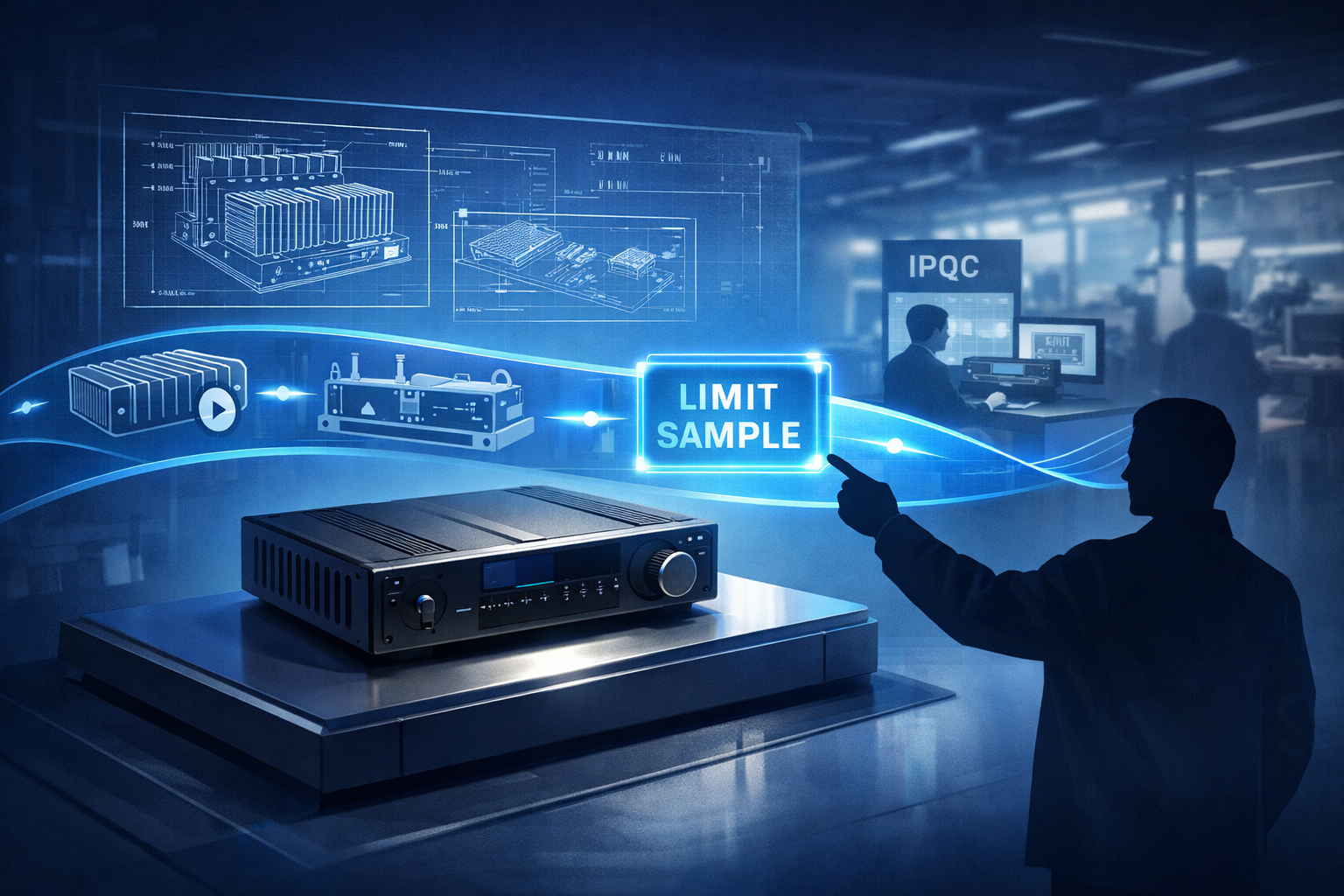
Gate Quality with a Golden Sample: Approve only after five checks—acoustics/electrical spec, materials/tolerances, cosmetics, reliability/aging, and packaging/drop—to lock repeatable mass-production performance.
Build a Platform, Not One-Offs: Standardize platformable parts and voicing across SKUs so today’s margin gains finance Gen-2/Gen-3 improvements through a disciplined reinvestment loop.
Engineer uniqueness, align decisions, and compound margin.
Margins are disappearing.
The conference room falls quiet as the latest line review reveals yet another page of look-alike SKUs and eroding price points. Product feels boxed in by copycat specs. Marketing can’t find a story that sticks. Finance sees a slow bleed.
If that sounds familiar, this guide was built to hand the Owner/Economic Buyer and the Sourcing/Product team a common language—and a system—to break out. The destination? A differentiated, defensible product line that Marketing can narrate with conviction, Operations can build at scale, and Finance can model with confidence.
Strategic pull-quote: Margin defense comes from uniqueness you can manufacture, not features you can copy.
Why Commodity Audio Lines Erode Margin
Commodity portfolios train customers to compare on specs alone. On marketplace shelves, near-identical products collapse into a single price anchor. Promotions get deeper; returns creep up; roadmap discipline weakens because every refresh reuses the same parts bin and the same story.
In the field, a recurring pattern emerges: the more generic the engineering, the less credible the marketing narrative. Without an engineerable difference—materials, geometry, tuning, reliability proof points—the story cannot sustain a premium. From a business perspective, this isn’t just a creative problem; it’s a gross-margin problem that compounds over time.
According to the China Future Sound framework, the remedy is not a boutique detour. It is a risk-managed shift from unit-cost procurement to a Partnership Path with an OEM/ODM capable of executing Custom speaker engineering & design end-to-end. That shift unlocks the flywheel that follows.
The Brand Differentiation Flywheel Turns Engineering Into Profit
Master definition:
Custom speaker engineering & design is the fastest, most controllable way for US audio e-commerce brands to escape commodity price wars. By making a few high-leverage engineering choices that Marketing can narrate and Operations can reliably build, you create products competitors can’t copy overnight. That uniqueness strengthens positioning, supports premium pricing, and funds the next round of R&D—forming a compounding Brand Differentiation Flywheel.
According to the China Future Sound Partnership Path, custom engineering is a risk-managed differentiation engine. The intent is simple: transform a few deliberate engineering choices into a unique product, arm Marketing with a stronger story, earn higher margins, and reinvest in R&D—which funds the next round of custom engineering. Round and round.
The Brand Differentiation Flywheel for Custom Audio: A Manager’s One-Page Playbook
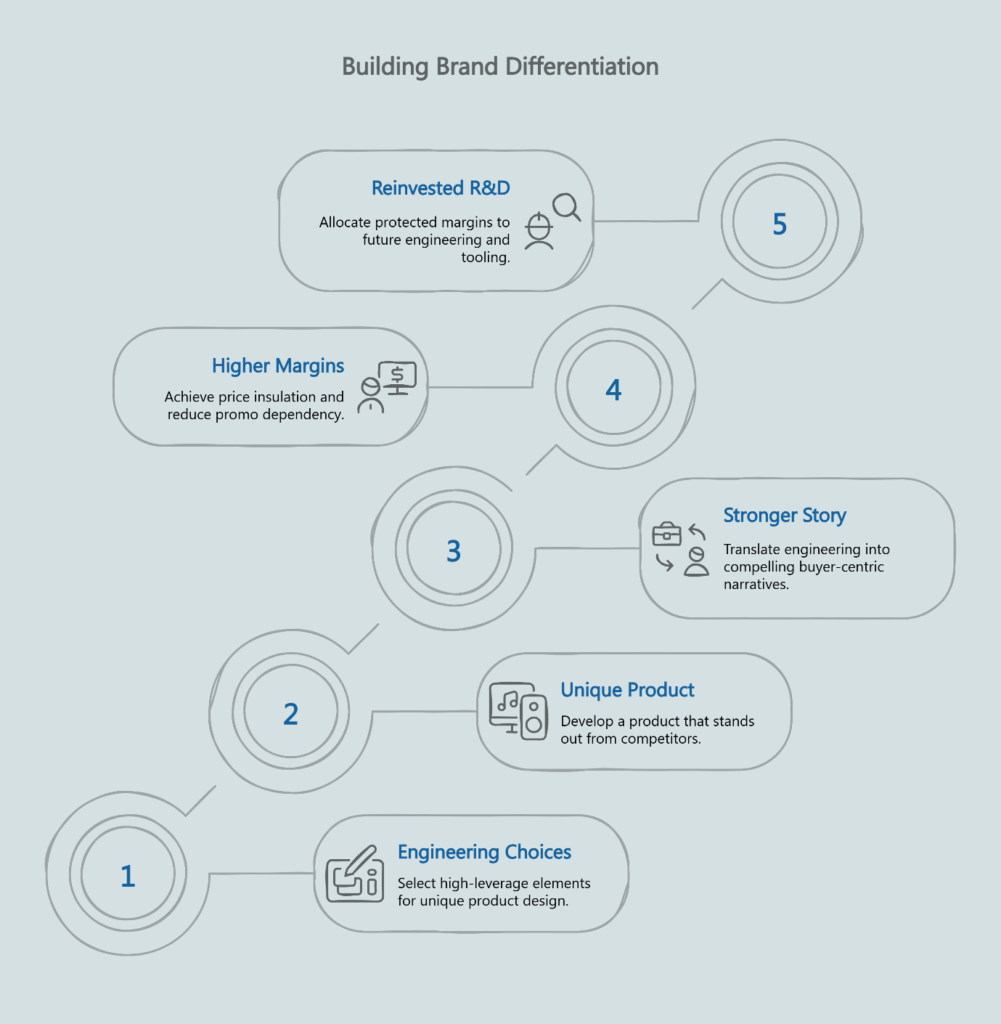
- Engineering Choices → Unique Product
Select high-leverage elements—e.g., magnet type (neodymium vs. ferrite), cone/diaphragm materials, surround/spider geometry, Enclosure volume/port topology, DSP presets, and industrial design features that are visible and narratable.
When to use: The moment an assortment refresh risks “spec parity,” redirect to 2–3 custom choices with measurable acoustic or experiential outcomes.
Risks & controls (summary): Lock specs and tolerances early; align choices to MOQ/lead-time constraints; document test methods. - Unique Product → Stronger Story
Translate engineering into language buyers value: weight/power ratio, thermal stability, transient response, directivity control, installation efficiency, durability under heat and vibration. Map “why it matters” to real scenarios (e.g., fewer returns from coil rub or fatigue; consistent voicing across the line). - Stronger Story → Higher Margins
Credible uniqueness supports price insulation and reduces promo dependency. Over the lifecycle, that protects gross margin while minimizing “race-to-the-bottom” elasticity. Evidence from established management research links strong, user-centered design practices to superior financial outcomes—this plays the same tune for hardware. - Higher Margins → Reinvested R&D
Allocate a portion of protected margin to the next round of engineering and tooling. Reuse platformable parts where wise; spend inventively where the story needs new proof points. - Reinvested R&D → More Engineering Choices
The loop closes: the next generation refines acoustics, reliability, and manufacturability, compounding advantage.
Implementation confidence: Use this playbook to align Owner/Sourcing/Marketing in a single working session. Bring the Feature Value Matrix (next section) and the Golden Sample Gates checklist to drive decisions to closure.
What Engineering Choices Create Real Story Value?
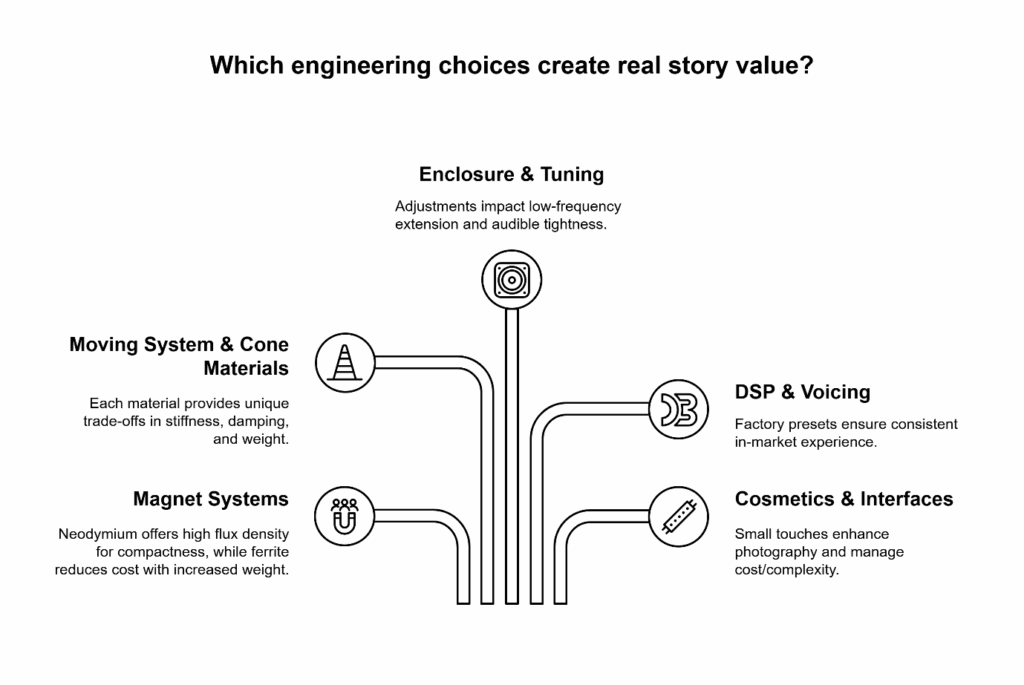
A useful test: Can Marketing explain it in one sentence, and can QC verify it in one test? When both are true, the choice likely belongs in your flywheel.
- Magnet systems: Neodymium enables high flux density for a given mass; ferrite can lower material cost while increasing weight—both are legitimate paths depending on your story (e.g., compactness vs. rugged value).
- Moving system & cone materials: Paper, polypropylene, mineral/fiber-filled composites, aluminum or treated fabrics each bring unique stiffness/damping/weight trade-offs that shape sensitivity and voicing.
- Enclosure & tuning: Volume, bracing, port geometry, and damping shift low-frequency extension, group delay, and audible tightness.
- DSP & voicing: Factory presets, limiters, or FIR filters translate engineering intent into consistent in-market experience.
- Cosmetics & interfaces: Grille geometry, finishes, connectors, mounting hardware—small touches that become on-page photography heroes and cost/complexity levers.
Real-talk moment: Look, this is where most teams get tripped up—over-customizing details that Marketing can’t actually narrate. If the audience won’t notice or the test plan can’t verify it, it’s not differentiation; it’s drag.
Use a Feature Value Matrix to Align Marketing and Manufacturing
Purpose: Reconcile story value with cost/complexity so decisions stop ping-ponging between teams.
How it works: List candidate features down the rows. Create two 1–5 scales across the columns:
- Customer Appeal (1–5): 1 = barely noticed, 5 = visible/audible and promotable.
- Manufacturing Cost/Complexity (1–5): 1 = minimal cost/standard process, 5 = high tooling, tight tolerances, new supplier/process risk.
Score as a cross-functional group, then choose High Appeal / Low–Mid Complexity items first. High Appeal / High Complexity items require a business case tied to pricing power or volume forecasts.
How to Score Appeal vs. Cost/Complexity
- Anchor with evidence: Short listening tests or quick prototypes can justify a higher “Appeal” score.
- Respect MOQs and lead times: A feature with a “2” raw cost but “5” lead-time risk belongs in “High Complexity.”
- Bundle for platforming: Prefer features that can scale across SKUs, amortizing tooling.
- Set a target margin and work backward: If a feature can’t be translated into pricing or return-rate reduction, re-score or defer.
Unexpected connection: Think of the matrix like portfolio theory. A few high-beta bets (complex features that drive story) can sit alongside low-beta workhorses, producing a balanced “return” in margin and differentiation—provided the overall risk stays managed.
Stakeholder Adaptation Hooks
Business Impact (Economic Stakeholder). Price protection through credible uniqueness; fewer returns from tighter QC; lower lifetime costs from platformable parts and consistent voicing. (Quantify internally; avoid invented ROI figures.)
Technical Note (Engineering). Choosing neodymium over ferrite can reduce mass and enable smaller form factors at higher flux densities; cone materials (e.g., treated paper vs. polypropylene vs. composite) change stiffness, damping, and sensitivity. Specify with manufacturability in mind: supplier capability, tolerances, adhesives, and test methods (see IEC-aligned measurements below). For measurement alignment, IEC 60268-21 details output-based loudspeaker testing practices suitable for p…
Day-to-Day Application (Ops/PM). Run a Feature Value Matrix session monthly during the line-refresh window. Bring updated MOQ/lead-time data; pre-score top candidates; exit with owner, decision, and test plan.
Risk Controls That Make Custom Safer Than “Cheap”
Narrative defense: The common pushback is, “Custom only raises cost.” The disciplined answer is: custom lowers strategic risk by creating price insulation, reducing returns via tighter QC, and lowering long-run switching and rework costs through platformable specs.
IP Protections (NNN, Development, Manufacturing Agreements)
In collaborative development, a non-disclosure agreement (and, in some jurisdictions, NNN-style protections) is standard practice for safeguarding trade secrets and pre-commercial information. Reputable international guidance emphasizes NDAs/confidentiality clauses as a baseline control during joint development and evaluation.
Practical baseline:
- Execute NDA/NNN-type terms before sharing CAD, BOM, or test plans.
- Define ownership of custom parts, tooling, test data, and firmware.
- Use milestone-based development and manufacturing agreements that tie payments to deliverables (prototype, EVT/DVT, golden sample).
QC Milestones and Communication Protocols
A staged QC program reduces surprises and prevents disputes:
- Pre-production validation: Verify materials, fixtures, and pilot builds.
- First-article inspection: Confirm critical dimensions/tolerances match drawings.
- In-process checks: Monitor assembly steps that drive acoustics, cosmetics, and reliability.
- Pre-shipment sampling: Use acceptance sampling (AQL) to verify lot quality against agreed limits—ISO 2859-1 is the common reference framework.
Professional self-correction: Sampling reduces risk; it doesn’t eliminate it—actually, let’s just say it never eliminates it. Pair sampling with strong process controls and clear rework/hold criteria.
From Concept to Golden Sample: Your First Custom Run
The first cycle must emphasize clarity over speed. A current leading practice is to track milestones using standard EVT/DVT/PVT stages, with documentation at each gate and a single “source of truth” spec pack.
Five Things to Confirm Before Approving the Golden Sample
- Acoustics & Electrical Spec: Frequency response, sensitivity, power handling, impedance curve, distortion at defined SPL, with test methods aligned to an output-based standard where possible.
- Materials & Tolerances: Verified suppliers, adhesives, windings, cone/surround specs, magnet grade, and dimensional tolerances that reflect real process capability.
- Cosmetics & Fit/Finish: Visual standards with samples under consistent lighting; agreed acceptance criteria for blemishes.
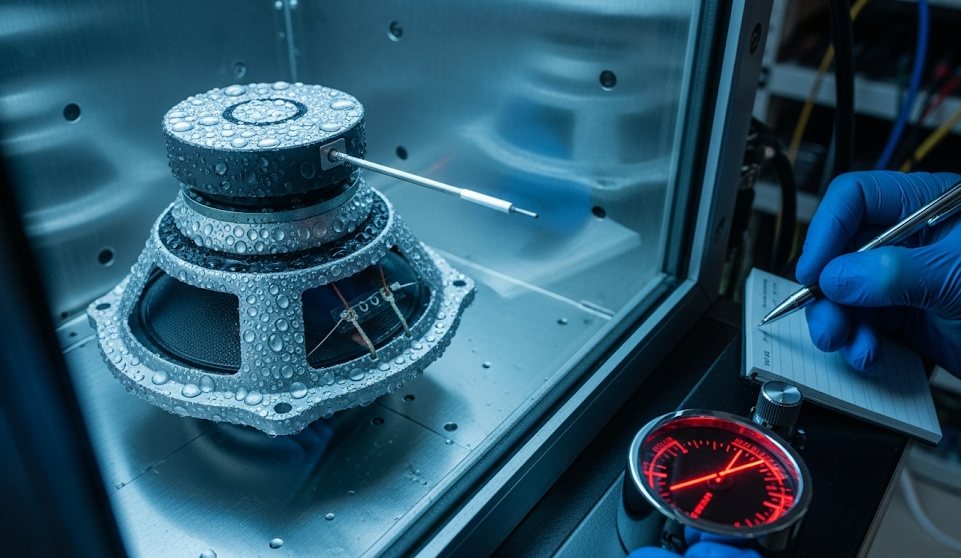
- Reliability & Aging: Thermal cycles, long-term power tests, mechanical fatigue, and vibration or environmental exposure appropriate to the use case.
- Packaging & Drop: Carton design, cushioning, and drop/transport simulation appropriate to retail and parcel channels, with clear pass/fail criteria.
Before/After picture: Before—rushed approvals, subjective listening, and fuzzy tolerances that invite returns. After—a documented, repeatable gate that produces the same product, at the same quality, every time.
Common Pitfalls to Avoid When Engineering Differentiation
- Over-customizing without story fit. If Marketing can’t tell it, the market won’t buy it.
- Skipping tooling/MOQ reality checks. Misaligned lot sizes or lead times can erase margin gains.
- Approving a golden sample without reliability tests. Early fatigue or thermal failures become returns and reputation risk.
- Copying boutique cues without manufacturability. A beautiful render that requires heroic assembly will not scale.
- Treating vendors as interchangeable. The Partnership Path is a capability match, not a price auction.
What If…? Planning for Budget Overruns and Margin Erosion
Scenario: BOM creep and tooling overages threaten target margin.
Plan of record:
- Re-score with the Feature Value Matrix. Reduce or defer low-appeal/high-complexity items.
- Adjust spec to hit target cost. Seek geometry/material changes that preserve the story while easing process risk.
- Lock Golden Sample Gates. Freeze changes; update launch margin models; instrument QC to guard drift.
Consider the future implication: Platform decisions—shared baskets of drivers, fasteners, harnesses—determine amortization envelopes and refresh velocity.
Conclusion: From Price-Taking to Platform-Building
The conference room scene plays differently now. The portfolio review opens with a one-page flywheel and a crisp scoring matrix. Engineering, Sourcing, and Marketing speak the same language. QC reports are cleaner; returns are steadier; the launch calendar reads like a plan, not a scramble.
Before: line parity, promo dependency, fragile margin.
After: engineerable uniqueness, story credibility, reinvestable R&D.
The implication is clear: Stop chasing cents off the BOM. Start compounding differentiation.
Ready to Turn Engineering Into Margin?
Request custom OEM quote — move from parity to platform with a full-service OEM/ODM partner.
FAQ: How Do We Escape Commodity Price Wars Fast?
Answer: Start with the Brand Differentiation Flywheel and a single Feature Value Matrix session. Choose two or three high-appeal features with manageable complexity (e.g., magnet system + enclosure tuning + DSP preset). Lock test methods and tolerances, then drive to a disciplined golden sample gate.
FAQ: Which Technologies Matter Most for Differentiation?
Answer: It varies by category, but common high-leverage levers include neodymium vs. ferrite magnet architectures, cone/surround systems, enclosure geometry/porting, and DSP voicing. The constant is verifiability—tie each choice to a test and a story.
FAQ: How Does Custom Speaker Engineering Systematically Create Margin and Defensibility?
Answer: Custom engineering enables brand differentiation; brand differentiation protects gross margin. Pair engineering choices with a story buyers value, verify with repeatable QC, and reinvest wins into the next round. Over time, that builds a moat competitors cannot cross quickly. Evidence on design-led performance supports the commercial logic behind this approach.
FAQ: How Do We Govern Risk (IP, QC, Timelines) with an Overseas OEM?
Answer: Combine contractual controls (NDA/NNN-style confidentiality and development/manufacturing agreements) with staged QC gates and ISO-aligned acceptance sampling before shipment. Maintain milestone-based payments. Guidance from international IP bodies underscores NDAs/confidentiality as a baseline in collaborative innovation.
FAQ: What Does a Realistic Path from Concept → Golden Sample → Scalable Line Look Like?
Answer: Concept brief → EVT (fast proofs of feasibility) → DVT (design lock with reliability) → Golden Sample (five checks) → PVT (pre-production run) → scaled production with AQL sampling. For acceptance sampling context, refer to ISO 2859-1.
Frequently Unasked Question: Are We Building a Platform or One-Off Hero SKUs?
Why it matters: Platform thinking determines re-usable parts, amortization of tooling, and roadmap coherence.
Expert answer: Favor platformable specs—shared baskets of materials and drivers that hold voicing and reliability across variants. That approach accelerates Gen-2/Gen-3 and strengthens the flywheel.
Evidence & Standards Referenced
- Management research correlating design maturity with superior financial outcomes.
- Loudspeaker measurement practices aligned with IEC 60268-21 for output-based testing.
- International IP guidance highlighting the role of NDAs/confidentiality in collaborative development.
- Acceptance sampling frameworks (AQL) referenced via ISO 2859-1 for pre-shipment quality control.
Our Editorial Process
“Our expert team uses AI tools to help organize and structure our initial drafts. Every piece is then extensively rewritten, fact-checked, and enriched with first-hand insights and experiences by expert humans on our Insights Team to ensure accuracy and clarity.
”About the China Future Sound Insights Team
“The China Future Sound Insights Team is our dedicated engine for synthesizing complex topics into clear, helpful guides. While our content is thoroughly reviewed for clarity and accuracy, it is for informational purposes and should not replace professional advice.”