📌 Key Takeaways
Quality control becomes trustworthy only when the production system makes shortcuts physically impossible—not just against the rules.
- Block, Don’t Trust: The best factories use barcode gates that stop untested products from moving forward, removing human judgment from the equation.
- Bind Data to Units: When test results link to individual serial numbers instead of batches, you can trace problems precisely and recall fewer products.
- Ask the Right Question: Don’t ask “Do you have quality checks?”—ask “Can anything ship without passing every required gate?”
- Verify Before Scaling: A short factory audit before mass production reveals whether quality systems work under real pressure or just look good on paper.
- Procedures Aren’t Proof: Certificates and checklists describe what should happen, but only physical enforcement guarantees it actually does.
Real quality control is built into the assembly line itself, not bolted on through paperwork.
Private-label program owners evaluating overseas manufacturers will find a practical framework here for asking sharper questions, preparing them for the supplier assessment guidance that follows.
~ ~ ~ ~ ~ ~ ~ ~ ~ ~ ~ ~ ~ ~ ~ ~ ~ ~
The line is moving. The quota board is lit. Somewhere between the third inspection station and the packaging line, a decision gets made. Skip the retest. Stamp the pass. Move the unit forward.
That unit now carries your brand.
For private-label program owners in professional audio, this scenario represents the invisible risk that no approved sample or QC document can fully prevent. Factories do not become reliable because a quality procedure exists on paper. They become reliable when bypassing that procedure becomes physically impossible.
The Industry Shift: Why Private-Label QA Must Become Non-Bypassable
The standard for private-label quality assurance is changing. For years, brand owners evaluated manufacturing partners based on visible signals: ISO certification on the wall, test equipment on the floor, a golden sample that met spec. These markers still matter. But they no longer answer the question that keeps program owners awake at night.
The question is not whether the factory can test properly. The question is whether the factory must test properly—even when quota pressure builds, even when the night shift takes over, even when no one from the brand is watching.
In a U.S. B2B buying cycle, where supplier credibility is often validated online long before a factory visit happens, this distinction dictates supplier selection. The focus must shift from how well a supplier describes its QA system to how strictly its physical architecture prevents shortcuts.
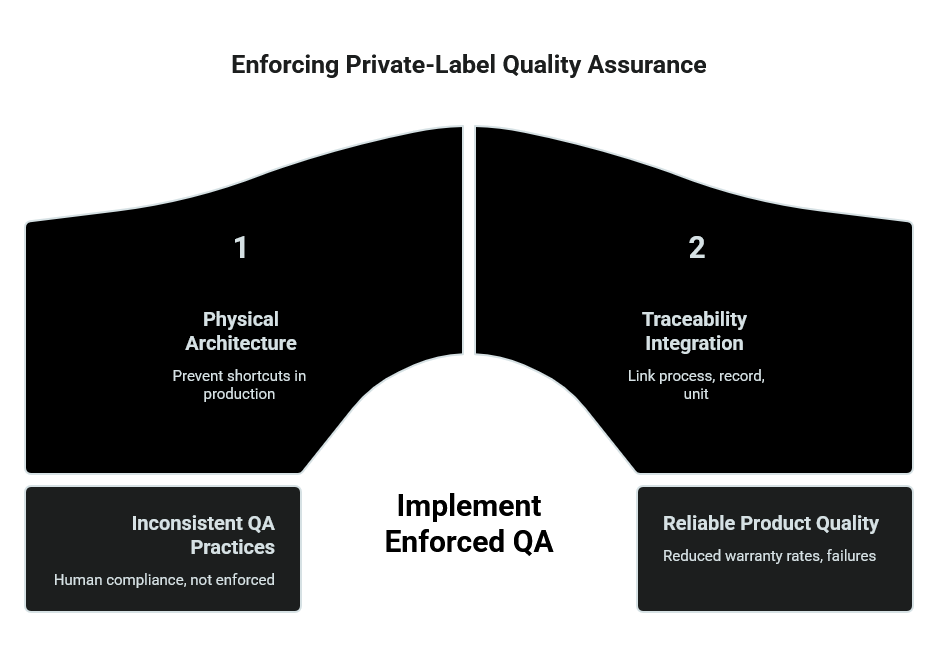
This shift represents a move from procedural QA to enforced QA. Procedural QA relies on human compliance with documented steps. Enforced QA builds compliance into the physical movement of units through the production line. The difference is not philosophical. It is operational, and it shows up in warranty rates, field failures, and the calls that come six months after launch when something goes wrong at scale.
Modern quality systems become more trustworthy when traceability is tied to real production events rather than after-the-fact reporting. That principle sits behind widely recognized resources such as the GS1 Global Traceability Standard and the core traceability frameworks detailed in ISO 9001. The common logic is straightforward: quality gets stronger when the process, the record, and the unit stay linked.
Why the Old Model Is Broken
Documentation describes intent. It does not guarantee execution.
The old belief sounds reasonable: if the supplier has standard QC paperwork, an approved sample, and test stations on the floor, the program is under control. The reality is harsher. A factory can still rush throughput, skip a station, or move a questionable unit forward if the workflow allows it.
Consider what actually happens in a quota-driven production environment. A unit arrives at a test station. The operator scans it, runs the test, logs the result. If the unit passes, it moves forward. If it fails, it should be routed for rework or rejection. But what if the operator is behind schedule? What if the test station is backed up? What if the pass rate for the shift is being tracked and a few borderline units could tip the numbers?
In a purely procedural system, the unit can still move forward. The stamp gets applied. The paperwork looks correct. The defect travels downstream, invisible until it reaches the field.
This failure mode is not theoretical. It is the reason why component drift ruins mass production QA even when the golden sample was perfect. The sample proved capability. It did not prove that capability would be enforced on unit 4,000 of a 10,000-unit run.
The New Strategic Imperative: Testing Route Control
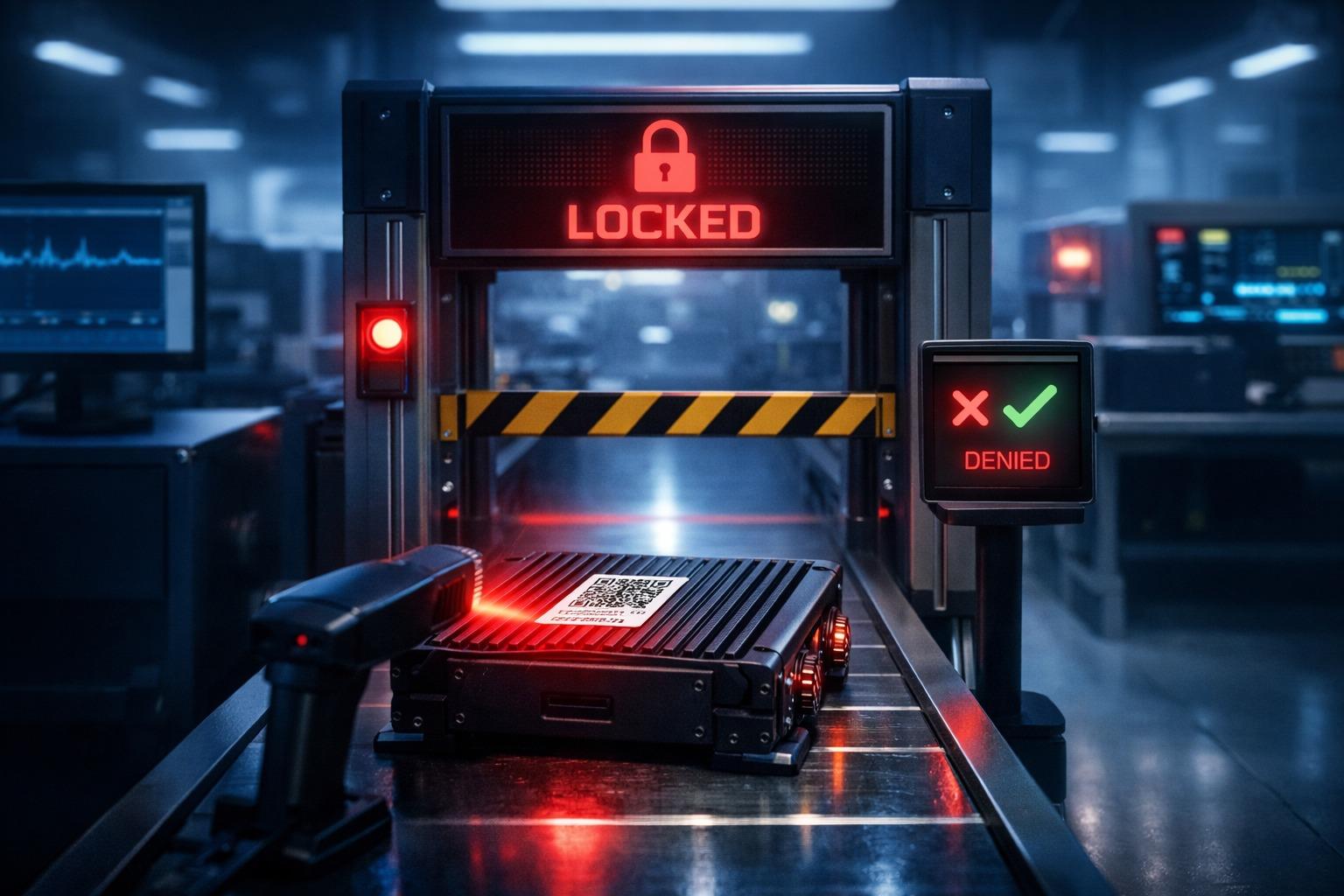
Testing route control closes that gap by making progression through the production line conditional. The core principle is straightforward: automated testing route control physically prevents a unit from moving to the next station if it has not passed the previous barcode scan.
This is not about adding more tests. It is about making the tests that already exist non-bypassable.
Route control converts traceability from a reporting function into an enforcement mechanism. Instead of logging that a test happened, the system requires proof of passage before the unit can physically advance. The barcode or QR code on each unit becomes a gatekeeper, not just an identifier.
The strategic implications extend beyond defect prevention:
- Spec-drift protection becomes architectural rather than supervisory
- Containment logic improves because every unit’s test history is bound to its serial number
- Launch confidence increases because the data reflects what actually happened, not what was supposed to happen
- Warranty risk becomes more predictable because failure patterns can be traced to specific production windows
China Future Sound implements this architecture with a quality system that includes ISO9001-2015 certification, ERP and WMS with FIFO control, KLIPPEL QC with golden sample management, barcodes and QR codes that control the testing route and bind test data for traceability, IQC/IPQC/FQC plus a reliability laboratory, AP Audio Precision in sample testing, and an R&D team of more than 20 people across acoustics, electronics, structure, and software.
Those details matter because they move the conversation away from generic claims. They suggest a system where route discipline, measurement discipline, and production discipline work together. That integration is also the logic behind AP Audio Precision Integration: Standardizing FQC for Pro Audio Amplifiers and AOI, Functional Test, and Aging: Proof Your OEM/ODM Amp Line Is Production-Ready.
For private-label program owners, this means the conversation with manufacturing partners needs to change. The question is no longer “Do you have quality gates?” The question is “Can a unit reach the shipping dock without passing every required gate?”
What Route Control Looks Like on the Factory Floor
A unit enters a required test station. The operator scans the barcode or QR code. The system checks whether the unit has a valid pass record from the previous station. If yes, the current test proceeds. If no, the system blocks progression.
When a unit passes the current test, the result is bound to that unit’s serial number, and the unit is cleared for the next station. When a unit fails, it enters a separate routing path—rework, re-inspection, or rejection—and cannot rejoin the main production flow until the failure is resolved and documented.
There is no manual override that allows an untested unit to skip forward. There is no way to stamp a pass without the system recording the actual test data. The production line’s physical logic enforces the quality logic.
A visible process chain reinforces this staged validation: AOI Inspection, Aging Testing, Function Testing, AP Test, and Final Assembly & Packaging. Each gate feeds into the route-controlled workflow, and each result stays bound to the unit for later containment and analysis.
When that logic is real, several advantages follow. Spec-drift becomes easier to catch before shipment. Root-cause work becomes faster because the record belongs to the unit, not just the batch. Containment becomes narrower because you can identify where the failure happened and which units were touched by it.
What Smart Program Owners Should Start Looking For
Evaluating a manufacturing partner’s quality architecture requires looking beyond equipment lists and certification logos. The presence of test stations does not prove that those stations function as gates. The presence of barcodes does not prove that those barcodes control routing.
The goal is to separate surface-level QA theater from enforceable compliance.
When assessing route control maturity, consider these questions:
Workflow evidence over equipment evidence. Can the supplier demonstrate that a unit physically cannot advance without a logged pass at each required station? Request a walkthrough that shows what happens when a unit fails mid-line. Does the system block it, or does it rely on an operator to manually divert it?
Unit-level binding over batch-level reporting. Is test data tied to individual serial numbers, or only to production batches? Unit-level binding enables precise containment if a field issue emerges. Batch-level reporting may require recalling far more units than necessary.
Route control evidence before scale-up. The best time to verify enforcement architecture is before committing to volume production. A 72-hour audit of manufacturing quality gates can reveal whether the system operates as designed under real conditions.
The goal is not to find a supplier with perfect answers. The goal is to find a supplier whose quality architecture makes non-compliance difficult by design rather than merely discouraged by policy.
Aligning Engineering and Procurement Priorities: A Checklist for OEM/ODM Amplifier Programs supports the internal alignment that often determines whether a program team asks strong questions or accepts weak proof.
Private-label quality does not become credible when a supplier promises discipline. It becomes credible when the production system makes indiscipline hard.
That is the standard worth carrying into every future qualification discussion. If this perspective matches the way your team wants to evaluate manufacturing risk, subscribe to the newsletter for more guidance on first-article execution, QA gates, and supplier validation. For a closer look at manufacturing capability, start with Amplifier Production.
Our Editorial Process:
Our expert team uses AI tools to help organize and structure our initial drafts. Every piece is then extensively rewritten, fact-checked, and enriched with first-hand insights and experiences by expert humans on our Insights Team to ensure accuracy and clarity.
About the China Future Sound Insights Team:
The China Future Sound Insights Team is our dedicated engine for synthesizing complex topics into clear, helpful guides. While our content is thoroughly reviewed for clarity and accuracy, it is for informational purposes and should not replace professional advice.