📌 Key Takeaways
A Golden Sample serves as your locked reference standard—the physical unit that prevents spec drift and protects brand reputation across every production run.
- Dual Sign-Off Creates Accountability: Both buyer and factory must approve the same physical unit with complete documentation, making quality disputes objectively resolvable.
- Change Control Prevents Drift: Material substitutions, supplier switches, and process tweaks require formal re-approval before implementation, stopping cumulative quality degradation.
- Three Gates Reference One Standard: Incoming, in-process, and final quality control must all point back to the approved Golden Sample so “acceptable” never gets redefined.
- Risk-Based Reliability Testing: Scope stress checks to match product risk and intended use rather than pursuing vague “reliability” promises that delay launches.
- Acoustic Validation Requires Precision: Frequency response tolerances (±2dB, 20Hz–20kHz) and THD thresholds must be spec-defined and measured with traceable, calibrated equipment.
Locked reference = repeatable production quality.
Private label brand owners building OEM partnerships will gain enforceable quality protocols here, preparing them for the detailed five-step approval checklist that follows.
~ ~ ~ ~ ~ ~ ~ ~ ~ ~ ~ ~ ~ ~ ~ ~ ~ ~
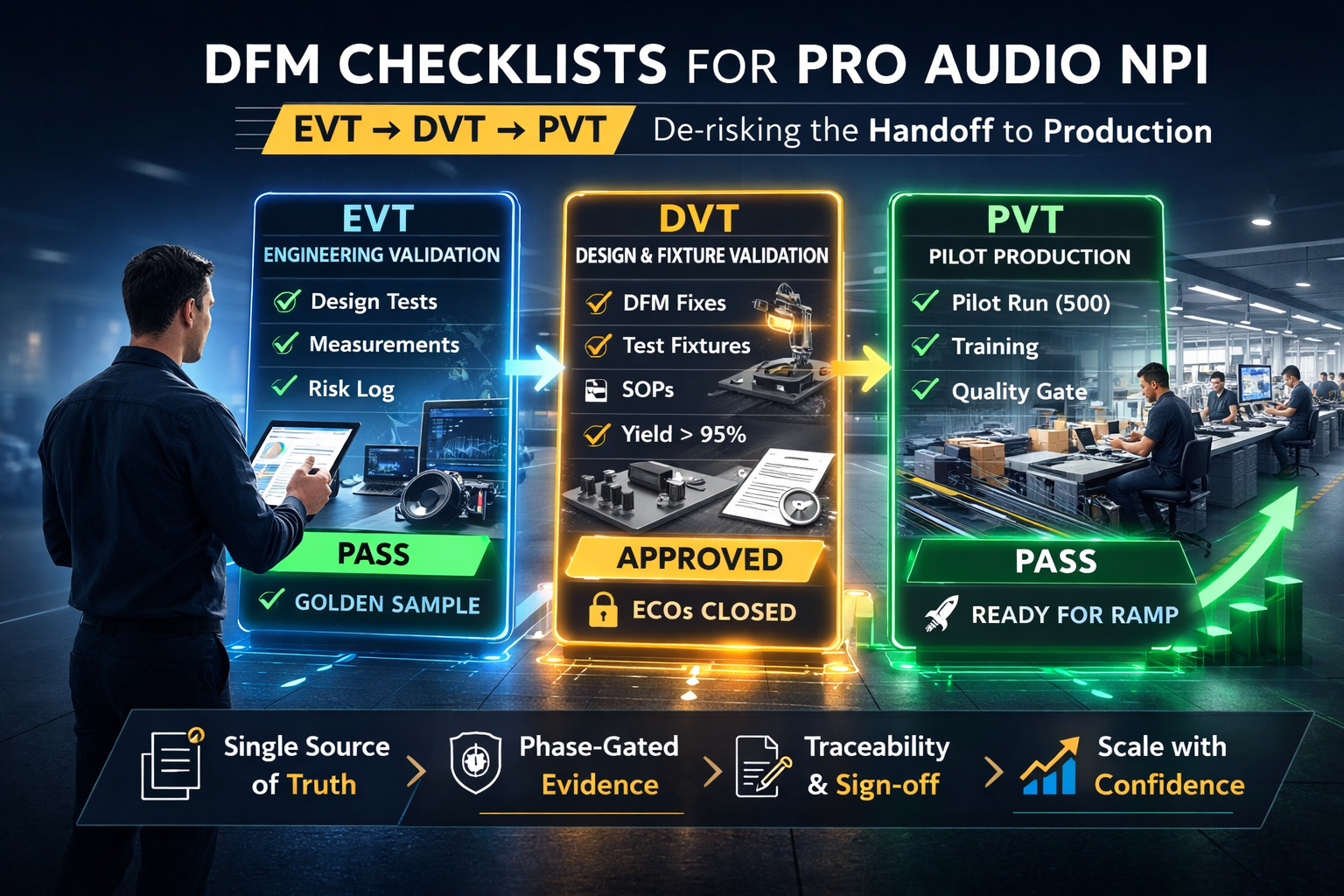
A Golden Sample is your locked reference standard—the physical unit that defines your specifications and serves as the single source of truth for every production run. When a factory commits to matching your Golden Sample, they’re committing to replicate its acoustic performance, cosmetic finish, and assembly quality at scale. This approval becomes the foundation for incoming quality control (IQC), in-process quality control (IPQC), and final quality control (FQC) gates throughout manufacturing.
The failure mode is simple: without a clear Golden Sample protocol, spec drift happens gradually. A supplier switches to a cheaper cone material. Assembly tolerances loosen. The finish color shifts slightly. Three months later, the production batch that arrives bears little resemblance to what you originally approved.
Why Golden Sample Approval Is the Highest-Leverage QC Decision You Make
The Financial Impact of Spec Drift
Every private label brand owner faces the same nightmare scenario—approving a sample that looks and sounds right, only to receive thousands of units that don’t match.
The stakes are particularly high in OEM audio manufacturing because acoustic performance can’t be visually inspected. A ±2dB deviation in frequency response or an increase in Total Harmonic Distortion (THD) might be imperceptible during a quick listening test but becomes audible and competitively disadvantageous when customers directly compare your product to others.^1 For brands transitioning from resale to private label ownership, this quality inconsistency can destroy years of reputation-building effort in a single production cycle.
Why a Contract Alone Doesn’t Stop Spec Drift
Purchase orders and manufacturing agreements describe what you want. A Golden Sample proves it exists. The difference matters because factory teams rotate, communication breaks down across time zones, and verbal commitments fade from memory. Contracts define obligations, but factories execute day-to-day decisions through operational artifacts—BOM revisions, drawings, test routines, and inspection checklists. When your IQC inspector holds an incoming shipment unit next to the approved Golden Sample and finds a mismatch, you have objective evidence of non-conformance. Without that physical reference, you’re left arguing interpretations of specifications.
Manufacturing facilities that maintain ISO 9001:2015 certification already understand this principle—they require documented reference standards for measurement traceability and process control. Your Golden Sample becomes part of that quality management system, creating a shared accountability structure between you and your supplier.
What Counts as a Golden Sample (and What Doesn’t)
Golden Sample vs Prototype vs Pre-Production Sample
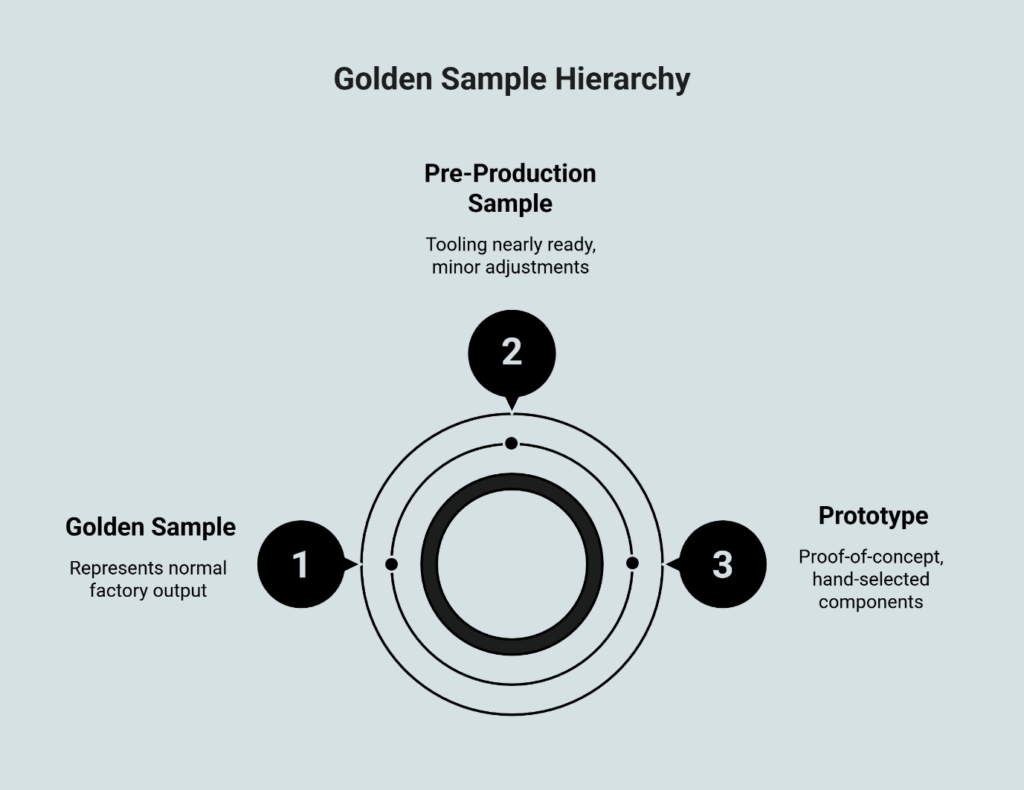
A prototype is a proof-of-concept unit built to validate your design. It often contains hand-selected components and receives extra attention from engineering teams. A pre-production sample comes from tooling that’s nearly ready but might still need minor adjustments. Neither of these should be confused with your Golden Sample.
Your Golden Sample must be built using the exact production tooling, production-grade components from your approved bill of materials, and standard assembly processes that will be used for mass manufacturing. This is the unit that represents normal, repeatable factory output—not an idealized version that engineering can achieve under laboratory conditions.
Who Owns It and Where It Lives
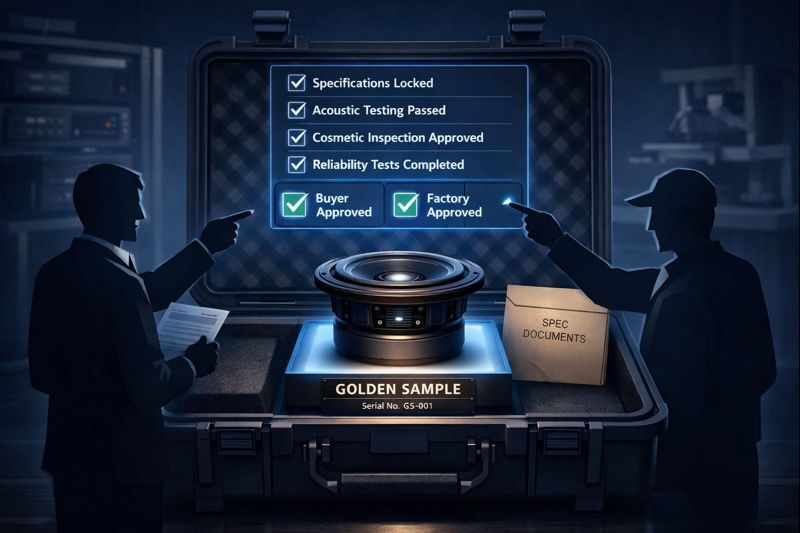
You need two Golden Samples. One stays with you as your reference for incoming inspections and quality audits. The other remains at the factory, accessible to production supervisors, quality inspectors, and line workers who need to verify their output against the approved standard.
Both units must be clearly labeled with identification numbers, approval dates, and revision codes. Store them in protective cases to prevent damage. If your product includes sensitive components—like voice coils in subwoofer drivers—ensure the storage environment controls temperature and humidity to prevent degradation.
The 5-Step Golden Sample Approval Checklist
This checklist transforms sample approval from a rushed formality into a documented gate that protects your brand.
| Checklist Item | Acceptance Criteria | How to Verify | What to Record | Owner | Sign-off Required |
|---|---|---|---|---|---|
| Step 1: Spec Lock | BOM matches purchase order; drawings show correct dimensions; tolerances are defined | Visual inspection of components; measurement of critical dimensions | Component serial numbers; drawing revision; tolerance ranges; CTQ list | Buyer + Factory | Both |
| Step 2: Acoustic Validation | Frequency response within ±2dB of target; THD below specified threshold; no audible rub or buzz | Frequency response measurement; distortion analysis; listening test at rated power | Frequency response curve; THD measurement file; audio recording of sweep test | Buyer (with factory QC data) | Both |
| Step 3: Cosmetic + Assembly | Finish matches approved color sample; labels are legible and correctly positioned; packaging protects product | Visual comparison to approved samples; drop test for packaging | High-resolution photos from multiple angles; packaging test results | Factory QC (buyer approval) | Both |
| Step 4: Reliability Sanity Checks | No failures during risk-based stress test; connections remain secure after thermal cycling | Limited life testing based on risk assessment; thermal cycling if applicable | Test duration; environmental conditions; failure modes observed | Factory QC (buyer review) | Buyer acknowledges |
| Step 5: Dual Sign-off + Documentation | Both parties agree unit represents production intent; all test data is attached | Review of complete test package | Signed approval form; serial number; attachment list; revision code | Buyer + Factory | Both |
Step 1: Spec Lock
Before any testing begins, confirm that what you’re evaluating matches what you ordered. This means physically verifying that the bill of materials lists the correct components, that engineering drawings reflect the agreed-upon dimensions, and that tolerance ranges are explicitly stated—not left to interpretation.
For audio products, this includes specifying the voice coil diameter, magnet weight, cone material, and suspension compliance. Vague language like “similar to reference sample” creates room for substitutions that degrade performance.
Add a short critical-to-quality (CTQ) list that spells out what cannot change without re-approval. This prevents well-intentioned process improvements from quietly altering characteristics that matter to your brand positioning.
Step 2: Acoustic Validation
Frequency response, total harmonic distortion, and mechanical noise (rub and buzz) are the three non-negotiable acoustic tests. Facilities with KLIPPEL QC systems and Audio Precision analyzers can provide objective measurement data that removes subjective judgment from the approval process.
Establish your acceptance criteria before testing begins. For example, you might specify that frequency response must remain within ±2dB of the target curve (20Hz–20kHz), and THD must stay below 1% at 90dB SPL. These thresholds should be based on your competitive positioning—not arbitrary numbers that sound impressive.
The exact measurement standard, fixtures, and test sequences differ by product class, but the controlling idea is consistent—measurement must be traceable to a documented method and a stable setup.
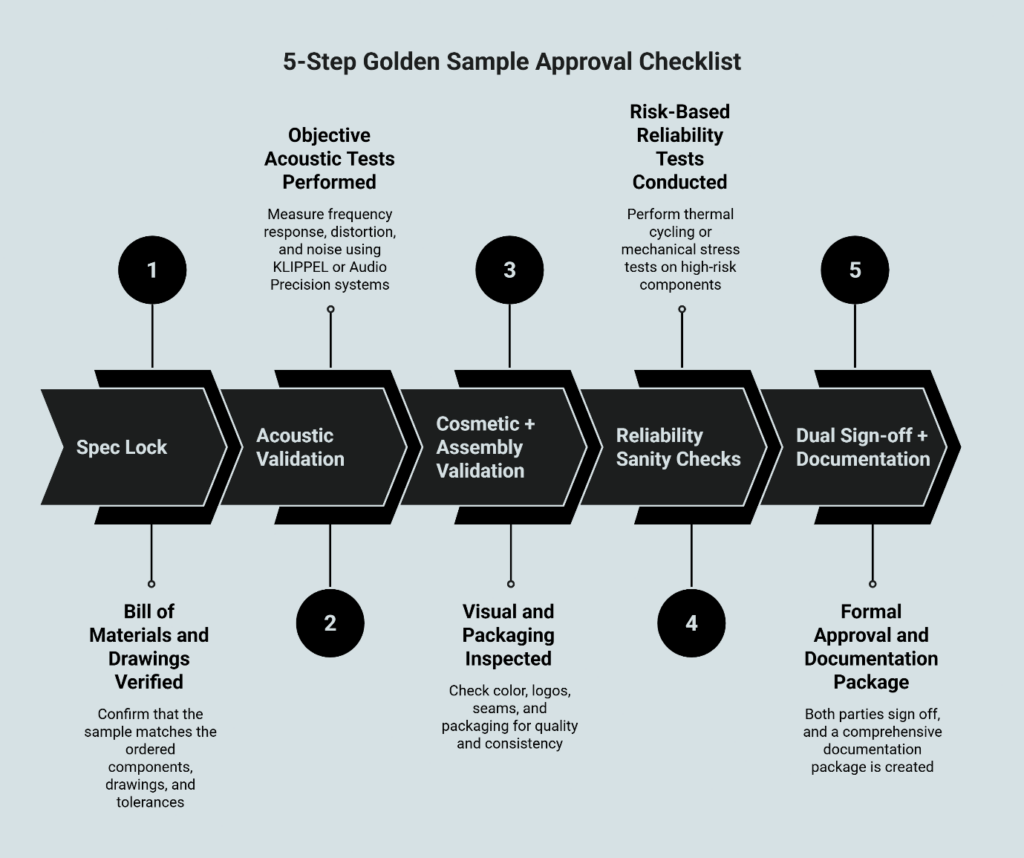
Step 3: Cosmetic + Assembly Validation
Visual quality matters because your customers will judge your brand by what they see. Approve physical color samples for finishes, verify that logos and labels are positioned correctly and remain legible, and inspect joints and seams for consistent assembly quality.
Packaging must protect the product during shipping without adding unnecessary cost. A simple drop test—lifting the packaged unit to waist height and releasing it onto a concrete floor—reveals whether your packaging design provides adequate cushioning.
Control your approval documentation with high-resolution photos taken from defined angles under consistent lighting, label placement and content checks, and packaging version control so cartons don’t drift while the product stays stable.
Step 4: Reliability Sanity Checks
Full reliability testing requires time and resources that aren’t always available during new product introduction. A risk-based approach focuses on the highest-risk failure modes based on your product’s design and intended use case.
For powered speakers or amplifiers, thermal cycling—running the unit at rated power for extended periods, then allowing it to cool—stresses solder joints and reveals thermal management issues. For passive speakers, mechanical stress testing of the suspension and surround materials helps predict long-term durability.
A small, well-chosen set of checks beats a large, vague “reliability” promise. Scope should match product risk and intended use.
Step 5: Dual Sign-off + Documentation
The approval process culminates in a formal sign-off where both you and the factory representative acknowledge that the sample represents production intent. This creates an enforceable reference point for all future quality discussions.
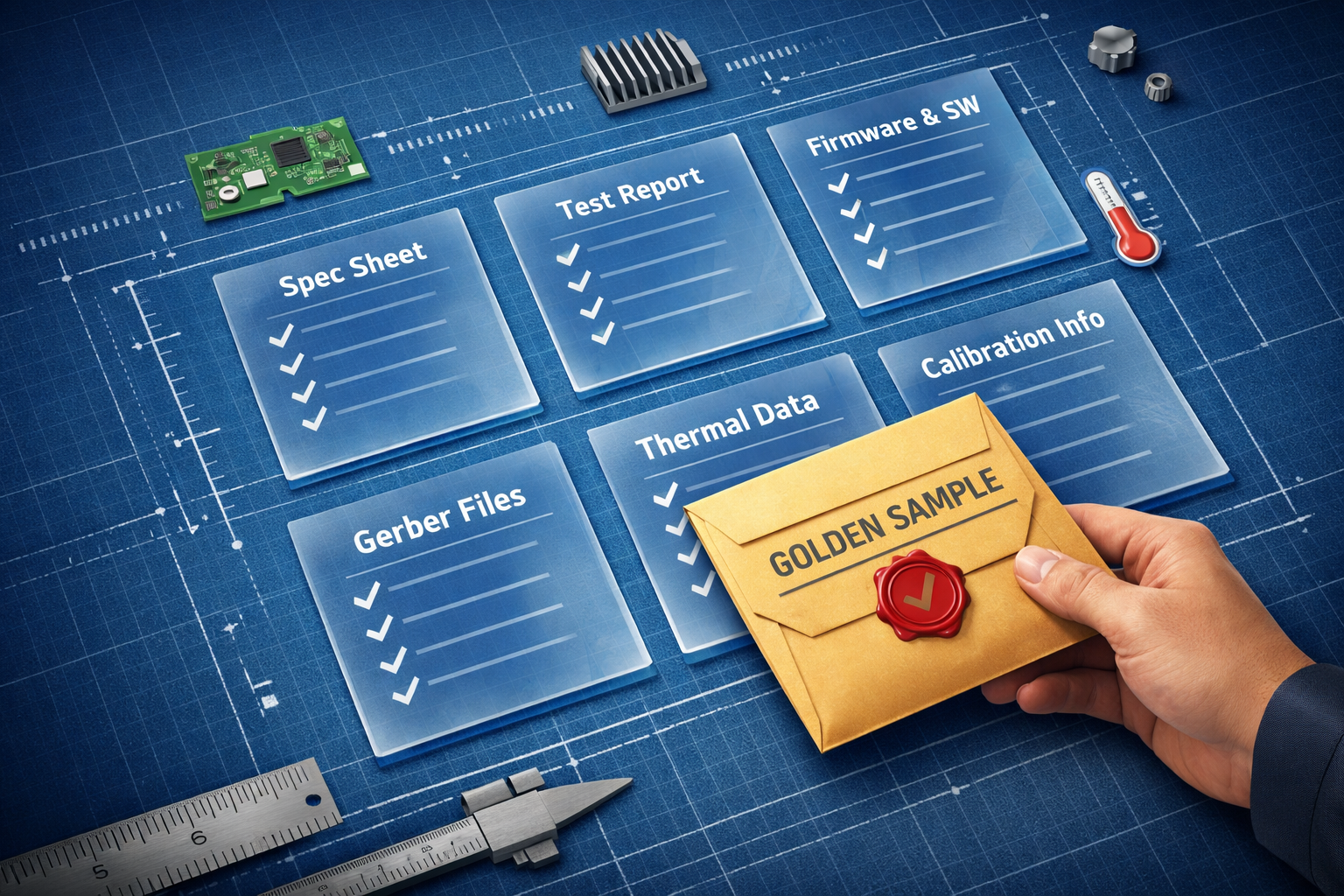
Your documentation package must include the serial number of the approved Golden Sample, the date of approval, the revision code that links to your current drawings and BOM, and an attachment list referencing all test data files. Store this package in a location that’s accessible to your quality team and can be retrieved quickly if disputes arise.
How to Keep Your Golden Sample from Drifting After Approval
Change Control Triggers
Any modification to materials, suppliers, manufacturing processes, or packaging must trigger a formal change request. The factory proposes the change, documents the technical rationale, and waits for your approval before implementation. This simple gate prevents well-intentioned cost savings from quietly degrading your product.
A change request should be mandatory when any of the following shifts:
- Materials or component suppliers (especially those touching acoustic performance)
- Production processes that affect fit, finish, or tolerances
- Packaging, labels, or included accessories
- Test method, fixtures, or calibration status
Each change must be evaluated against the Golden Sample standard to determine whether revalidation testing is necessary.
IQC/IPQC/FQC Must Reference the Golden Sample
Quality control isn’t a one-time event at final inspection. The Golden Sample prevents drift only if production gates keep pointing back to it.
Incoming Quality Control (IQC) verifies inbound components match the locked spec and reference. In-Process Quality Control (IPQC) ensures the build process stays inside the approved conditions during assembly. Final Quality Control (FQC) confirms finished units match the reference standard before shipment.
Every QC checkpoint should point to the same approved packet—Golden Sample plus revision set—so “acceptable” doesn’t get redefined on the fly.
International standards (such as ISO 17025) mandate measurement traceability to ensure test equipment remains calibrated and reliable over time. Measurement results are only meaningful when they can be related back to stable references through documented chains. Regular calibration of frequency response measurement systems and distortion analyzers prevents measurement drift from masking production quality issues.
What to Do If the Sample Fails (Without Blowing Up Your Schedule)
Classify Failures: Cosmetic vs Acoustic vs Reliability
Not all failures carry equal weight. A cosmetic issue—like a logo that’s slightly misaligned—might be acceptable if it doesn’t affect brand perception and can be corrected quickly. An acoustic failure that impacts frequency response requires immediate attention because it compromises the core product promise. A reliability concern discovered during stress testing might warrant a design change that delays production but prevents field failures.
Your classification system should guide corrective action priority and help you communicate severity to the factory. A minor cosmetic issue might be documented for correction in the next production batch. An acoustic failure requires immediate resampling with corrected components.
Fast Feedback Loop and Resampling Rules
Speed matters during new product introduction because delays cascade through your launch timeline. Establish clear resampling rules that prevent endless revision cycles.
If a sample fails acoustic validation, the factory should have 48 hours to identify the root cause and propose corrective action. If the issue requires component substitution, they should provide a revised sample within one week. If cosmetic issues persist after two resampling attempts, schedule a video call to review the concern in real-time rather than continuing to exchange photos and descriptions.
Resampling should follow a defined rule—what changed, what evidence is required, and which revision is now controlling.
Next Step: Get a Golden Sample Protocol You Can Run Consistently
Building a private label brand requires quality discipline that scales beyond your personal attention. The checklist you’ve just reviewed provides that structure, but implementation requires partnership with a manufacturing team that understands why these gates matter.
China Future Sound’s manufacturing system is ISO 9001:2015 certified, with in-house testing capabilities including KLIPPEL R&D and QC systems, Audio Precision analyzers, and frequency response test chambers. Our 6-acre facility produces 5,000 speakers and 1,000 amplifiers daily, with a 20-engineer R&D team that helps private label partners establish repeatable quality standards.
Whether you’re evaluating your first Golden Sample or refining an existing approval process, start with clear documentation. Request a custom OEM quote that includes your specific acoustic and cosmetic requirements, or reach out to discuss how Golden Sample protocols integrate with your broader pro audio manufacturing strategy.
Subscribe to our newsletter for additional QC playbooks that help growing brands build supply chain predictability.
Contact: hu@chinafuturesound.com | lisa@chinafuturesound.com
Phone: +86 139 6730 8635 | +86 180 5732 0802
Disclaimer: This article provides general guidance on quality control practices in OEM manufacturing. Specific requirements vary by product type, target market, and regulatory environment. Consult with qualified engineering and quality professionals to develop protocols appropriate for your application.
Our Editorial Process:
Our expert team uses AI tools to help ensure our content is accurate, relevant, and useful. Every article is reviewed by our Insights Team to ensure accuracy and clarity. The final content is always written with the goal of helping our readers make better sourcing and manufacturing decisions.
About the China Future Sound Insights Team
The China Future Sound Insights Team is our dedicated engine for synthesizing complex topics into clear, helpful guides. While our content is thoroughly reviewed for clarity and accuracy, it is for informational purposes and should not replace professional advice.