📌 Key Takeaways
The cheapest OEM quote often becomes the most expensive supply chain when quality failures compound into replacement costs, lost customer trust, and operational chaos.
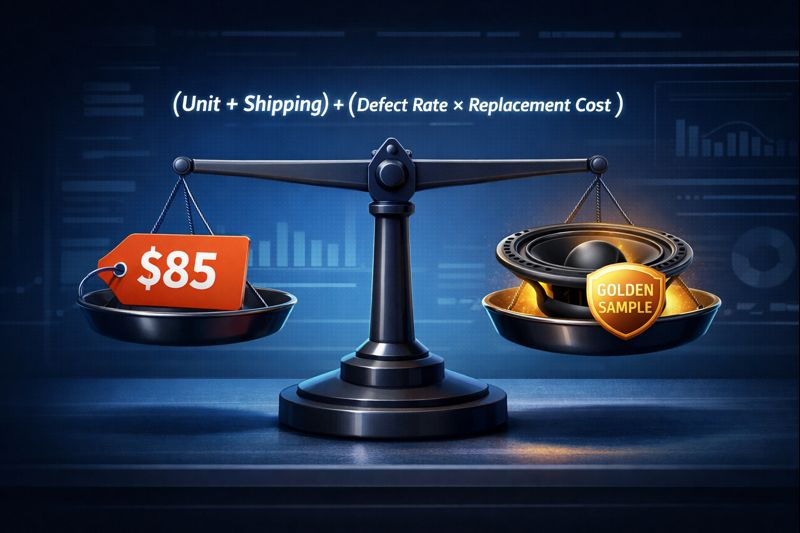
- TCO Math Reveals Hidden Costs: A supplier quoting $85 per unit with 8% defects costs $104.60 real cost, while a $92 supplier with 1% defects costs only $103.20—the “expensive” choice wins.
- Spec Drift Creates Silent Failures: Gradual, undocumented changes to adhesives, materials, or assembly processes cause defects that pass inspection but fail under real-world use.
- Golden Sample Discipline Predicts Consistency: Suppliers who treat the approved prototype as a binding standard across all production runs deliver predictable outcomes; those who don’t create risk.
- Quality Gates Must Be Documented: IQC, IPQC, and FQC systems with traceability catch deviations early, while suppliers without these controls ship problems downstream.
- Change Control Prevents Mid-Run Substitutions: Formal Engineering Change Order workflows ensure components don’t quietly swap during production, maintaining acoustic integrity across batches.
Predictability is the premium—not the unit price.
Online audio retailers building private label brands will gain a decision framework for evaluating manufacturing partners on risk rather than price alone, preparing them for the supplier evaluation questions that follow.
~ ~ ~ ~ ~ ~ ~ ~ ~ ~ ~ ~ ~ ~ ~ ~ ~ ~
It’s 2:00 AM. You’re on a WeChat call trying to explain a cone defect through a grainy video. The price you ‘saved’ is now paid back in time, stress, and risk.
For online audio retailers building private label brands, the lowest OEM quote can feel like a competitive advantage. But that $85-per-unit price tag doesn’t tell the whole story. When a shipment arrives with subtle acoustic deviations—voice coils that rattle under load, surrounds that separate after a few weeks—the real cost equation reveals itself. You’re not just paying for replacement units. You’re paying in lost customer trust, strained supplier relationships, and hours spent troubleshooting problems that should never have shipped.
The manufacturers who survive the transition from reseller to brand owner learn this quickly: predictability is the premium. The “lowest quote” is often the highest-risk supply chain.
Why the “Lowest Quote” Can Be the Most Expensive Decision
When evaluating subwoofer manufacturers, most buyers default to a simple comparison: unit price plus shipping. It’s visible, measurable, and easy to plug into a margin calculator. A supplier offering 20% less per unit looks like an immediate path to better profitability.
But this creates a dangerous blind spot. Audio manufacturing—especially for components like subwoofers—is sensitive to microscopic deviations. A voice coil assembly with poor concentricity—deviating as little as 0.5mm in the magnetic gap—can pass static visual inspection but suffer catastrophic rubbing or ‘rocking’ failures under high-excursion bass transients.[1] A cone material that meets thickness specifications but uses a slightly different resin formulation can crack after thermal cycling. These aren’t defects you catch during a factory walkthrough. They reveal themselves after units reach end customers.
The hidden variable is quality failure cost: the compound expense of defective units, warranty claims, replacement logistics, and reputational damage. For a growing e-commerce brand, one problematic batch doesn’t just erase the savings from a lower unit price. It can destroy months of work building channel credibility.
The Simple TCO Formula to Compare OEM Quotes (Without a Spreadsheet from Hell)
To make smarter sourcing decisions, you need a way to account for quality risk without building complex financial models. The Total Cost of Ownership approach uses a straightforward formula:
(Unit Price + Shipping) + (Defect Rate × Replacement Cost) = Real Cost
Let’s break down each variable:
| Variable | Meaning | Notes on Certainty |
|---|---|---|
| UP (Unit Price) | The quoted cost per unit from your supplier | Verified in any quote |
| S (Shipping) | Freight, duties, and landed cost per unit | Logistics costs vary by lane, terms, and timing |
| DR (Defect Rate) | The percentage of units that fail quality standards—either during your own inspection or after reaching customers | Measurement rules differ by factory; insist on definitions |
| RC (Replacement Cost) | The full cost of addressing a defective unit, including the replacement unit itself, return shipping, customer service time, and potential refunds or goodwill credits | Includes more than just the product itself |
Defect Rate is the unknown variable that separates low-cost suppliers from reliable partners. Replacement Cost typically includes the replacement unit itself, re-shipping or resending costs, customer support and internal coordination time, warranty exposure, and brand trust impact—elements that are hard to model precisely but devastatingly real.
Even a seemingly small defect rate compounds quickly at scale. Assume you’re evaluating two suppliers for a 1,000-unit order. Supplier A quotes $92 per unit. Supplier B quotes $85 per unit. Both charge $10 shipping per unit. The difference looks clear: you save $7,000 by choosing Supplier B.
But introduce quality failure into the equation. If Supplier B’s inconsistent manufacturing process results in an 8% defect rate, and each defective unit costs $120 to replace (including logistics and customer impact), your real cost becomes:
Supplier B Real Cost: ($85 + $10) + (0.08 × $120) = $104.60 per unit (excluding potential inventory holding costs and brand equity erosion).[3]
Supplier A, with rigorous quality gates and a 1% defect rate, actually costs less in total:
Supplier A Real Cost: ($92 + $10) + (0.01 × $120) = $103.20 per unit
The broader business implication becomes clear when you extend this thinking to gross profit. Your actual unit contribution follows this relationship:
Gross Profit (Unit Contribution) ≈ Selling Price − Real Cost[2]
If Real Cost rises because defect rate multiplied by replacement cost grows, profit compresses regardless of what the quote said on day one. The math here is illustrative—your actual defect rates and replacement costs will vary. The point is that without accounting for quality failure, you’re making decisions with incomplete information. A 20% price reduction evaporates if it comes with a 4-5 percentage point increase in defect risk.
Where Defects Actually Come From in Audio Manufacturing (The Parts You Don’t See in the Quote)
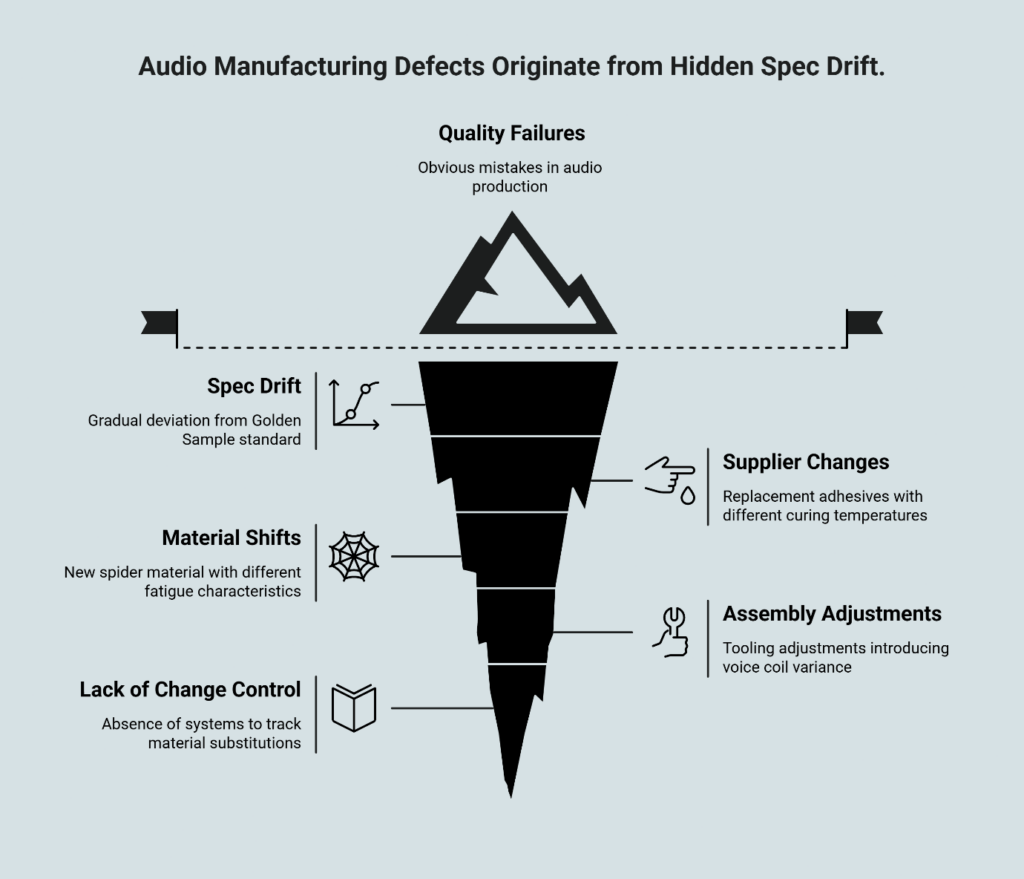
Most quality failures in OEM audio production don’t stem from obvious mistakes. They come from a phenomenon called spec drift: the gradual, often invisible deviation of components and processes from the original Golden Sample standard.
Here’s how it happens. During the prototyping phase, you approve a Golden Sample—a reference unit that defines the exact acoustic signature, material specifications, and build quality you expect. This sample becomes the binding standard for production. But without rigorous change control systems, subtle shifts occur over time.
A supplier sources a replacement adhesive from a different vendor. The tensile strength is within spec, but the curing temperature is slightly different, affecting cone damping. A production line shifts to a new batch of spider material. The compliance measurement matches the original, but the long-term fatigue characteristics don’t. An assembly technician adjusts tooling to speed up winding, introducing a 0.3mm variance in voice coil alignment.
Each change, in isolation, seems minor. Individually, they might pass incoming quality control checks that focus on dimensional tolerances. But audio components operate as integrated systems. Small deviations in multiple subsystems create cumulative acoustic distortion that doesn’t show up until units are tested under load—or worse, until customers report issues.
This is why change control in OEM audio production matters more than unit price. A supplier with documented processes for tracking every material substitution, every tooling adjustment, and every process modification can maintain Golden Sample consistency across production runs. A supplier without these systems can’t—even if they have good intentions.
The defect rate variable in the TCO formula isn’t random. It’s a direct reflection of whether a manufacturer has engineering discipline, traceability systems, and the internal processes to prevent spec drift.
What to Ask an OEM So You Don’t Pay for Units You Can’t Sell
When evaluating potential manufacturing partners, the questions you ask reveal more than a factory tour. Focus on the systems that prevent quality failure, not just the capabilities that enable production.
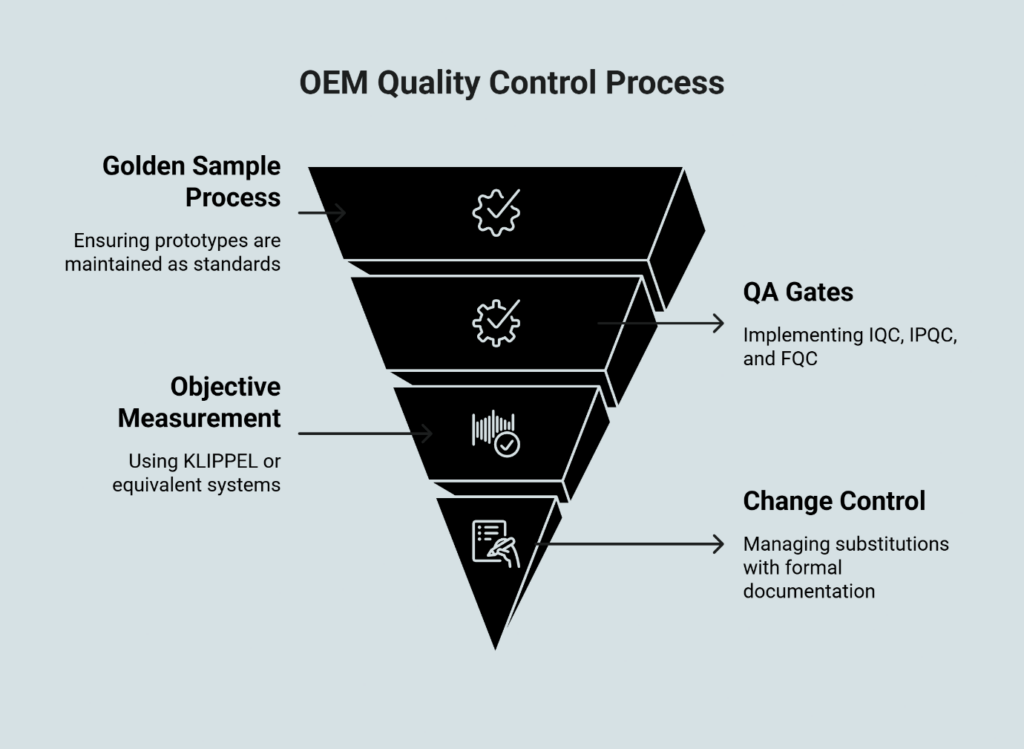
What is your Golden Sample process, and how is it used as the binding standard?
A reliable OEM will describe how the approved prototype is stored, how production units are compared against it during quality gates, and what happens when deviations are detected. If the answer is vague—or if the Golden Sample is treated as a one-time reference rather than an ongoing benchmark—that’s a risk signal.
What QA gates do you run (IQC/IPQC/FQC) and what gets recorded?
Look for a three-stage system structured around industry-standard quality control terminology:
- IQC (Incoming Quality Control): Checks on raw materials and components before they enter production
- IPQC (In-Process Quality Control): Inspections during assembly to catch issues before they compound
- FQC (Final Quality Control): Comprehensive testing before shipment to verify units match the approved standard
More importantly, ask what gets documented. Traceability matters. Systems like ERP/WMS integration with barcode or QR tracking mean every component can be traced back to its source batch if issues emerge later.
Do you have KLIPPEL QC or equivalent objective measurement?
Subjective listening tests have value, but objective acoustic measurement systems provide repeatable, documented evidence that units match the Golden Sample’s frequency response, distortion profile, and impedance curve. Suppliers with KLIPPEL or similar measurement capabilities can catch deviations that human testers miss.
How do you handle change control so parts don’t quietly swap mid-run?
The answer should involve formal documentation, engineering review, and customer notification before any substitution occurs—even for components the supplier considers equivalent. Look for evidence of an Engineering Change Order workflow with a clear cut-in plan so mixed builds don’t ship under one SKU. If the response is “we source the best available materials,” that’s not change control. That’s the recipe for spec drift.
These questions aren’t about being difficult. They’re about identifying whether a supplier has the infrastructure to deliver predictable outcomes. A manufacturer might have excellent equipment and skilled workers but still produce inconsistent results if they lack the systems to maintain standards across batches.
For reference, capabilities like ISO 9001:2015 certification, dedicated R&D teams with mechanical and acoustic engineering specialists, and FIFO inventory management with full traceability indicate a supplier has invested in the infrastructure that correlates with lower defect rates. These aren’t guarantees—but their absence is a warning.
The Practical Decision Rule: When Paying More is the Cheaper Option
The decision framework becomes clearer when you consider your risk tolerance and the maturity of your channel relationships. If you’re operating at low volume and one problematic batch could damage your standing with key retail partners or destroy your direct customer reviews, the cost of quality failure is disproportionately high. In this context, paying a premium for a supplier with proven QA systems and engineering rigor isn’t an expense—it’s insurance.
The tipping point shifts as volume increases and you develop the internal capability to absorb quality issues. Larger operations with dedicated quality teams, established reverse logistics processes, and deeper customer relationships can manage occasional defects without existential risk. But for growing e-commerce bass specialists building their first private label line, the margin for error is slim.
The decision rule is straightforward: when predictability matters more than the absolute lowest cost per unit, prioritize suppliers who treat the Golden Sample as a binding contract and who have documented systems to maintain that standard across production runs. When your business model can absorb variability and you have the internal resources to manage quality issues reactively, cost optimization becomes more viable.
This isn’t about always choosing the most expensive supplier. It’s about making the choice visible. Run the TCO calculation with realistic assumptions about defect rates and replacement costs. If a 20% price reduction evaporates with a 3% quality failure increase, you’re not saving money—you’re deferring cost and risk to a less convenient moment.
For most retailers transitioning from reseller to brand owner, the first OEM partnership is a test of whether private label is viable. Choosing a manufacturing partner based purely on unit price optimizes for the wrong variable. You’re not buying subwoofers. You’re buying the predictable delivery of units that match your approved Golden Sample, shipment after shipment, without surprises.
That’s what the lowest “real cost” looks like.
Subscribe to our newsletter to receive the complete OEM risk assessment checklist and stay informed on quality-focused manufacturing strategies for private label audio brands.
Explore our catalog of pro audio subwoofer solutions, or contact us to discuss your private label manufacturing needs. Learn more about our approach to quality-first OEM partnerships.
Disclaimer: This article provides general educational information about OEM manufacturing considerations for audio products. Specific quality outcomes, defect rates, and total cost calculations will vary significantly based on individual supplier capabilities, production processes, and product specifications. Readers should conduct their own due diligence and quality assessments when evaluating manufacturing partners.
Our Editorial Process:
Our content is developed through comprehensive research of industry practices, manufacturing standards, and quality management principles in audio production. We prioritize accuracy and practical utility for growing audio brands navigating OEM partnerships.
About the China Future Sound Insights Team
The China Future Sound Insights Team is our dedicated engine for synthesizing complex topics into clear, helpful guides. While our content is thoroughly reviewed for clarity and accuracy, it is for informational purposes and should not replace professional advice.