📌 Key Takeaways
Quality drift—gradual performance deviation across production runs—erodes your private-label amplifier brand even when specs stay unchanged, making the first successful batch a false indicator of ramp stability.
- Golden Sample Prevents Subjective Drift: A physically controlled, signed-off reference unit with documented acceptance criteria stops “it sounds fine” debates and anchors every production lot to measurable standards.
- Traceability Enables Minutes-Fast Containment: Systems binding test data to unit IDs through barcodes let you isolate affected serial ranges by component lot or shift within minutes, not days, when variance surfaces.
- ECO Cut-In Plans Stop Mixed Builds: Documenting exactly where old versions end and new ones begin prevents the highest-risk scenario—two different internal circuit versions shipping in identical boxes under the same SKU.
- Weekly Ramp Reviews Catch Drift Before Shipping: Monitoring yield trends, ECO logs, traceability gaps, and defining hard stop-ship triggers (like three consecutive same-root-cause failures) turns oversight meetings into release-authority checkpoints.
- Supplier Evidence Beats Quality Claims: Request end-of-line test reports, ECO workflow examples, and serial-to-solder-paste traceability records during selection—”we can do it” means nothing without format samples and historical proof.
Repeatability derives from system stability, not single-batch success.
Brand partners and product managers sourcing private-label amplifiers will find risk-reduction frameworks here, preparing them for the supplier evaluation criteria that follow.
Quality drift is the gradual departure from an approved performance baseline during volume production. It’s like putting your logo on a supply chain—if the supplier’s controls are weak, your brand is the one that pays the price.
Everything seemed fine three weeks ago. The first run of [insert typical batch size, e.g., 500 units] cleared the warehouse with zero issues. But now, consider a common failure scenario where incoming QC data indicates the second lot exhibits a detectable deviation [e.g., a 1.8% shift] in Thermal Protection thresholds and a statistically significant increase in Mean Noise Floor across Channel 3/4.
To protect your launch and your margins, you must verify three specific pillars of repeatability before the ramp begins: reference alignment through a golden sample, detailed traceability records, and a strict engineering change order (ECO) process.
Quality drift after the first run: what it means in private-label car amps
In the context of private-label car amps, quality drift refers to run-to-run variation in performance and defect behavior, even when the written specifications remain identical. Unlike a sudden catastrophic failure, drift is a silent erosion of consistency. A strong first run does not prove a supplier is ready for a stable ramp; it only proves they could make one good batch.
Repeatability is the result of a system, not a single test. When you partner with Amplifier Manufacturers, the goal is a predictable outcome where the 10,000th unit performs exactly like the approved sample.
Why drift happens even when the design “didn’t change”
When a program enters volume production, the environment becomes dynamic. Even if the engineering drawing hasn’t moved an inch, four primary mechanisms can trigger drift:
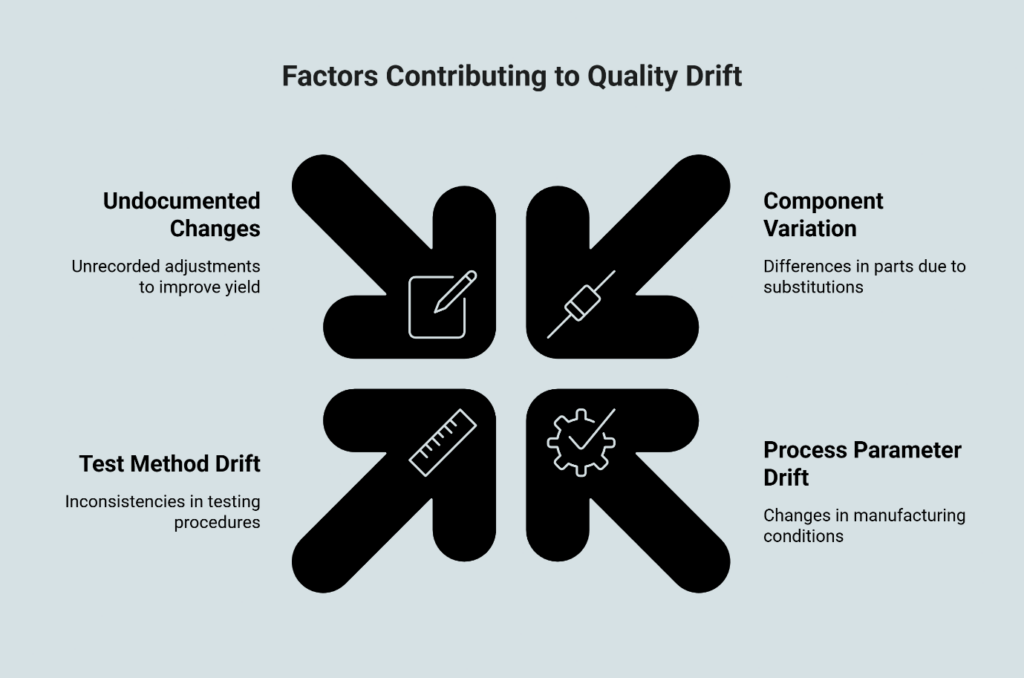
Component variation and substitutions
Global supply chains often force “equivalent” part substitutions to maintain schedules. A different brand of capacitor or a new lot of MOSFETs might meet the basic spec but exhibit different thermal coefficients. Without strict approval gates, these silent changes accumulate.
Process parameter drift
Manufacturing is sensitive to the physical environment. Reflow oven profiles can shift, manual torque drivers can lose calibration, and the fixtures used to hold PCBs can wear down over thousands of cycles. These small deviations lead to inconsistent solder joints or mechanical stress that only shows up after a few weeks in the field.
Test method drift
If the measurement system is not controlled, the pass/fail line moves. Test conditions differ—load impedance, supply voltage, or ambient temperature vary between runs. Thresholds get tweaked to “improve yield.” Calibration or fixture setup changes without being recorded. When the “ruler” changes, you can ship amps that are different while still “passing test.”
Undocumented engineering changes
The most dangerous drift comes from “small” tweaks made on the floor to improve yield without a formal ECO (engineering change order: a controlled process for approving and documenting changes). A firmware update or a DSP tuning adjustment that isn’t logged correctly creates a split in your inventory where some units under the same SKU behave differently than others. This is the highest-risk category because it creates mixed builds—two different internal versions shipping in identical boxes.
What quality drift looks like in the real world
For a growth-stage business, the consequences of drift are visible in your financial reports before they are visible on the workbench. You may notice:
- A rising rate of units arriving “Dead on Arrival” (DOA)
- Intermittent failures that tech support cannot replicate
- Mixed behavior under the same SKU, such as different thermal protection thresholds
- Higher return rates that erase the projected BOM savings [typically estimated between 10-20%] you initially negotiated
To mitigate margin erosion from variance, implement a three-tier control framework: Reference Alignment, Traceability, and Change Control.
To prevent your program from sliding into inconsistency, you must require a system built on three specific controls:
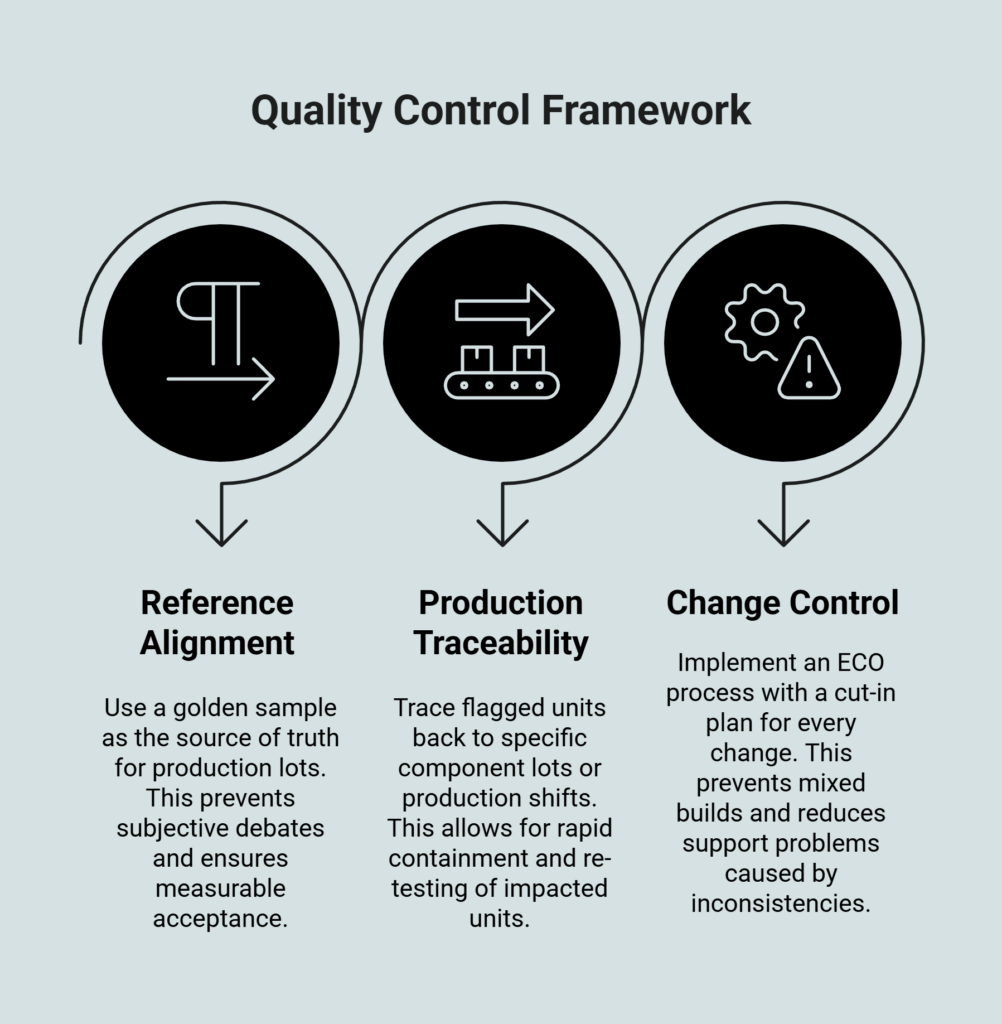
1. Golden sample alignment (Reference)
A golden sample prevents drift by providing a physical, signed-off “perfect unit” that acts as the source of truth for every production lot. It’s not a trophy unit—it’s a controlled reference tied to documented acceptance criteria and re-validated at defined checkpoints: pilot run, first mass production, and subsequent runs. Golden sample governance is also a way to keep subjective “it sounds fine” debates from replacing measurable acceptance.
For a practical workflow and sign-off structure, see: How ‘Golden Sample’ QA Prevents Defective Inventory
2. Production traceability (Records)
Traceability is only valuable if it maps to action: Which units are impacted? What changed? What can be segregated and re-tested? You should be able to trace any flagged unit during production back to a specific component lot or production shift in minutes, not days.
Look for containment-grade traceability—systems that bind test data to unit identification through barcodes or QR codes, and that support lot and material control in a way that makes containment feasible. Containment-grade traceability requires sub-lot granularity; if a supplier cannot isolate a specific MOSFET batch ID within a serial range, the traceability system fails to meet the standard for rapid containment.
3. Change control with a cut-in plan (Rules)
Every change must be approved through an ECO process that includes a “cut-in” plan—a documented point where the old version stops and the new version starts. This prevents “mixed builds” where two different versions of the internal circuitry are shipped in the same box, creating the highest-risk drift category where small changes become big support problems.
Drift Early Warning Checklist
Monitor these 6 signals during weekly ramp reviews to catch drift before it ships.
| Signal | Evidence to Request | Containment Action |
|---|---|---|
| Test yield shifts | Weekly First Pass Yield (FPY) reports | Hold lot if yield drops >5% vs. baseline |
| BOM substitutions | Supplier Change Notice (SCN) log | Verify thermal impact of alternate parts |
| Calibration gaps | Last-calibration dates for ATE fixtures | Re-test lot if fixture calibration is expired |
| Firmware mismatch | DSP/Firmware version log per lot | Flash units to the approved version |
| Environment drift | Ambient temp/humidity logs of test area | Adjust test limits for environmental bias |
| Lot mixing | Serial number vs. Pallet ID records | Segregate lots for 100% audit |
How to structure a weekly ramp review so drift gets caught
Effective oversight requires a disciplined meeting cadence during SOP (start of production). Weekly ramp reviews exist to answer one question: Can we confidently release the next shipment? To make that call, decision-makers need visibility into:
- Yield Trends: Are failure categories shifting? If “Power Stage Failure” suddenly jumps, something in the process has changed.
- ECO Log: Review any open engineering changes and confirm they haven’t been cut into production without your signature.
- Traceability Exceptions: Flag any units that have missing test data in the system.
- Escalation Triggers: Define exactly when to “Stop-Ship.” For example, three consecutive units failing for the same root cause should trigger an immediate line halt.
Ownership and recordkeeping
Assign clear accountability: one decision-maker owns quality gates, one owns ECO governance. Maintain a lightweight decision log capturing what changed, what evidence supported the call, and what action was authorized. This structure prevents “review theater” where meetings happen but release authority remains unclear.
What to request from an OEM/ODM partner when drift risk is a concern
If you are currently evaluating supplier selection frameworks, do not ask if they have “high quality.” Instead, ask for evidence of their repeatability systems:
- Request a sample end-of-line testing evidence report from a similar program
- Ask to see their ECO workflow and a history of how they managed a forced component substitution
- Verify their traceability depth—can they link a serial number to a specific solder paste lot?
If an answer is “we can do it,” follow with “show the record format and the last example.”
If your team is still selecting partners, a sourcing-ready evaluation structure is here: OEM Amplifier Supplier Selection: A Risk-Minimized Sourcing Framework for Audio Brands
Conclusion: Reliability is a derivative of system stability.
“A strong first run is not proof of a stable ramp—controls are.” In the world of high-performance audio, your brand reputation depends on the consistency of the hardware behind the logo. By enforcing golden sample alignment, deep traceability, and strict change control, you move from “hoping the next lot is good” to “knowing the system is stable.”
If your current program is facing rising DOA rates or silent variation between runs, contact us to discuss program controls offline.
Disclaimer: This guide is for informational purposes only. When establishing manufacturing programs, organizations should consult quality management professionals and review relevant standards such as ISO 9001.