📌 Key Takeaways
Supply chain instability costs more than emergency freight—it drains cash, damages reputation, and keeps teams in constant crisis mode instead of building growth.
- Predictability Outperforms Promises: A supplier consistently delivering in 45 days beats one promising 30 but delivering in 50—track actual versus promised lead times to separate reliable partners from optimistic ones.
- Golden Samples Prevent Specification Drift: Physical reference units signed off by both parties eliminate the “which version did we approve” confusion that leads to inconsistent production runs and field failures months after shipping.
- Single-Factory Concentration Creates Single Points of Failure: Concentrating all production with one manufacturer for simplicity actually builds fragility—capacity diversification across vetted factories protects against disruptions without splitting every SKU.
- Communication Rhythm Matters More Than Contract Terms: Proactive partners who share QC reports, batch data, and production schedules early enough for adaptation outperform those hiding behind legal language until problems become crises.
- Quick Wins Versus Structural Risks: Low scores on communication rhythm can improve through monthly checkpoint calls, but chronic overcommitment and capacity mismatches require new manufacturing relationships—not better conversations.
Audio distributors managing multi-channel fulfillment will find this framework here, preparing them for the detailed 10-point scorecard and evaluation criteria that follow.
Consider an audio distributor in the final week before a major order fulfillment cycle. The container they’d been counting on—the one that should have cleared customs two weeks ago—sits delayed at port. Their operations manager is managing unfulfilled purchase orders across multiple channels. Their business development team has commitments to brand partners that can’t be honored. By the time inventory finally arrives, the delivery window has closed, leaving them with inventory mismatch and strained business relationships.
This scenario plays out repeatedly across the audio distribution industry, but it’s not inevitable. Supply chain stability in B2B audio means predictable lead times, consistent specifications and performance across production runs, and low variance in defect rates. Think of it like a live sound system where one unreliable cable can kill the entire show regardless of how good the rest of the gear is. Your supply chain works the same way—a single weak link creates cascading failures that no amount of inventory planning can prevent.
This article gives you a structured, 10-point checklist to score existing and potential suppliers so you can design stability into your audio supply chain.
Why Supply Chain Stability Matters More Than “Just Having Stock”
Most distributors think supply chain stability means maintaining full warehouses. That’s actually the expensive symptom of an unstable supply chain—you’re holding excess inventory as insurance against unpredictability. Real stability means building a predictable, low-risk pipeline that lets you focus on growth instead of constant firefighting.
The difference shows up in three places that directly affect your bottom line. Cash flow improves because you’re not tying up capital in safety stock or paying premium freight charges for emergency shipments. Brand reputation strengthens because consistent quality means fewer DOAs and fewer field performance issues from bad production runs. Your team shifts focus from damage control to actually building your business—more time on product development and channel expansion, less time on supplier escalations and technical recovery.
This isn’t just anecdotal concern. The World Economic Forum’s Global Risks Report 2023 documents how supply chain disruptions have emerged as a persistent challenge for businesses across industries, with organizations reporting significant operational difficulties in maintaining stable delivery timelines and meeting commitment schedules in the post-pandemic business environment.
A stable supply chain transforms from an abstract goal into measurable risk scores through systematic evaluation. The checklist in this article provides that measurement framework, turning gut feelings about factories into documented assessments you can act on.
The Four Pillars of a Stable Audio Supply Chain
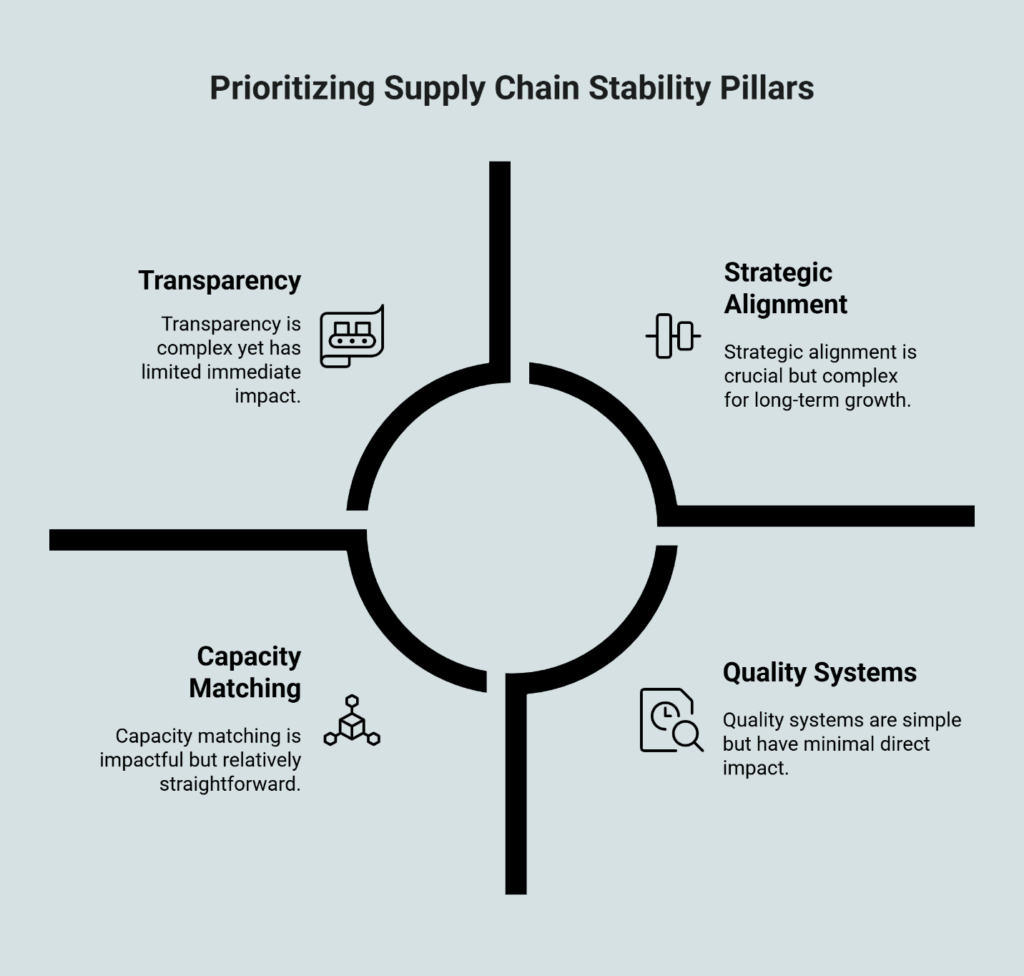
Supply chain stability rests on four foundational elements: quality systems you can verify, capacity that matches your demand patterns, transparency that prevents surprises, and strategic alignment that supports your long-term growth. Understanding these pillars helps you ask the right questions and evaluate what matters.
Pillar 1 – Quality & QA Systems You Can Trust
A stable speaker wholesaler relationship starts with documented, repeatable quality processes and a golden sample protocol. The golden sample concept means your supplier maintains a physical reference unit—signed off by both parties—that defines the standard for every production run. When manufacturing begins, automated acoustic testing using systems like KLIPPEL compares each batch against this golden sample, ensuring consistency rather than hoping for it.
Look for suppliers with ISO 9001:2015 certification or equivalent quality management systems. ISO 9001 establishes a framework emphasizing documented processes, measurement, and continual improvement to deliver consistent products. This isn’t bureaucratic overhead—it’s evidence of systematic discipline. Multi-stage quality control should include IQC (incoming quality control) for raw materials, IPQC (in-process quality control) during assembly, and FQC (final quality control) before shipping. Reliability testing including power tests and life-cycle testing catches slow-burning problems that only appear after months in the field.
When evaluating a supplier’s QA systems, ask specific questions: “Show me how you document and store golden samples.” “What tests do you run on every unit versus sample units?” “How do you handle golden sample updates when designs change?” “Can I see your most recent audit report?” These questions reveal whether quality management is real or just marketing language.
Pillar 2 – Capacity, Lead Times & Production Flexibility
Stability requires capacity that matches your demand curve and honest communication about constraints. A factory might have impressive total capacity, but if they’re already running at 95% utilization, they can’t absorb your growth or handle unexpected volume. You need to understand not just their current capacity but their ability to support container-sized orders alongside smaller private-label pilots.
Factory size matters. A six-acre facility with 300 employees produces differently than a smaller operation—both in daily output and ability to handle complexity. When evaluating audio suppliers, ask about their standard lead times versus peak-period lead times. Manufacturing has predictable pressure points—Chinese New Year being the most significant—where capacity tightens across the industry. Suppliers who acknowledge these constraints and plan around them are more reliable than those who promise consistent lead times year-round.
Track actual versus promised lead times for every order. This data becomes part of your scorecard. A supplier who consistently delivers in 45 days when they promised 40 is more valuable than one who promises 30 but delivers in 50. Predictability beats optimism.
Pillar 3 – Transparency & Communication
Stable relationships rely more on proactive communication than on legalese. When problems emerge—and they will—you need a partner who tells you early enough to adapt rather than presenting you with a crisis at the last minute. This transparency starts with systems: ERP and WMS platforms, FIFO inventory management, and barcode or QR traceability that lets suppliers quickly identify and contain issues when they arise.
Look for willingness to share QC reports, batch data, and production schedules. Some suppliers treat this information as proprietary; others recognize that transparency builds trust and prevents downstream problems. The difference matters when you’re trying to diagnose a quality issue or verify compliance documentation for a distribution partner.
Guidance from NIST emphasizes the importance of visibility and traceability across supply chains to detect and manage issues quickly. In practical terms for audio distributors, this means establishing regular communication protocols. Set recurring checkpoint calls—weekly during new product launches, monthly for established programs—and note responsiveness as a separate line item in your evaluation. Language fluency matters too. If your main contact struggles to explain technical problems clearly, you’ll waste time clarifying issues that should be straightforward.
Pillar 4 – Strategic Fit & Risk Diversification
Strategic fit includes how well the factory supports your private label roadmap, not just your next purchase order. One critical mistake distributors make is concentrating all production with a single factory for “simplicity.” That’s not simple—it’s a single point of failure. If that factory faces a disruption, your entire product line goes down with it.
View new manufacturing partners as capacity expansion and risk diversification, not just cost reduction opportunities. Score potential suppliers on appetite for customization, alignment with your 12-24 month product roadmap, and openness to pilot runs and iteration. A factory that only wants large, repeating orders won’t support your growth into private label products that require engineering collaboration and phased launches.
Consider hybrid inventory models where you maintain production relationships with multiple vetted factories. This doesn’t mean splitting every SKU—it means building redundancy into your supply network so a problem with one partner doesn’t shut down your business. For more detailed guidance on understanding the OEM/ODM manufacturing process, explore how engineering-led partnerships differ from transactional vendor relationships.
The 10-Point Vendor Reliability Scorecard (Your Checklist)
This scorecard functions as a zero-click assessment tool. Print it, copy it to a spreadsheet, or use it during supplier meetings. Score each checkpoint from 1 to 5, where 1 represents significant concern and 5 represents strong confidence.
How to Use This Scorecard
Focus first on patterns rather than individual scores. Low scores clustered in Quality, Traceability, or Strategic Fit signal fundamental problems that require immediate attention. The goal isn’t achieving perfection across all ten checkpoints—it’s identifying risk concentrations and making informed decisions about where to invest in improvements or backup capacity.
Treat scores as starting points for discussion, not rigid approval formulas. A supplier scoring 3 on “Communication Rhythm” might improve dramatically with a simple agreement to hold monthly checkpoint calls. A supplier scoring 2 on “Traceability & Data Access” indicates a structural problem requiring significant investment to resolve.
Summary of the 10 Checkpoints
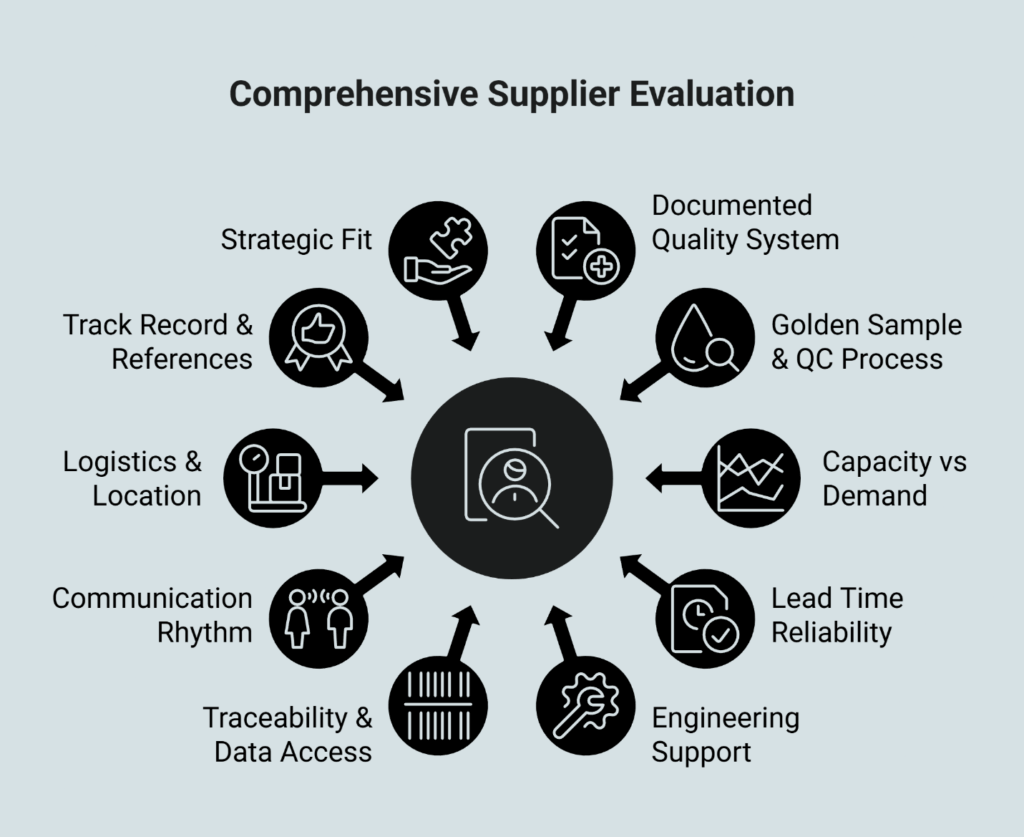
- Documented Quality System – Formal quality management system with audits and clear procedures
- Golden Sample & QC Process – Reference standard with acoustic testing and batch-level verification
- Capacity vs Your Demand Curve – Ability to handle forecast volumes without constant stress
- Lead Time Reliability – Historic performance and honest communication about constraints
- Engineering Support & Problem-Solving – Access to technical staff for design and troubleshooting
- Traceability & Data Access – Systems enabling batch tracking and root cause analysis
- Communication Rhythm – Responsiveness and predictable update cadence
- Logistics & Location Advantage – Port proximity and shipping experience to your markets
- Track Record & References – Proven performance in similar markets and conditions
- Strategic Fit with Your Roadmap – Alignment with private-label ambitions and long-term programs
Detailed Scorecard Table
| # | Checkpoint | What to Ask / Look For | Score (1–5) |
|---|---|---|---|
| 1 | Documented Quality System | ISO 9001:2015 or equivalent certification; written procedures accessible to operations teams; recent audit reports; evidence that procedures are actually followed, not just documented | |
| 2 | Golden Sample & QC Process | Existence of physically signed golden samples; use of automated acoustic testing (KLIPPEL or equivalent); clear pass/fail criteria; documented process for golden sample updates when designs change | |
| 3 | Capacity vs Your Demand Curve | Current utilization rate leaves room for your growth; facility size and workforce match the scale of programs you’re planning; ability to handle both container loads and smaller pilot runs | |
| 4 | Lead Time Reliability | Track record of on-time delivery over past 12 months; clear distinction between standard lead times and peak-period lead times; honest communication when delays are possible rather than optimistic promises | |
| 5 | Engineering Support & Problem-Solving | Access to actual engineers for DFM (design for manufacturing), acoustic tuning, and issue resolution—not just sales representatives; evidence of technical problem-solving in previous programs | |
| 6 | Traceability & Data Access | ERP/WMS systems in place; barcode or QR code traceability for batch tracking; willingness to share QC reports, batch data, and production schedules; demonstrated ability to trace issues quickly | |
| 7 | Communication Rhythm | Responsiveness to inquiries (within 24-48 hours); language fluency adequate for technical discussions; pre-agreed update cadence (weekly for new programs, monthly for established ones) | |
| 8 | Logistics & Location Advantage | Proximity to major ports (Shanghai, Shenzhen, etc.); familiarity with shipping routes to your region; understanding of customs and compliance requirements for your market | |
| 9 | Track Record & References | Years in operation serving similar markets; willingness to provide references from comparable businesses; demonstrated performance during recent disruptions (COVID-19, supply shortages, etc.) | |
| 10 | Strategic Fit with Your Roadmap | Alignment with your private label ambitions rather than viewing you as a spot-order customer; willingness to support long-term programs with reasonable MOQs for new product testing; appetite for collaborative product development |
For a more comprehensive evaluation framework, review this factory evaluation checklist for amplifier manufacturing that expands on these concepts with 30 detailed checkpoints.
Total each supplier’s score. A score below 35 indicates significant supply chain risk requiring immediate attention. Scores between 35-40 suggest specific areas for improvement that should be addressed through negotiation or operational changes. Scores above 40 indicate a stable foundation, though no supplier is perfect—continue monitoring for degradation over time.
How an Engineering-Led OEM Partner Improves Supply Chain Stability
Each checkpoint in the scorecard maps directly to capabilities that engineering-led OEM partners bring to the relationship. This matters because supply chain stability isn’t just about checking boxes—it’s about finding manufacturing partners whose operational discipline makes consistent execution inevitable rather than hopeful.
Consider how systematic QC and reliability testing prevent field failures. Many quality problems emerge not during initial production but months later when products reach end users. An engineering-led manufacturer runs power tests and life-cycle testing that simulate long-term usage, catching these issues before they become warranty claims and performance issues. Golden sample management provides a single reference point for every production run, eliminating the “which version did we approve?” confusion that leads to specification drift.
Traceability through ERP and WMS systems enables quick containment when issues appear. Suppose a batch shows elevated failure rates three months after shipping. Barcode traceability lets you identify exactly which production run, which component suppliers, and which clients received affected units. Without this system, you’re forced into blanket recalls or hoping the problem resolves itself—neither option protects your brand.
Capacity and flexibility matter differently than you might expect. Large-scale manufacturing facilities can handle both container loads for your established products and smaller pilot runs for testing new designs. This dual capability means you’re not forced to choose between scale and innovation. Your car audio production can grow without switching suppliers every time your volume increases.
The real question behind these capabilities is one of discipline and craft. Engineering-led partners view manufacturing as precision work requiring controlled conditions and documented processes. This stands in contrast to two common alternatives in the market: “The Value Champion” approach focused on lowest BOM cost at the expense of consistency, and “The Simplicity Play” pushing dropship-only models that eliminate your ability to build differentiated private label products.
Look—let’s be practical about this. You’re not choosing between cheap and expensive. You’re choosing between predictable costs and unpredictable crisis management. The hidden expenses of instability—emergency air freight, excess safety stock, technical recovery, warranty exposure—can significantly erode gross margins on affected products. A more expensive but reliable partner often costs less once you account for what stability actually prevents.
How to Use This Checklist with Your Current and Future Suppliers
Apply this scorecard to your current suppliers first. The exercise reveals patterns you might have sensed but never quantified. Score each supplier across all ten checkpoints, then look for two things: quick wins and structural risks.
Quick wins are issues you can resolve through better communication or modified expectations. Perhaps your supplier scores poorly on “Communication Rhythm” not because they’re unreliable but because you never established regular checkpoint calls. Set up monthly reviews and watch that score improve. Maybe “Engineering Support” is weak because you’ve been working through a sales rep rather than directly with technical staff. Request direct engineering contacts for your next program.
Structural risks are harder. Heavy dependence on a single factory for all critical SKUs is a structural risk. You can’t fix it with better communication—you need capacity diversification. A supplier scoring low on “Lead Time Reliability” due to chronic overcommitment is a structural risk. They’re not going to suddenly develop better capacity planning; you need alternatives.
When evaluating new suppliers, use the checklist during your RFQ process. Take notes during factory visits, paying particular attention to checkpoints 1, 2, and 6—these require direct observation to verify. During engineering calls, assess checkpoint 5 by asking technical questions and observing who responds. If the sales rep deflects technical questions or can’t connect you with engineering, that’s a warning sign.
Research published in Harvard Business Review demonstrates how transparency and resilience in supply chain partnerships create measurable competitive advantage rather than simply adding cost. Using a structured scorecard helps growth-stage audio distributors apply that principle in a concrete, program-level way. For detailed guidance on vetting and securing your manufacturing partnerships, review frameworks specific to audio manufacturing risk management.
This evaluation should inform specific decisions: which suppliers to grow with, where to add a second factory, and what conditions to negotiate. For instance, if a supplier scores well on most checkpoints but poorly on “Communication Rhythm,” you might negotiate explicit requirements into your agreement—weekly status updates, 24-hour response time for critical issues, quarterly business reviews.
The scorecard also helps you make the second-factory decision less emotional. When your primary supplier scores below 40 overall or shows particular weakness in strategic areas like capacity (checkpoint 3) or strategic fit (checkpoint 10), you have data-driven justification for diversification rather than basing the decision on a single bad experience.
Next Steps: From Checklist to Real Supply Chain Stability
Supply chain stability is not accidental. It emerges from asking better questions, choosing better partners, and using structured evaluation frameworks to guide decisions. The ten checkpoints in this article give you a repeatable method for assessing manufacturing relationships and identifying risk before it creates business impact.
This scorecard supports a broader shift away from “lowest price wins” thinking toward a worldview where manufacturing consistency and traceability are recognized as key drivers of distribution profitability. Understanding that quality systems and reliability testing protect margins through reduced field failures and warranty costs becomes central to building sustainable competitive advantage in the audio distribution market.
Start by scoring your current suppliers this week. Block an hour, pull recent communications and delivery data, and work through the checklist for each active manufacturing relationship. The patterns you discover—clusters of low scores, single suppliers representing dangerous concentration, misalignment between your growth plans and partner capabilities—become your roadmap for the next 6-12 months of supply chain improvement.
If you’d like a second pair of eyes on your vendor scores, get in touch with our team to walk through your checklist and discuss options for stabilization or capacity expansion. We’ll help you identify risk points and explore practical steps for building resilience into your supply network.
For ongoing tools and frameworks on OEM sourcing, quality assurance protocols, and private label growth strategies, subscribe to receive practical resources designed specifically for audio distributors navigating manufacturing partnerships.
Our Editorial Process
Our expert team uses AI tools to help organize and structure our initial drafts. Every piece is then extensively rewritten, fact-checked, and enriched with first-hand insights and experiences by expert humans on our Insights Team to ensure accuracy and clarity.
About the China Future Sound Insights Team
The China Future Sound Insights Team is our dedicated engine for synthesizing complex topics into clear, helpful guides. While our content is thoroughly reviewed for clarity and accuracy, it is for informational purposes and should not replace professional advice.