📌 Key Takeaways
Ship on schedule by running your OEM/ODM program as a gated, sample-led process that clarifies ownership, artifacts, and pass/fail decisions.
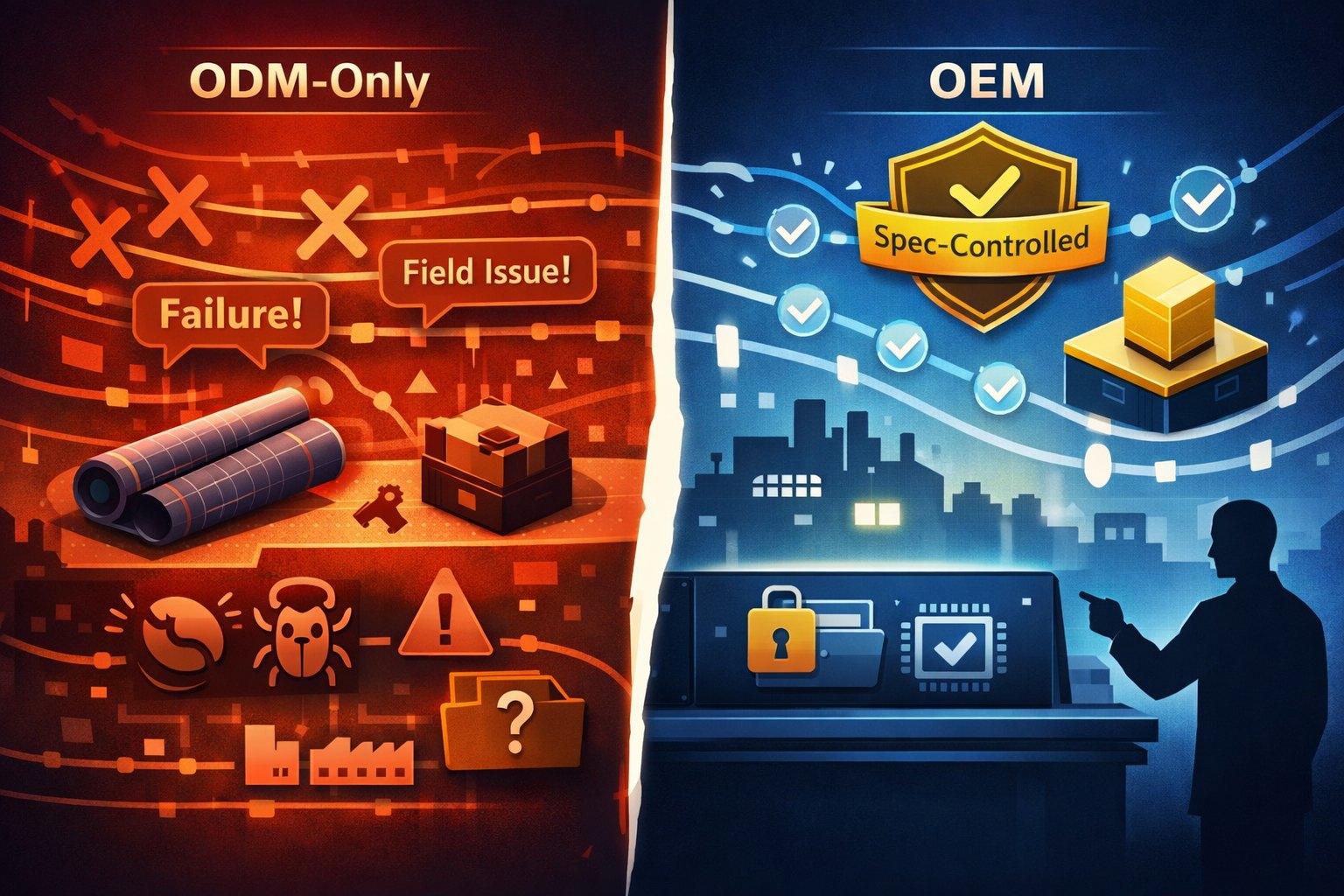
Treat Manufacturing as Risk Management: Use a seven-stage, gate-driven plan with clear owners, required artifacts, and pass/fail criteria to prevent defects, delays, and IP leakage.
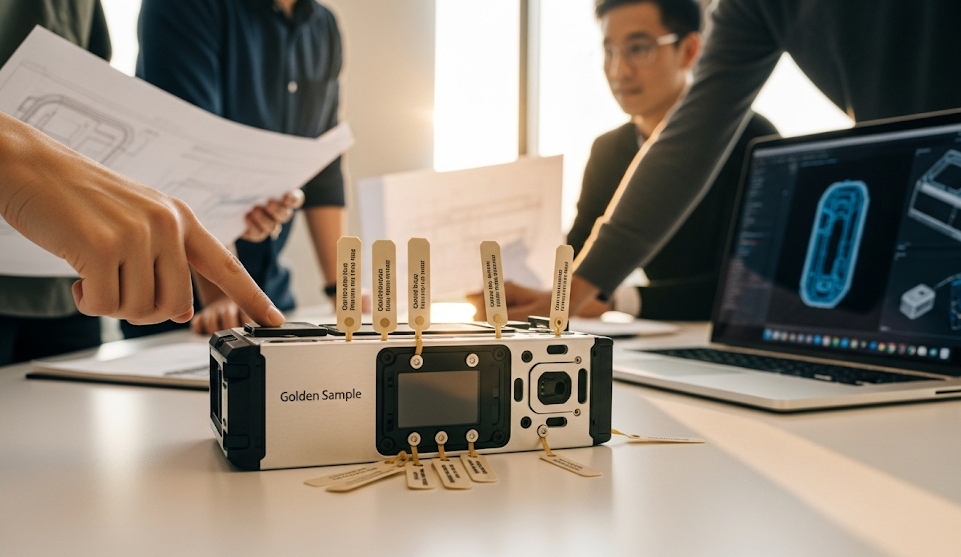
Lock the Golden Sample Before the PO: Approve a labeled, photo-documented Golden Sample and make it the single source of truth for QC plans, work instructions, and mass-production acceptance.
Close DFM Before Tooling: Resolve DFM issues and document them upfront to avoid tooling resets, costly rework, and downstream schedule slips.
Tie Quality to AQL and the Sample: Issue an AQL-based QC plan and FQA checklist explicitly referencing the Golden Sample to keep lots consistent and acceptance unambiguous.
Fix Logistics Early, Not at the Dock: Lock INCOTERMS, packing specs, and handoffs in writing so cost and risk are clear and cartons survive transit without surprise fees or damage.
Golden Sample locked, gates passed, on-time loading.
Breathe.
The conference room is quiet. A prototype sits between sample swatches and cost spreadsheets while a team wonders what happens next—and who owns which step. You need a clear map, not more jargon. Here it is.
The goal is simple: a seven-stage, gated process that shows who does what, which artifacts lock decisions, and how each gate reduces risk. The destination? Predictable lead times, fewer defects, and on-time loading—without last-minute airfreight.
According to the China Future Sound process framework, an OEM/ODM program runs as a gated project plan from Design Review to Shipping. Treating it as risk management—not just procurement—reduces delays, protects IP, and aligns teams around a Golden Sample that becomes the single source of truth for mass production and quality control (QC).
Key Terminology (for fast alignment)
- OEM vs. ODM
OEM: Factory builds to your design/spec. ODM: Factory offers a base design you can tailor. - Golden Sample
The approved, labeled, final reference sample—used to drive QC plans and work instructions. - INCOTERMS
Standard trade terms defining cost/risk hand-offs in international shipping.
“A Golden Sample is your single source of truth—lock it before POs, and your factory and QC teams will stay aligned.”
Why a Gated OEM/ODM Process Prevents Costly Surprises
A properly gated process forces clarity: roles, artifacts, and pass/fail criteria. It also defends margin. Skipping gates appears faster, but it often triggers rework, returns, and expedited freight—delays that cost more than the time “saved.”
Stakeholder lens:
Economic stakeholders see predictable lead times and fewer expedites; engineering sees alignment to the Golden Sample; sourcing/product managers get a stage-by-stage artifact checklist to run supplier meetings.
The 7-Stage OEM/ODM Manufacturing Checklist (With Roles & Required Artifacts)
How to use this asset: Print or share it for your next vendor call. Each stage lists Owner, Required Artifacts, and the Gate.
- Design Review — DFM, BOM, IP Safeguards
- Owner: Buyer leads requirements; factory leads DFM.
- Artifacts (required): DFM notes, preliminary BOM, drawings/specs, draft NNN/IP protections. (NNN = Non-use, Non-disclosure, Non-circumvention.)
- Gate: DFM issues resolved; specs and IP terms acknowledged.
- Why it matters: DFM before tooling reduces rework and time.
- Prototyping — Golden Sample Path
- Tooling — Molds, Lead Times, T1/T2 Trials
- Owner: Factory leads; buyer approves trial outcomes.
- Artifacts (required): Tooling plan, T1/T2 trial reports, updated DFM close-outs.
- Gate: Trials meet spec; readiness for pilot confirmed.
- Material Sourcing — Approved Vendors, Compliance
- Owner: Factory sources; buyer approves critical vendors/materials.
- Artifacts (required): AVL (approved vendor list), compliance certificates, traceability records.
- Gate: Materials approved and kitted; compliance confirmed.
- Assembly — Line Setup, Work Instructions
- Owner: Factory runs build; buyer audits readiness.
- Artifacts (required): Work instructions referencing the Golden Sample, labeled photos, torque/fixture settings.
- Gate: Pilot build matches Golden Sample; line ready for mass production.
- Quality Control — AQL, FQA, Lot Sampling
- Owner: Factory QC executes; buyer sets acceptance criteria.
- Artifacts (required): QC plan with AQL sampling, FAI/PPAP as applicable, FQA checklist.
- Gate: FQA passed against Golden Sample and QC plan.
- Shipping — INCOTERMS, Packing, Handoffs
- Owner: Factory executes packing/shipping; buyer confirms terms/forwarder.
- Artifacts (required): Packing spec with carton/drop tests as applicable, INCOTERMS agreed, handoff instructions.
- Gate: On-time loading with correct documents and damage-resistant packing.
Roles & Artifacts (Mini-Table)
| Stage | Primary Owner | Must-Have Artifacts | Gate (Pass/Fail) |
|---|---|---|---|
| Design Review | Buyer + Factory (DFM) | DFM notes, BOM, drawings, NNN | DFM issues closed |
| Prototyping | Factory | Labeled Golden Sample + photos | Golden Sample approved |
| Tooling | Factory | Tooling plan, T1/T2 reports | Trials meet spec |
| Material Sourcing | Factory | AVL, compliance certs | Materials approved |
| Assembly | Factory | Work instructions linked to Golden Sample | Pilot matches sample |
| Quality Control | Factory QC + Buyer criteria | QC plan with AQL, FQA checklist | FQA passed |
| Shipping | Factory + Buyer logistics | Packing spec, INCOTERMS | On-time loading |
Typical Timelines, Decision Gates, and Ownership Matrix
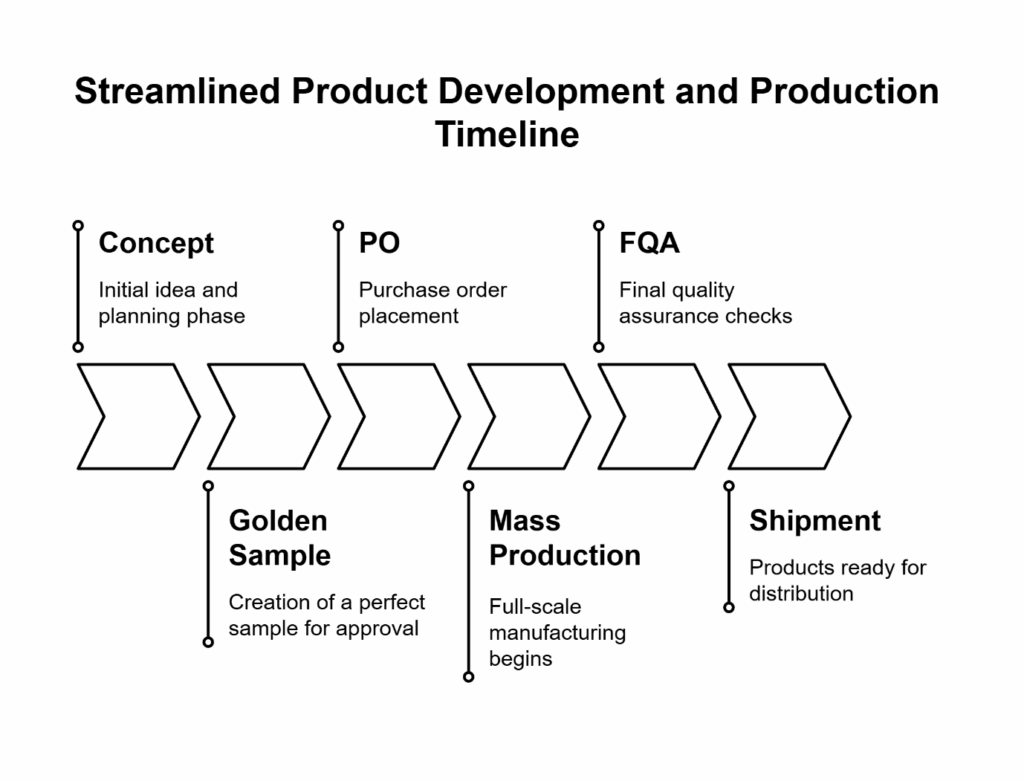
While exact durations vary by product and factory, decisions usually lock in this sequence: Concept → Golden Sample → PO → Mass Production → FQA → Shipment. Approve the Golden Sample before issuing the PO whenever possible; it reduces the probability of downstream change orders, retests, and escalation.
When to Approve the Golden Sample and Place the PO
Approve the Golden Sample first, then place the PO with the sample and QC plan referenced in the contract and packing specs. This keeps production, QC, and logistics synchronized to the same baseline.
Myth & Fact
Myth: “If we push straight to production, we’ll save time.”
Fact: Skipping gates creates rework and delays; in practice, gates reduce net timeline and total cost by preventing defects, airfreight, and returns.
Risks & Mitigations (target at least three)
- Skipping DFM → Tooling rework and slips. Mitigation: Hold a DFM close-out before tooling release; require sign-off artifacts.
- Vague QC criteria → Inconsistent lot acceptance. Mitigation: Issue an AQL-based QC plan tied to the Golden Sample and photos; require FQA sign-off.
- Undefined INCOTERMS/packing → Fees, damage, missed handoffs. Mitigation: Lock INCOTERMS and packing spec early; specify forwarder/handoffs in writing.
What If the First Golden Sample Fails or Lead Times Slip?
- Stabilize the baseline. Record variances with labeled photos and measurements; update the revision log.
- Close the loop. Run a focused DFM review on the failed characteristics; agree on a rework plan and new sample date.
- Protect the schedule. Adjust PO timing and logistics before committing to production; escalate only if FQA impact persists.
Common Pitfalls to Avoid
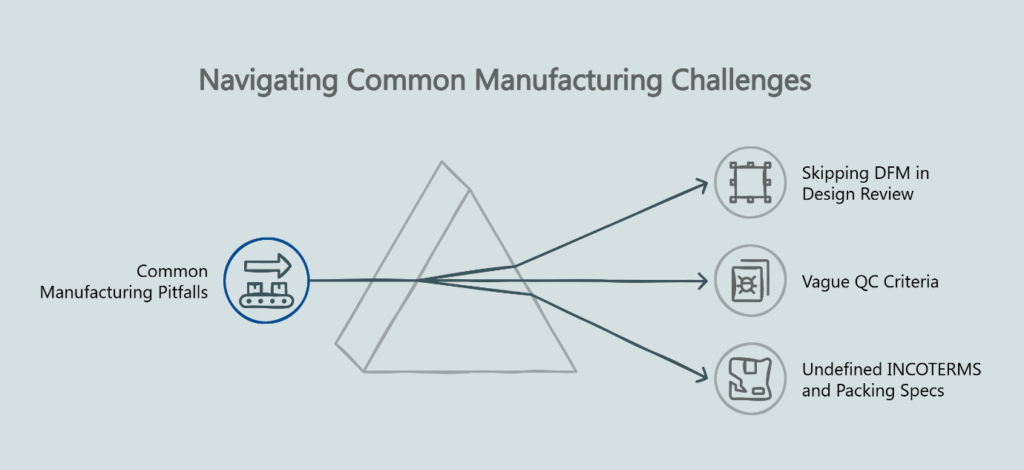
Skipping DFM in Design Review
Leads to tooling rework. Hold a DFM close-out with sign-offs before cutting tools.
Vague QC Criteria
Causes lot-to-lot drift. Tie the QC plan (with AQL sampling) directly to the Golden Sample and labeled photos.
Undefined INCOTERMS and Packing Specs
Creates surprise fees and avoidable damage. Lock terms, carton tests, and handoffs in the PO.
Answers to Common Questions
What is the difference between OEM and ODM in practice?
OEM builds to your spec; ODM adapts a factory’s base design. In practice, many programs blend both—buyer-owned branding and requirements with factory-proposed subassemblies.
How long does tooling typically take?
It varies by complexity and material. Typical ranges run weeks, not days, and include T1/T2 trials. Lock DFM first to avoid resets.
What is a Golden Sample and why is it critical?
It is the approved reference that everything else points to—QC plan, work instructions, and mass production acceptance. Using a single, labeled sample with photos reduces interpretation drift.
Which documents should be collected before issuing a PO?
At minimum: Golden Sample approval, QC plan with AQL, packing spec, and INCOTERMS. Reference them in the PO.
How do INCOTERMS affect total landed cost and risk?
INCOTERMS set who pays and who bears risk at each leg. Choosing the wrong term can move insurance, handling, and customs responsibility unexpectedly.
From Process Confidence to Custom Engineering Advantage
Picture the next build: the Golden Sample is approved, work instructions match it line-by-line, FQA passes cleanly, and cartons roll into the container on schedule. Fewer escalations. Fewer surprises. More margin. With this baseline mastered, the path opens to custom engineering and moat-building differentiation across acoustics, drivers, and enclosures—grounded in a process that already ships on time.
Ready to Improve Predictability and Quality?
- Subscribe to Our Newsletter to get frameworks and checklists that keep your builds on track.
- Request Custom OEM Quote if you’re ready to scope a program with gated controls and sample-driven QC.
External Resources
- AQL sampling and quality planning — International Organization for Standardization (e.g., ISO 2859 / ISO 9001 principles): https://www.iso.org/home.html
- INCOTERMS responsibilities and risk — International Chamber of Commerce: https://iccwbo.org/business-solutions/incoterms-rules/
- Impact of DFM on rework and time — Society of Manufacturing Engineers / IPC guidance: https://www.sme.org/
Contextual Disclaimer:
This article provides general information about the OEM/ODM manufacturing process for educational purposes. Individual circumstances vary significantly based on factors like industry compliance requirements, your chosen INCOTERMS, product safety certifications, and logistics arrangements. For guidance tailored to your organization’s supply-chain risk profile, QC standards, and legal agreements, consult a qualified professional.
Our Editorial Process
Our expert team uses AI tools to help organize and structure our initial drafts. Every piece is then extensively rewritten, fact-checked, and enriched with first-hand insights and experiences by expert humans on our Insights Team to ensure accuracy and clarity.
About the ChinaFutureSound.com Insights Team
The China Future Sound Insights Team is our dedicated engine for synthesizing complex topics into clear, helpful guides. While our content is thoroughly reviewed for clarity and accuracy, it is for informational purposes and should not replace professional advice.