
📌 Key Takeaways
Your OEM Partner is a Custodian of Your Brand’s Reputation: Product failures reflect on your brand regardless of whether they stem from design flaws or manufacturing defects, making partner selection a critical brand protection strategy rather than just a sourcing decision.
Use a 4-Phase Systematic Evaluation Framework: Technical due diligence, production and quality control assessment, partnership scorecard alignment, and logistics evaluation ensure comprehensive partner vetting that addresses engineering, operations, and finance concerns simultaneously.
Material Selection Reveals Engineering Philosophy: A manufacturer’s ability to clearly articulate why they’ve chosen specific cone materials (paper, polypropylene, carbon fiber), surround materials (rubber, foam), and voice coil options (copper, aluminum) demonstrates the engineering depth necessary for successful collaboration.
Verify Capabilities Through Evidence, Not Claims: Request documentation of quality control processes, production capacity history, FEM simulation examples, and testing protocols rather than accepting marketing presentations at face value.
Total Cost of Ownership Trumps Unit Price: Hidden costs from quality issues, warranty claims, delivery delays, and communication inefficiencies can eliminate any unit price advantages, making comprehensive evaluation essential for true cost assessment.
This framework transforms OEM selection from reactive sourcing into proactive brand protection, providing the structured tools and systematic approach needed to confidently navigate the “Supply Chain Gauntlet” while building partnerships that strengthen rather than threaten your market position.
Beyond the Spec Sheet: Why Your OEM Partner is a Custodian of Your Brand
The decision to partner with an OEM subwoofer manufacturer carries weight that extends far beyond unit economics. For audio brand manufacturers, this choice represents a fundamental transfer of trust—placing your brand’s reputation into the hands of a production partner who may be thousands of miles away.
Here’s the reality: your customers don’t distinguish between a product failure caused by your design versus one caused by manufacturing defects. When a subwoofer fails prematurely, develops distortion, or simply doesn’t meet the performance claims on your spec sheet, the responsibility lands squarely on your brand. The manufacturing partner’s name isn’t on the product (or rather, it shouldn’t be)—yours is.
This creates what we call the “Supply Chain Gauntlet”—the challenge of finding a partner who can consistently deliver on your brand’s promise while maintaining the quality, scalability, and reliability your customers expect. The stakes are particularly high in the audio industry, where performance specifications directly correlate to customer satisfaction and brand loyalty.
Business Impact The cost of choosing the wrong manufacturing partner extends beyond immediate product failures. Poor-quality products can trigger warranty claims, damage dealer relationships, and create negative reviews that persist long after the problematic batch has been replaced. The prudent business leader recognizes that thorough vetting today prevents costly brand rehabilitation tomorrow.
The Vetting Framework: A 4-Phase Approach to Choosing the Right OEM Subwoofer Manufacturer
Effective partner selection requires moving beyond surface-level comparisons of price per unit and delivery timelines. Our framework addresses the complete partnership lifecycle through four critical evaluation phases:
Phase 1: Technical Due Diligence focuses on matching the manufacturer’s engineering capabilities to your brand’s performance promises. This phase examines material specifications, manufacturing technologies, and engineering processes.
Phase 2: Production & Quality Control evaluates the manufacturer’s ability to maintain consistency at scale while implementing robust quality control measures throughout the production process.
Phase 3: The Partnership Scorecard provides a structured tool for aligning your entire team—from engineering to operations to finance—around a unified evaluation framework.
Phase 4: Logistics & Communication assesses the operational aspects of the partnership, including supply chain management, communication protocols, and ongoing support capabilities.
Each phase builds upon the previous one, creating a comprehensive evaluation that addresses both immediate production needs and long-term partnership sustainability.
Phase 1: Technical Due Diligence – Matching Capabilities to Your Brand’s Promise
Reading Between the Lines: How to Analyze Material Specifications
Material selection represents the foundation of subwoofer performance and longevity. Understanding how different materials impact sound quality, durability, and cost allows for more informed discussions with potential partners.
Common cone materials include paper, polypropylene, and carbon fiber, each offering different characteristics. Paper cones are widely used for their natural damping properties and cost-effectiveness. Polypropylene provides moisture resistance and consistency across temperature variations—characteristics often valued in automotive applications. Carbon fiber composites are known for their strength-to-weight properties but typically command higher costs.
Surround materials commonly include rubber and foam options. Rubber surrounds are recognized for durability and maintaining flexibility across temperature ranges, while foam surrounds may offer different compliance characteristics but can be more susceptible to environmental degradation over time.
Voice coil materials typically include copper and aluminum options. Copper is known for its electrical conductivity properties, while aluminum offers lower mass characteristics. The choice between these materials often involves trade-offs between electrical performance, thermal characteristics, and cost considerations.
A manufacturing partner’s material selection philosophy reveals their understanding of the performance-cost trade-offs inherent in your market positioning. Partners who can clearly articulate why they’ve chosen specific materials for specific applications demonstrate engineering consideration necessary for successful collaboration.
The Telltale Sign of Quality: Assessing a Manufacturer’s Use of Advanced Technology
Technical Note Finite Element Method (FEM) or Finite Element Analysis (FEA) simulation represents one indicator of a manufacturer’s engineering approach. This computational analysis technique allows engineers to model how components might behave under various conditions before physical prototypes are built, potentially reducing the likelihood of design-related issues in production.
Manufacturers employing FEM simulation may be able to analyze motor structures, predict thermal behavior under various power conditions, and identify potential mechanical stress points during the design phase. When evaluating potential partners, you can request examples of analysis work for products similar to your specifications.
A manufacturer using advanced simulation tools should be able to demonstrate their analysis capabilities through documentation and reports that show their design validation process. However, the specific implementation and sophistication of these tools can vary significantly between manufacturers.
The presence or absence of such capabilities provides one data point in your overall evaluation, but should be considered alongside other factors like manufacturing consistency, quality control processes, and actual product performance results.
Verifying Performance Claims: Key Questions for Their Engineering Team
Direct engagement with the manufacturer’s engineering team provides insights that specification sheets cannot convey. Focus your technical discussions around verification methodologies rather than just performance claims.
Ask how they validate frequency response measurements. Professional operations typically use controlled measurement environments with standardized positioning. Inquire about their power handling test protocols—whether they follow industry standards and what testing procedures they employ.
Request details about their quality control sampling procedures. What percentage of units from each production batch undergo testing? What parameters would trigger a production review? How do they handle units that fall outside specified tolerances?
The engineering team’s responses to these questions reveal both their technical approach and their commitment to consistent quality output.
Phase 2: Production & Quality Control – From Factory Floor to Final Product
Gauging Scalability: Can They Meet Your Volume Demands Without Sacrificing Quality?
Production scalability represents one of the most critical—and often underestimated—factors in OEM partner selection. A manufacturer’s current capacity provides only a snapshot; understanding their scalability approach reveals their ability to grow with your business.
Examine their current production capabilities as baseline indicators. For perspective, China Future Sound maintains capacity for 5,000 speakers and 1,000 amplifiers per day through systematic workflow management and equipment planning. However, capacity numbers represent only part of the scalability picture.
Day-to-Day Application When production volumes increase significantly, manufacturers face various challenges that can affect quality if not properly managed. Evaluate how potential partners approach capacity increases: Do they add shifts, expand equipment, or work with sub-contractors? Each approach carries different implications for quality consistency and delivery reliability.
Investigate their equipment maintenance and backup protocols. Production disruptions in critical steps can create significant delivery challenges. Well-managed operations typically maintain preventive maintenance schedules and contingency plans to minimize unplanned disruptions.
The Critical Role of Certified Testing in Ensuring Consistency
Testing protocols serve as the bridge between engineering specifications and production reality. Without systematic testing frameworks, even well-designed products can suffer from manufacturing variations that compromise performance.
Effective testing typically begins with incoming material verification. Components should undergo inspection before entering the production line to prevent defective materials from progressing through assembly processes.
In-process testing at critical assembly points can identify deviations before they become finished product issues. This might include dimensional checks, electrical parameter verification, and adhesive application monitoring at various assembly stages.
Final product testing should encompass both performance verification and consistency assessment. Look for manufacturers who can document their testing procedures and provide examples of their quality records and corrective action processes.
A Look Behind the Curtain: Why Factory Transparency Matters
Production transparency demonstrates a manufacturer’s confidence in their processes and willingness to explain their operations clearly.
Modern audio manufacturing involves various processes, from electronic component assembly to precision mechanical assembly techniques. A transparent manufacturer should be able to explain their process flow, from component receiving through final packaging.
Pay attention to their approach to process documentation and traceability. Can they track products through their manufacturing history? Do they maintain records of which components were used in specific production runs? This level of documentation becomes valuable if quality questions emerge after products reach the market.
Environmental controls and facility organization also indicate production attention to detail. Temperature and humidity management, clean assembly areas, and proper component storage demonstrate consideration of factors that can impact product consistency.
Phase 3: The Partnership Scorecard – Aligning Your Entire Team
The OEM Partnership Scorecard: A Tool for Confident Decision-Making
Core Reusable Asset: OEM Partnership Scorecard
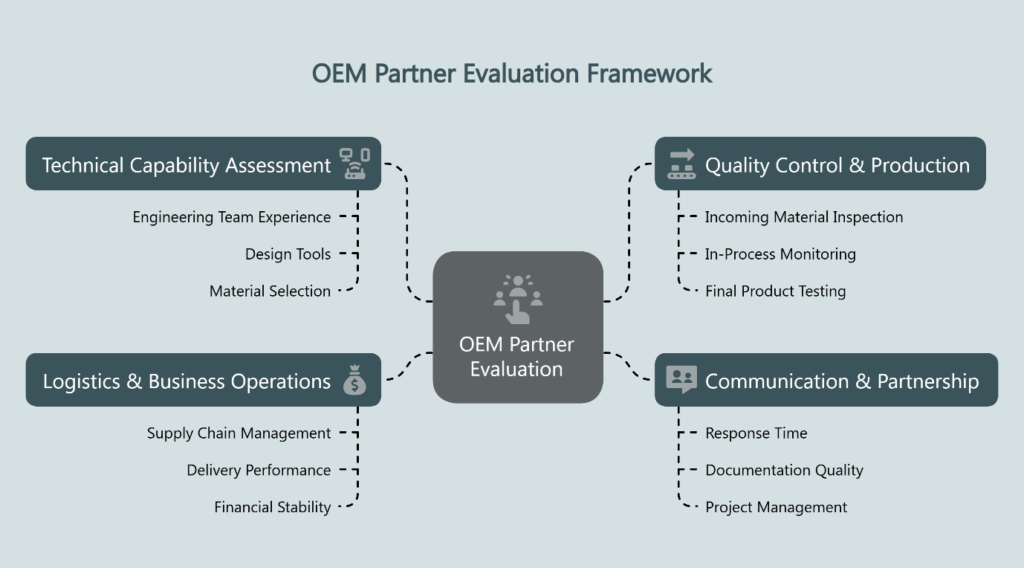
Effective partner evaluation requires a structured framework that addresses the concerns of your entire buying committee. This scorecard provides a systematic approach to evaluating potential OEM partners across four critical dimensions:
Technical Capability Assessment
- Engineering team experience and credentials
- Design and analysis tools capabilities
- Material selection rationale and sourcing
- Testing and validation processes
- Intellectual property protection procedures
Quality Control & Production
- Incoming material inspection procedures
- In-process quality monitoring points
- Final product testing protocols
- Compliance with testing standards
- Production capacity and scalability planning
Communication & Partnership
- Response time to inquiries and requests
- Documentation quality and completeness
- Project management and timeline tracking
- Problem resolution approach and transparency
- Cultural and communication compatibility
Logistics & Business Operations
- Supply chain management and component sourcing
- Delivery performance and schedule reliability
- Packaging and shipping quality standards
- Financial stability and business continuity
- Flexibility in order quantities and specifications
Evaluation Approach: Rather than arbitrary point systems, use this framework to systematically document each potential partner’s capabilities and approaches across these four areas. This creates a structured comparison that helps align your team’s evaluation criteria and provides documentation for your decision-making process.
The goal is comprehensive evaluation rather than mathematical scoring, ensuring that technical excellence, quality control, communication effectiveness, and operational reliability all receive appropriate consideration in your decision-making process.
How to Use the Scorecard to Bridge the Gap Between Engineering and Operations
A familiar challenge for any brand manager is bridging the gap between engineering’s specifications and operations’ practical concerns. The ideal partner addresses both technical requirements and operational realities effectively.
Engineering teams typically focus on technical specifications, material quality, and performance validation. Operations and finance teams prioritize cost predictability, delivery reliability, and scalability. The scorecard framework ensures that both perspectives receive appropriate consideration in the evaluation process.
Use the scorecard during cross-functional evaluation meetings. Have each team member evaluate the potential partners independently across all four dimensions, then discuss areas where assessments diverge significantly. These discussions often reveal underlying assumptions and priorities that need to be addressed before making a final decision.
The evaluation process also creates documentation that supports future decision-making. When questions arise about why a particular partner was selected, the scorecard provides a clear rationale based on multiple evaluation criteria rather than subjective impressions.
Phase 4: Logistics & Communication – The Hallmarks of a Smooth Partnership
Evaluating Communication and Support
Effective communication forms the foundation of successful OEM partnerships, particularly when geographic distance and time zones create natural barriers to real-time collaboration.
Assess potential partners’ communication approaches during the evaluation process itself. How quickly do they respond to technical questions? Are their responses thorough and technically relevant? Do they ask clarifying questions that demonstrate understanding of your requirements?
Technical communication requires precision and the ability to discuss complex engineering concepts clearly. During technical discussions, pay attention to whether the manufacturer’s team can explain their processes and recommendations in ways that address your specific concerns.
Project management capabilities become important during product development and production phases. Effective partners maintain clear milestone tracking, provide regular status updates, and communicate potential issues before they impact delivery schedules.
Understanding the Supply Chain: From Production to Your Warehouse
Supply chain management directly impacts your ability to meet customer commitments and manage inventory effectively. Understanding your potential partner’s approach to component sourcing, inventory management, and logistics coordination helps predict supply chain reliability.
Investigate their component sourcing strategies. Do they maintain inventory of critical components? How do they handle component availability issues or quality problems with their suppliers? A manufacturer with diversified supplier relationships and strategic inventory planning can better navigate supply chain challenges.
Packaging and shipping quality often receives insufficient attention during partner evaluation, but inadequate packaging can result in product damage that creates warranty issues and customer dissatisfaction. Request examples of their standard packaging approaches and ask about their experience with damage during shipping.
Consider their flexibility in delivery scheduling and order quantities. Market conditions may require adjustments to your ordering patterns, and partners who can accommodate reasonable variations in volume and timing provide valuable operational flexibility.
Common Pitfalls to Avoid When Selecting an OEM Partner
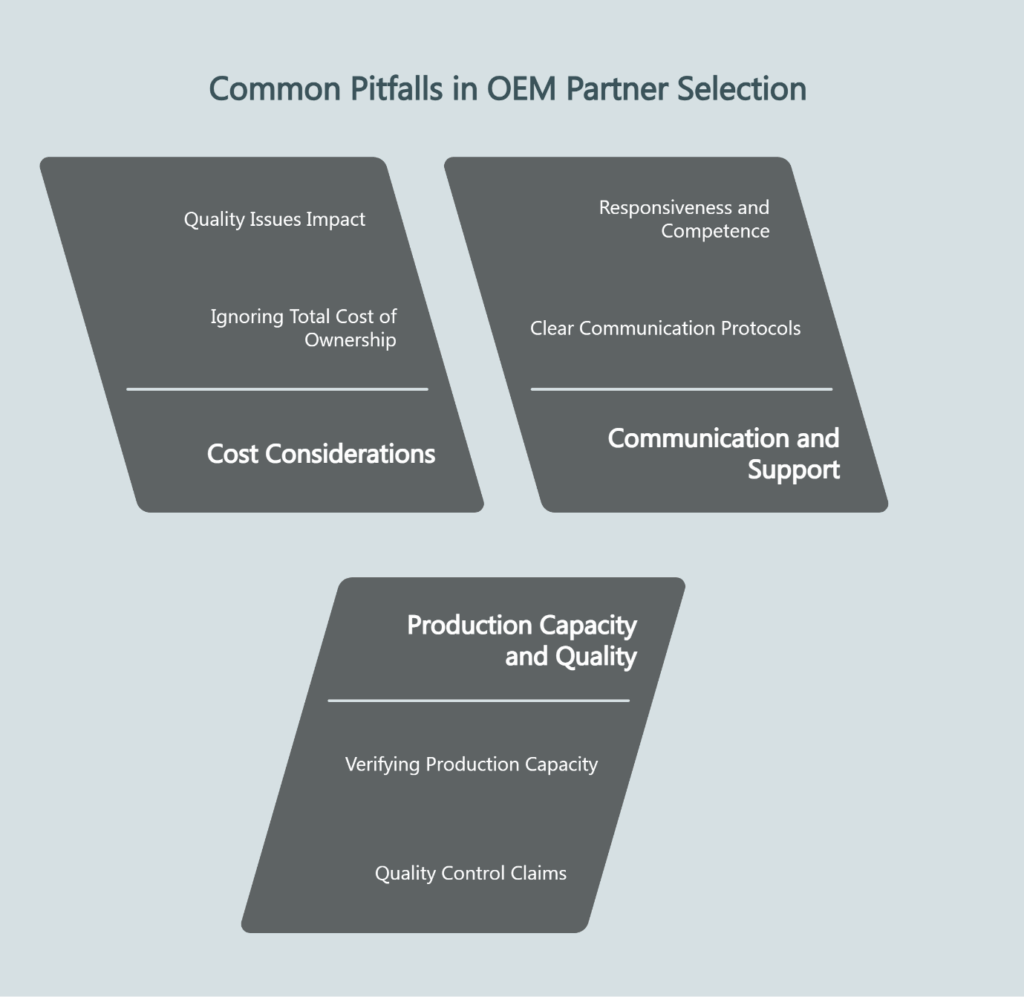
Pitfall 1: Focusing Solely on Unit Price While Ignoring Total Cost of Ownership
The lowest quoted unit price rarely translates to the lowest total cost of ownership. Additional costs in OEM partnerships can include quality issues that trigger warranty claims, delivery delays that disrupt sales cycles, and communication inefficiencies that extend development timelines.
Consider the total cost impact of potential quality issues. If one manufacturer has higher defect rates than competitors, the additional warranty and customer service costs may eliminate any unit price advantage. Factor in the cost of your time spent managing quality issues, handling customer complaints, and coordinating corrective actions.
Consider the development efficiency implications of working with different partners. A manufacturer who requires extensive oversight and multiple design iterations may consume more of your engineering resources than one who can work more independently with appropriate guidance.
Pitfall 2: Failing to Verify Production Capacity and Quality Control Claims
Many manufacturers present impressive facility presentations and detailed capability descriptions, but actual production practices may not align with these marketing materials.
Request specific evidence of their quality control processes. Can they provide documentation of their testing procedures, examples of quality records from recent production, and descriptions of their corrective action processes? Established manufacturers typically maintain detailed quality documentation and should be willing to share relevant examples.
Verify their production capacity claims through multiple approaches. If they claim specific daily production capacity, ask about their recent production history and whether their stated capacity represents peak output or sustainable production rates that maintain quality standards.
Pitfall 3: Overlooking the Importance of Clear Communication and Support
Communication challenges in OEM relationships often stem from unclear expectations rather than language barriers or technical incompetence.
Establish clear communication protocols during the evaluation process. Who will serve as your primary points of contact for technical questions, production status updates, and problem resolution? How do they handle urgent issues that arise outside normal business hours?
Test their responsiveness and technical competence through realistic scenarios during the evaluation process. Present them with a technical challenge similar to ones you might face in actual production and evaluate both the quality of their response and their communication approach.
What If…? Planning for a Worst-Case Scenario: A Product Quality Issue
Product quality issues can occur in any manufacturing relationship—the key is how effectively your partner responds when they do.
Step 1: Immediate Response and Assessment Your manufacturing partner should have procedures for addressing quality issues quickly, including stopping production of potentially affected products and conducting assessment to determine the scope of the issue. This includes isolating finished goods until the cause is identified.
Step 2: Investigation and Corrective Action Effective partners investigate problems systematically rather than just addressing immediate symptoms. This requires detailed investigation of the failure mode, identification of process changes needed to prevent similar issues, and verification that corrective actions are effective.
Step 3: Communication and Recovery Planning Clear communication during quality issues helps maintain rather than damage long-term partnerships. Your manufacturing partner should provide realistic timelines for resolution, regular status updates, and detailed documentation of corrective actions taken. They should also work collaboratively with you to minimize market impact and customer disruption.
The key is establishing these response expectations and communication protocols before quality issues occur, not after they emerge.
A Question You Should Be Asking
The Unasked Question: “Beyond the product itself, what is the manufacturer’s process for handling custom designs and intellectual property protection?”
Why It Matters: Partnerships often involve sharing sensitive design information. Understanding how a potential partner protects your intellectual property is important for long-term brand security.
The Expert Answer: A trustworthy OEM partner should have clear, documented processes for handling custom designs, including non-disclosure agreements and secure data management procedures. They should be able to explain their intellectual property protection protocols. According to the China Future Sound framework, we offer fully customizable solutions and understand the importance of safeguarding our partners’ unique designs.
Conclusion: Building a Resilient Supply Chain is Building a Stronger Brand
The framework presented here transforms OEM partner selection from a reactive sourcing exercise into a proactive brand protection strategy. By systematically evaluating technical capabilities, production quality, communication effectiveness, and operational reliability, you create partnerships that strengthen rather than threaten your brand reputation.
The scorecard and evaluation processes outlined in this framework provide the structure necessary to make informed decisions while managing the inherent risks of manufacturing partnerships. More importantly, they ensure that your entire team—from engineering to operations to finance—shares a common understanding of what constitutes an appropriate manufacturing partner.
Beyond immediate sourcing needs, the due diligence skills developed through this framework serve as foundational capabilities for strategic supply chain management. As your brand grows and your product portfolio expands, the ability to quickly and accurately assess manufacturing partners becomes increasingly valuable. These competencies position you for more senior leadership roles where supply chain strategy directly impacts business success.
The manufacturers who successfully navigate this evaluation process demonstrate the transparency, capability, and commitment necessary for long-term partnership success. They understand that serving as a custodian of your brand’s reputation requires more than just meeting technical specifications—it demands a comprehensive approach to quality, communication, and continuous improvement that aligns with your brand’s values and market positioning.
Our Editorial Process This guide was drafted with AI assistance and has been reviewed, fact-checked, and edited by the expert humans on our Insights Team to ensure accuracy and clarity.