📌 Key Takeaways
Yield targets and containment plans protect amplifier programs from costly launch delays by converting quality events into pre-authorized execution rather than emergency negotiations.
- Define Yield Before Setting Targets: Agree where yield is measured, what counts as a pass, and whether rework units count—or you’ll debate standards during crises instead of executing containment.
- Phase-Gate Your Expectations: Set different yield targets for pilot, early production, and SOP with explicit exit criteria, because the cost of a defect changes dramatically as you move toward mass shipments.
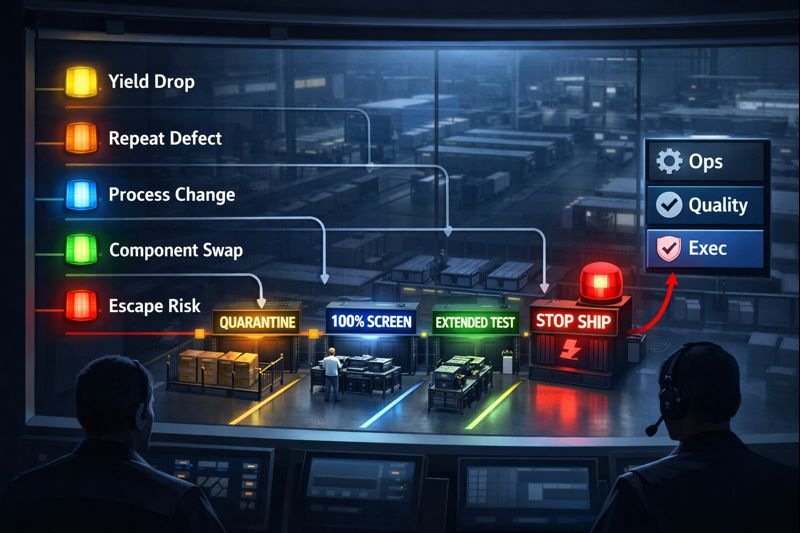
- Pre-Authorize Containment Actions: Map triggers (yield drops, repeat defects, field signals) to specific screening actions and stop-ship authority before ramp begins—decisions made in advance cost hours; decisions made during crises cost days.
- Lock Decision Rights and Escalation: Document who executes quarantine, who approves rework, and who authorizes containment exit with clear evidence requirements—ambiguity during quality events creates executive fire drills and shipment delays.
Prepared governance = faster containment response and protected launch windows.
Audio brand product managers and sourcing directors navigating amplifier production partnerships will gain immediate clarity on risk-minimizing quality gates, preparing them for the detailed OEM program frameworks that follow.
Yield targets are the pass/fail expectations a factory agrees to hit during ramp—based on a defined way of counting “good” units. A containment plan is the operational safety net designed to prevent defective units from leaving the facility through pre-authorized actions tied to specific triggers. SOP (Start of Production) is the point where a program transitions from builds meant to learn into builds meant to ship.
Yield targets without definitions are like SLAs without measurement rules: everyone thinks they agree—until the first incident costs you a launch window.
Picture the week before SOP. A line that looked “fine” in pilot suddenly shows a yield drop. Engineering says rework should count as a pass. Operations says it does not. Procurement wants shipments to keep moving. Quality wants a quarantine. The argument becomes the process, and the brand carries the risk—along with the cost of delayed shipments, strained channel relationships, and potential warranty exposure.
The fix is simple in concept: before SOP, agree (in writing) on yield definitions, targets by phase, triggers, containment actions, owners, and exit criteria—so a yield event becomes execution, not negotiation. This governance framework protects your program from the hidden costs of ambiguity.
What “yield targets” and “containment plans” really mean before SOP
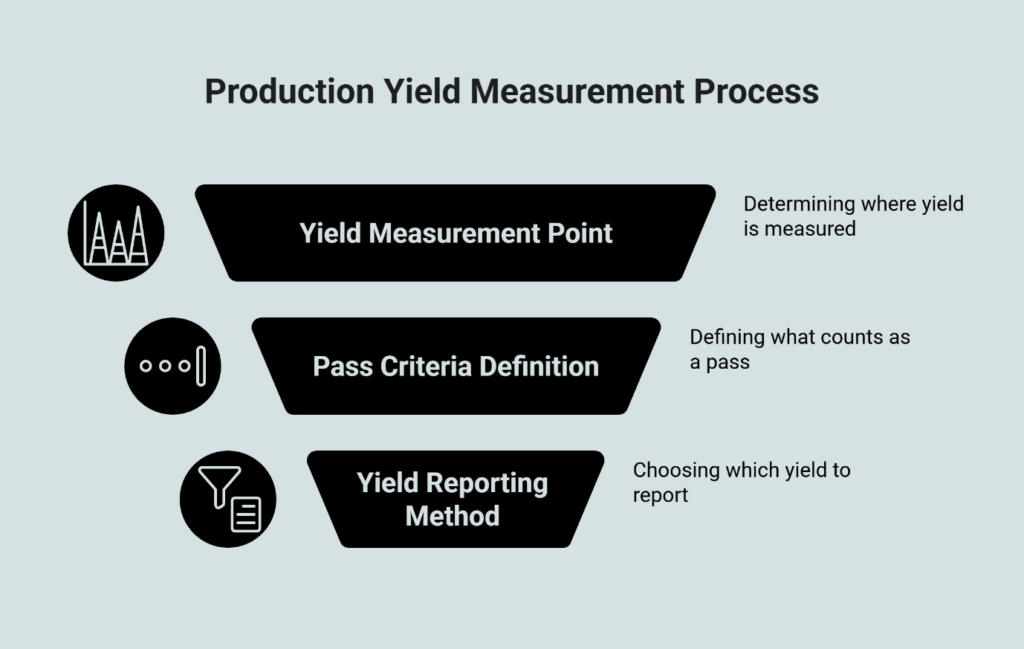
Before SOP, “yield” is not a vibe or a single number. It is a measurement system that determines whether your program ships on time or stalls in containment loops:
- Where yield is measured (station, line, or shipment)
- What counts as a pass (including retest/rework rules)
- Which yield is reported (FPY/FTY vs final yield)
Without this clarity, programs experience “yield creep”—the gradual lowering of standards just to keep the line moving. This creates a hidden tax: units that appear to “pass” but require expensive rework loops that eat margins and extend lead times.
A containment plan is not a generic “we’ll sort it.” It is a pre-authorized set of actions tied to specific triggers, with clear stop-ship authority, screening scope, and exit criteria. The business value is simple: containment decisions made in advance cost hours; containment decisions made during a crisis cost days and damage channel relationships.
Agree on yield definitions first (or targets become negotiation points)
Where yield is measured: station vs line vs ship
The trade-off: Yield measured at a single station can hide downstream fallout that turns into warranty claims. Yield measured only at shipment can hide where the process is failing, making corrective action slower and more expensive. The pre-SOP agreement should specify the official reporting point(s) and how each rolls up—because this determines whether your quality data drives improvement or just tracks damage.
What counts as a pass: rework, retest, concession
The business decision: Every rework cycle adds cost and time. If reworked units count as “good output,” you lose visibility into the true cost of production and the risk of field failures. Define rules for each category up front:
- Re-test: If a unit fails then passes without changes, does it count against yield? (Implication: Are you measuring process stability or just final output?)
- Rework: If a unit requires component replacement or solder touch-up, does it count as “good output” or “salvaged output”? (Implication: What’s the true cost per shipped unit?)
- Concession/deviation: If a unit ships under a deviation, is it removed from yield math or counted separately? (Implication: Are you tracking deviation volume for warranty risk modeling?)
Which yield you will report: FPY/FTY vs final yield
Why this matters for decision-makers: First Pass Yield (FPY) tells you whether your process is stable. Final yield tells you whether you can ship. Teams that report only final yield hide the cost of instability—and that cost shows up later as extended lead times, capacity constraints, and margin erosion.
Define acronyms once, plainly:
- FPY (First Pass Yield): The percentage of units that pass a process step the first time with no rework/retest. Calculated as:
FPY = (Units Entering – (Scrap + Rework)) / Units Entering
- RTY (Rolled Throughput Yield): The probability that a unit passes all process steps without defects. Unlike an average, this is the product of all station yields, revealing the true cumulative cost of defects across the line.
RTY = ∏(i=1 to n) Yᵢ
- Final yield: The pass rate after rework/retest loops are completed. This is your shipment capacity signal, often calculated as:
Formula: Y_Final = Total Good Units / Total Units Started
Critical production metrics: what they tell you about program risk
| Metric | What it reveals about program health | Business impact if ignored | Who owns the decision |
|---|---|---|---|
| FPY | Process stability and hidden rework costs | Margin erosion from untracked rework cycles | Manufacturing/Quality |
| FTY | Whether teams are using measurement consistently | Misaligned expectations between buyer and supplier | Program/Quality |
| Final yield | Ship-ability and capacity utilization | Missed delivery windows; channel strain | Ops/Program |
| Rolled yield | Where small losses compound across the line | Extended lead times; low throughput despite high station yields | Quality/Process Eng. |
| Escape rate | Containment effectiveness and warranty risk | Field failures; warranty cost spikes; brand damage | Quality |
Set yield targets that match the ramp phase—or pay for instability twice
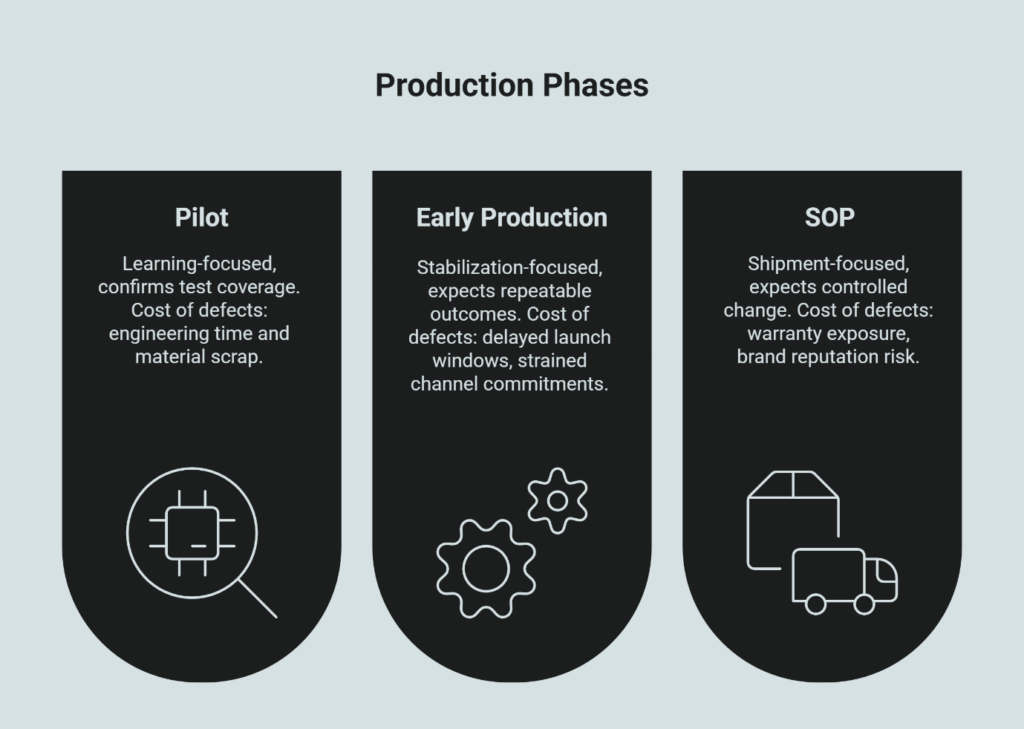
Yield expectations should be phase-gated because the cost of a defect changes dramatically as you move from pilot to mass production. A defect caught in pilot costs hours of engineering time. A defect caught after SOP costs warranty dollars and customer relationships.
Pilot vs early production vs SOP: the risk profile changes
Instead of debating a single target, define phase gates that reflect your risk tolerance:
- Pilot: Learning-focused; confirms test coverage and top failure modes. Cost of defects: engineering time and material scrap.
- Early production: Stabilization-focused; expects repeatable outcomes and faster containment response. Cost of defects: delayed launch windows; strained channel commitments.
- SOP: Shipment-focused; expects controlled change and predictable daily output. Cost of defects: warranty exposure; brand reputation risk; potential stop-ship events.
Define exit criteria: what “stable enough” means in business terms
“Stable enough” should be expressed as evidence that protects your investment, not optimism that hopes for the best. According to ISO 7870 (Control Charts) or the AIAG SPC reference manual, a stable process is one where variability is predictable and within controlled limits, whereas ISO 22514 applies to determining if that stable process is capable of meeting specifications. Your exit criteria should include:
- Yield trend is improving or stable under normal operating conditions (not just during “watched” builds)
- Dominant defects are understood with verified corrective actions in progress (so you’re not shipping unknowns)
- Test coverage is confirmed for known failure modes (so escapes don’t turn into warranty events)
- Containment plan is active, measured, and has an exit rule (so you know when to declare victory)
The business logic: moving to the next phase without meeting exit criteria means you’re accepting higher warranty risk and potential stop-ship exposure downstream. That choice should be explicit, documented, and approved by executives who understand the cost.
Define reporting cadence: governance that catches drift early
The trade-off: More frequent reporting during ramp catches issues while they’re still cheap to fix. Less frequent reporting reduces meeting overhead but increases the risk that problems compound before anyone notices. A common pattern is daily reviews during early production, transitioning to weekly reviews after demonstrating stability—what matters is agreeing the format and decision rights before the ramp starts.
Hypothetical scenario (labeled): A pilot run shows “high yield” because the team reports final yield after rework. In early production, the buyer asks for FPY and discovers the line is spending hours on rework loops—eroding margins and threatening the launch timeline. Both sides feel misled, even if nobody intended it. The cost: delayed launch, emergency corrective actions, and damaged trust between buyer and supplier. This is why the definition must be locked before targets are debated.
Design the containment plan before you need it—or accept decision delays during crises
Containment planning is about converting uncertainty into pre-approved actions that protect your brand without requiring executive escalation for every quality event. As outlined in ISO 9001 Clause 8.7, the control of nonconforming outputs is essential to ensure that unintended use or delivery is prevented. The business value: containment decisions made in advance cost hours; containment decisions made during a crisis cost days and damage relationships.
Triggers to define (pre-SOP): when containment activates automatically
The decision: Triggers should be set at levels that balance risk tolerance with operational disruption. Set them too sensitive, and you’ll spend resources chasing normal variation. Set them too loose, and you’ll ship defects that turn into warranty claims.
Agree the triggers that automatically activate containment, such as:
- Yield drop beyond an agreed threshold relative to the current baseline (no universal number—calibrate to your program’s complexity and warranty risk)
- Repeat defect signature (same failure mode recurring, suggesting systemic issue rather than random variation)
- Field/DOA signal indicating potential escape (early warning that current screening missed something)
- Process change (fixture update, station change, operator shift pattern—any change that could introduce new failure modes)
- Component substitution or supplier lot concern (traceability risk that could affect warranty exposure)
Actions menu: what “containment” actually costs
The trade-off: Containment actions protect your brand but consume capacity and delay shipments. The key is defining the menu in advance so teams execute quickly rather than debating authority during the event.
Containment actions should be chosen from a defined menu, including:
- Quarantine / segregation of suspect WIP and finished goods (cost: inventory carrying cost and potential shipment delays)
- 100% screening at a defined station with scope and duration defined (cost: labor hours and throughput reduction)
- Re-test, extended aging, or additional functional checks (cost: extended cycle time and test capacity)
- Stop-ship with explicit authority and decision window (cost: channel strain, potential revenue delays, and escalation overhead)
Pre-SOP containment matrix: decisions made in advance
| Trigger | Containment action | Business impact of action | Evidence required to exit | Who approves exit |
|---|---|---|---|---|
| Repeat defect mode | Quarantine + focused screen for that mode | Shipment delay (days); labor cost for screening | Verified corrective action + clean sample set proving fix | Quality → Program lead |
| Yield trend degradation | Increase screen scope + ramp review | Reduced throughput; potential shipment delays | Yield recovery trend + root-cause hypothesis with validation | Ops → Quality → Exec sponsor |
| Process change | Temporary heightened checks | Incremental test cost; throughput impact | Validation results + controlled cut-in with traceability | Process Eng. → Quality |
| Component substitution | Hold lot + verify compatibility | Inventory carrying cost; potential shortage risk | Approved change control + traceability check | Eng. → Quality → Buyer |
| Potential escape signal | Stop-ship + 100% screen (time-boxed) | Revenue delay; channel relationship strain | Clear decision memo + verified screening results | Quality head → Exec sponsor |
Disposition rules: who decides what happens to suspect units
The business logic: Rework, scrap, and deviation decisions affect both immediate costs and long-term warranty exposure. Pre-agreeing the decision rights prevents delays when units are in quarantine.
Define how decisions are made for:
- Rework (allowed/not allowed, who approves)—Cost impact: labor hours vs scrap cost
- Scrap (who authorizes)—Cost impact: material loss vs warranty risk of marginal units
- Deviation/concession (who signs, how recorded)—Cost impact: shipment release vs future warranty exposure
- Return-to-vendor at a component level (only as a commercial/quality interface, not legal guidance)—Cost impact: component cost recovery vs relationship strain
Define escalation, ownership, and communication—or every event becomes an executive fire drill
Decision rights: who decides what when time is short
The trade-off: Clear decision rights enable fast action but require trust that owners will escalate appropriately. Unclear rights create delay, executive overhead, and decision paralysis during quality events.
| Decision | Who executes | Who approves | Who must be consulted | Who gets informed | Business impact of delay |
|---|---|---|---|---|---|
| Stop-ship call | Quality | Executive sponsor / Program owner | Ops, Engineering | Procurement, Sales ops | Every hour of delay increases escape risk |
| Quarantine scope | Ops/Quality | Quality | Program | Procurement | Delay = inventory carrying cost |
| Rework method approval | Engineering | Quality | Ops | Program | Delay = throughput loss |
| Exit containment | Quality/Program | Program owner | Engineering, Ops | Procurement | Delay = extended shipment holds |
What gets shared in ramp reviews: governance that drives improvement
The decision: Ramp reviews should focus on decisions needed, not just status updates. Make the packet predictable so executives can pattern-match and spot risks quickly:
- Yield dashboard (using agreed definitions)—Shows whether the program is on track for SOP
- Top defects (Pareto) and status of corrective actions—Shows whether issues are being resolved or accumulating
- Containment status (what’s being screened/held)—Shows whether actions are protecting the brand or creating bottlenecks
- Open risks, decisions needed, and owners—Forces visibility on what’s blocking progress
Change control tie-in: why ECO discipline protects your warranty budget
The business logic: If a fix changes hardware, firmware, test limits, or process settings, it needs formal change control. ECO (Engineering Change Order) discipline prevents “mixed builds”—shipments containing different product configurations without clear traceability. Mixed builds create warranty nightmares: when failures appear in the field, you can’t determine which configuration failed, making root cause analysis slower and more expensive.
The cost of skipping ECO discipline: warranty claims that can’t be traced to specific design versions, meaning you may end up replacing units that don’t actually have the defect—or missing units that do.
Governance readiness assessment: what to confirm before SOP
Use this assessment during your final pre-SOP gate review to identify decision gaps that create risk:
Measurement Governance:
- Are FPY and FTY defined, agreed upon, and documented in writing?
- Is it clear where yield is measured on the line and how station yields roll up to final yield?
- Is there a written rule for re-tests and rework units that prevents definition drift?
Phase Management:
- Are targets set for Pilot, Early Production, and SOP with explicit exit criteria for each phase?
- Are exit criteria defined as verifiable evidence rather than subjective assessments?
Containment Readiness:
- Are specific yield drops or defect patterns labeled as “triggers” with pre-authorized containment actions?
- Is stop-ship authority documented with explicit decision windows and escalation paths?
- Can you identify every unit built with a specific component lot through traceability systems?
Governance Cadence:
- Is there a schedule for ramp reviews with agreed attendees and decision rights?
- Do executives understand their approval authority for containment exits and change control?
Risk Exposure:
- What happens if you move to SOP without meeting exit criteria? (Force the conversation about risk acceptance.)
- What’s the cost of a stop-ship event one week after SOP? (Quantify the downside to calibrate trigger sensitivity.)
Explore our guides on OEM/ODM amplifier programs, including RFQ to SOP timelines that actually hold and DFM inputs for amplifiers. For broader partner context, see Amplifier Manufacturers.
Frequently Asked Questions
What is SOP in manufacturing?
SOP (Start of Production) is the transition point where production is expected to run predictably and ship to customers under controlled processes—not just prove a design can be built. This is when warranty risk and channel commitments become real.
What is first pass yield (FPY)?
FPY is the percentage of units that pass a process step on the first attempt, without rework or retest, at the agreed measurement point. It is a stability signal that predicts margin health—not just a shipment signal.
What is a containment plan?
A containment plan is a pre-agreed set of actions and decision rules that limit defect escape during ramp—by defining triggers, quarantine/screening actions, stop-ship authority, and exit criteria. The value is speed: decisions are execution, not negotiation.
When should a stop-ship be triggered?
Stop-ship should be triggered when there is credible risk of defect escape or uncontrolled variation—and when the program’s pre-agreed triggers indicate customer exposure is possible. The key is that authority and triggers are defined before the event, so the decision is about data, not politics.
How long should an early containment period last?
There is no universal duration. It should last long enough to demonstrate stable output under normal variability, with the exit defined by evidence (trend stability, verified corrective actions, and controlled change), not by calendar alone. The business logic: exiting too early increases warranty risk; exiting too late wastes containment resources.
Disclaimer: This article is for informational purposes only. It does not constitute engineering, quality, regulatory, or legal advice. Program requirements and acceptance criteria should be defined with qualified stakeholders and validated for the specific product, process, and customer context.
Our Editorial Process: China Future Sound publishes risk-first, evidence-led guidance for OEM/ODM and private-label amplifier programs. Recommendations prioritize practical decision-making, clear ownership, and verifiable gates. When benchmarks or data are referenced, citations are provided; when examples are illustrative, they are labeled as hypothetical.
By China Future Sound Editorial Team. China Future Sound publishes risk-first, evidence-led guides for OEM/ODM and private-label amplifier programs—focused on predictable ramps, controlled change, and warranty protection.