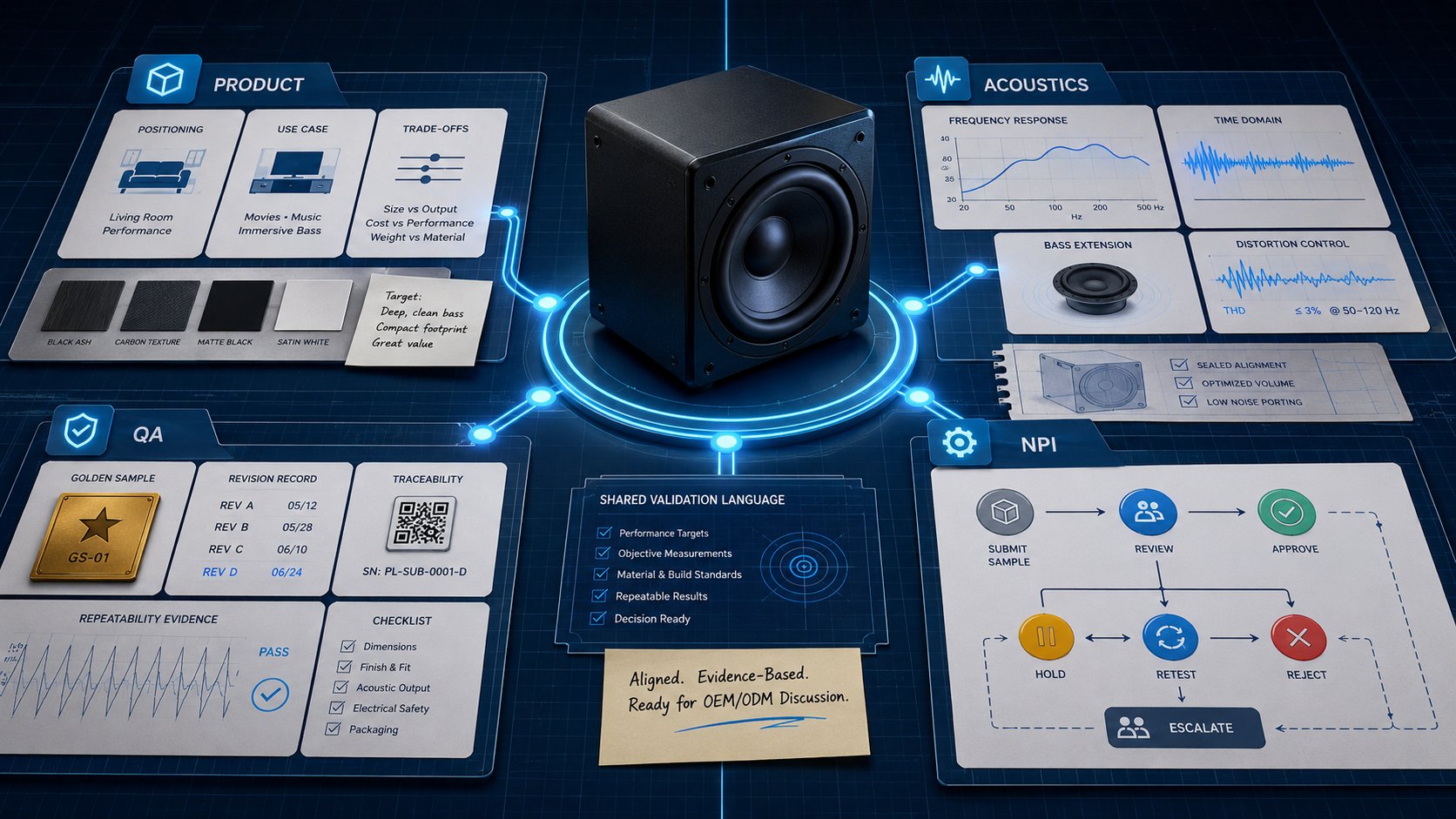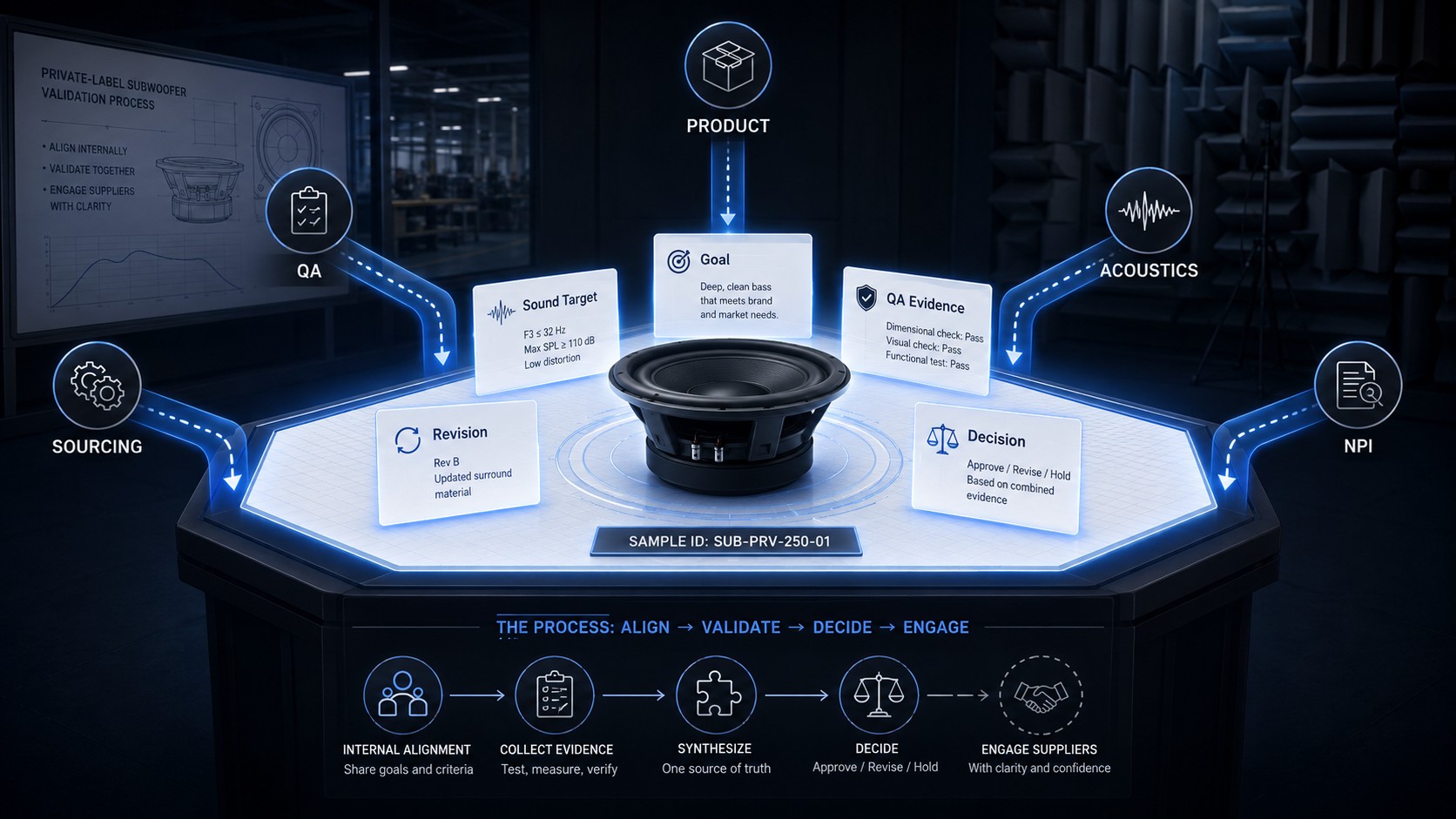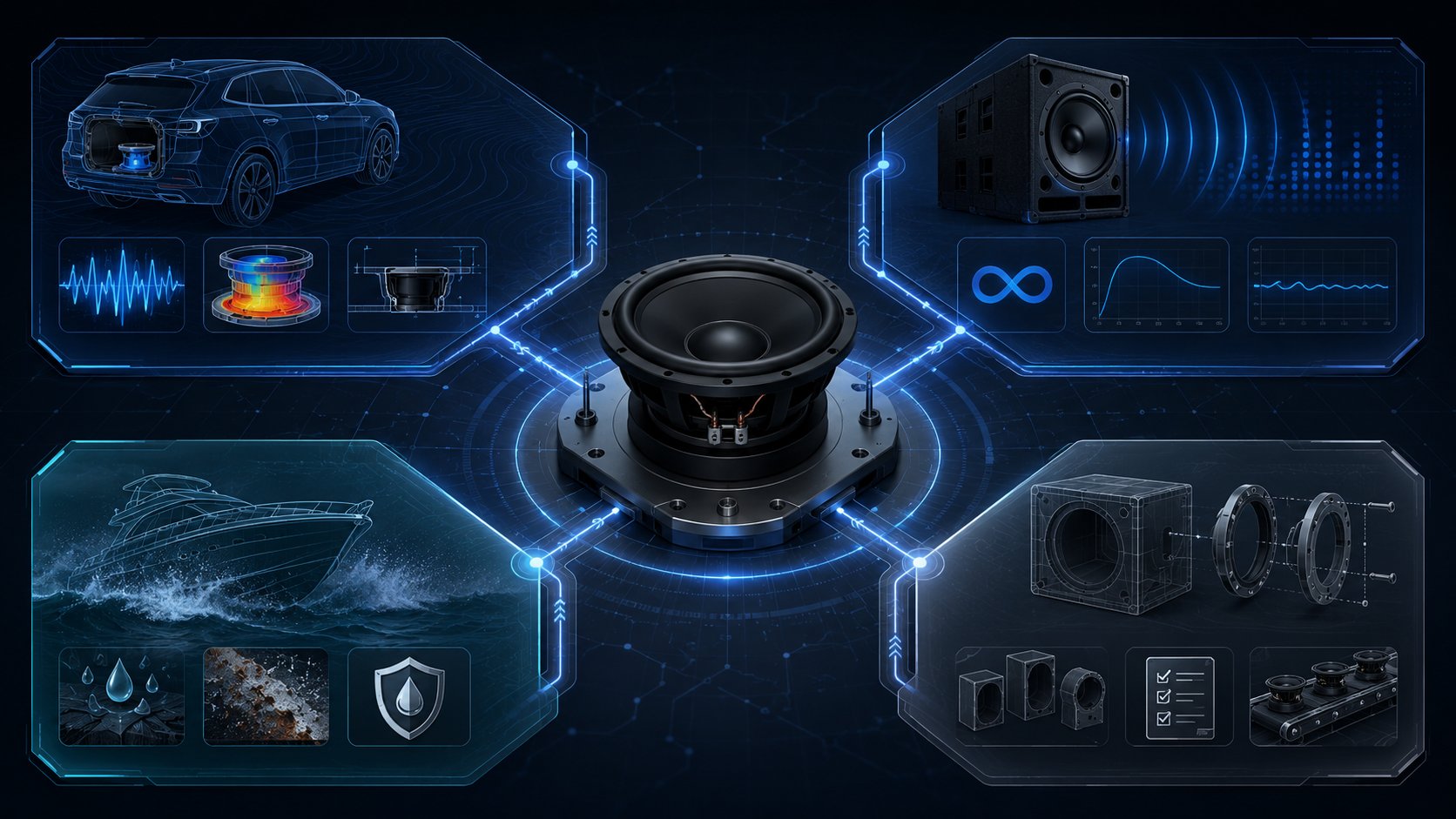
📌 Key Takeaways
Private-label subwoofer testing only works when the plan matches the product’s real use environment.
- Start With Use: Automotive, pro audio, marine, and custom projects each stress subwoofers in different ways.
- Test Real Risks: Focus first on heat, vibration, moisture, fit, duty cycle, and sound goals.
- Question Generic Proof: A broad test summary may miss the risks that matter for one specific program.
- Connect Samples To Production: Approved samples need clear controls so mass production keeps matching the agreed product.
- Avoid Overclaims: Environmental claims need exact proof, not broad words like waterproof, salt-proof, or corrosion-proof.
Good validation starts with the product’s real world, not a generic checklist.
Hardware, quality, product, and sourcing teams will gain clearer supplier conversations here, preparing them for the detailed overview that follows.
~ ~ ~ ~ ~ ~ ~ ~ ~ ~ ~ ~ ~ ~ ~ ~ ~ ~
Why “Subwoofer Validation” Should Start With the Intended Use Case
Private-label subwoofer validation can become misleading when the intended use environment is unclear. A sample may appear ready against a generic evidence package, but that package may not answer the questions that matter most for the actual program.
For Hardware/Acoustics Managers, QA Directors, NPI leads, and sourcing stakeholders, the issue is rarely “what is a subwoofer?” The practical question is sharper: what assumptions should be clarified before a sample validation plan is treated as fit for this program?
Use-case assumptions change validation priorities because they influence which risks deserve attention first. Depending on the program, those risks may include thermal behavior, vibration exposure, moisture or corrosive exposure, continuous-output expectations, fit constraints, installation variability, acoustic tuning, documentation needs, and production consistency.
Prioritize test plan utility over excessive rigor; avoid turning early supplier discussions into lab-procedure reviews. It is to make sure the validation evidence reflects the intended operating context before sample approval, tooling, supplier comparison, or production planning moves too far ahead.
A Practical Framework: Match Validation Priorities to Program Assumptions
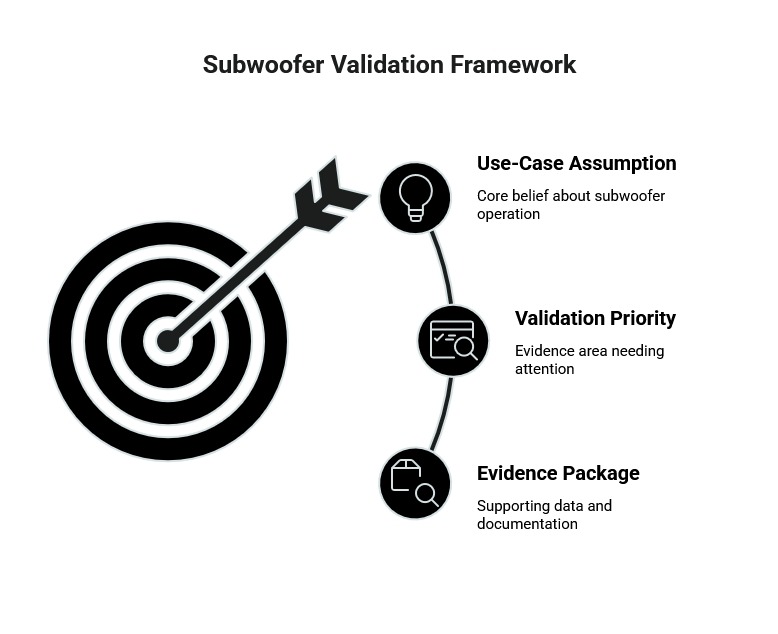
A use-case assumption is a working belief about where and how the subwoofer will operate. A validation priority is the evidence area that deserves more attention because of that assumption. An evidence package is the set of sample data, qualification evidence, QC records, and documentation used to support a program decision.
For private-label subwoofer programs, brand teams can use a simple sequence before locking validation expectations:
Clarify the intended environment. Identify the dominant stressors or constraints. Ask what evidence should change by use case. Confirm how sample validation connects to production consistency. Align the validation conversation before approval milestones.
That sequence helps product, QA, sourcing, and manufacturer stakeholders avoid a common friction point: one team may want fast supplier comparison, while another needs confidence that the evidence reflects the application rather than a generic category review.
Use-Case Assumptions That Can Change Subwoofer Validation Priorities
| Program context | Assumptions to clarify | Validation priorities that may change | Evidence to discuss with manufacturer |
|---|---|---|---|
| Automotive | Installation space, vibration, heat exposure, voltage environment, cabin acoustics | Fit, thermal behavior, consistency, acoustic target alignment | Sample test data, design assumptions, production QC plan, golden sample controls |
| Pro audio | Output expectations, duty cycle, transport/handling, continuous use patterns | Power handling, thermal durability, mechanical robustness, repeatability | Power-test approach, reliability testing, component and assembly controls |
| Marine | Moisture, UV exposure, salt/corrosive conditions, open-air use | Material suitability, corrosion resistance, humidity tolerance, environmental aging | Environmental exposure evidence, material rationale, manufacturing controls |
| Custom OEM/ODM | Integration constraints, brand differentiation, enclosure or platform limits | Fit-for-platform validation, tuning alignment, change control, documentation | DFM/DFX inputs, sample-to-production controls, ECO/ECR expectations |
This table should not be read as a universal checklist. It is a validation assumption map. The useful conversation is not “which test applies to every subwoofer?” It is “which assumptions are most important for this program, and what evidence supports them?”
Automotive Subwoofer Programs: Clarify Installation and Operating Assumptions
Automotive subwoofer validation may involve space, vehicle electrical, thermal, vibration, and cabin-acoustic assumptions. A program intended for compact aftermarket fit may raise different questions from a platform with OEM-style integration or brand-specific tuning expectations.
For automotive audio manufacturing programs, brand teams should clarify whether the manufacturer’s sample review assumed the same installation space, enclosure context, power environment, and acoustic target that the final product will face. Those assumptions can influence what sample data, design rationale, and production QC evidence deserve attention.
Avoid applying named automotive standards unless verified. The more effective approach is interrogating the specific operating assumptions that shaped the manufacturer’s validation strategy.
That framing protects against two opposite risks. One is under-specifying the discussion and accepting a generic test summary. The other is over-specifying too early without knowing which stressors actually matter for the product architecture.
Pro Audio Programs: Focus on Duty Cycle, Output Expectations, and Repeatability
Pro audio subwoofer programs may place more emphasis on sustained use patterns, output expectations, thermal behavior, mechanical robustness, transport handling, and repeatability. The key question is not only whether the sample performs. It is whether the qualification evidence reflects the intended duty cycle.
For pro audio program requirements, brand teams should ask how the manufacturer thinks about power-test evidence, component control, assembly consistency, and subwoofer reliability testing. This is where private-label audio QA becomes more than an inspection checklist. It becomes a way to connect intended use, sample approval, and production control.
CFS source material identifies short-term destructive power tests and long-term power tests on samples as approved capability areas. These should be treated as evidence categories for discussion, not as universal proof that a product fits every pro audio use case. Test evidence is only useful when the assumptions behind it are clear.
Marine Subwoofer Programs: Treat Environment as a First-Class Assumption
Marine subwoofer validation requires careful language because environmental exposure can quickly become overclaimed. Moisture, UV exposure, salt or corrosive conditions, humidity, and open-air use may all be relevant discussion points, but they should not automatically become public claims such as “waterproof,” “salt-proof,” “UV-proof,” or “corrosion-proof.”
A better early question is: what environmental assumptions did the manufacturer use, and what evidence supports the material choices, assembly controls, and validation priorities?
When external references are needed, high-authority standards pages can help teams understand the scope and limitations of common environmental evidence. For example, ASTM B117 covers the apparatus, procedure, and conditions for creating and maintaining a salt spray test environment, but ASTM also notes that it does not prescribe the specimen type, exposure period, or interpretation of results for a specific product. (ASTM International | ASTM) ASTM G154 provides general procedures for fluorescent UV lamp weathering devices and cautions that results should be accompanied by specific operating-condition reporting. (ASTM International | ASTM)
Those references can support disciplined questions. They should not be used to imply that a marine subwoofer meets a requirement unless the exact product claim, test conditions, and applicability have been reviewed.
Custom OEM/ODM Programs: Validate the Fit, Not Just the Component
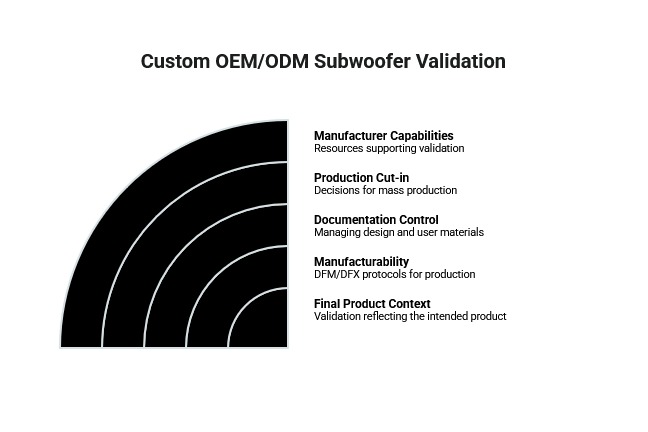
Custom OEM/ODM subwoofer programs may involve enclosure constraints, platform limits, acoustic tuning targets, branding, packaging, documentation, or integration with other system elements. In these programs, validation should reflect the final intended product context, not only a standalone driver or sample.
Use this stage to formalize DFM/DFX and ECO/ECR protocols. Brand teams should ask how manufacturability input is captured, how design changes are reviewed, how documentation is controlled, and how production cut-in decisions are managed.
CFS source material identifies an R&D team of more than 20 people across Acoustics, Electronics, Structure, and Software Development. It also identifies finite element simulation for magnetic circuit and speaker vibration system analysis, KLIPPEL R&D sample testing, golden sample management, ISO9001-2015 quality management certification, ERP/WMS with FIFO controls, KLIPPEL QC with golden samples, barcode/QR route control, IQC/IPQC/FQC inspection stages, and reliability laboratory testing.
For a brand partner, these are not reasons to skip program-specific validation questions. They are examples of manufacturer capability areas that can support a more concrete discussion about NPI risk, production consistency, and warranty risk.
What Evidence Should Change by Program Type?
Evidence may include sample data, qualification evidence, golden sample controls, production QC plans, traceability records, inspection gates, reliability testing, material rationale, and change-control documentation. The right mix may vary by program context.
A golden sample is a controlled reference used to align production output with approved sample characteristics. It can support consistency, but only when it is actively managed and used in QC. Production consistency means the manufacturer can keep mass-produced units aligned with approved requirements, rather than treating sample approval as an isolated milestone.
This connection matters because late-stage uncertainty often appears after teams believe the validation question has already been answered. A generic evidence package may show that a sample was reviewed, but it may not show whether the same assumptions are controlled in production.
For audio-specific standards discovery, the Audio Engineering Society standards pages can be a useful starting point for understanding the standards landscape, but they should not be treated as proof that any specific subwoofer program meets a requirement. (AES)
Questions Brand Teams Should Ask Before Locking Validation Expectations
Before setting validation expectations, brand teams should align on these questions:
- Which use environment did the sample validation assume?
- Which risks are most important for this program: thermal behavior, vibration, moisture, duty cycle, acoustic target, fit, or production consistency?
- What evidence connects sample approval to mass-production control?
- How are golden samples maintained and used in QC?
- What inspection gates apply before finished goods approval?
- How is test data linked to production traceability?
- What assumptions require technical or compliance review before final claims are made?
These questions help manufacturers and brand stakeholders discuss durability, reliability, and environmental exposure without making unsupported compliance or safety claims. They also give sourcing teams a more disciplined way to compare suppliers beyond a generic test-summary package.
Conclusion: Validation Fit Is a Program Conversation, Not a Generic Checklist
Private-label subwoofer validation is strongest when the brand team and manufacturer agree on the intended environment, duty cycle, installation context, evidence expectations, and production-control plan before treating a sample as representative of the final program.
Automotive, pro audio, marine, and custom OEM/ODM programs may each shift the evidence that matters most. The practical task is to identify the assumptions first, then ask for validation evidence that connects those assumptions to sample approval and production consistency.
To review which use-case assumptions should shape a future subwoofer platform, discuss your next subwoofer program with the CFS team.
Disclaimer:
This article is for general informational purposes only and does not constitute compliance, safety, technical, or professional advice. Requirements, risks, and best practices may vary by context, jurisdiction, system, provider, or use case. Confirm important decisions with the appropriate qualified professional, authority, or technical expert.
Our Editorial Process:
Our expert team uses AI tools to help organize and structure our initial drafts. Every piece is then extensively rewritten, fact-checked, and enriched with first-hand insights and experiences by expert humans on our Insights Team to ensure accuracy and clarity.
About the China Future Sound Insights Team
The China Future Sound Insights Team is our dedicated engine for synthesizing complex topics into clear, helpful guides. While our content is thoroughly reviewed for clarity and accuracy, it is for informational purposes and should not replace professional advice.