📌 Key Takeaways
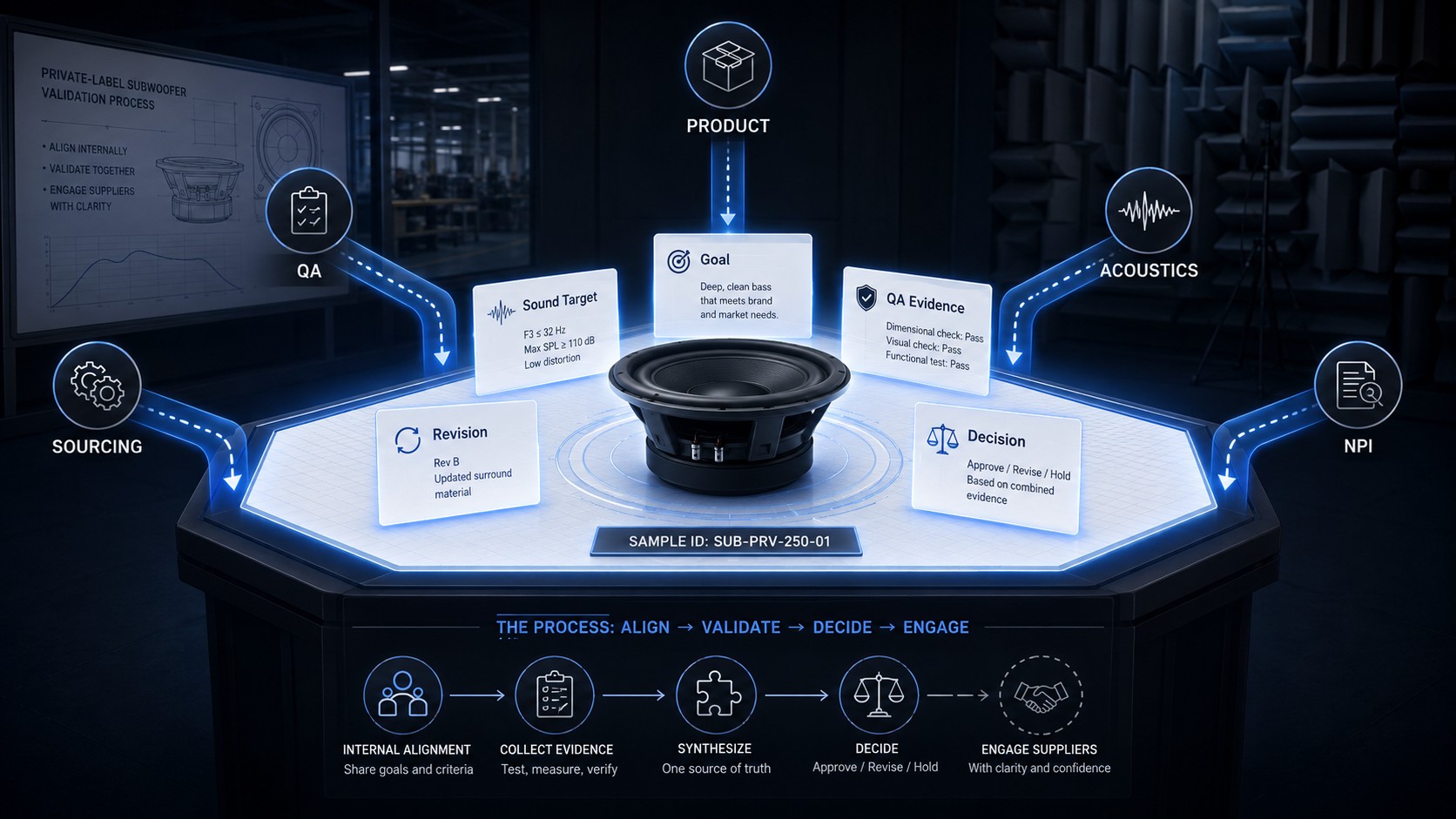
A strong subwoofer program starts with one shared meaning of “powerful” before the manufacturer joins the discussion.
- Align Before Calling: Product, acoustics, QA, and NPI should agree on goals before speaking with the manufacturer.
- Define The Role: Product should explain the use case, price tier, brand goal, and trade-offs.
- Make Sound Reviewable: Acoustics should turn “more bass” into clear points the whole team can judge.
- Agree On Evidence: QA should define what proof supports sample approval before production planning moves ahead.
- Clarify Decision Owners: NPI should name who can approve, reject, hold, or retest each sample.
Shared language turns sample review from opinion-based debate into a cleaner path toward action.
Private-label audio teams preparing an OEM/ODM subwoofer program will gain clearer alignment here, preparing them for the detailed overview that follows.
~ ~ ~ ~ ~ ~ ~ ~ ~ ~ ~ ~ ~ ~ ~ ~ ~ ~
A private-label audio brand may enter an OEM/ODM discussion with one simple request: a powerful subwoofer. That sounds clear until each internal team interprets “powerful” differently.
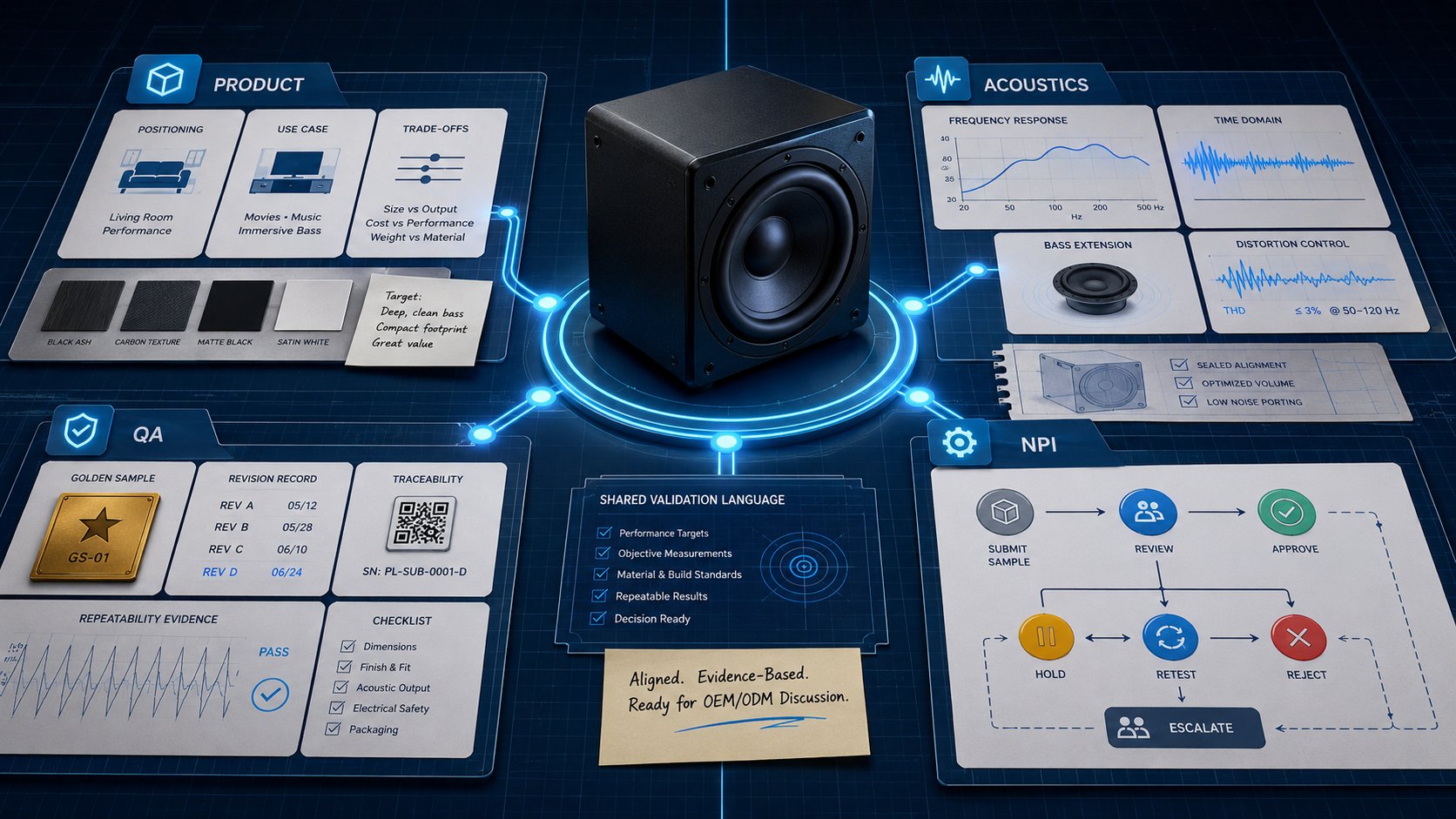
The Product team may be thinking about category positioning, price tier, and the sound signature customers should associate with the brand. The Acoustics team may be thinking about output, low-frequency extension, distortion behavior, enclosure assumptions, and fit constraints. The QA team may be thinking about sample evidence, golden sample control, production repeatability, and traceability. The NPI team may be thinking about timing, revision ownership, and who has authority to approve or hold the next sample.
Those priorities are compatible, but only if they are aligned before the manufacturer conversation starts. A useful manufacturer conversation starts with shared validation language: what the subwoofer must achieve, what evidence matters, which trade-offs are acceptable, and how sample feedback will be judged.
Why Internal Alignment Matters Before the First Manufacturer Conversation
The first OEM/ODM call should not force the manufacturer to decode unresolved internal disagreement. The manufacturer can help refine feasibility, materials, process controls, and sample strategy, but the brand team should already know what problem the subwoofer program is meant to solve.
From a broader program-management perspective, early ambiguity can create revision friction. That does not mean every specification must be finalized before the call. It means the team should agree on enough language to explain the program clearly. For example, “stronger bass” may refer to higher perceived output, deeper extension, tighter control, lower distortion, better enclosure integration, or more consistent production behavior.
Before involving a manufacturer, align on the role each function plays in sample readiness.
| Team | What to clarify before the OEM/ODM call |
|---|---|
| Product | Target use case, product tier, differentiation intent, and non-negotiable trade-offs |
| Acoustics / Hardware | Bass character, output expectation, distortion tolerance, enclosure assumptions, and fit constraints |
| QA | Sample identity, revision records, golden sample expectations, repeatability checks, and production-control evidence |
| NPI | Approval authority, retest logic, timing impact, and escalation path when feedback conflicts |
This alignment keeps the discussion at decision-maker altitude. It prevents the conversation from becoming either too vague for engineering action or too procedural for an early-stage manufacturer discussion.
Product Should Define Program Intent Before Evidence Is Debated
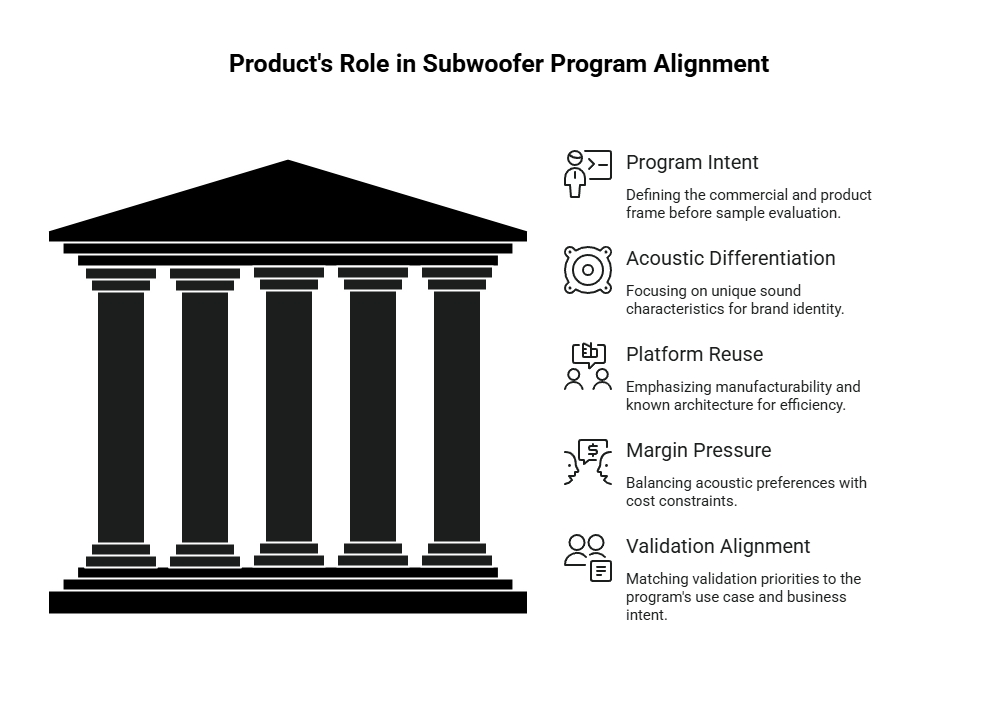
Product should define the commercial and product frame before Acoustics and QA evaluate sample readiness. That frame may vary by application. An automotive program, a marine program, a pro audio program, and a custom OEM platform can carry different priorities for form factor, environmental assumptions, acoustic identity, platform reuse, and production handoff.
The key is not to turn Product’s role into a full market-research exercise. It is to explain what the subwoofer must achieve for the brand.
A program built around acoustic differentiation may require tighter control over tuning direction and sample comparison. A program built around platform reuse may give more weight to manufacturability, known architecture, and qualification speed. A program under margin pressure may need earlier agreement on which acoustic preferences can flex and which cannot.
A concise Product alignment discussion should answer four questions:
- What use case is this subwoofer program designed to serve?
- Which product tier or brand position should the manufacturer understand?
- Which requirements are non-negotiable, and which are trade-off areas?
- What would make the first sample directionally right, even if it still needs refinement?
For teams comparing program types before sampling, a useful follow-up step is matching subwoofer validation to the OEM/ODM program type. The principle is context-dependent: validation priorities should follow the program’s use case and business intent, not a generic template.
Acoustics Should Translate Sound Goals Into Reviewable Criteria
Acoustic preferences become easier to review when they are translated into criteria that a cross-functional team can discuss consistently. “More bass” is not enough. It can describe output, extension, control, tuning balance, or subjective impact.
A generally accepted audio-development practice is separating subjective preference from reviewable evidence. The exact measurement targets, limits, and test conditions will vary by product architecture and program requirements, so numeric thresholds should come from verified engineering specifications or formal test methods—not assumption.
Useful validation language might look like this:
“Improve low-end impact without changing the approved enclosure constraint.”
“Preserve the intended bass character while reducing audible mechanical concern at higher drive levels.”
“Compare the next sample against the agreed reference sample under consistent review conditions.”
These statements do not replace engineering work. They make engineering work easier to direct.
China Future Sound (CFS) applies this principle by utilizing finite element simulation for magnetic circuits and speaker vibration systems, alongside KLIPPEL R&D for sample testing, power evaluation, and golden sample management. Official KLIPPEL R&D System documentation describes measurement capabilities such as acoustical tests, parameter measurement, distortion measurement, and power testing for speakers, including subwoofers. That external reference can help technical teams understand the type of measurement ecosystem involved, but it should not be treated as a substitute for program-specific acceptance criteria.
For a deeper internal preparation path, see how hardware and acoustics teams can align subwoofer validation criteria before OEM sampling.
QA Should Agree on Evidence Before Sample Approval
QA does not need to own every acoustic decision, but it does need clarity on what evidence will support sample approval. A sample can sound promising and still be difficult to carry into repeatable production if the team has not agreed how sample identity, revision history, and production-control handoff will be handled.
The level of QA evidence should fit the program’s risk profile. A minor variation of an existing platform may not need the same discussion as a new design with tighter acoustic expectations. Even so, the team should decide what evidence must be available before NPI treats the sample as ready for the next gate.
Useful QA questions include sample-level and production-level concerns. Which sample version is being reviewed? What changed from the previous build? Which conditions were used for evaluation? What becomes the reference or golden sample? What evidence should be handed off before production planning advances?
For instance, the quality system at CFS mitigates these risks through ISO9001-2015 quality management, ERP/WMS with FIFO controls, KLIPPEL QC with golden samples, barcode/QR route control tied to test-data traceability, IQC/IPQC/FQC inspection stages, and reliability laboratory testing. Official ISO 9001:2015 information describes the standard as a quality management system standard for organizations seeking consistent processes and customer/regulatory requirement alignment. That reference supports general understanding of the standard; it does not prove specific product outcomes by itself.
For QA leaders, the next practical step is to examine how QA teams can use acoustic validation evidence without turning early sample review into a lab manual.
NPI Should Clarify Decision Ownership Before Revisions Start
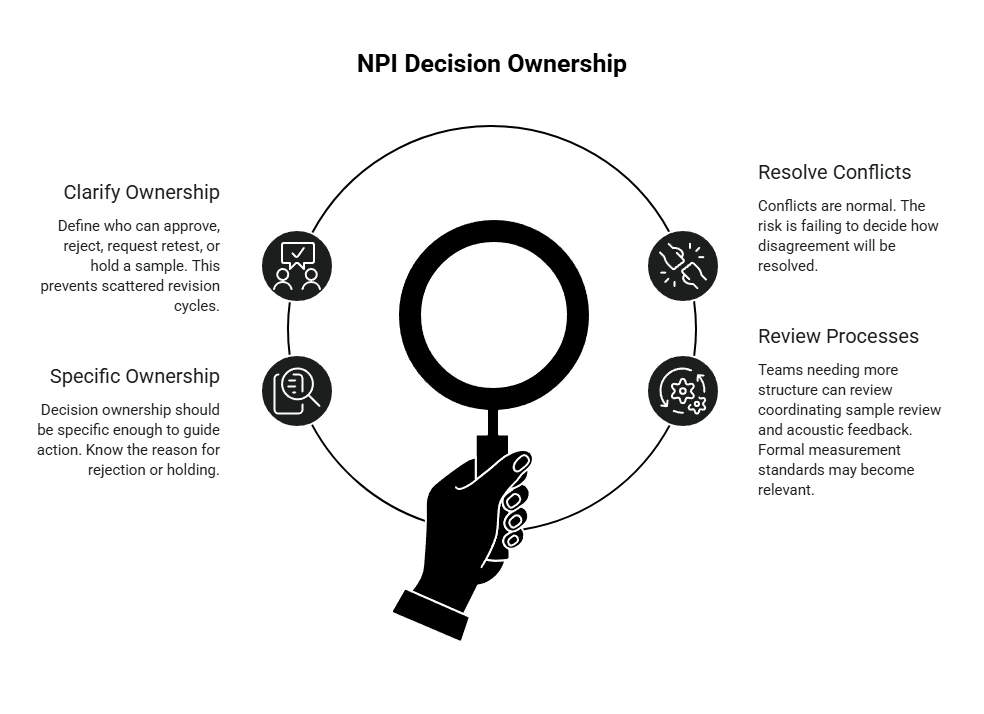
The NPI team keeps the revision cycle from becoming scattered. The team should define who can approve, reject, request retest, or hold a sample before feedback begins moving between functions and the manufacturer.
Conflicts are normal. Product may prefer a tuning direction. Acoustics may flag a technical concern. QA may ask for clearer evidence. Sourcing or program leadership may care about feasibility and timing. The risk is not disagreement; the risk is failing to decide how disagreement will be resolved.
Decision ownership should be specific enough to guide action. If a sample is rejected, the manufacturer should know whether the issue is acoustic character, fit, reliability concern, documentation gap, production-control readiness, or unresolved brand preference. If a sample is held, the team should know what information would release it.
Teams that need more structure after the first sample can review coordinating sample review and acoustic feedback in NPI. Formal measurement standards may become relevant later depending on the product and claims being made; official AES standards are a better reference point for standards exploration than informal summaries, but standards selection should be handled by qualified technical stakeholders.
What to Bring Into the Manufacturer Conversation
Bring an alignment summary, not a rigid script. The manufacturer should understand the program intent, target use case, acoustic expectations, QA evidence needs, sample-review ownership, and open trade-offs where supplier input is welcome.
A private-label subwoofer program becomes easier to discuss when the Product team can explain the intended market position, the Acoustics team can define reviewable sound expectations, the QA team can describe evidence needs, and the NPI team can identify who owns the next decision. That is enough to make the first manufacturer conversation more focused without pretending every detail is already solved.
For teams preparing to speak with a subwoofer manufacturer, the strongest first step is internal agreement on validation language. To discuss how that alignment could apply to an upcoming program, contact China Future Sound to discuss your next subwoofer program.
Disclaimer: This article is for general informational purposes only. It is not a substitute for advice from a qualified professional, provider, or official source relevant to your situation. Always verify important decisions with the appropriate expert, authority, or service provider.
Our Editorial Process:
Our expert team uses AI tools to help organize and structure our initial drafts. Every piece is then extensively rewritten, fact-checked, and enriched with first-hand insights and experiences by expert humans on our Insights Team to ensure accuracy and clarity.
About the China Future Sound Insights Team
The China Future Sound Insights Team is our dedicated engine for synthesizing complex topics into clear, helpful guides. While our content is thoroughly reviewed for clarity and accuracy, it is for informational purposes and should not replace professional advice.