📌 Key Takeaways
Subwoofer proof must match the exact program, not just the supplier’s testing label.
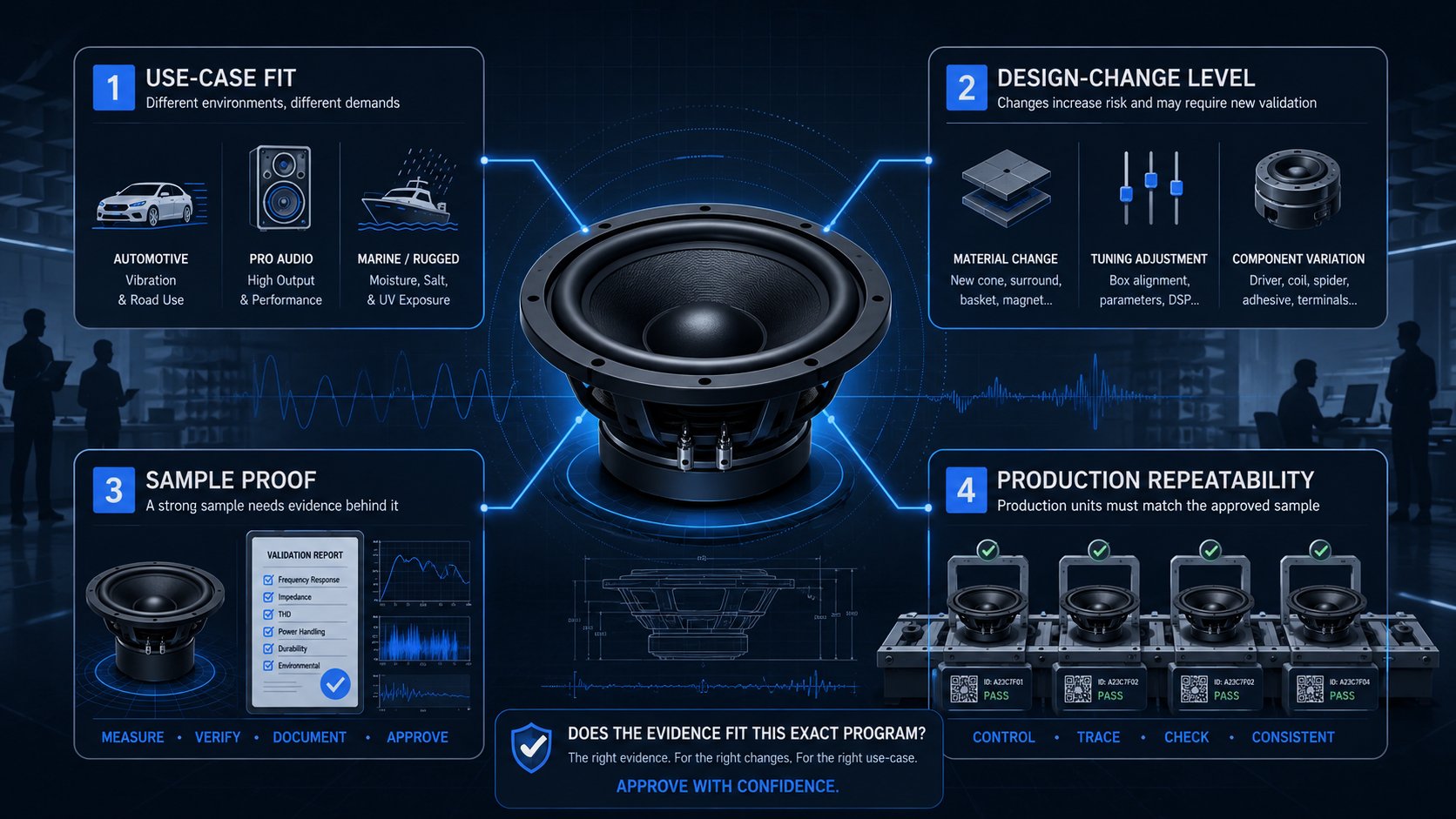
- Fit Comes First: Ask what the subwoofer will face before judging any supplier test results.
- Samples Need Backup: A strong sample means less without proof that production units stay the same.
- Changes Raise Risk: New materials, tuning, or use cases may need fresh tests before approval.
- Generic Claims Fall Short: Peak-power claims or equipment lists do not prove real-world product fit.
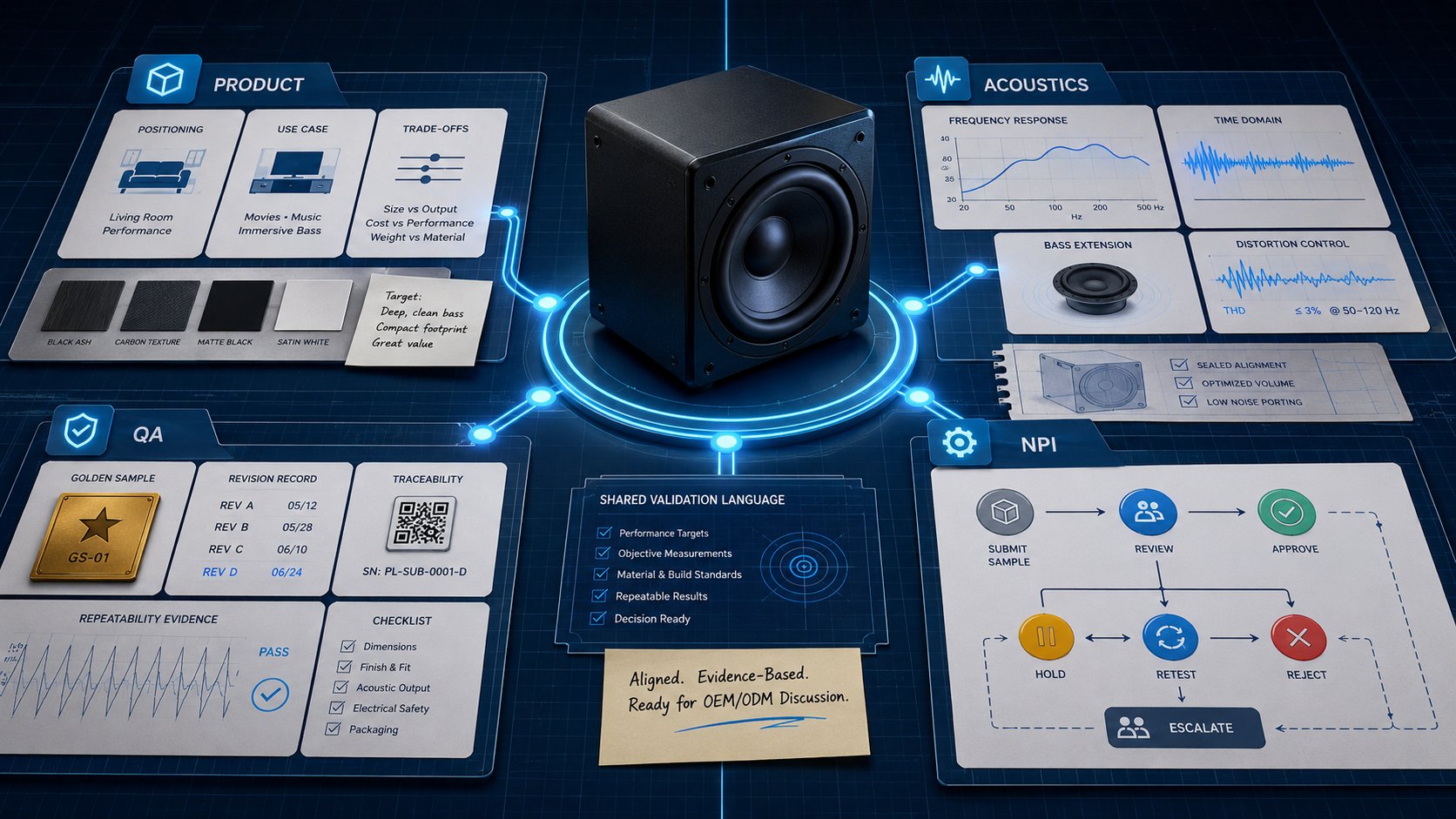
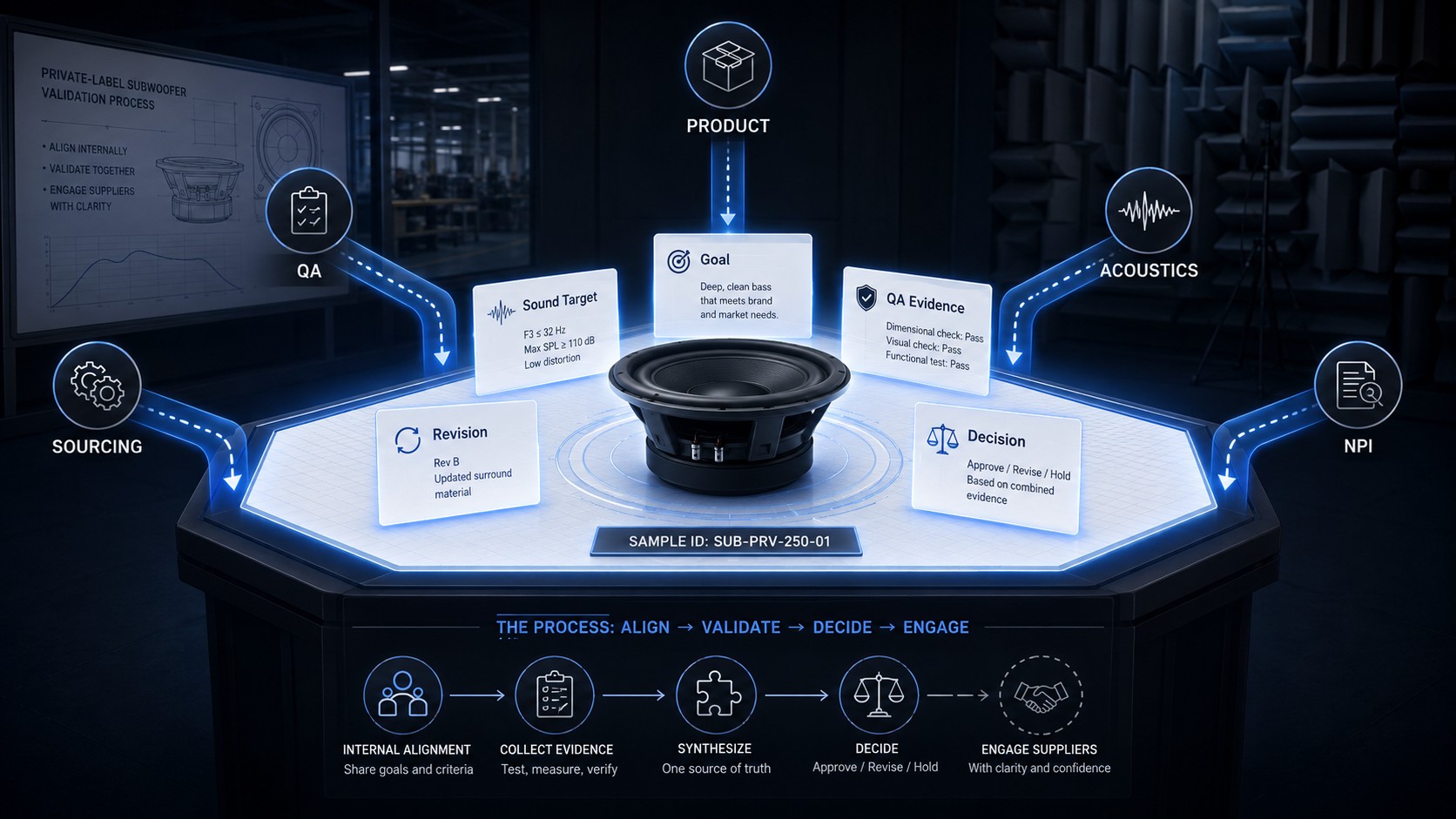
- Evidence Aligns Teams: Clear proof helps Product, QA, and Sourcing agree before RFQ, tooling, or SOP.
Good supplier proof connects the tested sample, real use conditions, and repeatable production.
Private-label audio teams comparing OEM and ODM subwoofer programs will spot stronger supplier proof, preparing them for the detailed overview that follows.
~ ~ ~ ~ ~ ~ ~ ~ ~ ~ ~ ~ ~ ~ ~ ~ ~ ~
“Validated” does not mean the same thing in every subwoofer program. A supplier may show a test summary, an equipment list, or an approved sample, but Product, QA, and Sourcing still need to know whether that evidence fits the actual program context.
For private-label audio brands comparing OEM/ODM subwoofer programs, validation fit depends on the use case, design-change level, production model, and evidence package. Automotive, pro audio, marine, and custom OEM/ODM subwoofers may each create different validation priorities. Weak validation fit does not mean a program will fail, but it can create late-stage questions, stakeholder disagreement, or uncertainty before NPI. The practical goal is to ask better supplier questions before RFQ, sample approval, tooling, or SOP.
Start With Program Context Before the Supplier Label
OEM and ODM labels can describe the business model, but they do not define the validation burden by themselves. A lightly adapted ODM platform may be lower risk than a highly customized build. That changes if the brand adjusts the enclosure, tuning, materials, application environment, or performance target.
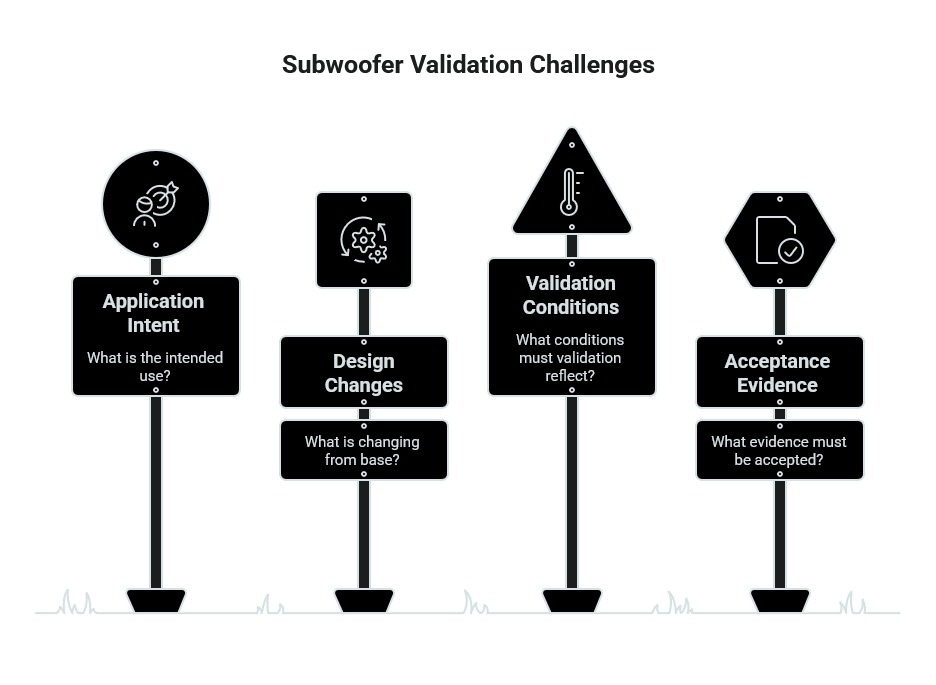
Before reviewing a supplier’s subwoofer manufacturing capabilities, align the team around four fit questions:
- What is the intended application?
- What is changing from the base design or platform?
- What conditions must validation reflect?
- What evidence must Product, QA, and Sourcing accept before moving forward?
This keeps the discussion at decision-maker altitude. The point is not to run the lab process internally. It is to understand whether the supplier evidence matches the program-specific risk.
For teams still clarifying manufacturing strategy, broader OEM vs. ODM model choices can provide useful context. The validation decision, however, should still come back to application assumptions, sample-to-production consistency, and change control.
Compare Validation Priorities by Subwoofer Program Type
The matrix below is an evaluation framework, not a regulatory checklist. Exact standards, pass/fail thresholds, and customer-specific requirements should be verified through approved test plans, qualified engineering review, or relevant standards professionals.
| Program type | What validation should reflect | Supplier evidence to ask for | Watch-out |
|---|---|---|---|
| Automotive subwoofer | Vehicle installation constraints, vibration exposure, temperature exposure, electrical integration, lot consistency | Sample test summary, design assumptions, golden sample criteria, production QC route, traceability plan | Do not accept generic “car audio tested” claims without application context. |
| Pro audio subwoofer | Sustained output, mechanical stress, thermal behavior, high-duty use patterns | Power-test summary, thermal or reliability evidence, driver/enclosure validation notes, consistency controls | Do not treat a peak-power claim as validation evidence. |
| Marine or outdoor-adjacent subwoofer | Humidity, corrosion-related material concerns, UV or material exposure where relevant, sealing assumptions | Material rationale, environmental test plan or supplier evidence, reliability-test summary, design-change log | Do not imply a marine standard unless it is verified for the program. |
| Custom OEM/ODM subwoofer | Customization level, platform reuse, tooling or material changes, new acoustic targets | Change-control log, revised validation plan, golden sample governance, pilot-run criteria | Do not assume an ODM base platform remains validated after major changes. |
Automotive programs may need closer attention to installation environment, electrical integration, and traceability. Pro audio programs may need stronger evidence around sustained power, thermal behavior, and mechanical durability. Marine or outdoor-adjacent programs may call for closer review of material selection and environmental exposure assumptions, supported by appropriate marine audio production context where relevant.
Where a supplier cites formal measurement or quality standards, verify the exact standard, title, edition, and relevance. For high-level context only, official references such as ISO 9001:2015, AES Standards, IEC audio/video standards activity, and CTA loudspeaker measurement resources can help teams check whether a cited method is being represented accurately—not whether it automatically governs every subwoofer validation program.
Separate Sample Validation From Production Repeatability
A good sample matters, but it does not prove that production units will remain aligned with the approved design. For brand teams, the stronger question is: what evidence connects the validated sample to ongoing production?
Supplier evidence should cover three levels:
| Evidence level | What it supports | Examples to request |
|---|---|---|
| Conceptual evidence | Whether validation maps to the use case and environment | Application assumptions, design rationale, change-risk notes |
| Supplier evidence categories | Whether testing and controls are tied to the program | Sample testing, power testing, reliability testing, QC gates, traceability, change control |
| Production repeatability evidence | Whether approved performance is protected at scale | Golden sample governance, route control, IQC/IPQC/FQC records, lot or unit traceability |
For an industry-representative baseline of evidence documentation, firms like China Future Sound integrate standard protocols including. Based on the provided brief, CFS has R&D functions across Acoustics, Electronics, Structure, and Software Development; uses KLIPPEL R&D sample testing against designed performance requirements; conducts short-term destructive and long-term power tests on samples; uses golden sample management; and applies ERP/WMS FIFO, KLIPPEL QC, barcode/QR route control, IQC, IPQC, FQC, and reliability lab testing according to design requirements. These are evidence categories to request and evaluate, not proof of guaranteed outcomes.
For teams formalizing supplier review expectations, golden sample governance and barcode testing route control are useful adjacent topics.
Ask What Changed Before Deciding How Much Validation Is Enough
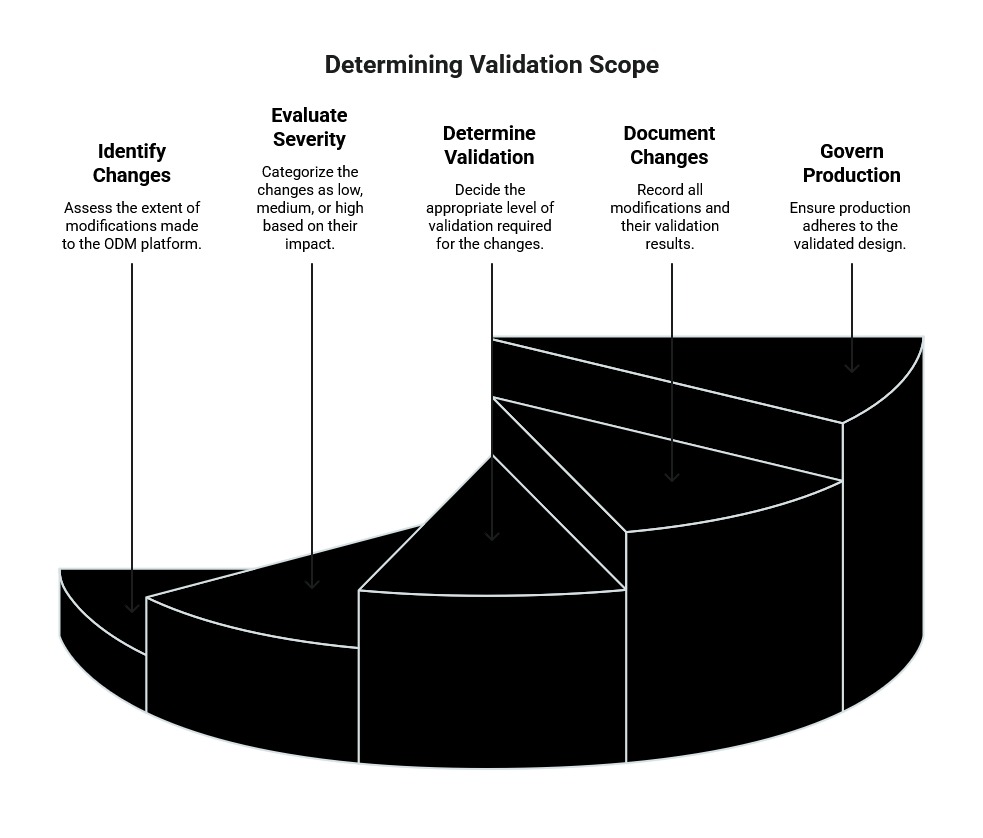
ODM platform reuse can reduce uncertainty when the brand makes limited changes. Validation scope should expand when changes affect acoustic targets, enclosure constraints, materials, magnet or voice-coil choices, cosmetics that affect structure, environmental assumptions, firmware/DSP integration, or supply-chain inputs.
Change severity callout:
Low-change programs may involve branding, packaging, or cosmetic adjustments that do not affect acoustic or mechanical function. Medium-change programs may involve tuning, enclosure, materials, or component substitutions. High-change programs may involve a new motor structure, new enclosure architecture, new application environment, or new performance target.
These categories are editorial evaluation tools, not formal standards. They help Product, QA, and Sourcing decide when existing platform evidence may be enough and when revised validation should be requested.
A supplier answer such as “same platform” should trigger follow-up if important assumptions changed. The more the program moves away from the original design or use environment, the more the team should ask what validation is repeated, what is newly documented, and how changes are governed before production.
Use These Supplier Questions Before RFQ or Sample Approval
A practical supplier review should make validation evidence easier for Product, QA, and Sourcing to compare. Use these questions before RFQ, sample approval, or NPI review:
- Which application environment did the validation plan assume?
- Which tests show the sample meets target acoustic and power requirements?
- Which evidence shows production units stay aligned with the approved sample?
- How are golden samples managed and version-controlled?
- Which QC gates apply before, during, and after production?
- How is unit or lot traceability maintained?
- What validation is repeated when materials, components, enclosure, or tuning changes?
- How are reliability tests tied to design requirements documented?
- What evidence will Product, QA, and Sourcing receive before approval?
- What risks would the supplier flag for this program type before tooling or SOP?
Strong answers should connect supplier evidence to program context. Weak answers often rely on generic claims, peak-power language, or a test-equipment list without showing how evidence maps to the intended use case. For broader NPI framing, teams can also review NPI validation gates as a related decision-support topic.
Validation Fit Is a Program Decision
Subwoofer validation fit across OEM/ODM program types should be evaluated by use case, change level, supplier evidence, and production controls. The right question is not only whether a supplier has tested the product. The better question is whether the validation package reflects what the product will experience and how production will preserve the approved design.
Use the validation-fit matrix before the next supplier review. To discuss validation expectations for a private-label subwoofer program, discuss your next program with China Future Sound’s team.
Disclaimer: This article is for general informational purposes only and does not constitute compliance, safety, technical, or professional advice. Requirements, risks, and best practices may vary by program context, jurisdiction, application, supplier, and test plan. Confirm important validation decisions with the appropriate qualified engineering, QA, compliance, or technical professional.
Our Editorial Process:
Our expert team uses AI tools to help organize and structure our initial drafts. Every piece is then extensively rewritten, fact-checked, and enriched with first-hand insights and experiences by expert humans on our Insights Team to ensure accuracy and clarity.
About the China Future Sound Insights Team
The China Future Sound Insights Team is our dedicated engine for synthesizing complex topics into clear, helpful guides. While our content is thoroughly reviewed for clarity and accuracy, it is for informational purposes and should not replace professional advice.