📌 Key Takeaways
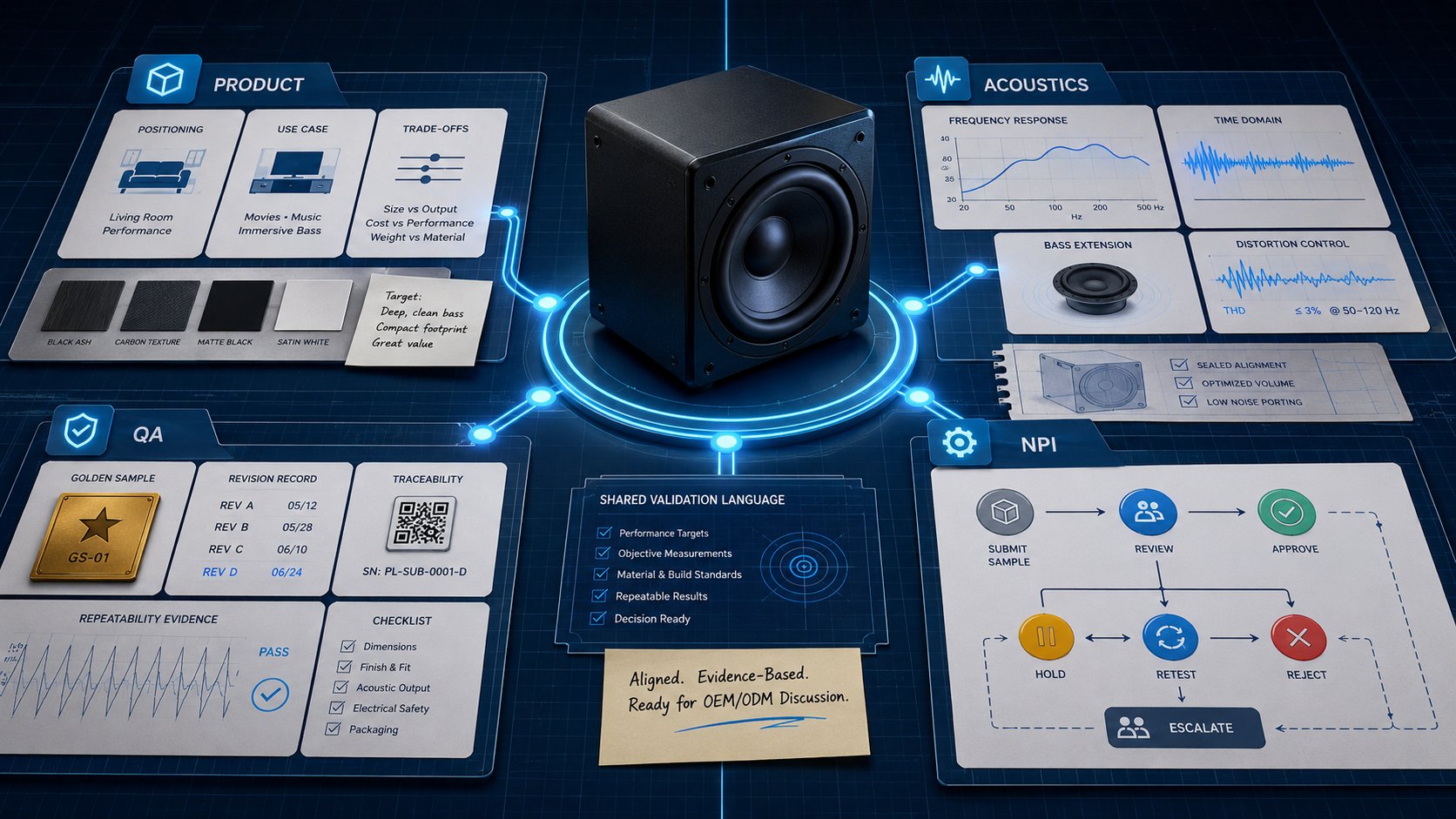
Subwoofer samples should prove more than good sound; they should show the supplier can repeat it in production.
- Agree On Targets: Product and QA should know what the sample must prove before approval starts.
- Ask For Proof: Strong suppliers explain what they tested, how they tested it, and which sample version passed.
- Control The Benchmark: A golden sample should guide production checks, not sit unused after signoff.
- Link Sound To Production: Future units need clear checks against the approved sample and agreed sound goals.
- Track Every Change: Good records help teams trace test data, product lots, and design changes during NPI.
One great prototype is not enough; repeatable proof is what makes a supplier ready.
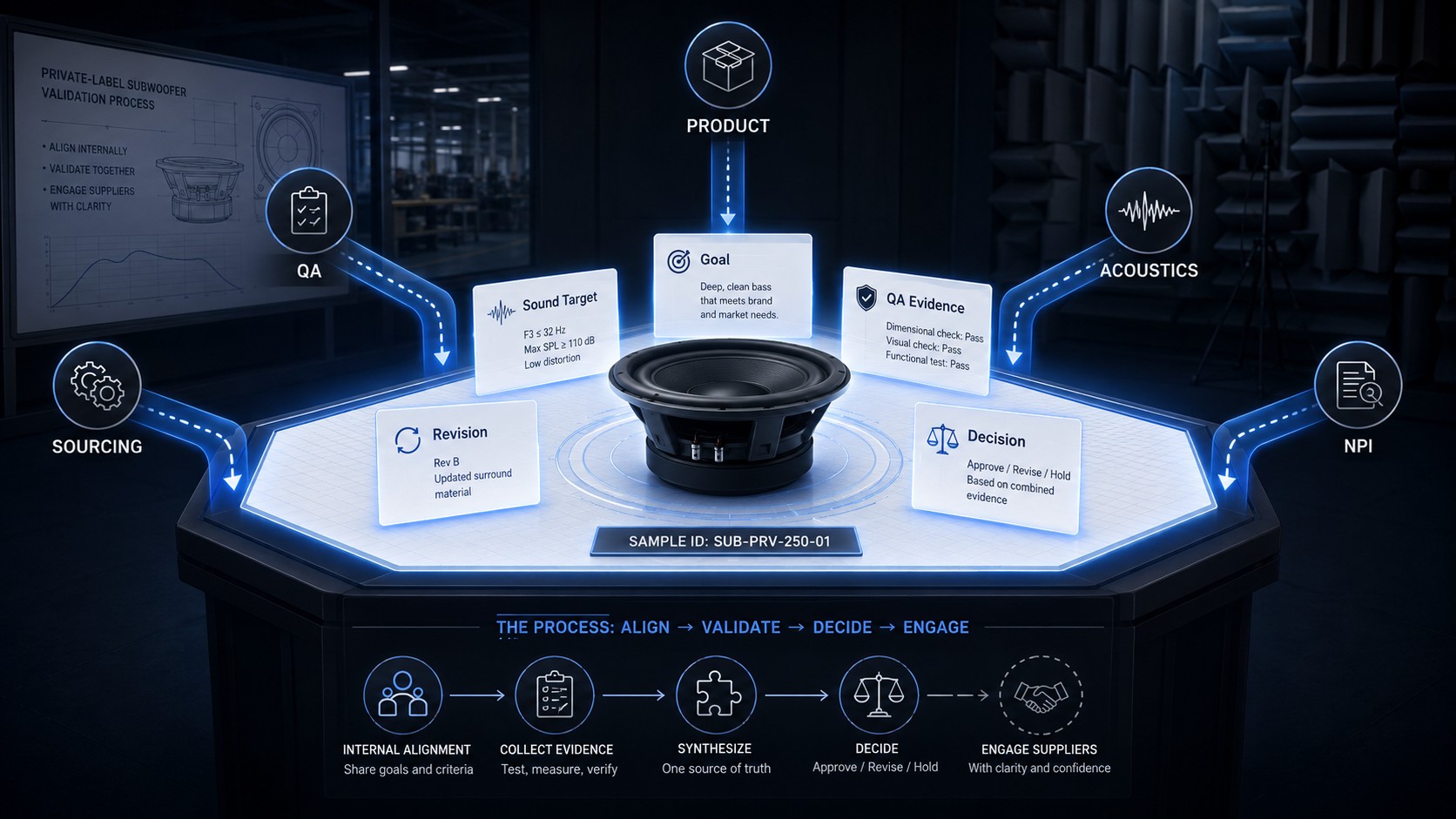
QA, Product, NPI, and sourcing teams will ask sharper supplier-readiness questions, preparing them for the detailed overview that follows.
~ ~ ~ ~ ~ ~ ~ ~ ~ ~ ~ ~ ~ ~ ~ ~ ~ ~
A growth-stage audio brand may hear a promising private-label subwoofer sample and still face a hard question: is the supplier ready to support NPI, or does the program only have one acceptable prototype?
That gap matters. If acoustic validation expectations are clarified too late, Product may believe the sound direction is approved while QA still lacks evidence, traceability, and production-control confidence. Subwoofer acoustic validation before NPI is the process of confirming that acoustic targets, sample evidence, and production-control expectations are clear before formal new product introduction work begins.
This is not a lab procedure. It is a supplier-readiness question framework for QA Directors, Heads of Product, NPI leads, acoustics managers, and sourcing stakeholders evaluating subwoofer manufacturers before a private-label program moves deeper into development.
Why Validation Questions Belong Before NPI
NPI, or new product introduction, is where product intent begins moving toward controlled production readiness. In general supplier-quality practice, that shift works best when teams define what must be validated, what evidence is acceptable, and who owns decisions before changes become expensive to unwind.
For subwoofer programs, the risk is not only poor sound. The practical risk is misalignment: a supplier may provide a sample that sounds acceptable once but cannot clearly explain how that sample maps to acoustic targets, production checks, or issue resolution. Exact validation methods vary by product, application, and supplier infrastructure, but the principle is stable: Product, QA, and supplier teams need the same definition of readiness.
A mature pre-NPI conversation should connect four things: target, evidence, control, and communication. If one is missing, the program may still move forward, but with more uncertainty than necessary.
Ask How Acoustic Targets Are Defined Before Samples Are Built
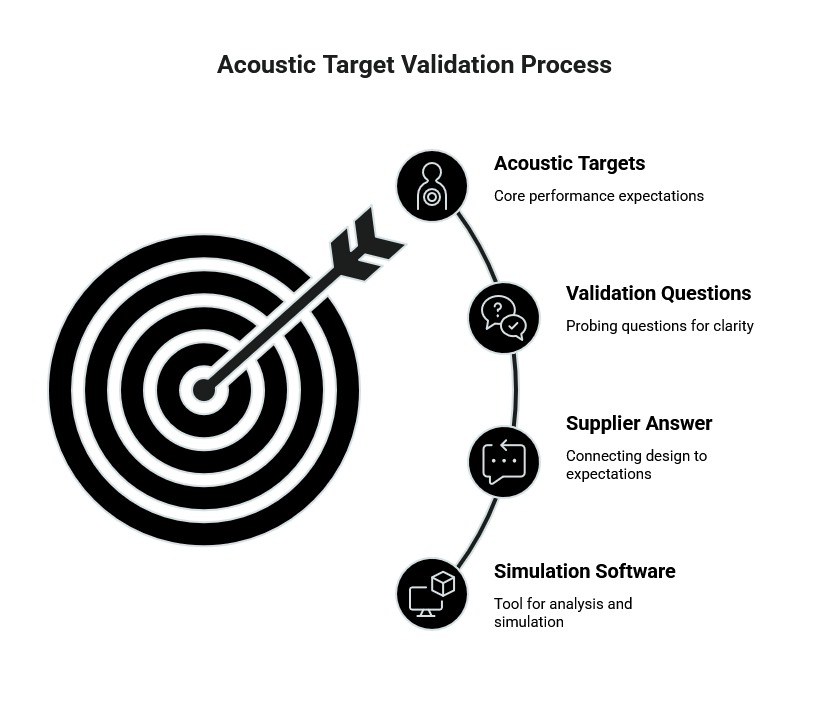
The first question is not “Does the sample sound good?” It is “What acoustic targets is this sample meant to prove?”
For a private-label subwoofer manufacturer, acoustic targets may include frequency response, distortion expectations, sensitivity, impedance, power handling, enclosure assumptions, thermal behavior, and application environment. These examples are general validation categories, not universal requirements. The right target set depends on the product concept and the brand’s intended use case.
Strong questions include:
- Which acoustic targets are being validated before sample approval?
- Are those targets tied to a vehicle, marine, pro audio, or other program context?
- How are trade-offs handled when bass output, form factor, thermal behavior, and cost conflict?
- Who approves target changes before NPI?
A strong supplier answer connects design intent to measurable expectations. A vague answer focuses only on subjective listening or says adjustments can happen later without explaining how target changes are controlled.
For example, China Future Sound’s (CFS) Acoustics Team uses finite element simulation software for magnetic circuit and speaker vibration system simulation, based on product performance requirements. That kind of capability is useful in a supplier evaluation when it helps the team discuss design intent and trade-offs early, not when it becomes an over-technical modeling tutorial.
Ask What Evidence Supports Sample Approval
Sample approval should not depend only on a single listening impression. Product teams need to confirm whether the sample fits the intended outcome. QA teams need to know what validation evidence supports that approval.
Before approving a subwoofer sample, ask what measurements were taken, what setup and conditions were used, how many samples were reviewed, and whether the data is tied to the exact sample version. If the supplier has revised the prototype, ask how differences between the first sample, revised sample, and final approved sample are recorded.
A stronger answer sounds specific without overpromising. The supplier can explain what was checked, what the result was compared against, and how the record will be used if the design changes. A risk signal is the phrase “the sample passed” without explaining what passed, under which conditions, or against which agreed acceptance criteria.
For instance, CFS engineers utilize KLIPPEL R&D to test samples against designed performance requirements. Program-specific test limits and acceptance criteria must be explicitly codified within the approved engineering plan.
Ask How Approved Samples Become Production Controls
The central pre-NPI issue is not whether one sample can perform well. It is whether future production can stay aligned with the approved benchmark.
A golden sample is an approved reference unit used to help compare future production output against agreed expectations. In supplier evaluation, the practical question is whether the golden sample is actively governed or simply treated as a one-time signoff artifact.
Ask who controls the golden sample, how it is identified, how revisions are handled, and how production units are compared with the approved benchmark. Then ask what happens when performance parameters drift. If the supplier cannot explain the link between sample approval and production consistency, QA may not have enough evidence to support progression into NPI.
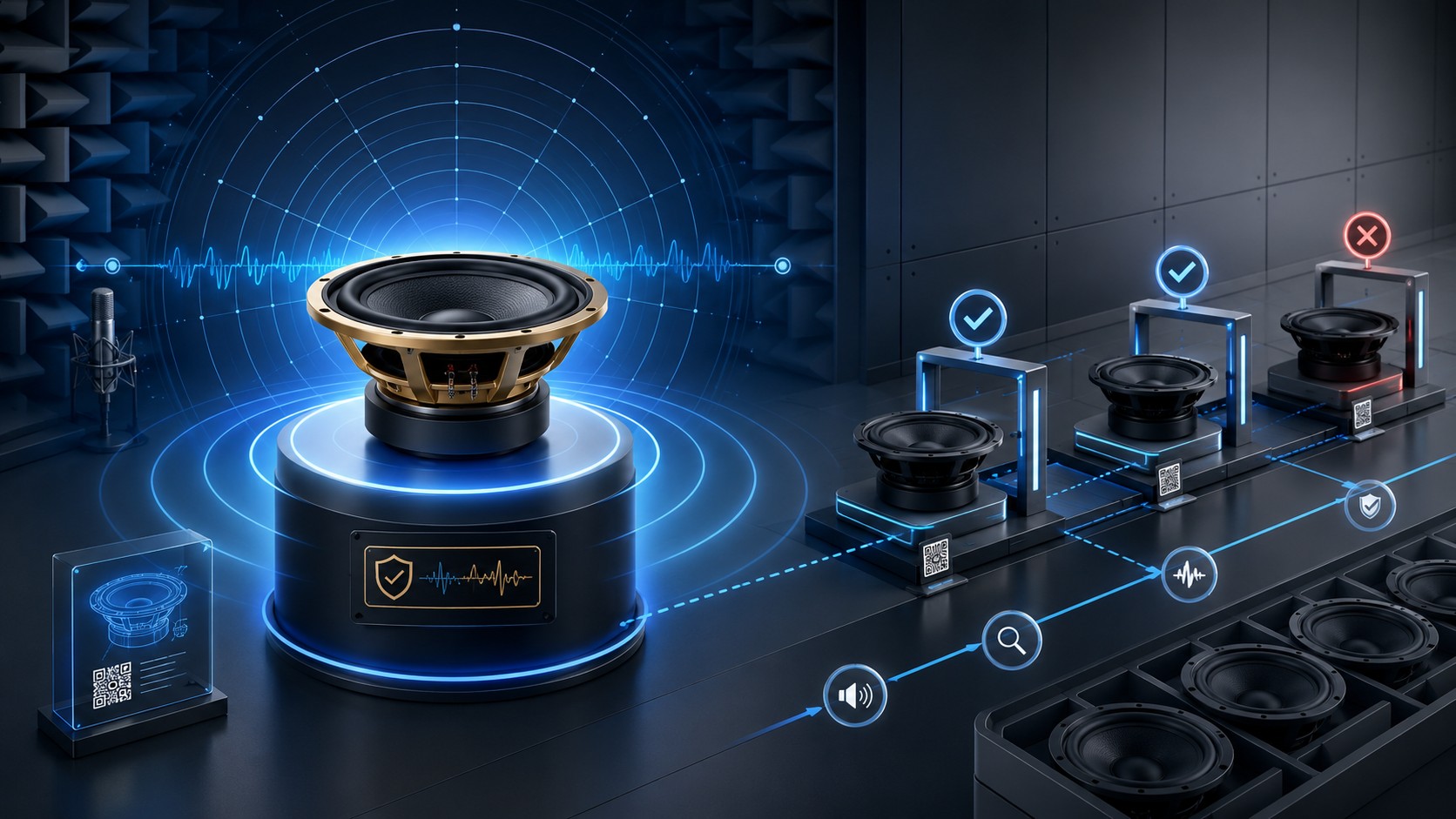
CFS, for example, integrates golden sample management with KLIPPEL QC to establish strict consistency control between mass-produced units and approved prototypes.
A strong answer shows custody, version control, comparison method, escalation path, and production-data linkage. A weak answer treats the golden sample as a customer approval item rather than a living QA reference.
Ask What Reliability, Traceability, And Communication Reveal
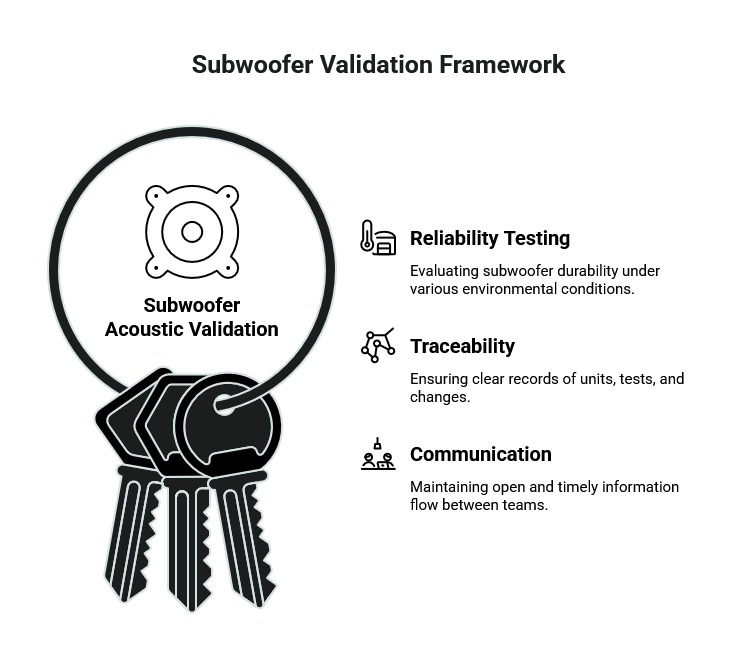
Subwoofer acoustic validation should also address durability under expected use. Ask what short-term and long-term power tests are performed, what usage environment is being simulated, whether tests are tied to design requirements, and how results are shared with QA and Product.
In practice, this requires subjecting units to short-term destructive and long-term power testing to accurately simulate extended environmental stress and evaluate baseline reliability.
Traceability is the ability to connect units, lots, test records, inspection results, and changes back to a clear record. In practical NPI terms, traceability helps teams understand where evidence lives and how it supports issue review. While frameworks like NIST provide foundational guidelines for measurement traceability, practical execution within an OEM/ODM program relies strictly on the supplier’s internal tracking systems and agreed-upon record-keeping.
Ask whether test data is tied to barcode or QR records, which QA gates exist before finished-product release, and how IQC, IPQC, and FQC are used. IQC means Incoming Quality Control, IPQC means In-Process Quality Control, and FQC means Final Quality Control.
Facilities like CFS maintain this traceability via barcode/QR route control, test-data binding, ERP/WMS/FIFO software, and an ISO9001-2015 compliant quality-system infrastructure. These protocols collectively secure the IQC, IPQC, and FQC workflows.
Communication is the final readiness test. Ask who owns validation updates, how ECO/ECR changes are handled, and what data Product and QA will receive if a performance question appears during NPI. Broader supplier-quality principles, such as process controls and quality-assurance planning, are also reflected in ASQ’s supplier-quality body of knowledge. A helpful next internal resource is the OEM audit checklist.
Pre-NPI Subwoofer Acoustic Validation Question Checklist
| Validation Area | Question to Ask | Why It Matters | Strong Evidence to Request | Risk Signal |
|---|---|---|---|---|
| Acoustic target definition | What targets are being validated before samples are approved? | Keeps sample approval from becoming subjective. | Target summary tied to product requirements and use context. | Supplier relies only on listening impressions. |
| Sample measurement evidence | What evidence supports sample approval? | Helps Product and QA approve the same version for the same reasons. | Measurement records, test conditions, sample version history. | “The sample passed” without details. |
| Golden sample governance | How is the approved benchmark controlled? | Connects approval to repeatable production checks. | Golden sample custody, revision control, comparison process. | Golden sample is treated as a one-time signoff. |
| Production consistency | How are mass-production units compared with the approved sample? | Supports NPI readiness and supplier scorecard review. | QA gate records, QC method, production test data. | No clear production-control link. |
| Reliability and power testing | What durability or power tests are performed before NPI? | Clarifies whether expected use conditions are considered. | Qualitative test summaries tied to design requirements. | Supplier implies testing guarantees all outcomes. |
| Traceability and data access | Can test data be tied to units, lots, or barcode/QR records? | Helps teams investigate issues during NPI. | Traceable records and data-access process. | Data exists but cannot be connected to decisions. |
| NPI communication and change control | Who owns validation updates and ECO/ECR handling? | Keeps Product, QA, sourcing, and engineering aligned. | Named owners, review cadence, change records. | Changes are handled informally or after the fact. |
Use this checklist before your next supplier conversation.
FAQs
What is subwoofer acoustic validation before NPI?
It is the operational gatepost where a brand and supplier mutually define acoustic benchmarks, acceptable testing data, and mass-production quality controls prior to manufacturing. The exact test methods and acceptance criteria may vary by program, product design, supplier, and application.
Should QA or Product own acoustic validation questions?
Both should participate. Product should clarify the target outcome, trade-offs, and intended user experience. QA should clarify evidence, controls, consistency expectations, traceability, and risk signals. The shared question list helps both teams evaluate readiness from the same facts.
What is a golden sample in a subwoofer program?
A golden sample is an approved benchmark used to help compare future production output against agreed performance expectations. In a mature supplier process, it should be version-controlled, protected from confusion with earlier samples, and connected to production QA checks.
Conclusion
Subwoofer acoustic validation before NPI is not about turning QA or Product teams into acoustic test engineers. It is about asking the right decision questions early enough to reduce supplier-selection uncertainty.
The best supplier conversations connect acoustic targets, sample evidence, golden sample governance, production consistency, reliability testing, traceability, and communication. That gives Product, QA, sourcing, and NPI teams a clearer basis for deciding whether a supplier is ready to move forward.
Discuss your next subwoofer program with a manufacturing partner that can connect acoustic validation, sample control, and production QA. For a commercial next step, qualified teams may request a quote for a subwoofer program review.
Disclaimer: This article is for general informational purposes only and does not constitute compliance, safety, technical, or professional advice. Requirements, risks, and best practices may vary by program, product design, supplier, test method, and use case. Confirm important decisions with the appropriate qualified engineering, QA, or technical expert.
Our Editorial Process:
Our expert team uses AI tools to help organize and structure our initial drafts. Every piece is then extensively rewritten, fact-checked, and enriched with first-hand insights and experiences by expert humans on our Insights Team to ensure accuracy and clarity.
About the China Future Sound Insights Team
The China Future Sound Insights Team is our dedicated engine for synthesizing complex topics into clear, helpful guides. While our content is thoroughly reviewed for clarity and accuracy, it is for informational purposes and should not replace professional advice.