📌 Key Takeaways
Material Choices Reveal OEM Engineering Standards: The materials used in subwoofer components—from cone composition to voice coil construction—serve as direct indicators of an OEM manufacturer’s engineering capabilities and quality standards, helping you identify partners who prioritize performance over cost-cutting.
Know What to Look for on Spec Sheets: Carbon fiber cones typically offer superior stiffness-to-weight ratios for high-performance applications, copper voice coils provide better conductivity than aluminum alternatives, and neodymium magnets deliver higher magnetic field strength in more compact designs compared to ferrite options.
Ask the Right Technical Questions: Quality manufacturers can explain their material selection rationale, provide documentation about sourcing standards, and discuss testing protocols—capabilities that distinguish serious engineering partners from basic assembly operations.
Evaluate Beyond Individual Components: The integration and implementation of materials matters as much as the materials themselves; a premium material with poor design integration will underperform compared to well-engineered conventional alternatives.
Build Foundation for Strategic Decisions: This material science knowledge becomes essential for director-level roles, forming the basis for strategic product decisions, supplier negotiations, and brand positioning strategies that define market leadership.
Understanding these material fundamentals transforms you from a passive spec sheet reader into an informed technical buyer capable of confidently evaluating OEM partnerships and reducing the risk of choosing partners who cannot meet your quality standards.
Introduction: Why Subwoofer Materials Are a Key Indicator of OEM Quality
You’re staring at another technical specification sheet, and the jargon feels overwhelming. Carbon fiber cones, aluminum voice coils, neodymium magnets—the terminology reads like a chemistry textbook, but your brand’s reputation depends on making the right choice.
Here’s the reality: The materials used in a subwoofer aren’t just components; they’re direct indicators of an OEM manufacturer’s engineering capabilities and quality standards. A partner who cuts corners on materials will likely compromise in other areas too—manufacturing consistency, testing protocols, and long-term reliability.
This guide breaks down the key materials that determine subwoofer performance, giving you the knowledge to confidently evaluate technical specifications and ask the right questions during your vetting process.
Key Terminology
- Voice Coil: The electromagnetic component that converts electrical signals into mechanical motion
- Excursion: The maximum distance a cone can move without distortion
- Xmax: Linear excursion limit where the subwoofer maintains accuracy
The Anatomy of a Subwoofer: Understanding the Core Components
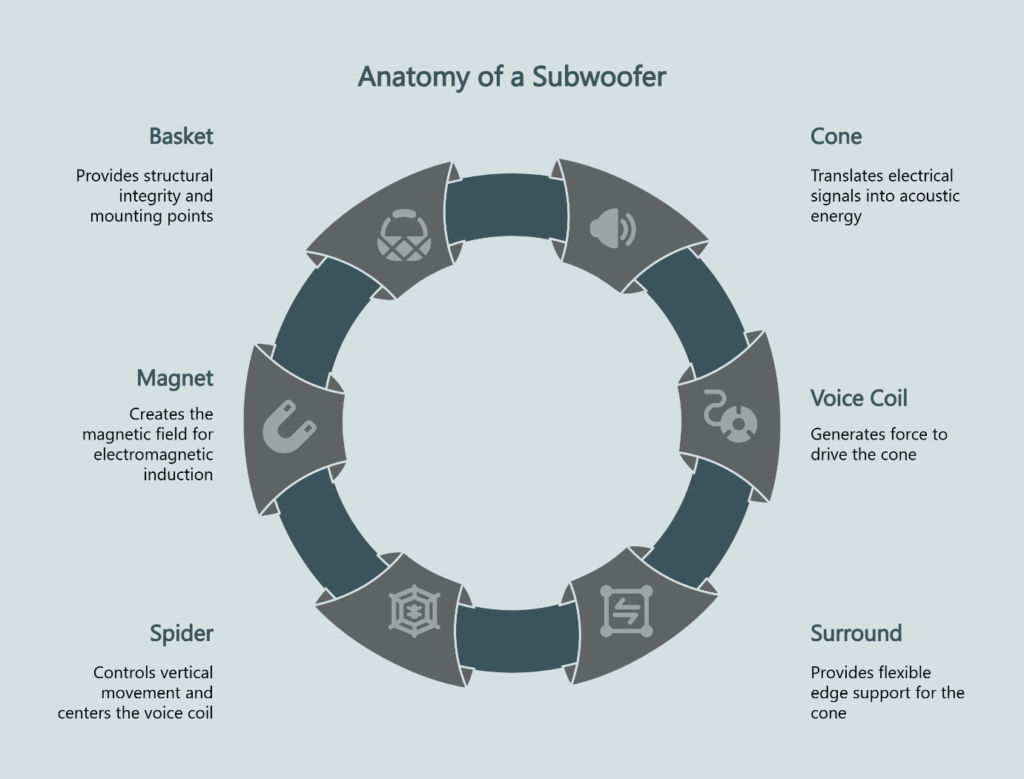
Before diving into materials, let’s establish the foundation. A high-performance subwoofer consists of six critical components, each serving a specific function:
The Cone translates electrical signals into acoustic energy through controlled movement. The Voice Coil acts as the electromagnetic engine, generating the force that drives the cone. The Surround provides flexible edge support, allowing the cone to move while maintaining alignment.
The Spider (or damper) controls vertical movement and centers the voice coil within the magnetic gap. The Magnet creates the magnetic field necessary for electromagnetic induction. The Basket provides structural integrity and mounting points for all components.
Each component’s material choice impacts performance characteristics including power handling, frequency response, and durability. (Understanding these relationships is what separates a knowledgeable buyer from someone who’s easily misled by marketing claims.)
The Subwoofer Cone: Translating Signal into Sound
The cone material influences how a subwoofer reproduces low frequencies and responds to different power levels.
Paper vs. Polypropylene vs. Carbon Fiber Cones
Paper cones offer natural damping characteristics that can reduce unwanted resonances. They typically provide warm bass reproduction but may have limitations with power handling and moisture resistance. For applications requiring consistent performance in varying environments, paper may present challenges.
Polypropylene cones deliver good durability and moisture resistance while maintaining reasonable acoustic properties. They generally handle moderate power levels effectively and tend to maintain consistent performance across temperature variations. This makes them common in automotive applications where environmental factors matter.
Carbon fiber cones represent a premium option for high-performance applications. Their high stiffness-to-weight ratio can enable precise control, while their construction typically allows for higher power handling compared to paper or polypropylene alternatives.
What does this mean for your evaluation process? An OEM using carbon fiber often demonstrates commitment to performance over cost savings. However, verify their implementation—the manufacturing process and overall design integration matter as much as the material choice itself.
The Voice Coil: The Engine of the Subwoofer
Voice coil material affects thermal management and electromagnetic efficiency—factors that influence whether a subwoofer maintains performance under demanding conditions.
Copper vs. Aluminum Voice Coils: Heat and Efficiency Trade-offs
Copper voice coils provide superior electrical conductivity, which generally translates to higher efficiency and better electromagnetic coupling. They typically generate more force per unit of electrical input, though their thermal mass can create heat management considerations at sustained high power levels.
Aluminum voice coils offer advantages in heat dissipation due to their lighter weight and thermal properties. While generally less conductive than copper, they often maintain performance consistency during extended use. Some aluminum voice coils feature surface treatments that may improve heat radiation.
From a partnership perspective, manufacturers investing in high-quality voice coil materials and construction typically demonstrate attention to engineering details. These choices often reflect broader commitments to performance and quality standards.
The Surround and Spider: Controlling Movement and Ensuring Durability
These components significantly impact long-term reliability and consistent performance.
The Role of Rubber, Foam, and Spider Design
Rubber surrounds typically provide good durability and maintain consistent properties across temperature ranges. They generally resist environmental degradation better than some alternatives and can maintain their characteristics through extended use. Quality manufacturers often use specialized rubber compounds designed for specific applications.
Foam surrounds may offer superior flexibility for applications requiring high excursion but can deteriorate faster than rubber alternatives. They’re sometimes found in applications prioritizing maximum output over longevity.
Spider design variations exist across manufacturers. Some use single spiders while others employ multiple layers or specialized designs. The specific approach often depends on the intended application and performance requirements.
Expert Q&A Question: What’s the most important factor when comparing subwoofer cone materials?
Answer: According to the ChinaFutureSound.com Insights Team, the critical factor isn’t just the material itself, but how it’s implemented within the overall design. A premium cone material with poor integration will underperform compared to a well-engineered conventional design. Look for manufacturers who can explain their material selection rationale and provide supporting technical documentation.
The Magnet: The Power Behind the Punch
Magnet selection reveals an OEM’s approach to balancing performance, cost, and manufacturing considerations.
Ferrite vs. Neodymium Magnets: A Trade-Off in Weight and Power
Ferrite magnets offer cost-effective magnetic field generation with good thermal stability. They’re larger and heavier than neodymium alternatives but provide consistent performance across temperature ranges. For applications where weight isn’t critical, ferrite magnets can deliver solid value.
Neodymium magnets provide significantly higher magnetic field strength in smaller packages. This enables more compact designs with equivalent or superior magnetic flux density. However, they’re more expensive and require consideration of thermal management to maintain performance.
The choice between ferrite and neodymium often reflects a manufacturer’s target market and engineering priorities. Companies using neodymium typically serve performance-oriented applications where space and weight considerations matter. Those using ferrite often focus on cost-effective solutions while maintaining fundamental performance requirements.
What If…? Planning for The Risk of Early Component Failure
Your concern about choosing materials that lead to premature product failure is legitimate—and can be addressed with the right evaluation approach.
Here’s a practical three-step process to mitigate this risk:
- Request Material Documentation: Ask potential partners about their material specifications and quality control processes. Reputable manufacturers maintain detailed documentation and can provide information about their sourcing standards.
- Evaluate Testing Protocols: Inquire about testing procedures for critical components. Quality partners typically conduct various performance tests and can discuss how their materials perform under different conditions.
- Assess Engineering Approach: Partner with manufacturers who demonstrate systematic design processes. This indicates engineering sophistication beyond basic assembly and suggests attention to long-term reliability.
Core Material Selection Guide
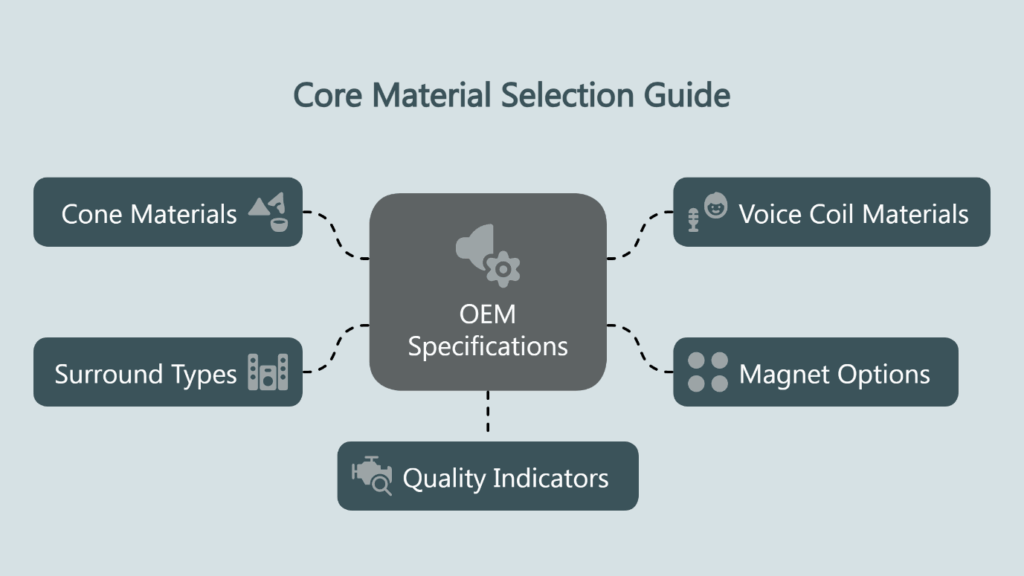
Here’s your reference tool for evaluating OEM specifications:
Cone Materials:
- Paper: Natural damping properties, moderate power handling, environmental sensitivity
- Polypropylene: Balanced performance characteristics, good durability, moderate cost
- Carbon Fiber: High-performance option, superior stiffness-to-weight ratio, requires expertise
Voice Coil Materials:
- Copper: Higher conductivity, superior electromagnetic coupling, thermal considerations
- Aluminum: Better heat dissipation characteristics, lighter weight, consistent performance
Magnet Options:
- Ferrite: Cost-effective, thermally stable, larger size/weight
- Neodymium: Compact design, high magnetic strength, premium cost
Surround Types:
- Rubber: Good durability, temperature stability, consistent properties
- Foam: High flexibility characteristics, potential longevity considerations
Quality Indicators:
- Sophisticated spider designs suggest engineering attention
- Quality voice coil construction indicates thermal considerations
- Systematic design approaches demonstrate engineering sophistication
Conclusion: How Material Knowledge Reduces Partnership Risk
Understanding subwoofer materials transforms you from a passive spec sheet reader into an informed technical buyer. You now recognize the engineering considerations behind material choices and can ask pointed questions that reveal an OEM’s true capabilities.
But material knowledge is just the foundation. The next step involves evaluating how these materials integrate into complete systems, assessing manufacturing quality control, and understanding production scalability—all critical factors in your partnership decision.
This technical foundation serves a larger purpose in your professional development. As you advance into director-level roles, this material science knowledge becomes the basis for strategic product decisions, supplier negotiations, and brand positioning strategies that define market leadership.
To see how understanding materials fits into the bigger picture of vetting a partner, explore our complete framework: [REF::when-sourcing-creates-risk-a-framework-for-vetting-oem-subwoofer-manufacturers].
Our Editorial Process
This content was drafted with AI assistance and has been reviewed, fact-checked, and edited by the expert humans on our Insights Team to ensure accuracy and clarity.