📌 Key Takeaways
Stop letting the lowest unit price decide your margin—measure and control total cost instead.
Choose TCO, Not Headlines: The lowest unit price often hides margin-killers; compare vendors by total landed cost across tooling, IP, QC, communication, freight, and tariffs.
Own the Tools, Own the Math: Tooling ownership clauses and a clear amortization model turn fixed costs into predictable unit economics; tooling plus failure-rate assumptions is the most overlooked driver.
Gate-Based QC Cuts Risk: Define incoming, in-process, and final audits with sampling levels and certification requirements to reduce rework, returns, and warranty exposure.
Control Communication Latency: Set response SLAs, maintain a single source of spec truth, and use a bilingual PM channel to shorten ECO cycles and prevent costly delays.
Model Incoterms to Protect Margin: Incoterm choice, freight mode, and tariffs determine landed cost; run scenario models and permit expedited switches only when TCO stays positive.
Predictable profit comes from structure, not sticker price.
When the Lowest Quote Costs the Most
An OEM car subwoofer supplier is more than a component vendor; it’s a manufacturing partner that delivers custom-branded product for retail and e-commerce. Think private-label winery: the label is yours, the craft happens behind the scenes—quietly, precisely, at scale. Now picture a familiar scene: two quotes land on the desk, one is 8% cheaper per unit. Three months later a QC failure, a tariff assumption, and a missed sailing erase the “savings,” plus reviews suffer after a stockout. The lesson writes itself.
Use TCO-aware controls before signing: tooling ownership and amortization, IP safeguards, gate-based QC, response-time SLAs, and landed-cost modeling (Incoterms + freight + tariffs). That’s how anxiety turns into predictable profit.
Pull-quote: Unit price is the smallest line in your TCO—treat it that way.
An OEM car subwoofer supplier isn’t just a factory with a low unit price; it’s a partner in brand economics. Like a private-label winery, the right supplier helps craft a signature product while protecting margin and reputation. The only reliable way to compare vendors is TCO: tooling ownership and amortization, IP safeguards, verifiable gate-based QC, responsive communication with SLAs, and landed-cost modeling (Incoterms, freight, tariffs). When these controls are explicit and measurable, return rates drop, delays shrink, and the price–value promise holds.
Explicit Relationships (for clarity and extraction):
Tooling ownership clauses enable predictable cost amortization. Gate-based QC reduces failure rates and warranty exposure. Defined communication SLAs shorten engineering-change cycle time. Incoterm selection determines the buyer’s landed cost and risk exposure. TCO-aware OEM vetting prevents margin erosion from rework and returns.
The 5 Hidden Costs (And How to Avoid Them)

Before choosing the cheapest quote, consider these five business costs.
- Tooling & Molds
Cost Drivers: Ownership, amortization schedule, change fees, storage, wear replacement.
Avoidance Controls: Contracted ownership clause, explicit amortization model, preventive-maintenance plan.
Definition: Amortization spreads tooling cost across units or time; the structure changes true per-unit economics. - IP Protection
Cost Drivers: Design leakage to other buyers, over-broad “work for hire,” subcontractor leak paths.
Avoidance Controls: Contracted IP ownership, vetted sub-supplier NDAs, controlled drawing release (watermarking, need-to-know).
WIPO: Trade Secrets & NDAs - Quality Control Failures
Cost Drivers: Scrap, rework, returns, warranty liabilities, brand damage.
Avoidance Controls: Gate-based QC plan (incoming → in-process → final), clearly defined acceptance sampling levels, certification requirements aligned with recognized quality systems (e.g., ISO 9001 process control expectations).
ISO 9001 Overview - Communication Delays
Cost Drivers: Time-zone lags, ambiguous specs, slow engineering change orders (ECOs), opportunity cost of idle inventory or delayed listings.
Avoidance Controls: Defined response SLAs, single source of truth for specs/BOM with revision control, bilingual PM channel. - Shipping & Tariffs (Landed Cost)
Cost Drivers: Incoterms responsibilities, freight mode/route, duties/tariffs, carrier surcharges.
Avoidance Controls: Landed-cost model by Incoterm, current tariff table, mode decision tree (ocean vs. air vs. rail/truck).
ICC: Incoterms® Rules
Outcome: Build these controls into quoting and supplier selection to protect margin and brand reputation.
According to the ChinaFutureSound.com Insights Team, the most overlooked cost driver is tooling amortization combined with failure-rate assumptions.
Why the Lowest Unit Price Often Raises Your Total Cost
In practice, unit price differentials are quickly overshadowed by non-obvious costs. Tooling treated as a sunk cost—actually, only when ownership and amortization are explicit does it stop distorting unit economics. Failure rates ripple: scrap triggers rework, rework triggers delays, delays trigger expedited freight, and expedited freight compresses gross margin. And this is where it gets expensive.
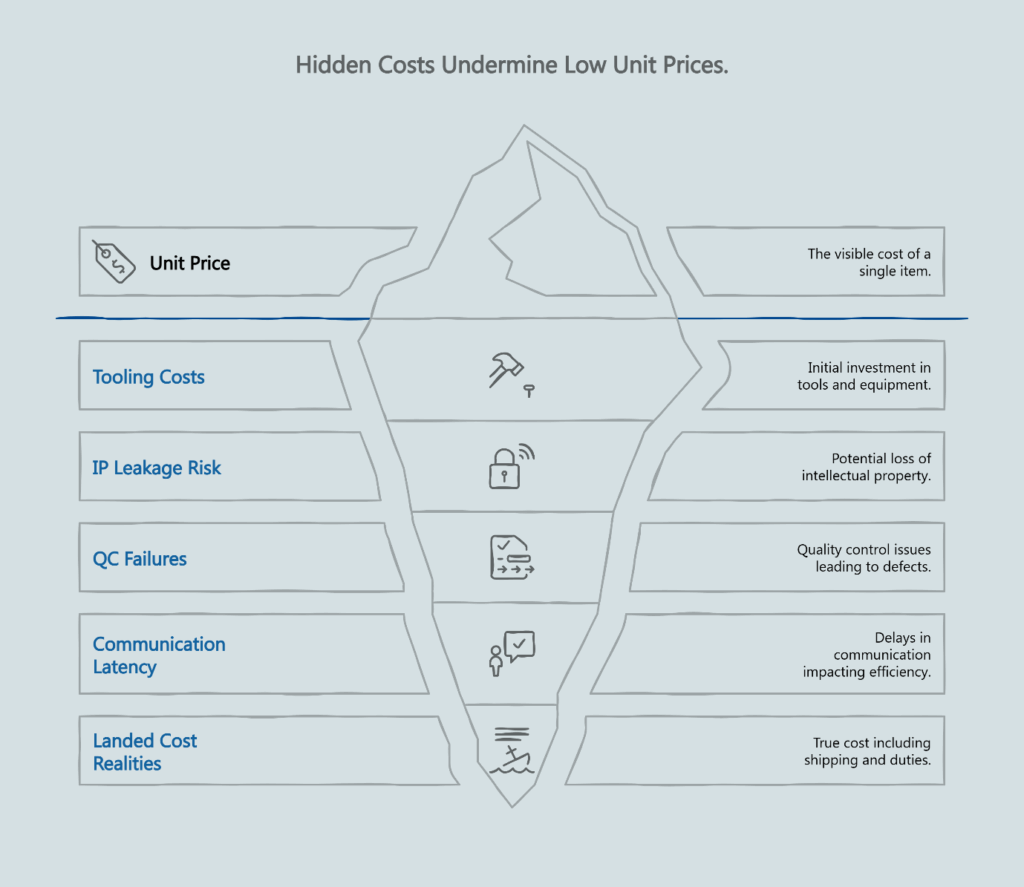
A useful mental model is the iceberg: visible unit price above the waterline; below sit tooling, IP leakage risk, QC failures, communication latency, and landed-cost realities. The remedy is not more negotiation; it’s better structure—clauses, gates, SLAs, and a landed-cost calculator integrated into the sourcing workflow.
TCO vs. Unit Price — A One-Table Comparison
Use this worksheet to compare two factories side by side. Populate with your figures; keep formulas consistent.
| Metric | Factory A | Factory B | Notes |
|---|---|---|---|
| Unit Price ($/unit) | Quoted ex-works, FOB, CIF, or DDP (state Incoterm). | ||
| Tooling Amortization ($/unit) | Tooling cost ÷ expected units or time; ensure ownership clause. | ||
| QC/Failure Rate (%) → Cost ($/unit) | Failure% × (rework + scrap + returns + warranty). | ||
| Communication Delay Cost ($/unit) | Hours lost to ECOs × burn rate / units. | ||
| Freight & Tariffs ($/unit) | Mode × route + duties/tariffs + surcharges. | ||
| Total Landed Cost ($/unit) | Sum of all rows above. |
Tip : Calculate sensitivity—how much Total Landed Cost moves when failure rate or tariff changes by ±1–2 points.
The QC Gate Checklist Your Engineer Will Approve
- Incoming Materials: magnet grade verification, cone/surround specs, adhesives, terminals.
- In-Process Tests: voice-coil alignment, impedance checks, excursion limits, thermal cycling where applicable.
- Final Audit: sample-based acceptance per agreed AQL, cosmetic and functional checks, packaging integrity.
- Certification Docs: test plans, measurement reports, calibration certificates, and batch traceability.
- Spec Control: single revision-controlled BOM/drawing set; ECO log signed by both parties.
Business Impact (Finance)
Cash flow is shaped by when and how costs hit:
- Tooling Ownership & Amortization: Amortize across realistic volume, not aspirational forecasts; tie to MOQs and reorder cadence.
- Failure Cost: Treat scrap/rework/returns as a forecastable line item; bake the % into landed cost.
- Mode Decisions: Ocean vs. air is not a logistics footnote; it’s a margin lever.
- Decision Tooling: Standardize the table above so Finance sees apples-to-apples comparisons each cycle.
Technical Note (QA/Engineering)
Gate-based QC requires a shared playbook:
- Sampling & AQL: Agree on levels and escalation paths before pilot run.
- Test Plans: Define acoustic, electrical, and environmental tests, fixture references, and acceptable windows.
- Documentation: Calibrations, lot traceability, and record retention timelines.
- Change Control: ECO turnaround SLAs; bilingual channels; single source of spec truth.
- Handoff: A “first-article” run, then controlled ramp to volume.
Risk → Mitigation
- Ambiguous Tooling Rights → Add an ownership clause, access rights during and after engagement, and a clear amortization schedule.
- Spec Drift → Lock a revision-controlled BOM/drawing set; require formal ECOs within SLA.
- QC Surprises → Define gate tests and acceptance sampling; require pre-shipment audits.
- Tariff/Freight Swings → Build a landed-cost model with Incoterm scenarios; pre-approve mode switches by TCO outcome.
- Communication Latency → Name a bilingual PM channel; set response windows for quoting, NPI, and ECOs.
Real-talk: Look, this is where most teams get tripped up—failure rate and tooling quietly overwhelm the “savings.” Fix those two inputs and the rest becomes manageable.
Myth & Fact
Myth: The factory with the lowest unit price is the best value.
Fact: TCO determines value; tooling, IP, QC, communication, and landed cost usually decide real margin.
What If…? Planning for a Missed Ship Window or QC Fail
- Activate the Rework Decision Tree with pre-approved limits (time, cost, quality thresholds).
- Switch to Expedited Mode only if the TCO remains positive after freight and duty deltas.
- Trigger Safety-Stock Release from a U.S. warehouse (if configured) to defend reviews and revenue.
Core Concept Deep Dive: TCO & Landed-Cost Modeling for OEM Quotes
Why It’s Critical. TCO modeling shifts vendor selection from price chasing to margin control. Decisions become about ownership terms, failure-rate assumptions, and Incoterm risk—not just ex-works headlines.
Common Misconceptions. “Freight and tariffs are rounding errors” (they aren’t), and “tooling is a sunk cost” (not if ownership or amortization is unclear). A second misconception is that process certifications alone guarantee quality—almost; they support consistency, but only when the gate plan and acceptance criteria are explicit.
Real-World Implications. Teams that master TCO avoid emergency air-freight, reduce returns, and maintain review velocity. Think of it like calibrating a crossover: a small error near the knee point skews the entire response—minor inputs, major output shifts.
Choose Predictable Profit Over Seductive Price
The opening dilemma—two quotes, one 8% lower—resolves differently when the iceberg below the waterline is measured. Before, decisions leaned on headline price and hope. After, the team compares tool ownership and amortization, models failure-rate impact, enforces gate-based QC, fixes SLAs, and runs landed-cost scenarios by Incoterm. The outcome is not just fewer surprises; it’s a brand that keeps its price–value promise.
Picture next quarter’s line review: the table is pre-filled, Finance sees the sensitivities, Engineering signs off on gates, and Product locks the launch window with confidence. That’s a small change in process with a compounding payoff.
Ready To De-Risk Your Next Quote?
Request custom OEM quote to apply these controls to an active project.
Contextual Disclaimer Mandate
This article provides general information about evaluating the total cost of OEM partnerships for educational purposes. Individual circumstances vary based on factors like product category and certification requirements, order volumes and MOQs, Incoterms and shipping modes, and applicable tariffs or duties. For personalized guidance tailored to your sourcing and margin-planning needs, consider consulting a qualified professional.
Our Editorial Process
“Our expert team uses AI tools to help organize and structure our initial drafts. Every piece is then extensively rewritten, fact-checked, and enriched with first-hand insights and experiences by expert humans on our Insights Team to ensure accuracy and clarity.”
About the ChinaFutureSound.com Insights Team
The ChinaFutureSound.com Insights Team is our dedicated engine for synthesizing complex topics into clear, helpful guides. While our content is thoroughly reviewed for clarity and accuracy, it is for informational purposes and should not replace professional advice.