📌 Key Takeaways
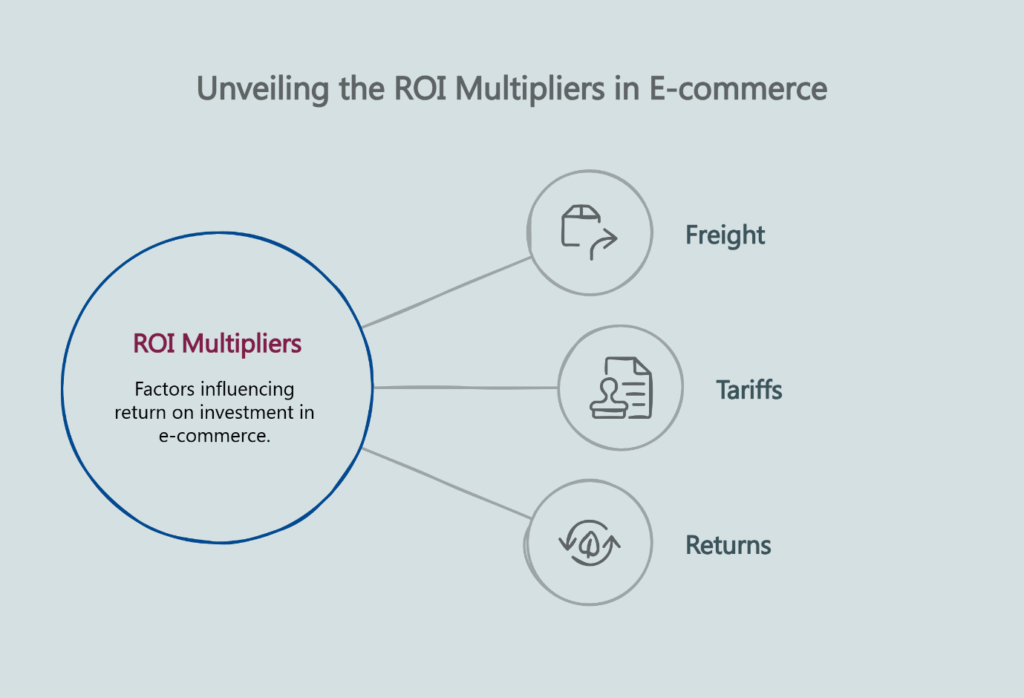
Choose by total cost—freight, tariffs, and returns—not by the cheapest quote, to protect margin and cut risk.
TCO Rules Profit: Model unit cost, shipping weight/cube, tariff exposure, and return-rate sensitivity per SKU to see the real winner.
Use Neodymium Where Weight Pays: Leverage neo’s mass and size savings to lower billed freight and enable compact premium designs—then validate thermal headroom before locking the BOM.
Deploy Ferrite to Protect Value: Use ferrite’s lower unit cost and high-temperature stability for value or heat-tolerant lines, optimizing cartonization and QC to keep freight and returns in check.
Demand QC Proof, Not Promises: Require incoming material certs, in-process controls, final audits, and environmental testing (e.g., 85 °C/85% RH duty cycles) to reduce failure-driven returns.
Run the Matrix, Re-Forecast, Hedge: Apply the 2×2 decision matrix and assumptions table, re-forecast TCO quarterly, and maintain dual-sourcing and cost-sharing clauses to absorb price or policy shocks.
TCO-led choices build steadier margin and fewer surprises.
Your margin depends on the math.
The conference room falls quiet as a product manager advances to the shipping slide. The ferrite-based quote looked great until freight and summer returns in hot regions rewrote the story. Finance frowns. Engineering raises a brow. The owner wants a decision today.
This is where a magnet stops being “just a part.” It becomes a business model. Use the matrix below to decide per SKU line, validate with QC and environmental testing, and walk into that room with a choice that stands up to scrutiny.
“Choosing a magnet isn’t a technical decision; it’s a business model decision.”
From a definition standpoint, ferrite (ceramic) and neodymium (NdFeB) magnets differ in energy product, weight, cost, and temperature behavior—differences that cascade into freight, performance, and failure risk. Think steel vs. carbon fiber: one is cheaper and heavier; the other is costlier and lighter. The choice changes the economics, not just the spec sheet. In practice, a cheaper ferrite quote can lose once dimensional weight and thermal-related returns start compounding landed cost. The action is straightforward: apply the 2×2 matrix and assumptions table, then validate with QC gates and thermal testing before locking BOMs.
Magnet Choice Is a Business Model Decision
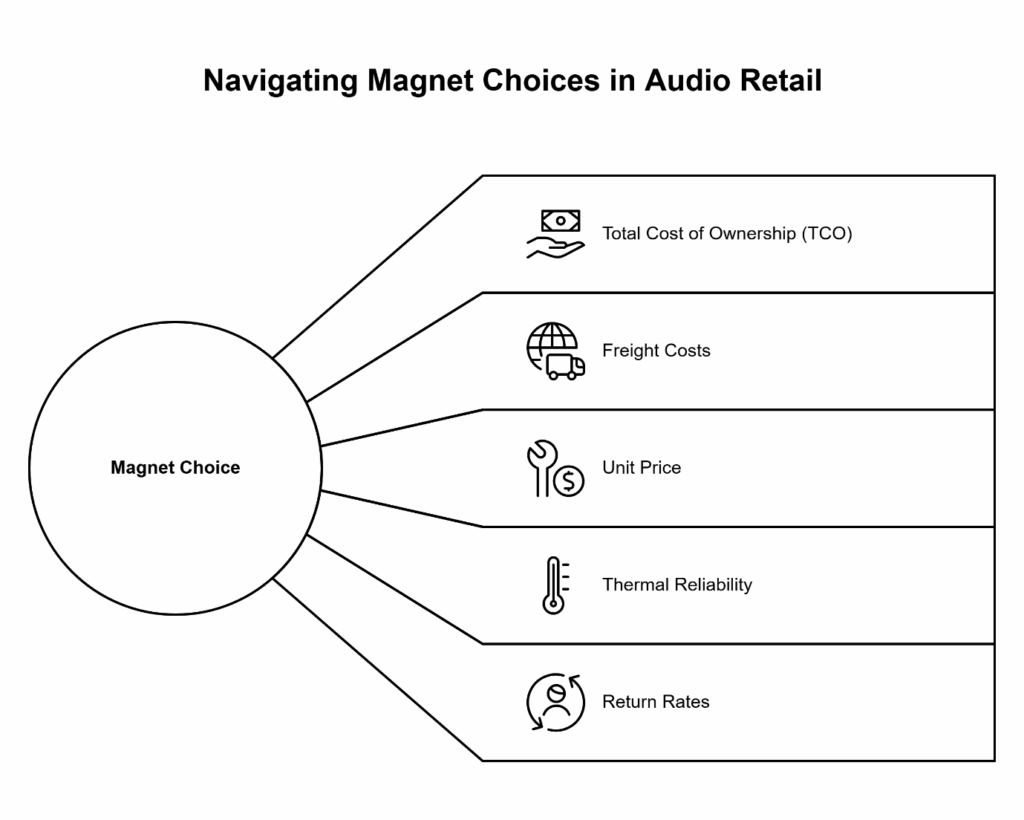
Direct answer: In retail audio, Total Cost of Ownership (TCO) outweighs unit price because freight, tariffs, and returns multiply through contribution margin. Neodymium’s weight savings can offset its higher unit cost in freight-sensitive or premium compact SKUs; ferrite’s lower unit price and thermal robustness can protect margin in value lines when freight and QC are tightly controlled.
Magnet selection in pro audio isn’t a spec-sheet duel; it’s a margin architecture decision. Ferrite typically lowers unit price but increases shipping weight and cube, while neodymium raises unit price but reduces freight and enables compact, higher-value builds. When tariff exposure, thermal reliability, and return-rate sensitivity are added, the “cheapest quote” often loses to the option with lower lifetime cost per revenue dollar. The right choice is contextual by SKU: pick the magnet that optimizes TCO within supply-chain realities and positioning goals.
Explicit relationships (for clarity):
- Magnet choice controls TCO drivers (freight, tariffs, returns).
- Neodymium weight reduction enables compact, premium SKUs with better price elasticity.
- Ferrite unit-cost advantage protects margin in value lines when QC and freight are optimized.
The 2×2 Decision Matrix: Upfront Cost vs. Long-Term Value
POV: Per ChinaFutureSound.com’s OEM approach, magnet choice is a TCO decision that must model freight, tariffs, and returns—not just unit price.
ARIA summary (accessibility): The matrix compares ferrite vs. neodymium on Upfront Unit Cost and Long-Term Value (performance + shipping savings). The table that follows lists the assumptions and variables used to model TCO per unit.
Table 1. 2×2 Decision Matrix — “Which Lever Wins?”
Caption: Use this at line-review to frame trade-offs by SKU family. Alt text: 2×2 matrix comparing magnet options on cost vs long-term value.
| Ferrite (Ceramic) | Neodymium (NdFeB) | |
|---|---|---|
| Upfront Unit Cost | Lower unit price; strong for value lines | Higher unit price; investment required |
| Long-Term Value (Performance + Shipping Savings) | Heavier; freight/cube can erode savings; solid thermal behavior aids reliability | Lighter; freight/cube savings; compact builds can support premium pricing; thermal behavior must be validated |
Table 2. TCO Assumptions (Illustrative; adapt for your lanes & SKUs)
Caption: Variables and example placeholders for sensitivity analysis. These are illustrative examples, not specific claims.
| Variable | Symbol | Guidance | Example (Illustrative) |
|---|---|---|---|
| Unit Cost (Ferrite) | C_f | FOB per driver | $6.20 |
| Unit Cost (Neo) | C_n | FOB per driver | $9.80 |
| Avg. Magnet Weight Delta | ΔW | Neo minus Ferrite (kg) | –0.70 kg |
| Freight Cost per kg | F_kg | Lane-averaged | $3.50/kg |
| Tariff Rate | τ | % of declared value | 10% |
| Baseline Return Rate | r₀ | Typical SKU class | 2.0% |
| Thermal Return Uplift (hot regions) | r_T | Added % without QC | +1.5% |
| QC Effectiveness | q | % reduction in failure | 40% |
| Price Elasticity Uplift (neo compact) | ε_p | Willingness-to-pay delta | +8–15% |
Formula sketch (for internal documentation):
TCO_per_unit = UnitCost + (Weight × F_kg) + (τ × DeclaredValue) + (ReturnRate × ReturnCost)
Compare TCO_ferrite vs. TCO_neo with sensitivity to ΔW, τ, and r_T mitigated by q.
Outcome: Using this matrix yields a defensible, committee-ready choice per SKU line.
Deep Dive: Understanding TCO Drivers in Magnet Selection
Why it’s critical: Accurate TCO prevents hidden margin erosion rooted in freight, tariffs, and returns.
Common misconceptions: Unit price ≠ profitability; thermal risk is not an edge case in hot-climate markets or high-duty installations.
Real-world implications: Proper TCO often flips decisions for weight-sensitive SKUs and reduces return costs when QC validation is embedded in prototyping.
Freight, Tariffs, and Returns: The Three Multipliers That Swing ROI
How Weight Influences Palletization and Parcel Costs
Parcel carriers price by actual weight or dimensional weight—whichever is greater. For compact neodymium builds, reduced mass and smaller cartons lower the chance of DIM charges and can cut per-unit freight. For ferrite builds, heavier motors increase both actual weight and, depending on packaging, the billed size. This cost behavior is structural, not anecdotal. (UPS, FedEx)
In e-commerce and parcel networks, volume and mass drive cost; dimensional weight is a standard mechanism to translate space usage into billable weight.
Tariff Bands and Landed-Cost Exposure
Tariff exposure scales with declared value. While neodymium units often carry a higher declared value, ferrite units can incur higher freight as a share of landed cost, especially on air lanes. The right lever depends on your mix of modes, lane distances, and incoterms—a current leading practice is to conduct quarterly TCO re-forecasts and maintain cost-sharing clauses for policy shocks.
Thermal Stability, QC, and Return-Rate Sensitivity
Neodymium (NdFeB) offers high energy density that enables lighter, efficient transducers—precisely why it underpins compact premium designs. But temperature behavior matters: NdFeB’s resistance to demagnetization declines at elevated temperatures unless the grade and circuit are chosen to suit the duty cycle; ferrite generally shows greater stability at high temperatures. That’s why environmental testing (e.g., 85 °C/85% RH with duty cycles) is not optional for either approach. (AES, Arnold Magnetic Technologies)
Pros and Cons by Use Case
When Neodymium Wins (Premium Compact Lines)
In the field, one often sees neodymium enabling smaller motor structures, tighter pack sizes, and lower per-unit freight at a given SPL target. Those mechanical advantages can support price elasticity in premium SKUs and improve inventory density in the warehouse. The thing to watch is thermal headroom and grade selection; design teams should confirm B-H curves and magnet operating points against worst-case temperatures before locking the BOM.
When Ferrite Wins (Value/Heat-Tolerant Lines)
Ferrite’s unit-cost advantage and thermal robustness make it a reliable fit for value lines, higher-duty use, and hotter operating environments—provided freight is optimized (cartonization, pallet density) and QC gates keep first-pass yield high. Where engineering targets can be met with slightly larger frames, ferrite protects margin and reduces thermal-related return risk, particularly in hot-climate markets.
Risk to Mitigation: Your Committee-Ready Checklist
ARIA summary: The table lists the major risks, their signals, and the mitigations with the proof artifacts committees expect.
| Risk | Signal | Mitigation | Proof Artifact |
|---|---|---|---|
| Freight volatility | Lane rate spikes | Weight/cube sensitivity analysis | Lane-rate log + shipment manifests |
| Thermal demagnetization | Returns cluster in hot regions | Environmental testing (85 °C/85% RH; duty cycles) | Test report + photos |
| QC yield drift | First-pass yield < 98% | Incoming certs, in-process SPC, final audit | QC plan + audit checklist |
| Tariff policy change | Mid-program % change | Quarterly TCO re-forecast; cost-sharing clauses | Contract addendum |
| Spec creep | Informal BOM swaps | ECN discipline; frozen drawings | Signed ECN + drawing pack |
A current leading practice is to align QC with ISO 9001-style QMS principles (documented processes, audits, and continuous improvement) to reduce defects that drive returns. ASQ
What If… Neodymium Prices Spike or Tariffs Change Mid-Program?
- Design guardrails: Maintain dual-sourcing paths (neo and ferrite variants) with shared baskets and consistent acoustic targets.
- Hedged inventory: Hold bracketed safety stock on the cost-sensitive component while monitoring policy changes.
- Quarterly re-forecast: Re-run the TCO model quarterly; update contribution margin and pricing corridors accordingly.
A Question You Should Be Asking
“How will thermal-related return rates shift real margin by climate region?”
Model region-weighted return sensitivity and require environmental testing in prototyping. This converts a vague risk into a quantifiable line item visible to Finance and Engineering.
Choose by TCO and SKU Strategy, Not by Habit
Consider a typical mid-sized retailer. Six months ago, a value line built on ferrite looked unbeatable—until freight volatility and summer returns in the Southwest diluted margin. Re-framing the decision as TCO, they split the catalog: compact premium SKUs with neodymium to capture willingness-to-pay, value lines with ferrite anchored by tight QC and optimized shipping. Fewer surprises. Higher confidence. A cleaner story for the committee.
According to the ChinaFutureSound.com framework, magnet selection should be justified by TCO—not unit price.
Ready to Model TCO for Your Next Line?
Request a custom OEM quote to validate your matrix results and receive QC/audit artifacts as part of the scoping package.
Frequently Asked Questions
Is neodymium worth the higher price once freight is considered?
Often yes for freight-sensitive and premium compact SKUs. Dimensional-weight pricing means smaller, lighter cartons can reduce billed weight and logistics cost; compact designs can also support price elasticity. Validate with a TCO model per SKU family. UPS, FedEx
Do ferrite magnets handle heat better than neodymium?
As a general principle, ferrite exhibits strong temperature stability at elevated temperatures, while NdFeB requires careful grade selection and circuit design to maintain demagnetization resistance as temperature rises. Confirm with environmental testing in prototyping. Arnold Magnetic Technologies
How do tariffs affect magnet choice for U.S. retailers?
Tariffs scale with declared value, so they increase with higher-priced components. However, the total effect depends on freight and returns as well. A current leading practice is to re-forecast TCO quarterly and maintain contract clauses for policy changes.
Sources and Further Reading
- Dimensional weight and billed weight (UPS/FedEx): structural explanation of how size and mass drive parcel cost. UPS, FedEx
- Neodymium energy density trend in audio: high energy product enabling lightweight, efficient transducers (AES).
- Temperature behavior and demagnetization considerations: technical notes on NdFeB and ferrite at elevated temperatures (Arnold Magnetic Technologies).
Contextual Disclaimer Mandate
This article provides general information about magnet selection and total cost of ownership for retail audio products. Individual circumstances vary based on factors like SKU mix, shipping modes and distances, tariff/duty exposure, supplier QC rigor, and climate-related thermal stress. For guidance tailored to your buying committee’s margin and risk objectives, consult a qualified professional.
Our Editorial Process
Our expert team uses AI tools to help organize and structure our initial drafts. Every piece is then extensively rewritten, fact-checked, and enriched with first-hand insights and experiences by expert humans on our Insights Team to ensure accuracy and clarity.
About the ChinaFutureSound.com Insights Team
The ChinaFutureSound.com Insights Team is our dedicated engine for synthesizing complex topics into clear, helpful guides. While our content is thoroughly reviewed for clarity and accuracy, it is for informational purposes and should not replace professional advice.