📌 Key Takeaways
Own your margins by treating speaker specs as business levers—not decorations.
Start With the Five Levers: Prioritize magnet system, cone/dust cap, voice coil/former, surround/spider, and motor/cooling to control performance, manufacturability, and supply risk.
Translate Claims Into Specs: Convert marketing goals into measurable ranges and QC tests, using tolerances instead of adjectives to protect yield and shorten cycles.
Plan Magnet Choices as Risk Dials: Apply neodymium for power-to-weight only with motor/cooling co-design and a ferrite fallback; choose ferrite when BOM stability and predictable packaging matter most.
Design for Heat First, Distortion Second: Tackle power compression with airflow, venting, and thermal paths, and use shorting rings or copper caps primarily to stabilize inductance and reduce distortion.
Build Resilience Into the RFQ: Add material-substitution clauses, quarterly price/lead-time gates, and explicit sample/retest protocols to retain control through commodity swings.
Clarity, measurability, and contingency turn specs into a defensible, repeatable product flywheel.
Specs aren’t the goal.
Control is.
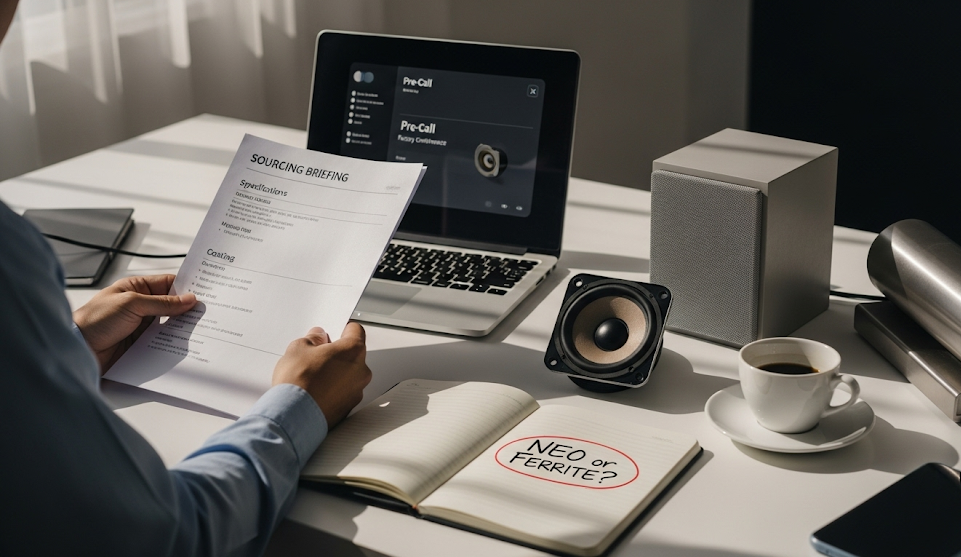
Picture the conference room just before a supplier call. Marketing wants a lighter coaxial that looks premium on the product page, ops wants predictable lead times, and finance wants guardrails on the BOM. You need a short list of engineering choices that move the needle without moving the margins.
This guide gives exactly that. The focus is business outcomes, not audiophile lore. Speaker technology selection determines the balance between differentiation and landed cost. Choose the right levers and the rest of the plan starts to click.
For B2B audio retailers in the US, the fastest path out of the “sea of sameness” is to treat speaker technology choices as business levers. Start with five controllable spec domains—magnet system, cone material, voice coil, suspension, and motor cooling—and weigh each for performance impact, manufacturability, and supply risk. By using a simple matrix to align sourcing and marketing, you can brief your OEM clearly, protect margins, and produce a line that stands out for reasons customers actually value.
“Feature selection is a risk lever, not a shopping list.”
Magnet system choice influences driver efficiency and weight.
Cone material shapes tonal character and environmental durability.
Voice coil design sets power handling and thermal reliability.
Motor/cooling enhancements reduce power compression at high output.
The Five Technology Levers That Shape Performance, Cost, and Risk
These are decision levers, not feature fodder. The aim is manufacturable differentiation with supply stability.
Magnet Systems Determine Efficiency and Weight (Neodymium vs. Ferrite)
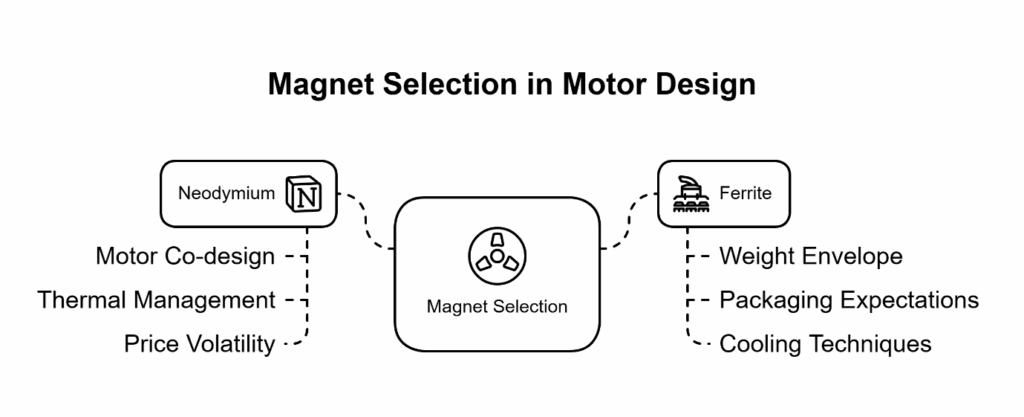
What it is (definitional). The magnet is the motor’s field source. Neodymium offers high flux density per mass, enabling compact, efficient motors. Ferrite is heavier and bulkier for the same flux but is widely available and predictable.
Analogy. Think of it like the engine block material in cars—power-to-weight improves with advanced alloys, but heat paths and long-term costs need attention; cast iron is heavier yet steady and forgiving.
Experiential scenario. A slim neodymium-based demo driver feels light and loud in hand—perfect for shelf appeal. Later, procurement’s dashboard pings: rare-earth market headlines and lead-time chatter. Marketing wants to keep the weight advantage; ops wants price stability. The room gets quiet.
Action framing.
- If selecting neodymium, specify motor co-design (gap geometry, shorting rings/caps), thermal notes, and a pre-approved ferrite fallback clause tied to sensitivity/weight targets.
- If selecting ferrite, set a weight envelope and packaging expectations early; use cooling/shorting techniques to offset efficiency limits.
Surprise insight. Lighter is not automatically better. Neodymium can raise BOM volatility unless the motor is redesigned and contracts anticipate price swings; confirm exposure against the current USGS Mineral Commodity Summaries “Rare Earths” data sheet and the Rare Earths statistics portal before locking specs. (U.S. Geological Survey, USGS)
Certainty levels.
- Treat magnet choice as a risk dial, not a vanity spec.
- Neodymium motors enable smaller, lighter drivers; ferrite offers cost stability.
- Real-world price exposure depends on contract terms and timing; verify with up-to-date USGS releases. (U.S. Geological Survey)
Cone & Dust Cap Materials Shape Tonal Character and Durability
What changes when you change cones?
- Paper/pulp (often coated): High internal damping for a natural tone; favorable mass-to-stiffness.
- Polypropylene (PP): Moisture resistant, stable in humid or outdoor installs; smooth breakup behavior.
- Fiber composites (e.g., glass, aramid): Higher stiffness and consistency; may require damping strategies.
Why it matters. Material and geometry together set breakup behavior, durability, and visual language (which helps marketing tell a product story). US-market note: outdoor/marine and automotive-adjacent SKUs often value moisture/UV resistance and easy cleaning—PP and treated paper are common choices.
Voice Coil & Former Choices Set Power Handling and Thermal Stability
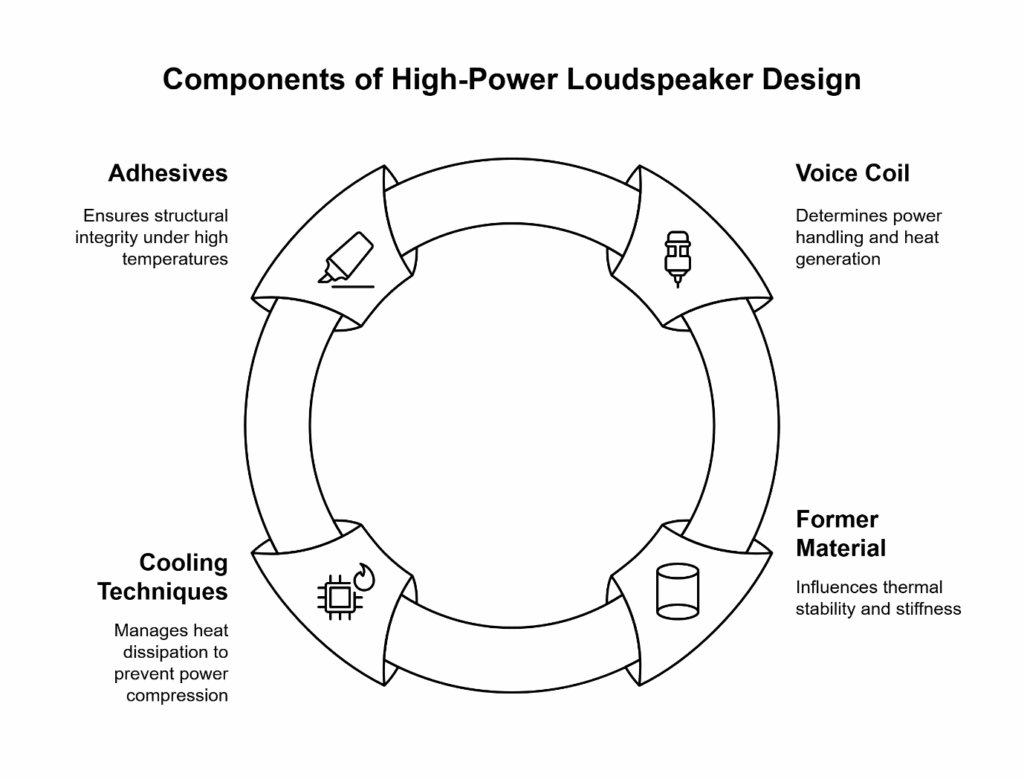
What to decide. Wire gauge/insulation, winding height, and former material (e.g., polyimide/Kapton vs. aluminum). Polyimide handles high temperatures with low thermal conductivity; aluminum adds stiffness and heat spreading but alters inductance and mass.
Why it matters. At real listening levels, only a small fraction of input power becomes sound; most becomes heat in the coil, raising DC resistance and causing power compression—the driver loses output as it warms. This mechanism is well-documented in loudspeaker engineering literature and application notes. (klippel.de)
Practical note. For SKUs marketed as “high-power” or “party-proof,” specify coil height, former, adhesives, and cooling techniques together; avoid asking for “more watts” without a thermal path.
Surround & Spider Control Excursion, Linearity, and Lifespan
What they do. The surround and spider are the elastic suspension. They center, limit, and linearize excursion. Their compliance and geometry shape sensitivity, bass extension, and mechanical noise.
What to watch.
- Over-stiff suspensions protect travel but can hurt low-level detail and sensitivity.
- Ultra-compliant builds may bottom mechanically under abuse.
- Ops cue: Ask for aging and fatigue data or at least a reference life-test method.
Motor & Cooling Enhancements Reduce Compression at High Output
Shorting rings / copper caps. Conductive elements in the motor can linearize inductance and cut distortion by shunting flux modulation; they also help curb power compression by stabilizing inductance at level. (scan-speak.dk)
Venting and airflow. Vented pole pieces and under-spider vents evacuate hot air, supporting thermal stability over long play. Generally accepted: better airflow preserves output under load; variable: advanced cooling and tight machining add cost and cycle time.
The 5-Lever Speaker Spec Matrix (B2B Edition)
According to the China Future Sound risk-management POV, feature selection is a risk lever, not a shopping list.
| Lever | Primary Benefit (1 sentence) | Things to Be Aware Of (1 sentence) | Cost/Complexity Signal | US-Market Note | Best-Fit Use Cases |
|---|---|---|---|---|---|
| Magnet System (Neodymium vs. Ferrite) | NEO enables compact, efficient motors for lighter SKUs and higher sensitivity per size. | NEO can add BOM volatility and needs motor/thermal co-design; ferrite is heavier but predictable. | NEO = Higher BOM + design effort; Ferrite = Lower BOM, heavier pack/ship | Retailers value lighter shelf units; ops teams value ferrite stability when planning quarterly buys | Slim coaxials, on-shelf “premium feel” lines (NEO); high-power subs and price-stable lines (ferrite) |
| Cone & Dust Cap (Paper, PP, Composites) | Material + geometry tune breakup, tone, and durability. | Stiff cones may need damping; PP resists moisture but can sound “soft” without geometry help. | Composites raise unit cost; PP/paper widely available | Outdoor/marine and auto-adjacent SKUs often prefer PP or treated paper | Moisture-exposed installs (PP), “natural” voicing (paper), high-SPL control (composites) |
| Voice Coil & Former (Wire, Height, Polyimide vs. Aluminum) | Thermally robust coils hold output under load and support reliable power ratings. | Poor thermal paths trigger power compression and failure modes; aluminum formers change mass/inductance. | Higher-temp adhesives and taller coils add cost and weight | “High-power” claims need matching cooling in RFQ to avoid returns | Party-proof SKUs, pro-styled retail subs |
| Surround & Spider (Compliance, Geometry) | Proper suspension yields linear excursion and consistent sensitivity over time. | Too stiff kills low-level detail; too soft risks bottoming and warranty pain. | Custom spiders and QC add MVA and cycle time | Ask suppliers for aging/fatigue approach; plan life tests in QA | Long-life retail lines, outdoor installs |
| Motor/Cooling Enhancements (Shorting Rings, Copper Caps, Vents) | Flux-linearizing parts and airflow reduce distortion and keep output stable at level. | Adds parts and machining; benefits vary by passband and motor geometry. | Copper rings/caps add BOM; machining adds cycle time | Strong value story for “clearer at volume” claims | High-SPL SKUs, premium “clean at loud” lines |
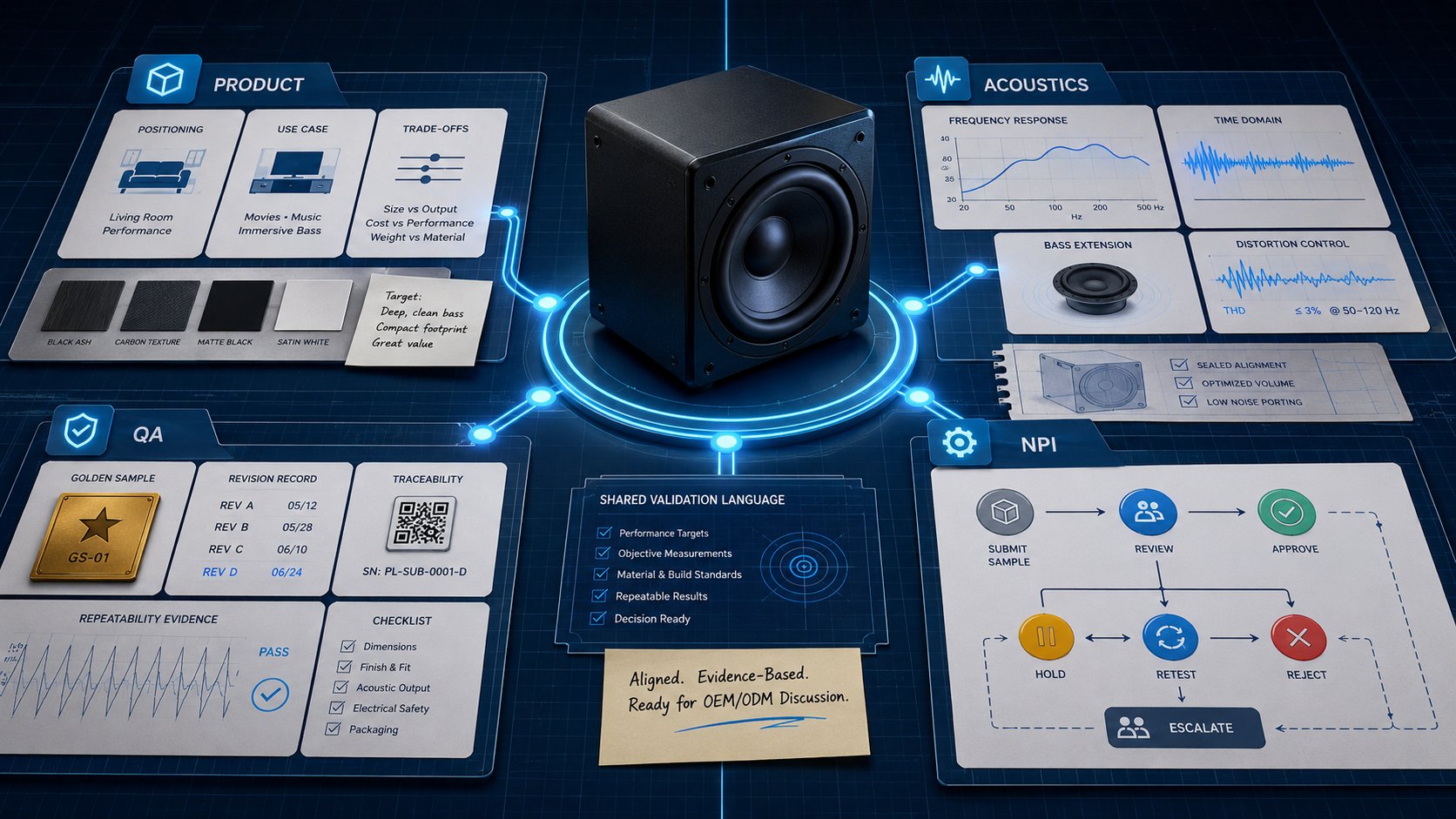
This matrix helps align sourcing, marketing, and QA so your specs sell without surprises.
How to Brief Your OEM Without Over-Spec’ing the BOM
Translate Marketing Claims Into Manufacturable Specs
- Map each claim to a lever + parameter.
- “Lighter to ship” → Magnet (NEO) + pack weight target.
- “Cleaner at volume” → Motor/cooling (shorting ring/copper cap + venting).
- “Outdoor-ready” → Cone (PP or treated paper) + surround UV spec.
- Provide ranges, not adjectives.
- Example: “Target sensitivity 90–91 dB/2.83V, min 89; moving mass within X g.”
- Tie claims to QC tests the factory already runs (or can run).
- Request a thermal run test and distortion sweep at specified power to validate heat and linearity.
Real-talk: Look, this is where most teams get tripped up—asking for performance words instead of measurable ranges. Translate the story into numbers, then let the factory propose the most manufacturable path.
Ask for Tolerances, Not Just Targets (Protect QC)
- Specify ± tolerances for sensitivity, Re, Fs, and moving mass.
- Require sample size and retest conditions after heat soak.
- Include a materials substitution clause: NEO ↔ ferrite contingency with revised sensitivity/weight targets and price gates.
Self-correction moment: It’s tempting to lock every number—actually, set guardrails and let the OEM optimize inside them. That’s how you get speed and yield.
Stakeholder callouts.
- Business Impact: Clear tolerances cut rework, improve yield, and stabilize COGS.
- Technical Note: If choosing NEO, ask for thermal notes (adhesives, venting, coil height) and whether a shorting ring is included.
- Day-to-Day Application: Bring the 5-Lever Matrix to the call; mark must-haves vs. nice-to-haves and capture factory trade-offs.
Myth & Fact: Neodymium Is Not Automatically “Better”
Myth: Neodymium magnets are always the superior choice.
Fact: Neodymium improves power-to-weight, but realizing the upside usually requires motor redesign and cooling tweaks, and price exposure must be planned. The USGS maintains the most authoritative overview of rare-earth supply and price context; check the current MCS “Rare Earths” data sheet and statistics page when validating BOM risk. (U.S. Geological Survey, USGS)
What If…? Planning for a Commodity Spike or Component Shortage
Scenario: A sudden price spike or export constraint on neodymium risks your build.
Plan:
- Pre-approve ferrite fallback in the RFQ with updated sensitivity and pack-weight targets.
- Specify an alternative motor/cooling combo (e.g., copper cap + vented pole) to hold performance.
- Set lead-time/price review gates in the PO (quarterly checkpoints) with auto-escalation to engineering review.
(According to the China Future Sound framework, these gates keep control during volatile cycles without restarting the program.)
Key Terminology (Beginner-Ready)
- Cone: The diaphragm that moves air; material and geometry set breakup and tone.
- Former: The tube the voice coil is wound on; material affects heat and mass.
- Surround: Flexible ring attaching cone to frame; controls excursion and sealing.
- Spider: Corrugated fabric that centers the coil; sets compliance and long-term stability.
- Shorting Ring (Faraday Ring): Conductive ring in the motor that stabilizes inductance, reducing distortion and power compression at level. Technical literature and manufacturer notes describe these effects and when they are most pronounced. (scan-speak.dk)
Conclusion: From Shortlist to Golden Sample — Keep the Risk Lens On
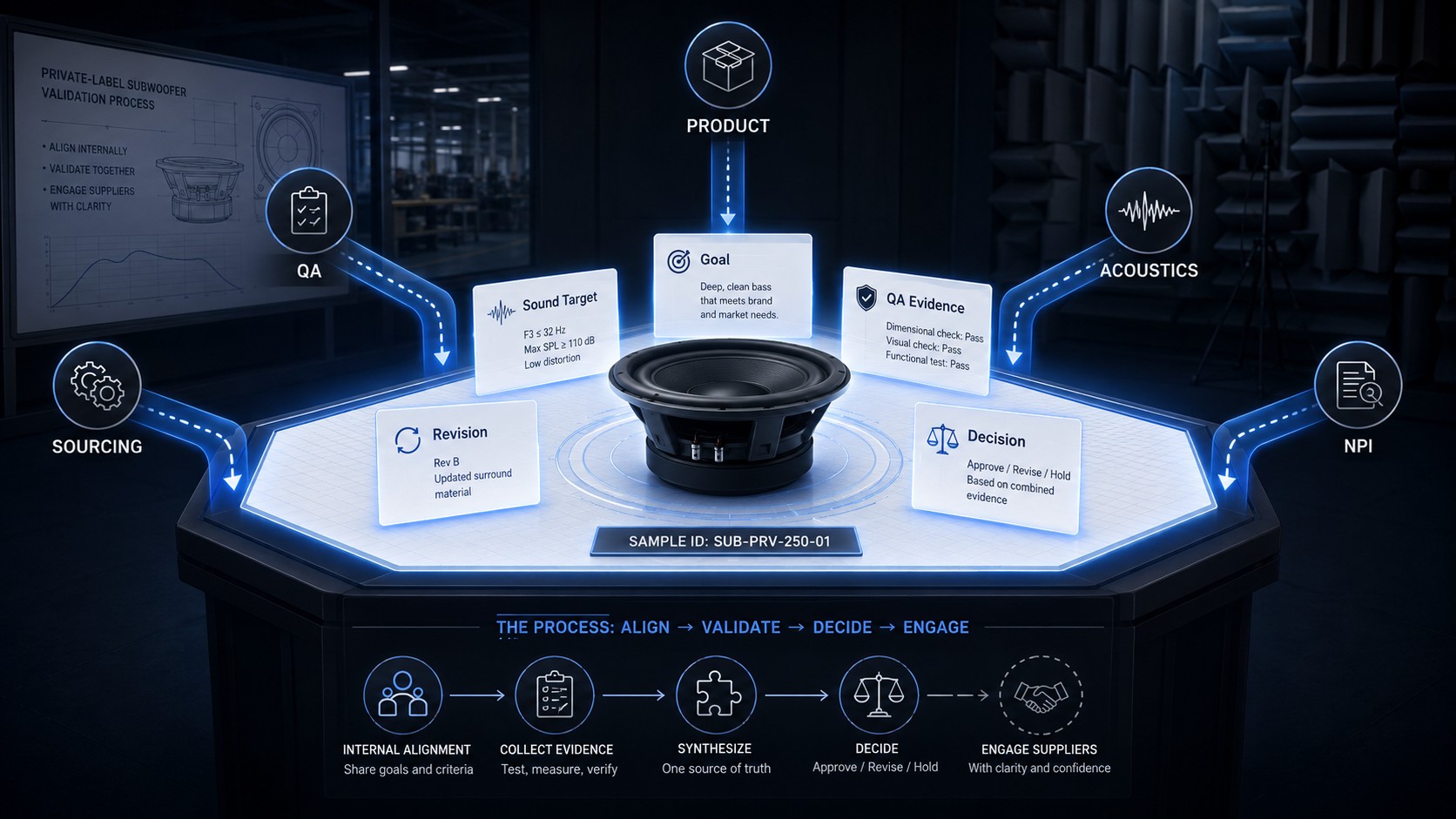
You now have a shortlist that balances differentiation, manufacturability, and landed cost. Move it forward with a prototype plan that validates the thermal path, linearity, and cosmetic fit before you scale. According to the China Future Sound framework, spec choices become a Brand Differentiation Flywheel when they are repeatable, testable, and easy to explain on product pages.
Next step: run this matrix and your tolerance ranges through a controlled prototype and golden-sample cycle with your OEM partner. A concise, factory-ready brief today means fewer surprises at PO time—and a product story that actually sells tomorrow.
Ready to Scope a Differentiated Speaker Line?
Request custom OEM quote — bring the matrix, your must-haves, and your tolerance ranges, and the fastest path to a confident spec can be scoped.
Prefer to keep learning? Subscribe to our newsletter for pragmatic B2B engineering checklists and buyer guides.
Sources for Further Evidence
- USGS — Mineral Commodity Summaries 2025 (Rare Earths data sheet) and MCS landing/statistics pages for supply/price context and data definitions. (U.S. Geological Survey, USGS)
- Klippel — Thermal and nonlinear compression (application notes and knowledge base) for mechanisms behind power compression and related test methods. (klippel.de)
- Scan-Speak Technote — “Symmetric Drive” for shorting-ring/copper-cap effects on inductance and distortion. (scan-speak.dk)
Our Editorial Process
“Our expert team uses AI tools to help organize and structure our initial drafts. Every piece is then extensively rewritten, fact-checked, and enriched with first-hand insights and experiences by expert humans on our Insights Team to ensure accuracy and clarity.”
About the ChinaFutureSound.com Insights Team
The ChinaFutureSound.com Insights Team is our dedicated engine for synthesizing complex topics into clear, helpful guides. While our content is thoroughly reviewed for clarity and accuracy, it is for informational purposes and should not replace professional advice.