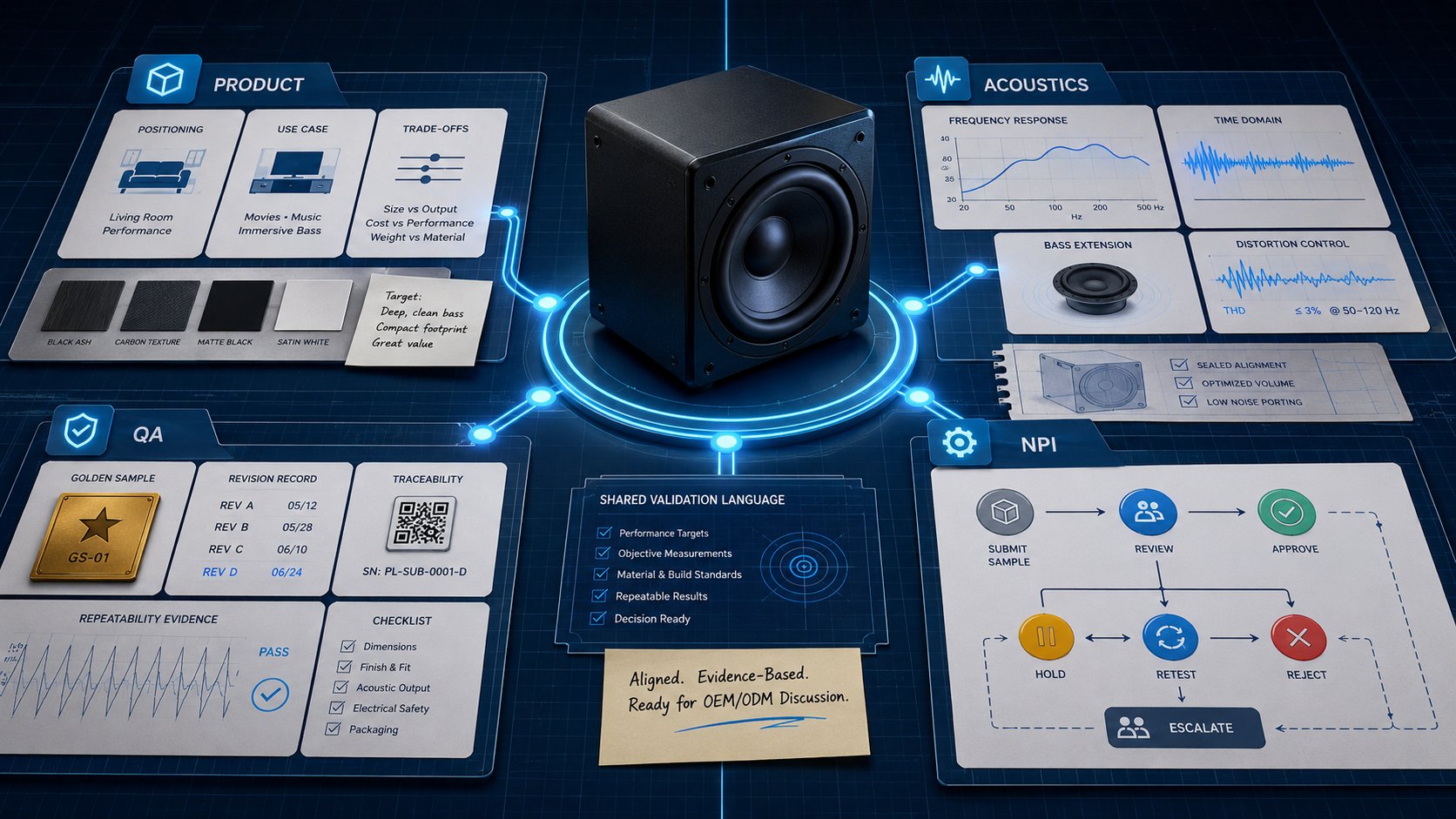
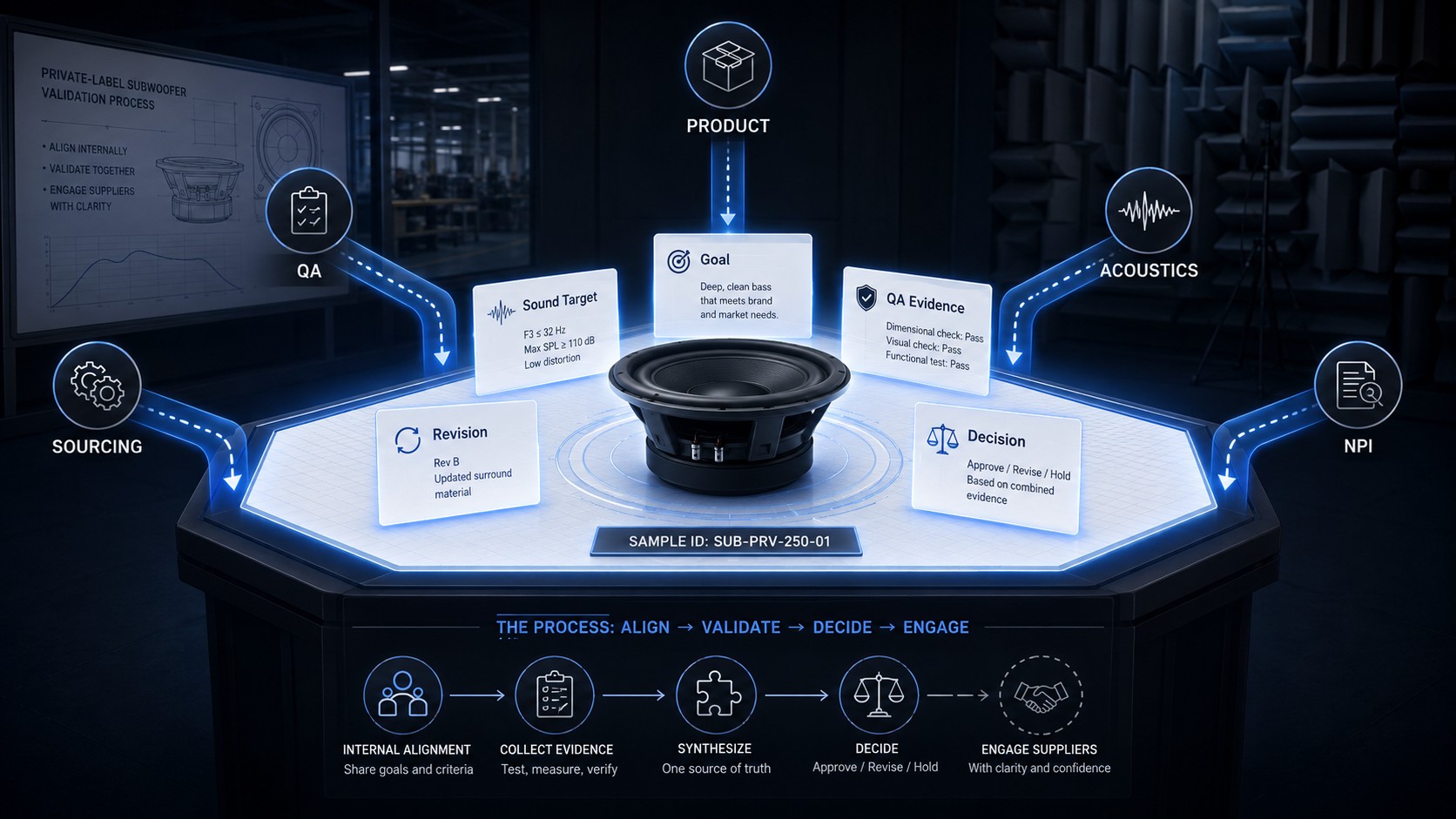
📌 Key Takeaways
Exclusive SKU ownership plus Golden Sample consistency builds defensible customer loyalty that third-party distribution cannot replicate.
- Third-Party Distribution Rents Loyalty: Distributing established brands builds equity for manufacturers, not your business, leaving you vulnerable to channel price competition.
- Exclusivity Eliminates Direct Comparison: Controlling the specification and SKU removes price-matching pressure and forces customers to return to your channel for replacements.
- Golden Sample Prevents Tolerance Drift: Locking a master reference unit and enforcing batch-to-batch consistency protects brand reputation from manufacturing variance.
- Pilot Before Scaling: A 30/60/90 phased approach validates quality gates and market response before committing to full production volumes.
- Vet Manufacturing Discipline: Ask OEM partners how they prevent silent substitutions, document validation tests, and maintain supplier communication cadence.
Exclusivity creates the opening; consistency converts it into repeat business.
Audio brand product managers and sourcing directors evaluating private-label programs will gain immediate strategic clarity here, preparing them for the detailed implementation framework that follows.
The red light on the dashboard flashes. It’s 9:14 AM, and you’ve already received the third warranty claim this morning. Another customer is frustrated with a batch inconsistency in the subwoofers carrying your brand—a defect you couldn’t prevent because you don’t own the factory or the spec. We can’t keep doing this, you think, staring at the warranty data. The brand reputation you spent years building is being eroded by someone else’s manufacturing drift.
This stops today.
Custom brand car audio—often referred to as private label audio—is the process of designing and manufacturing exclusive audio components under your own brand name rather than distributing third-party equipment. Think of a high-end manufacturer as a “ghostwriter” for your business; they provide the technical engineering and production muscle while you provide the brand identity and market vision. When you shift from distributing established brands to owning your product roadmap, you move from a “Sea of Sameness” where you compete on price to a defensible ecosystem where you control specifications and quality gates.
Custom Brand Car Audio builds higher customer loyalty than distributing third-party brands because you own the exclusive SKU and can keep quality consistent. That combination prevents direct product comparisons, protects market perception from batch-to-batch variation, and turns a one-time purchase into repeat trust in your brand.
Distributing third-party brands builds loyalty to someone else; custom brand programs build loyalty through exclusivity plus consistent quality.
The loyalty problem with third-party distribution: you don’t own the relationship
Direct answer: Distributing established brands creates customers of that brand, not customers of your business.
Practical application: If your SKU is identical to your competitors’, loyalty collapses into price-based competition.
When an audio brand relies solely on distributing established manufacturers’ products, they are effectively building equity for a third party. End customers remember the performance of the woofer they bought, but they don’t necessarily attach that satisfaction to the brand name on the invoice. This creates a transactional relationship where the buyer is one search away from finding the same model through a different channel.
Furthermore, third-party distribution locks you into someone else’s supply chain. When that manufacturer has a “warranty spike” due to a silent substitution at their factory, your brand bears the cost and reputation damage. You are forced to defend a product roadmap you didn’t design and quality gates you don’t control.
Program manager check: If you are stuck in third-party distribution, you will see at least two of these signals:
- Your highest-volume SKUs face the most aggressive channel price competition
- Market feedback references the manufacturer constantly, but rarely your brand
- Supplier communication cadence is inconsistent, so you learn about changes late
- Warranty claims fluctuate by batch, not by market segment or application
Custom brand loyalty is mostly an exclusivity effect
Direct answer: Exclusivity keeps the buying decision inside your ecosystem.
Practical application: If you control the spec and the SKU, you control comparisons.
In the car audio market, end customers seek specific performance outcomes—deeper lows, higher SPL, or better thermal management. When these results are attached to your exclusive branded product line, the customer has no choice but to return to your channel for their next upgrade. Research from McKinsey on private-label programs shows that exclusive brands are increasingly seen as high-quality alternatives that drive repeat behavior through unique value propositions—a dynamic that applies across B2B audio equipment markets.[^1]
This effect is only sustainable if the Custom Brand Car Audio maintains absolute consistency. When a customer trusts your branded product line to deliver “Golden Sample” performance consistently, the barrier to purchasing a complete system integration—amps, mids, and highs—decreases substantially.
Loyalty benefits you can actually plan around:
- Reduced direct comparison: Exclusive SKUs limit channel price competition and commoditization
- Clearer brand attribution: End customers attach outcomes to your brand name
- More predictable reinvestment: When margins stabilize, you can reinvest in differentiation instead of chasing promotional cycles
- Better internal alignment: A branded product line gives product, sourcing, and leadership a shared platform to build on
One important caveat: exclusivity only creates loyalty if the product experience stays consistent across batches. That is where manufacturing discipline becomes a growth lever, not an operational detail.[^2][^3]
The Customer Loyalty Flywheel for audio brands
Direct answer: Loyalty compounds when exclusivity and consistency reinforce trust.
Practical application: Design the program so product quality feeds market perception, and market perception drives repeat purchases.
For an audio brand, the path to margin stability isn’t found in a lower BOM (bill of materials) cost, but in the “Flywheel Effect” generated by manufacturing discipline.
The Customer Loyalty Flywheel:
- Exclusive Product: You launch a SKU that competitors cannot undercut because they cannot source it.
- Consistent Quality: Every unit matches the Golden Sample, preventing reputation-killing field-failure rates.
- Strong Market Perception: Reliable performance leads to positive market feedback and lower warranty cost.
- Repeat Purchase: Satisfied customers return to your brand for their next integration project.
- Margin Stability: Reduced price pressure and lower customer acquisition costs (CAC) stabilize profits.
- Reinvest in Differentiation: Higher margins fund further development, restarting the cycle.
6-step caption (scannable):
- Exclusive product: Competitors cannot source the identical specification
- Golden Sample consistency: Prevents silent substitutions and tolerance drift
- Market perception: Reliability becomes your brand’s shorthand
- Repeat purchase: Your second program is easier than your first
- Margin stability: You can plan, not panic
- Reinvestment: You widen the gap competitors cannot copy quickly
Research on customer loyalty programs indicates that recognition and consistent experience are now primary drivers of loyalty beyond simple discounts.[^5]
How to earn trust fast with a new branded product line
Direct answer: Start narrow, build proof, then expand.
Practical application: Launch 1–2 hero SKUs with documented QA and a clear positioning promise.
The biggest mistake growth-stage brands make is trying to launch a 50-SKU catalog overnight. To build loyalty, you must first build a “hero.” This is usually a component that fills a specific gap in the market—perhaps a shallow-mount subwoofer with high excursion that actually fits in a modern truck’s under-seat enclosure.
By focusing on a narrow range, you can implement Golden Sample QA with extreme precision. When your first 500 units ship without a single defect-related complaint, you have created a foundation of trust. This “evidence-first” approach allows you to communicate performance commitments based on data, not marketing hype.
Mini-checklist for the product or brand manager:
- What does “good” sound like and measure like for this SKU?
- What would cause a warranty claims spike, and what gate prevents it?
- What is the MOQ and lead time, and do they support your launch window?
- What is your escalation path if a batch deviates from the Golden Sample?
If you want a deeper walk-through of the transition, use From Reseller to Brand Owner: The Private Label Roadmap as a planning companion.
What to ask your OEM partner so loyalty isn’t sabotaged at the factory
Direct answer: Loyalty is downstream of manufacturing discipline.
Practical application: Ask for the controls that prevent tolerance drift and silent substitutions.
As a Subwoofer Manufacturer, a partner’s role is to protect your brand. Loyalty can be killed by “tolerance drift”—the slow shift in component performance over multiple production runs. To prevent this, you must vet your partner’s OEM/ODM manufacturing process.
Think of OEM/ODM manufacturing as the “ghostwriter” behind your brand. The best ghostwriters do not change the plot mid-book. They follow the agreed spec, keep the voice consistent, and document the process.
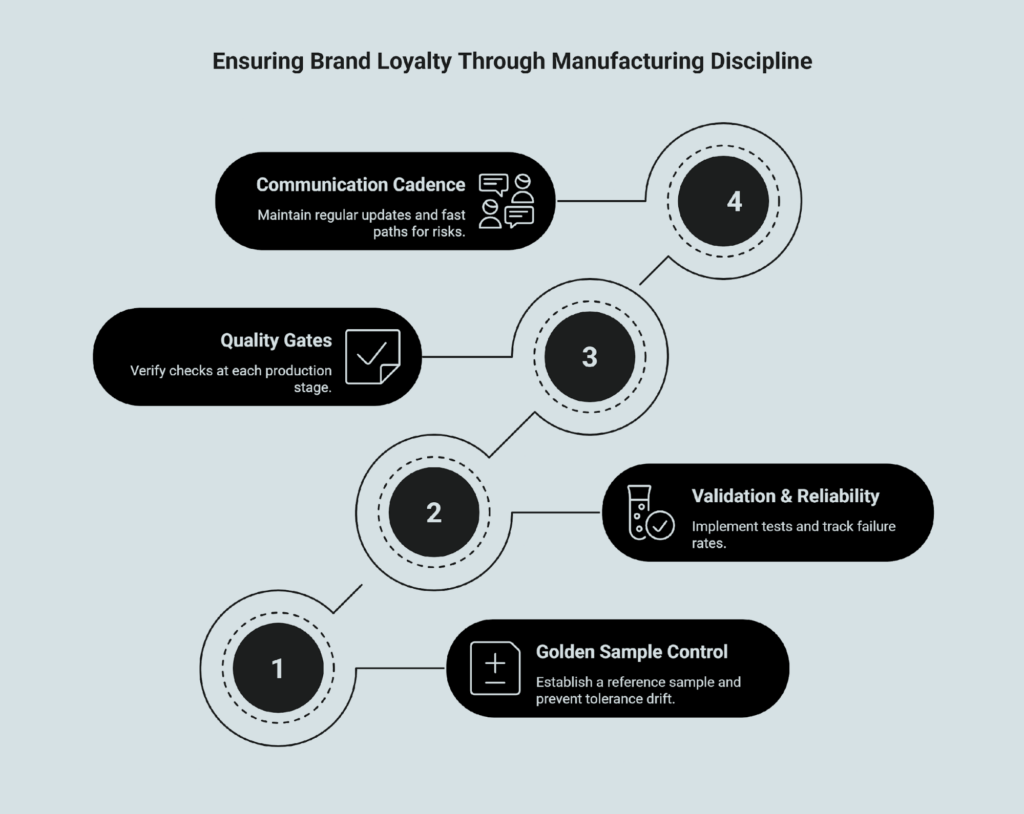
If an OEM partner cannot answer these clearly, your loyalty flywheel will stall.
1) Golden Sample control
- How do you lock the Golden Sample reference and ensure every run matches it?
- What prevents tolerance drift across suppliers and production lines?
- What happens if a component goes out of spec or out of stock?
2) Validation and reliability posture
- What validation or reliability tests are standard for this product class?
- What gets documented, and what is shared with the brand partner?
- How do you track field-failure rate signals without blaming end users?
3) Quality gates you can verify
- What are the incoming, in-process, and final checks?
- Who signs off, and what evidence is retained?
- How do you handle change control so there are no “silent substitutions”?
4) Communication cadence
- Who is accountable for production communication, and how often do you get updates?
- What are the fast paths when a risk appears (materials, tooling, or schedule)?
If Golden Sample discipline is central to your brand promise, this guide is also relevant: How Golden Sample QA Prevents Defective Inventory.
A low-risk way to start: the 30/60/90 pilot
Direct answer: Pilot to reduce political and financial risk.
Practical application: Use a small run to validate quality gates and market response before scaling.
Moving from third-party distribution to brand ownership doesn’t have to be a high-risk gamble. We recommend a phased Private Label Roadmap to secure stakeholder buy-in.
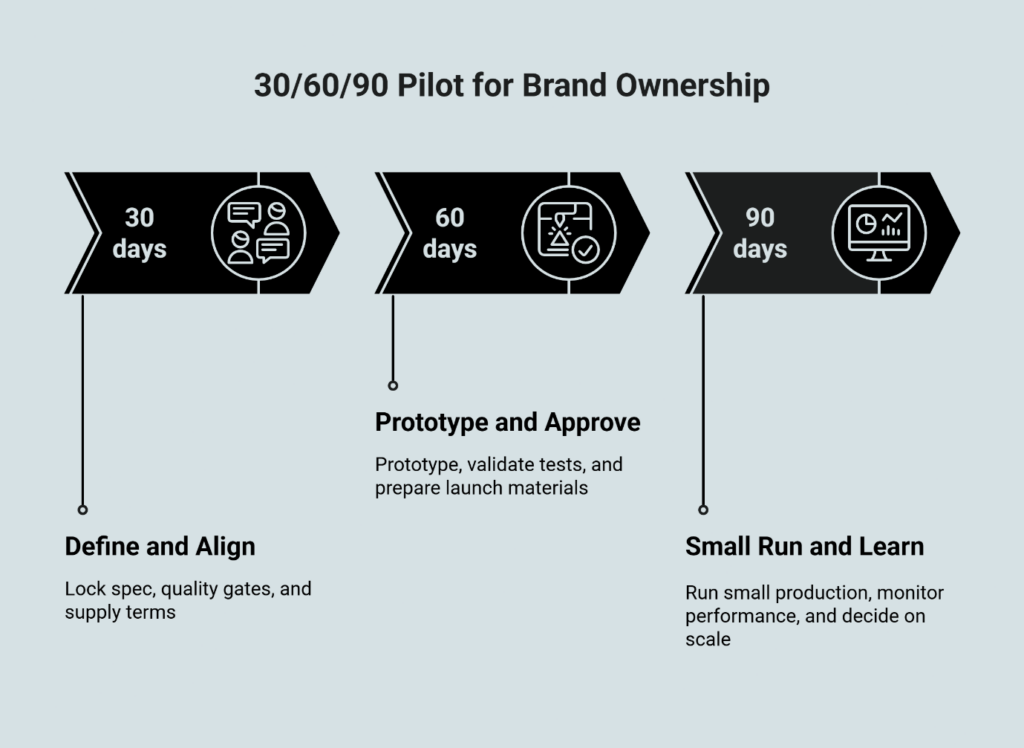
30 days: Define and align
- Lock the spec and positioning promise (what you will be known for)
- Align on quality gates and documentation
- Confirm MOQ, lead time, and change-control rules
60 days: Prototype and approve
- Prototype, then approve the Golden Sample
- Validate the tests you care about (reliability, consistency, fitment)
- Prepare launch materials that describe outcomes and support commitments, without hype
90 days: Small run and learn
- Run a small first production batch
- Monitor field performance, defect signals, and warranty claims data
- Decide whether to scale, revise the spec, or tighten gates
If you want a broader operational view of stabilizing supply, this is a useful companion: The Supply Chain Stability Checklist for Audio Retailers.
Closing thought: loyalty is an asset you can design
Third-party distribution can be a strong starting channel, but it rarely creates a defensible relationship. A custom branded program does, because it replaces “same SKU, different channel” with “their product, their consistency, their reputation.”
If you are serious about escaping the Sea of Sameness, start where loyalty actually forms: exclusivity plus manufacturing discipline. Get one or two hero SKUs right, prove Golden Sample consistency, and let trust compound.
Ready to explore what an engineering-led program looks like? Learn more about working with experienced Subwoofer Manufacturers or reach out via Contact Us.
Frequently Asked Questions
Is private label car audio the same as white label?
Not exactly. White label usually means a mostly fixed, off-the-shelf product with your branding. Private label (custom brand) implies you control more of the spec and quality expectations, which is what makes exclusivity and consistency possible.
What actually creates loyalty in a branded product program?
Exclusivity removes direct SKU comparison, and consistent quality protects market perception. Those two forces drive repeat purchases more reliably than price-based tactics.[^1][^2]
Does custom brand audio require high minimum order quantities (MOQs)?
While MOQs vary by component, many partners offer flexible entry points for pilot runs to help brands validate their market positioning before scaling.
How do I avoid a warranty-claims spike on a new branded program?
Start narrow with 1–2 hero SKUs, lock a Golden Sample, require documented QA gates, and enforce change control so there are no silent substitutions.
What should I ask an OEM/ODM partner before committing?
Ask how they control Golden Sample matching, how they prevent tolerance drift, what validation they run, what gets documented, and what their supplier communication cadence looks like.
Will end customers trust a brand they haven’t heard of?
Trust is earned through transparency. By providing documented QA results and clear performance specs, you provide the evidence customers need to choose your brand over an established name.
What is the safest way to launch without betting the company?
Use a 30/60/90 pilot: align on spec and gates, prototype and approve the Golden Sample, then run a small batch to validate quality and market response before scaling.
This guide is intended as a comprehensive starting point. For decisions specific to your unique situation, we always recommend consulting a qualified professional.
Disclaimer: This content is for informational purposes only and does not constitute professional, legal, or financial advice.
About the China Future Sound Insights Team
The China Future Sound Insights Team is our dedicated engine for synthesizing complex topics into clear, helpful guides. While our content is thoroughly reviewed for clarity and accuracy, it is for informational purposes and should not replace professional advice.
Our expert team uses AI tools to help organize and structure our initial drafts. Every piece is then extensively rewritten and fact-checked by our human team for clarity, accuracy, and usefulness.
[^1]: McKinsey & Company (2024). A turning point for private brands: How retailers can seize the opportunity.
[^2]: McKinsey & Company (2024). The power of private-label brands in distribution.
[^3]: NIQ (2024). The Rise of Private Label.
[^4]: PLMA (2024). Private Label Report 2024.
[^5]: Deloitte (2025). The new consumer loyalty landscape: Transcending consumer expectations.