📌 Key Takeaways
Amplifier supplier selection succeeds when engineering and procurement agree on evidence requirements, quality gates, and decision rights before the shortlist—not after.
- Testable Requirements Prevent Drift: Define acceptance criteria, test conditions, golden sample rules, and firmware version control before supplier evaluation to eliminate subjective assessments.
- Evidence Gates Compress Risk: Require specific proof—AP or Klippel test reports—at prototype, pilot, and SOP milestones rather than accepting “passed” status claims.
- Traceability Enables Fast Containment: Unit-level or lot-level traceability reduces containment costs by 30-50% by shrinking the search window from weeks to hours during field failures.
- ECO Discipline Stops Silent Changes: Establish clear decision rights and documented cut-in plans to prevent quality drift from uncontrolled component substitutions during ramp.
- Procurement Constraints Shape Design: Surface lead times, MOQs, and single-source risks early so technical decisions account for commercial realities before design freeze.
Alignment = predictable ramp and protected margin.
Product managers and sourcing directors evaluating OEM amplifier suppliers will gain a repeatable framework here, preparing them for the six-gate alignment checklist and RACI implementation guide that follows.
Effective OEM/ODM amplifier programs fail not because of technical specifications, but because of a “priority gap” between engineering and procurement. While engineering optimizes for performance and reliability, procurement targets bill-of-materials (BOM) cost and lead times. Without a shared alignment checklist, this friction creates late-cycle rework, quality drift, and warranty exposure that erases margin. This guide provides a six-gate checklist and a RACI-lite framework to synchronize these functions, ensuring your program reaches start-of-production (SOP) with technical stability and commercial predictability.
What “Alignment” Means in OEM/ODM Amplifier Programs
You can hear the frantic clicking of a mouse in a silent conference room as a sourcing director refreshes a shipping portal that hasn’t updated in three days.
You have likely seen the “Good Sample, Bad Ramp” cycle before. The golden sample sounds perfect on the lab bench, but three months into mass production, field failure rates start climbing and your engineering team is too busy troubleshooting legacy issues to focus on the next new product introduction (NPI).
In the context of Amplifier Manufacturers, alignment is the formal agreement between engineering and procurement on evidence requirements, quality gates, and decision rights. It is the mechanism that ensures a technical requirement is not just a “wish list” item but a testable, enforceable standard that procurement can use to hold a supplier accountable.
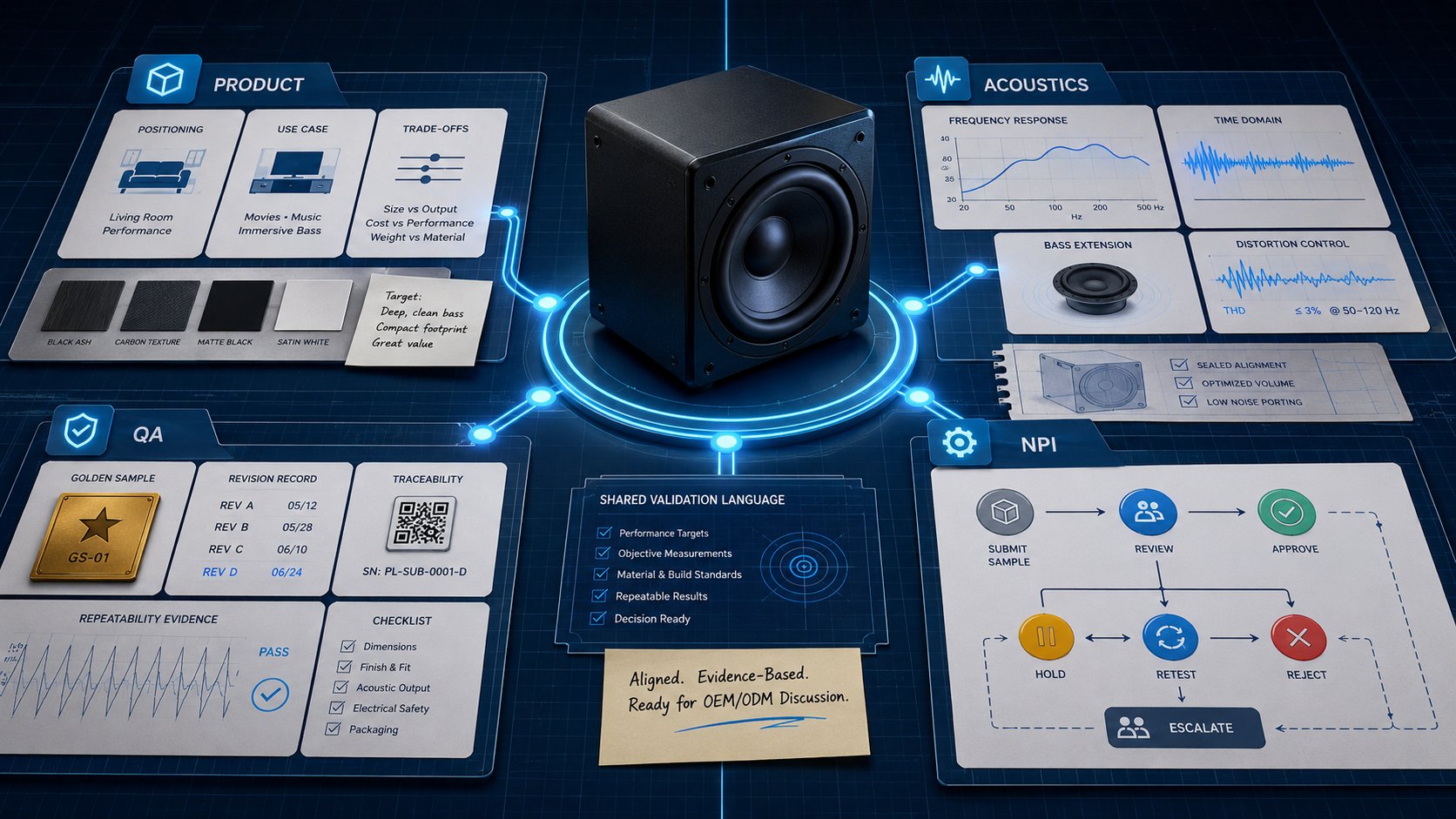
Alignment means engineering and procurement agree—up front—on what “ready” looks like, what proof is required at each step, and who has decision rights. Treat alignment like a production-ready bridge from spec to scale: if the bridge has missing supports (evidence gates, traceability, change control), a program can look solid in prototypes and still fail under load in ramp.
Picture the real moment: a shortlist meeting is on the calendar, sample units sound fine, and timelines feel tight. Engineering pushes for confidence that performance will hold at volume; procurement pushes for predictability around lead times, MOQs (minimum order quantities), and substitutions. If those priorities stay implicit, the program pays later—through late-cycle reversals, “surprise work,” and unclear accountability during escalation.
With this shared checklist, your team can bridge the gap between “it works in the lab” and “it works at scale.”
The Checklist: Agreement Before the Shortlist
Traditional sourcing often defaults to the lowest quoted BOM, but strategic program management recognizes that the cheapest unit cost is rarely the lowest total program cost. Misalignment between internal teams leads to late-cycle surprises—such as realizing a “standard” component has a 42-week lead time only after the design is frozen.
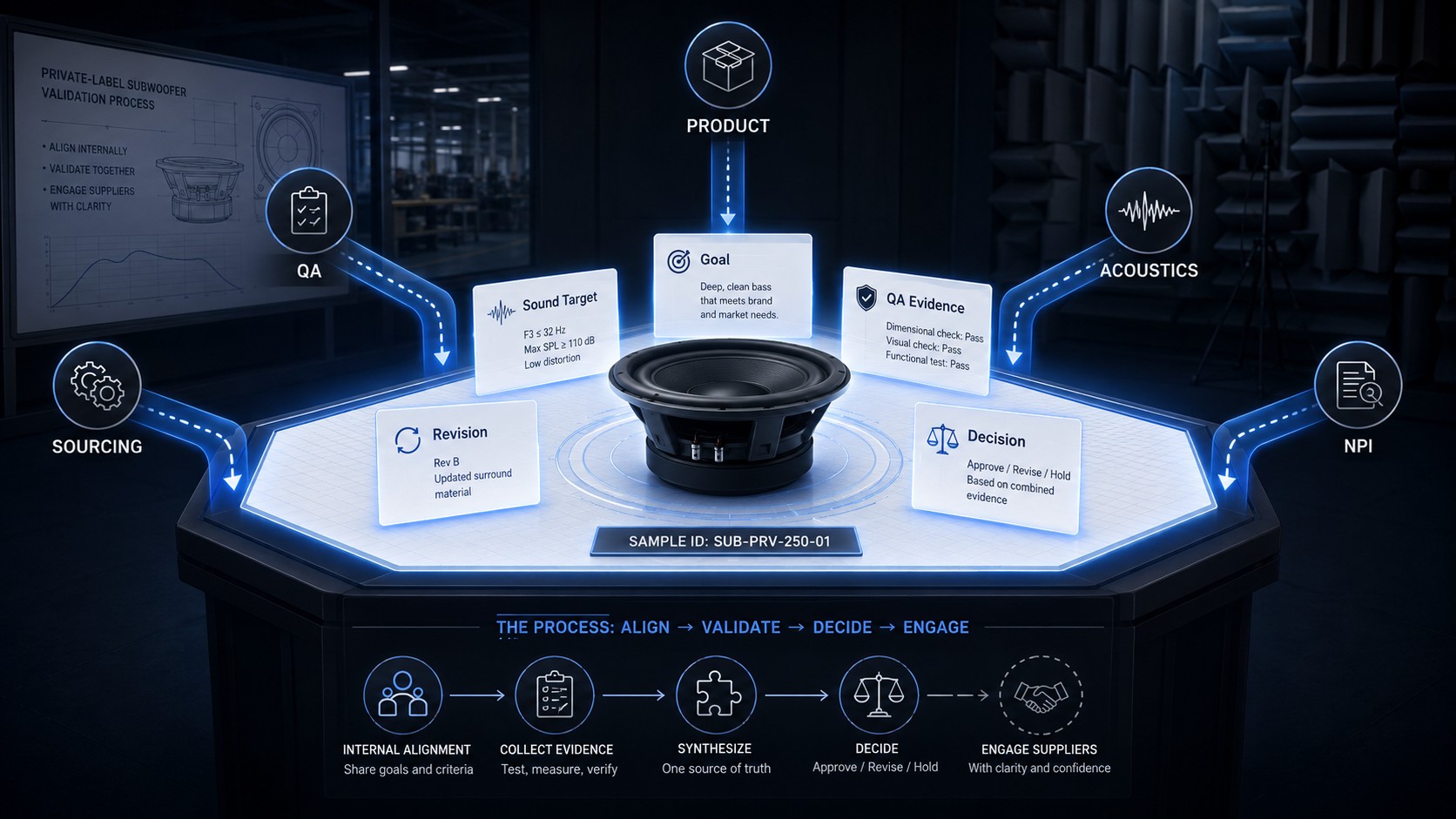
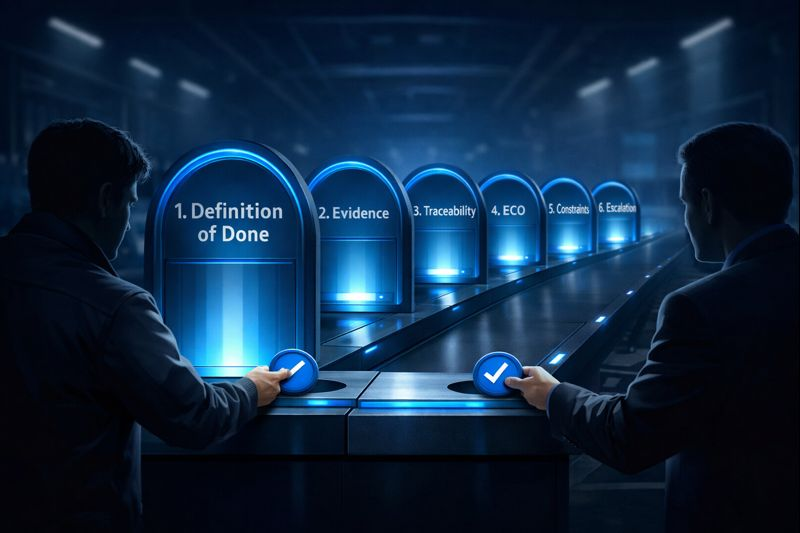
To prevent these slips, engineering and procurement must agree on the following six gates before any supplier commitment. Use this checklist as the core agenda for a 30-45 minute internal session. The output should be a single alignment artifact that can be copied into an RFQ (request for quote) and used as a supplier Q&A script.
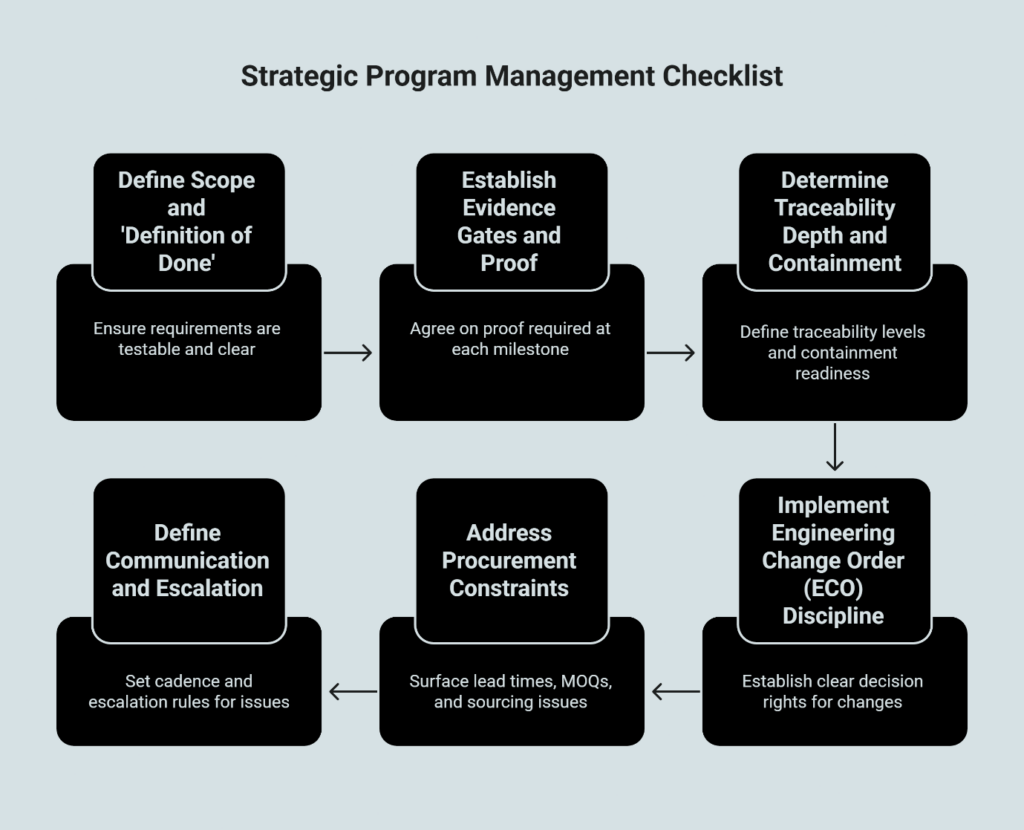
1) Scope and ‘Definition of Done’
If requirements are not testable, supplier evaluation becomes subjective—and subjective programs produce late surprises.
Alignment begins by ensuring that all requirements are testable. Engineering must define the “Definition of Done” for each phase, particularly regarding the firmware and Digital Signal Processing (DSP) version control. Procurement needs this clarity to ensure that the Amplifier Manufacturers are quoting a fixed scope rather than an evolving prototype.
Confirm the following is written down and mutually understood:
- Acceptance criteria (pass/fail): What must be true for the build to be accepted (functional, reliability, mechanical, labeling, documentation).
- Test conditions: The test setup and operating conditions that determine pass/fail, so results are comparable across suppliers.
- Golden sample rules: How reference units are approved, stored, and used as the single source of truth for production checks.
- Variant/SKU clarity: Which variants exist, which components differ, and what “shared platform” really means for documentation and tests.
- Firmware/DSP version control: How firmware/DSP versions are named, frozen, and verified in builds (including rollback expectations).
2) Evidence Gates and Proof
Evidence gates compress risk by forcing “show the proof” before the program earns the right to scale.
Agree on what counts as proof at each milestone: Prototype, Pilot, and SOP. Do not settle for a “passed” status; require specific test reports from systems like Audio Precision (AP) or Klippel QC. Procurement should view these evidence logs as the ‘commercial currency’ required for payment or phase advancement.
Define the gates and the proof required at each one:
- Prototype gate: What must be validated before spending time and money on the next step (fit, core performance behaviors, protection behavior, basic manufacturability signals).
- Pilot gate: What must be demonstrated in a controlled run that resembles production (repeatability, clear defect tracking, process stability signals).
- SOP gate: What must be proven before volume commitments (documented control plans, stable build instructions, release-ready change control, traceability and retention rules).
Explicit quality gates with evidence requirements enable procurement decisions that reflect program risk, not only quoted BOM.
3) Traceability Depth and Containment
Traceability is not paperwork; it is containment speed when a ramp issue appears.
Define whether you require unit-level, lot-level, or component-level traceability. In the event of a field failure, knowing exactly which batch of transistors went into a specific serial number range is the difference between a 1,000-unit recall and a 50,000-unit disaster. Industry analysis suggests that robust traceability discipline can reduce containment costs by significant margins—often estimated between 30-50% in high-volume production—by reducing the ‘search-and-quarantine’ window from weeks to hours.¹
Agree on traceability depth and the records required:
- Depth expectation: Unit-level, lot-level, or component-level traceability (and which components, if any, must be traced more deeply).
- Record linkage: Which records must tie a shipped unit to its build conditions and its test evidence (serial/lot identifiers, test logs, revision identifiers).
- Data retention: How long production and test records must be retained, and in what format.
- Containment readiness: What information is required within a defined time window to isolate affected units and prevent mixed builds.
Traceability is part of containment readiness. If traceability is shallow, containment becomes slow and disruptive.
4) Engineering Change Order (ECO) Discipline
Uncontrolled changes are the fastest way to create “good sample, bad ramp” outcomes.
Establish clear decision rights for changes. Engineering owns the technical validity of a change, but procurement must own the “cut-in” plan—the precise date or serial number when the old version stops and the new version begins. Silent changes are a primary driver of quality drift in mature programs.
Define the ECO rules before selecting a supplier:
- Decision rights: Who can approve changes, and what the approval thresholds are (engineering, procurement, shared sign-off).
- Documentation standard: What the ECO must include (reason, impacted parts, impacted tests, risk assessment, implementation plan).
- Cut-in plan: The rule for when a change becomes active, and how mixed builds are prevented across inventory, WIP, and shipments.
- Rollback/containment: What triggers rollback, and what evidence is required to close the loop.
A cut-in plan prevents mixed builds by forcing a single, documented transition point instead of “silent drift.”
5) Procurement Constraints
Procurement constraints are manageable when known early; they become schedule breakers when discovered late.
Procurement must surface lead times, Minimum Order Quantities (MOQs), and multi-sourcing requirements early. If an engineering spec requires a specialized capacitor only available from a single source with a high MOQ, this must be flagged before the design is finalized.
Surface constraints that change technical decisions:
- Lead times and MOQs: Which parts or processes drive long lead times and MOQ exposure, and what options exist (without allowing ungoverned substitutions).
- Sourcing constraints: Single-source risks, planned alternates, and the governance for substitutes.
- Substitution rules: What can be substituted without re-qualification—and what always requires re-approval.
- Packaging/labeling/documentation needs: What must be controlled and signed off (label masters, revision marks, document bundles) as part of program governance.
6) Communication and Escalation
Cadence and escalation rules reduce “decision churn” by making response expectations objective.
Unaligned teams wait for the weekly meeting to report problems; aligned teams have pre-agreed “stop-ship” and “containment” triggers. Define exactly who has the authority to halt the line if a Klippel QC test falls outside of the golden sample tolerance.
Define how the program will run once suppliers are engaged:
- Weekly ramp review: Standing agenda tied to gates, open issues, ECOs, and risk flags.
- Escalation triggers: What events trigger escalation (missed evidence, repeated defects, late changes, documentation gaps).
- Stop-ship and containment triggers: Pre-agreed rules for when shipments pause and what evidence is required to restart.
Mini RACI-lite: Clarifying Ownership
A lightweight ownership map prevents ambiguity from turning into delays. Ambiguity is the enemy of execution. Use the following table to define who is Responsible (R), Accountable (A), Consulted (C), or Informed (I) for critical program deliverables.
| Deliverable/Decision | Engineering | Procurement |
|---|---|---|
| Technical Acceptance Criteria | A | I |
| BOM Cost & Vendor Selection | C | A |
| Quality Gate Evidence Sign-off | A | R |
| ECO Approval & Cut-in Plan | A | C |
| Lead Time & MOQ Governance | I | A |
How to Use This Checklist in Practice
The checklist works when treated as a repeatable internal system—not as an extra document.
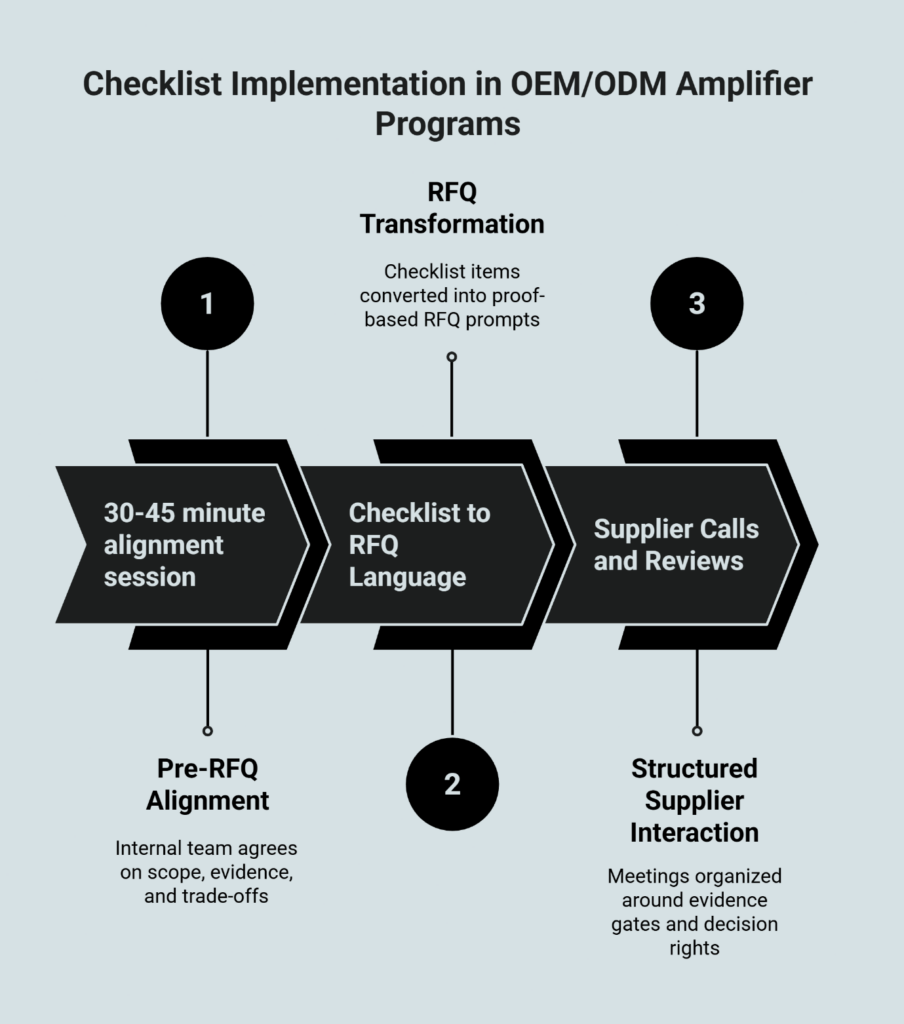
1. Run a 30-45 minute alignment session before RFQs/shortlisting
Convert disagreements into documented trade-offs (for example: deeper traceability vs. operational overhead; faster timeline vs. tighter gate proof). This session produces the alignment artifact that becomes your RFQ foundation.
2. Convert the checklist into RFQ language and a supplier Q&A script
Each checklist item becomes a requirement prompt: “Show the evidence you will provide at Gate X,” rather than “Confirm you can do X.” This shift transforms the RFQ from a checkbox exercise into a proof-based evaluation tool.
3. Use it as the agenda for supplier calls and pilot readiness reviews
The program stays stable when meetings are structured around evidence gates and decision rights—not general progress updates. Every supplier interaction should reference the shared alignment artifact to maintain consistency across evaluation and execution phases.
Operationalizing the Handshake
Turning a checklist into a repeatable process requires objective truth. At China Future Sound, we have found that relying on standardized test data is the most effective way to eliminate friction between engineering and procurement. Our R&D team of over 20 specialists utilizes the same tools your engineers use—including AP Audio Precision systems, APx555 B-Series analyzers, and Klippel R&D systems—to ensure that every sample meets the testable requirements agreed upon at the start of the program.
We believe that “Spec sheets guarantee quality” is a myth that leads to late-cycle surprises. True quality is part of a managed manufacturing system that includes ISO9001-2015 certification, ERP/WMS inventory control, and barcode-based unit traceability.
When both teams work from the same evidence, the procurement decision reflects program risk, not just the BOM. This is critical because a 3% warranty rate versus a 1% rate can effectively erase the entirety of the projected margin gain. This follows the established ‘1-10-100 Rule’ of quality costs, where the expense of a failure detected in the field (CoPQ) scales to approximately 10x the cost of catching it in production, driven by field-service labor, logistics, and brand damage.
Conclusion: Stability Through Alignment
The blinking cursor on a late-night email to a factory doesn’t have to be your team’s reality. By implementing a shared checklist, you move from a reactive “firefighting” mode to a proactive program-risk strategy.
You have gained the ability to filter out risky suppliers by demanding evidence gates over promises. You have replaced decision churn with a clear RACI-lite matrix that respects the expertise of both engineering and procurement.
The result is a more predictable ramp, stable output, and the protection of your brand’s reputation.
Stop chasing the lowest bid. Start building the lowest-risk program.
Schedule an In-Person Consultation
Our Editorial Process: China Future Sound publishes risk-first, evidence-led guides designed to help B2B teams reduce OEM/ODM program risk. Content is written to prioritize practical decision utility, avoids unverifiable claims, and treats statistics or benchmarks as citation-required.
Byline: China Future Sound Editorial Team
Bio: China Future Sound publishes risk-first, evidence-led guides for OEM/ODM and private-label amplifier programs—focused on predictable ramps, controlled change, and warranty protection.