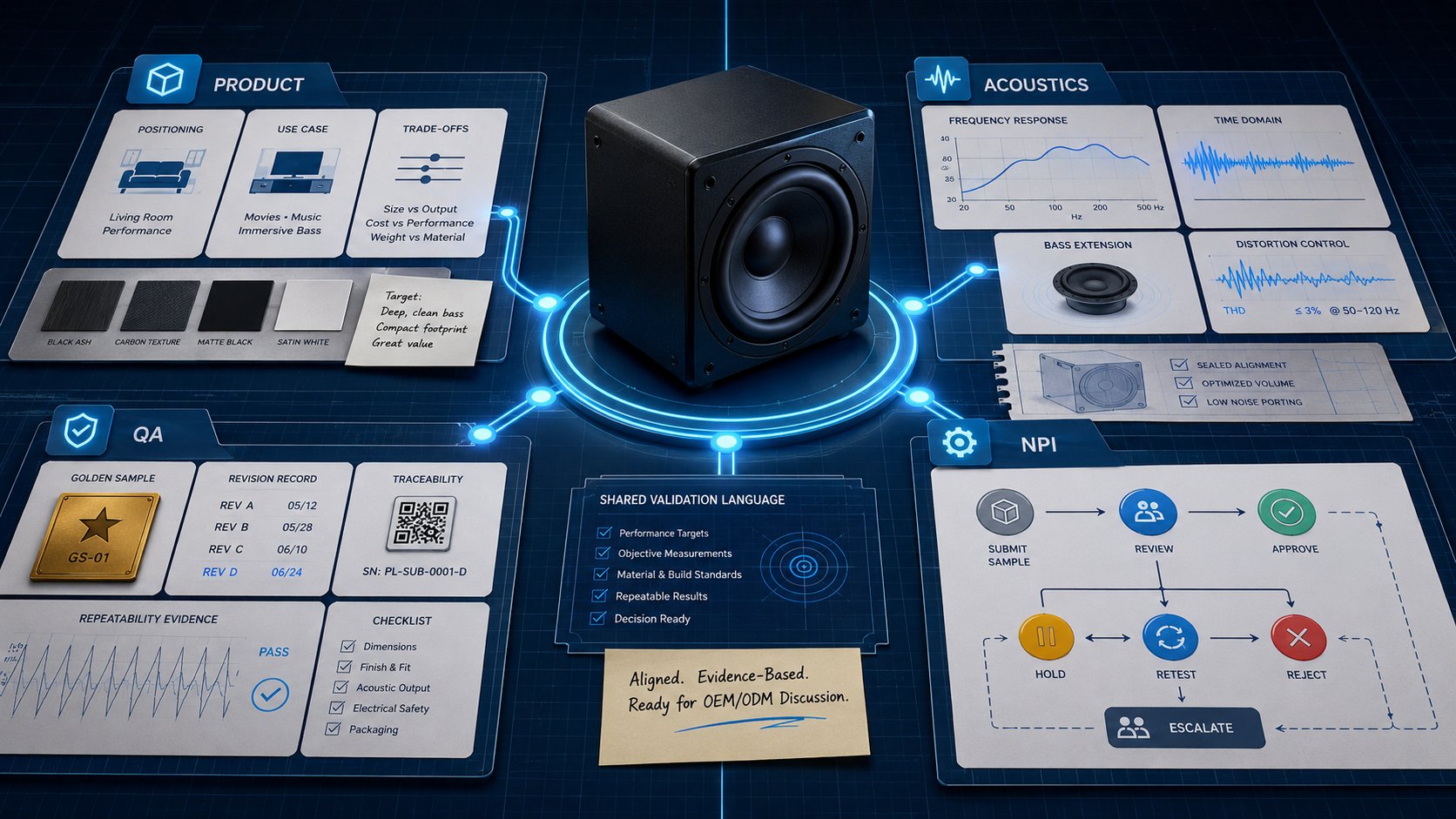
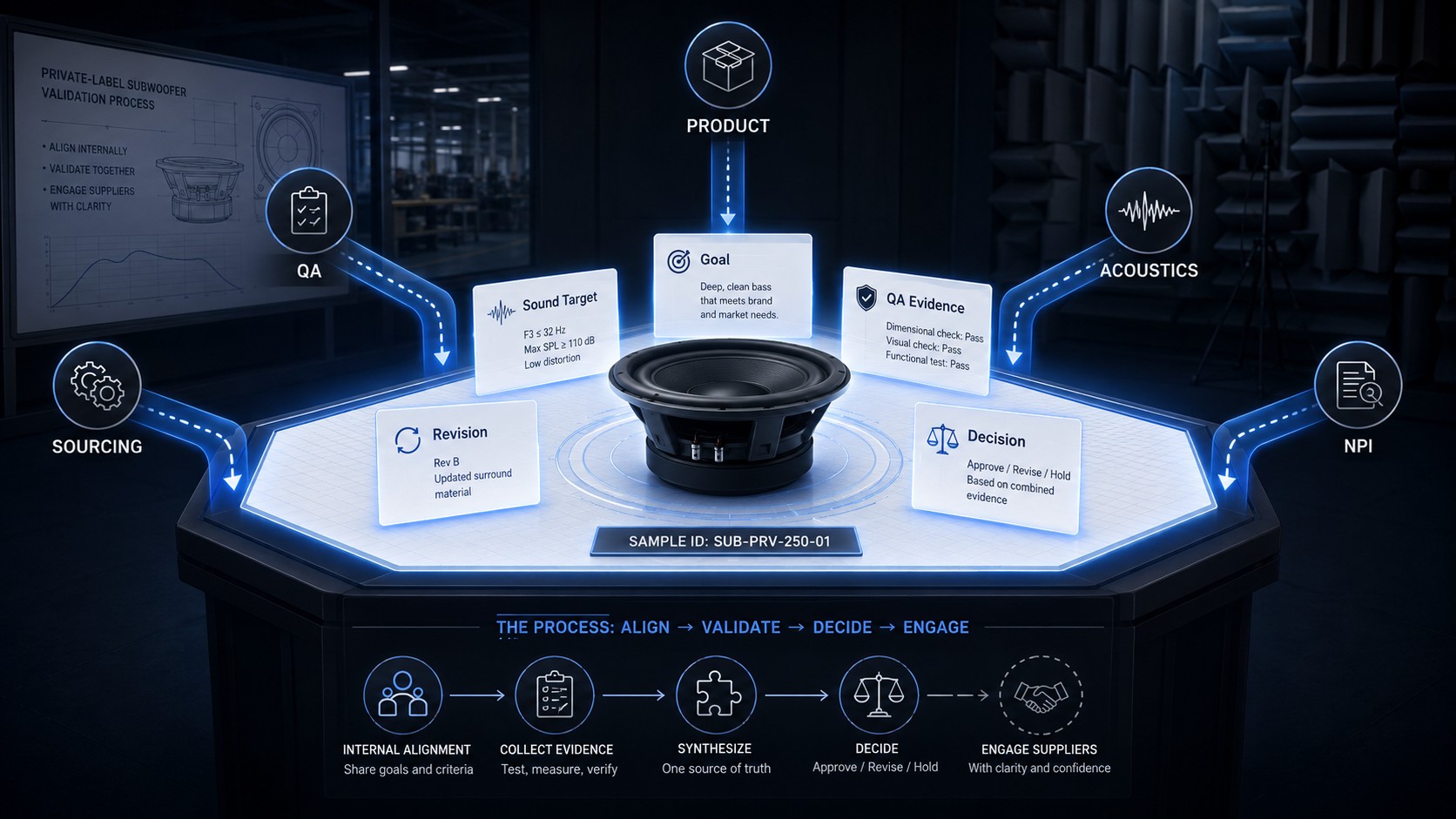
📌 Key Takeaways
Custom branding and DSP tuning become rework drivers when requirements remain subjective and change control stays informal.
- Testable Requirements Stop Debates: Every branding element and DSP behavior must map to pass/fail conditions with pre-agreed evidence, eliminating subjective “punchier sound” disputes that derail timelines.
- Version Control Prevents Mixed Builds: Firmware and tuning files require naming conventions, checksums, release notes, and cut-in plans—tracing every unit to its exact software state stops warranty exposure from invisible drift.
- Golden Samples Anchor Consistency: The approved reference unit defines the standard; A/B comparisons under identical test conditions validate pilot and production units against this single source of truth.
- Change Control Protects Launch Dates: ECO workflows with version tags, cut-in serial numbers, and rollback procedures ensure modifications enter production deliberately, not accidentally mid-run.
- Traceability Enables Fast Containment: Binding unit serials to firmware versions, tuning files, and test data allows immediate identification of affected inventory when post-launch issues surface.
Frozen baselines, versioned releases, and serial-level traceability transform differentiation from a rework risk into a controlled advantage.
Heads of Product, Sourcing Directors, and PMM leads managing private-label amplifier programs will gain clarity on the acceptance gates that prevent late-stage surprises, preparing them for the detailed requirements framework that follows.
The boardroom falls silent. You watch twenty pairs of eyes shift toward the pilot samples on the table—the ones that sound fundamentally different from the engineering prototypes approved last month. The cursor on the lead engineer’s laptop blinks steadily in an empty field titled “Final Firmware Hash,” but nobody in the room can confirm which tuning file was actually flashed to the production line.
That silence is the sound of an NPI (New Product Introduction) schedule slipping. When differentiation is the goal, custom branding and DSP tuning are the primary levers, yet they are also the most common sources of rework and mixed-build inventory. With a disciplined requirements framework, you can transform these subjective requests into testable gates that protect your launch timeline and warranty margins.
Store-brand amplifier manufacturing: what “custom branding + DSP tuning” really means
Store-brand amplifier manufacturing is the process of having an OEM/ODM partner build private-label car audio amplifiers to requirements that the brand controls—including custom branding requirements for amplifiers (labels, cosmetics, packaging) and DSP tuning requirements (signal behavior, firmware/tuning releases). In practical terms, it is a program where differentiation is created upstream—inside manufacturing controls, documentation, and release discipline—before product ships.
Like shipping a single product recipe, but deciding to change the seasoning and labels mid-run without a release process. A buyer wants differentiation, and stakeholders request last-minute logo placement changes and tuning tweaks. The supplier asks, “Which file is final?” Pilot units arrive with a different “feel” than the approved sample, and the team debates what “correct” means. Rework begins: artwork gets re-opened, files get re-sent, production builds drift under one SKU, and the launch date starts slipping.
The practical fix is not “more meetings.” The fix is to freeze what matters, make requirements testable, and control DSP/firmware like a release: version tag + cut-in plan + traceability.
Custom branding scope typically includes artwork (logos, finishes, silkscreen/laser), mechanical cosmetics (badge, end-caps, colorways), packaging, printed inserts, and the product label set (model/SKU, serial label, regulatory marks, carton labels).
DSP tuning scope depends on architecture, but it usually means controlling the behavior (filters, limiters, EQ curves, protection thresholds, gains) and the implementation (tuning file + firmware image + programming method). When the program lacks disciplined firmware version control, it becomes easy for multiple “valid” files to exist at once—which is how mixed-build outcomes happen.
Experience indicates that significant rework loops are frequently not caused by ‘bad manufacturing.’ Instead, they often stem from requirements that are subjective (‘punchier,’ ‘cleaner,’ ‘more dynamic’) and by change requests that are not tied to acceptance evidence, version tags, and a cut-in plan.
Required definitions (plain language)
DSP (Digital Signal Processing): Digital settings that shape how audio behaves (filters, EQ, limiters).
Firmware: The software running on the amplifier’s controller/DSP hardware.
Tuning file: The configuration data (or project file) that sets DSP behavior.
Golden sample: The approved reference unit used as the comparison baseline for validation and production consistency.
Traceability: The ability to connect a finished unit to its build history (including key components, test data, and software/tuning versions).
Change control / ECO: A formal process to propose, review, approve, and release changes (often via Engineering Change Orders).
Cut-in plan: The rule for when an approved change becomes effective (for example, “effective from serial number X”).
SOP (Start of Production): The point when the program transitions to routine volume builds under controlled processes.
Requirements principle: make every customization testable
Every customization must be written as a pass/fail condition tied to objective acceptance evidence. This reduces subjective debates during validation and prevents the repeated rework loops that drain program budgets.
The most common root cause of rework in store-brand amplifier manufacturing is ambiguity. When a requirement is stated as “the audio should sound punchier,” it is impossible to validate on a production line. Customization succeeds when requirements create clear test conditions, pre-agreed evidence, and established baselines.
Define test conditions once. All comparisons must be made under identical conditions—including input voltages, loads, fixtures, and ambient temperatures—to ensure the evidence is valid. Comparisons only work when everyone agrees on the “test world.” Define (at minimum) the load, input signal, supply conditions, temperature range (if relevant), fixtures, and the measurement method. This avoids A/B comparisons that are not actually comparable.
Pre-agree on evidence. Before a single unit is built, define exactly what artifacts constitute “proof” of compliance, such as automated test reports, checksum logs, or A/B acoustic results against a golden sample. Common examples at program level include measurement reports with conditions clearly stated, firmware/tuning release notes with version IDs, logs that show programming verification at end-of-line, and A/B comparison results versus the golden sample under the same conditions.
Establish a golden sample. A golden sample is the single source of truth—the physical unit that represents the exact intersection of branding and tuning that mass production must match.
Configuration management disciplines exist specifically to prevent uncontrolled drift across versions and builds. ISO 10007:2017 provides guidelines for configuration management systems, while ISO 9001:2015 Clause 8.5.2 (Identification and Traceability) reinforces the need for unique identification of outputs.
Branding requirements that prevent late surprises
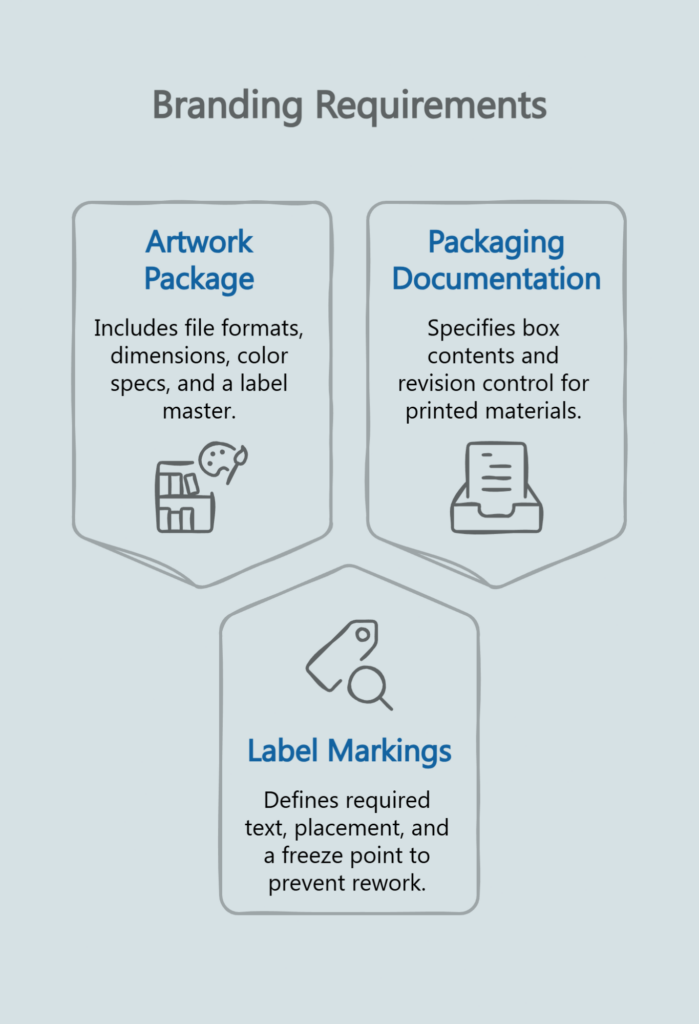
Artwork package must be frozen well before SOP to prevent pilot-stage panic. Custom branding scope typically includes visual elements like logos, mechanical finishes, packaging, and compliance labels. Because these are often the last items finalized, they are the most likely to cause late surprises.
A complete artwork package typically includes file formats (source + production-ready) and revision naming rules, dimensions with placement datums and minimum clearances, color specs and finish callouts (gloss/matte, texture) with tolerances where meaningful, and a “label master” approach with exact strings, fonts, and placement rules that are frozen at a defined milestone.
Label and compliance markings: what must appear, where, and when to freeze
Labeling and compliance markings are equally critical. You must define exactly what text must appear—including serial number schemes and regulatory marks—and where it must be placed. Failing to define a Label Master can lead to receiving holds that stop your product at the warehouse door.
Rework accelerates when label content is treated as “design polish” rather than controlled requirements. Define required fields (model, SKU, serial format, electrical ratings as applicable, and any mandatory markings), placement (chassis location + orientation + durability expectations such as smear resistance and abrasion resistance), and a freeze point—a clear milestone after which label content changes require an ECO.
Packaging + documentation: what ships with the unit
Define what the box must contain (printed inserts, safety sheets, quick-start cards) and how revisions are controlled. Treat printed materials like software: versioned, released, and cut-in controlled to avoid mixed content in the field.
DSP tuning and firmware requirements that prevent rework
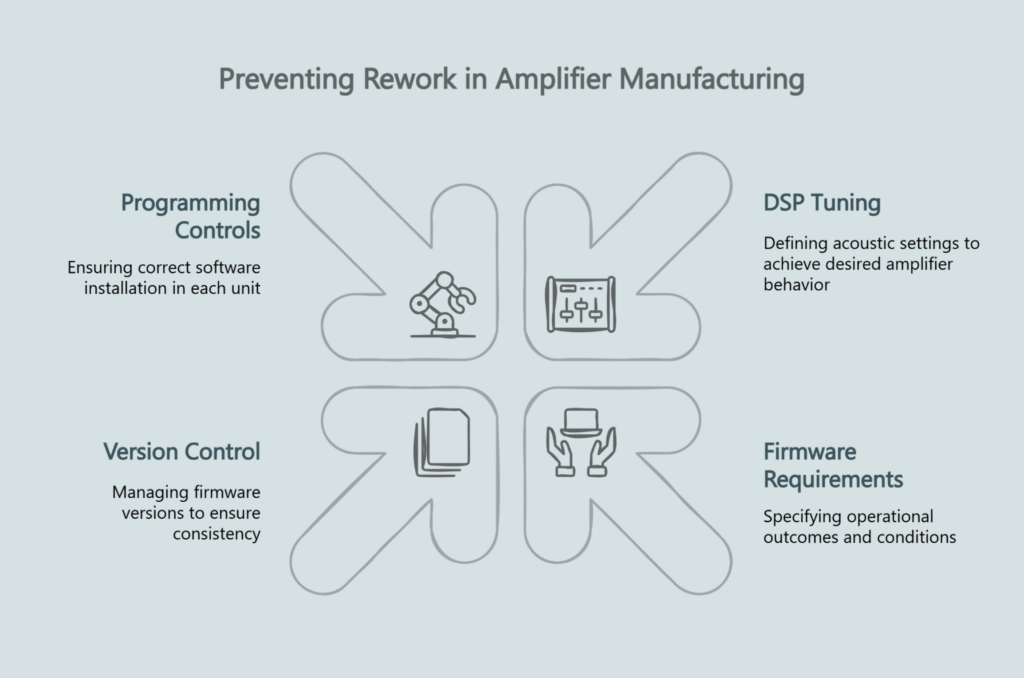
Define the tuning goal (behavior) before discussing the file (implementation). DSP tuning involves the specific acoustic settings (crossover points, EQ curves, limiters) that define an amplifier’s behavior. In modern amplifier manufacturing, the tuning intent (the desired behavior) must be defined before discussing the implementation (the actual file).
Tuning requirements should describe the expected outcome in operational terms: target behavior under defined inputs and loads, protection and limiter behaviors (what triggers, how it recovers, what it must not do), and any “must not” conditions (for example, unacceptable clipping behavior under a defined test). This allows engineering teams to improve implementation without re-litigating objectives.
Version control: naming, release notes, checksums
Rework often occurs because of ‘mixed outputs’—shipping units that behave differently under a single SKU. Rigorous version control is a primary defense against this risk.
A workable firmware version control requirement set typically includes a file naming convention with version tags (and a single source of truth repository or controlled handoff method), release notes documenting what changed and why along with impacted SKUs/variants and required evidence, integrity controls using checksums/hashes for files plus an explicit approver list, and a “no silent updates” rule where any change, even “minor,” is an ECO-controlled release.
Programming and end-of-line controls: right image into the right unit
Your manufacturing partner must implement programming controls to ensure the “right tuning goes into the right unit.” This often involves version readback or log capture during the final test phase to confirm the correct software state.
Mixed builds usually happen at programming. Requirements should define how the correct firmware/tuning version is selected for a given SKU/variant, a verification step (for example, read-back of version ID + log capture), and what traceability fields are captured at programming and tied to the unit serial.
Programs that bind test data to serials and enforce barcode/QR-driven routing typically contain issues faster when a release goes wrong. This is the practical value of production traceability.
Acceptance evidence: what to request before pilot and before SOP
Acceptance evidence is the bridge between a theoretical requirement and a physical product. For amplifier manufacturers, this evidence should be tiered based on the program stage.
Golden sample and A/B comparison plan
Before the pilot build, require a comprehensive A/B comparison report. This report should document the performance of the pilot units against the golden sample, highlighting any deviations in branding or acoustic response.
Golden sample alignment is most effective when it is procedural: identify which characteristics must match (cosmetics, label set, tuning behavior), define A/B comparison conditions and acceptance thresholds, and define sign-off artifacts (who signs, what gets archived, and how it is referenced later). Golden sample management is also a consistency control during ramp, not only an approval moment.
Traceability fields that matter for tuning/branding variants
Traceability is the second pillar of acceptance. Within a professional production environment, you should be able to trace every unit or lot back to its specific hardware version and tuning file. This enables fast containment if a tuning issue is discovered after the product has left the factory.
When variants exist, minimum traceability should connect unit serial, SKU/variant ID, firmware version and tuning version, key test results and test station IDs, build date/lot and (where feasible) critical component lot identifiers.
What to do when results diverge (escalation + disposition)
If results diverge from the approved standard, a clear escalation and disposition path must exist to determine who owns the final “go/no-go” decision.
Define the “disagree path” in advance: who has authority to place a hold, what evidence is required to disposition (re-test, scrap, rework, accept with deviation), and how ECOs are triggered if the “correct” behavior must change.
ISO 9001 provides useful general principles for controlled processes and documented evidence in quality management systems.
Change-control rules for branding and tuning
Change is inevitable, but uncontrolled change is a program killer. Establishing configuration management ensures that every modification is reviewed, approved, and tracked.
A change control workflow must cover both physical branding changes and digital tuning/firmware changes. Every change request, whether for a logo tweak or a DSP update, should follow a standard ECO (Engineering Change Order) process.
Minimum required fields for a change request
At minimum, require what changed (with version IDs), why it changed (root cause or improvement rationale), impacted SKUs/variants and effective date target, required validation evidence, owner + approvers, and risk assessment (including mixed-build risk).
Cut-in planning
Furthermore, a “cut-in plan” is required to define exactly when the change enters the build. This plan specifies the serial number or lot number where the old configuration ends and the new one begins. A cut-in plan should specify “effective from serial/lot ___” (or build date/time window), how old and new builds are segregated, and how inventory is labeled/contained to prevent mixing. This level of discipline ensures that you never ship mixed-behavior inventory that confuses customers or complicates warranty support.
Rollback and containment expectations
If a tuning release causes an issue, the program must be able to identify impacted units quickly (via traceability), stop shipment/production (containment), and roll back to the last approved version and document the rollback ECO.
Tuning release mini-workflow (5 steps)
- Draft
- Review
- Validate (A/B vs. golden sample)
- Approve (version tag + release notes)
- Cut-in + traceability capture
A requirements starter list teams can copy into an RFQ or SOW
Differentiation is easy; repeatable differentiation is a requirements and version-control problem. Use the following starter list as a foundation for your next program’s Request for Quotation (RFQ) or Statement of Work (SOW) to ensure all parties are aligned on acceptance criteria.
| Requirement | Why it prevents rework | Acceptance evidence | Owner |
|---|---|---|---|
| Branding | |||
| Artwork Package (formats/specs) | Prevents visual errors/scaling issues | Signed PDF/AI Proof | Shared |
| Label Master (content/placement) | Prevents receiving/regulatory holds | Digital Label Proof | Buyer |
| Color/Finish Specs (Pantone/RAL) | Ensures aesthetic consistency | Physical Color Chip | Shared |
| Mechanical cosmetic drawing with datums + tolerances | Eliminates subjective placement debates | Drawing + first-article cosmetic report | Shared |
| Packaging BOM (inserts, manuals, languages, revisions) | Stops “missing insert” and mixed box content | Packout checklist + carton/inbox label sample | Shared |
| Freeze milestone for branding changes (pre-pilot / pre-SOP) | Prevents scope creep near launch | Signed freeze memo + ECO rule | Shared |
| DSP & Firmware | |||
| Tuning Intent Document (Behavior) | Aligns goals before file creation | Response Curve Specs | Buyer |
| Version Control Protocol | Prevents mixed-build SKUs | Revision History Log | OEM/ODM |
| EOL Programming Verification | Ensures correct file in unit | Checksum/Readback Log | OEM/ODM |
| Firmware/tuning file naming + version tag standard | Prevents uncontrolled file proliferation | Versioning standard + example tags | Shared |
| Release notes required for every change | Makes validation objective and repeatable | Release note template + completed example | OEM/ODM |
| File integrity control (checksum/hash) | Prevents corrupted/incorrect file loads | Hash record stored with release | OEM/ODM |
| Variant mapping rules (SKU → allowed versions) | Blocks wrong file on wrong variant | Mapping table + programming rule evidence | OEM/ODM |
| Documentation | |||
| User/Installation Manual Revision | Prevents shipping outdated info | Controlled PDF Doc | Shared |
| Packaging Graphics Control | Aligns box with contents | Printed Sample Box | Shared |
| Controlled document list (specs, drawings, labels, tuning) | Prevents “which doc is current?” | Doc register + revision history | Shared |
| Golden sample reference ID tied to document set | Aligns physical and digital baselines | Golden sample sign-off + reference ID | Shared |
| Acceptance Evidence | |||
| Golden Sample Alignment | Single source of truth for QA | Signed Physical Unit | Shared |
| Traceability (Serial-to-File) | Enables fast post-launch containment | MES Database Export | OEM/ODM |
| A/B Comparison Report | Validates build vs. standard | Test Report Artifact | OEM/ODM |
| Pilot acceptance criteria (cosmetic + behavior + logs) | Reduces subjective debates at pilot | Pilot acceptance report | Shared |
| Pre-SOP gate: version-controlled baseline established | Prevents late “final file” churn | Baseline release package archive | OEM/ODM |
| Escalation/disposition rules when results diverge | Avoids schedule stalls | RACI + disposition workflow | Buyer |
| Change Control | |||
| ECO form and approval matrix | Ensures changes are reviewed and owned | ECO template + approver list | Shared |
| Cut-in plan format required per ECO | Prevents mixed inventory | Cut-in statement on ECO + execution proof | OEM/ODM |
| Containment/rollback playbook for tuning releases | Limits blast radius of a bad release | Rollback procedure + drill evidence | OEM/ODM |
Next steps
Managing the complexity of store-brand amplifier manufacturing requires a partner who treats operational discipline as a core feature of the relationship. By standardizing your requirements and acceptance gates, you move from “hoping the samples are right” to “knowing the production is stable.”
For teams building a requirements package for store-brand amplifier manufacturing, the fastest improvement often comes from standardizing three items: testable requirements, versioned releases, and traceability that makes containment real.
Subscribe to Our Newsletter for regular insights on OEM/ODM manufacturing.
Get in Touch for a detailed discussion on your upcoming project’s branding and tuning requirements.
References
[1] ISO 10007:2017 — Guidelines for configuration management (ISO).
[2] ISO 9001:2015 — Quality management systems — Requirements (ISO).
Disclaimer: This article provides general program-management guidance for OEM/ODM and private-label amplifier projects. Requirements, test methods, and approval gates vary by product design, regulatory context, and manufacturing setup.
Our Editorial Process
China Future Sound publishes risk-first, evidence-led guides for OEM/ODM and private-label amplifier programs—focused on predictable ramps, controlled change, and warranty protection. Content is based on (1) the requirements and constraints provided in the content brief, (2) widely established manufacturing and quality-management principles, and (3) reputable standards or primary sources when specific evidence is required. Hypothetical examples are labeled as hypothetical, and no customer results or performance metrics are invented.
China Future Sound Editorial Team
China Future Sound publishes risk-first, evidence-led guides for OEM/ODM and private-label amplifier programs—focused on predictable ramps, controlled change, and warranty protection.