📌Key Takeaways
Engineering capability—not sales polish—determines whether an Audio OEM can deliver consistent quality across production runs.
- Ownership Reveals Capability: Named engineering owners with clear decision authority signal internal design capability rather than outsourced coordination that adds risk.
- DFM Discipline Prevents Surprises: Formal design review gates with production feedback loops catch manufacturability issues before tooling investment, not after.
- Objective Testing Drives Consistency: Pass-fail limits tied to statistical acceptance criteria—using tools like Audio Precision or KLIPPEL QC—ensure repeatability that subjective listening cannot provide.
- Golden Sample Lock Stops Drift: Physical and procedural controls that force re-validation before any component substitution prevent silent spec changes that compromise brand quality.
- Traceability Enables Containment: Data trails linking serial numbers to component lots and process steps allow rapid isolation of defects and closed-loop corrective action.
Evidence beats promises when vetting manufacturing partners.
Private label brand owners evaluating OEM partnerships will gain structured criteria for partner selection, preparing them for the detailed vetting scorecard that follows.
~ ~ ~ ~ ~ ~ ~ ~ ~ ~ ~ ~ ~ ~ ~ ~ ~ ~
It’s late. A message comes in: “Small issue in final test. We’ll fix.” No photos. No measurements. No serial range. Just confidence.
That moment is the real risk in OEM audio manufacturing. A single defect is survivable. What sinks a private label launch is uncertainty—spec drift, vague quality language, and no way to prove whether production still matches the Golden Sample that earned the purchase order.
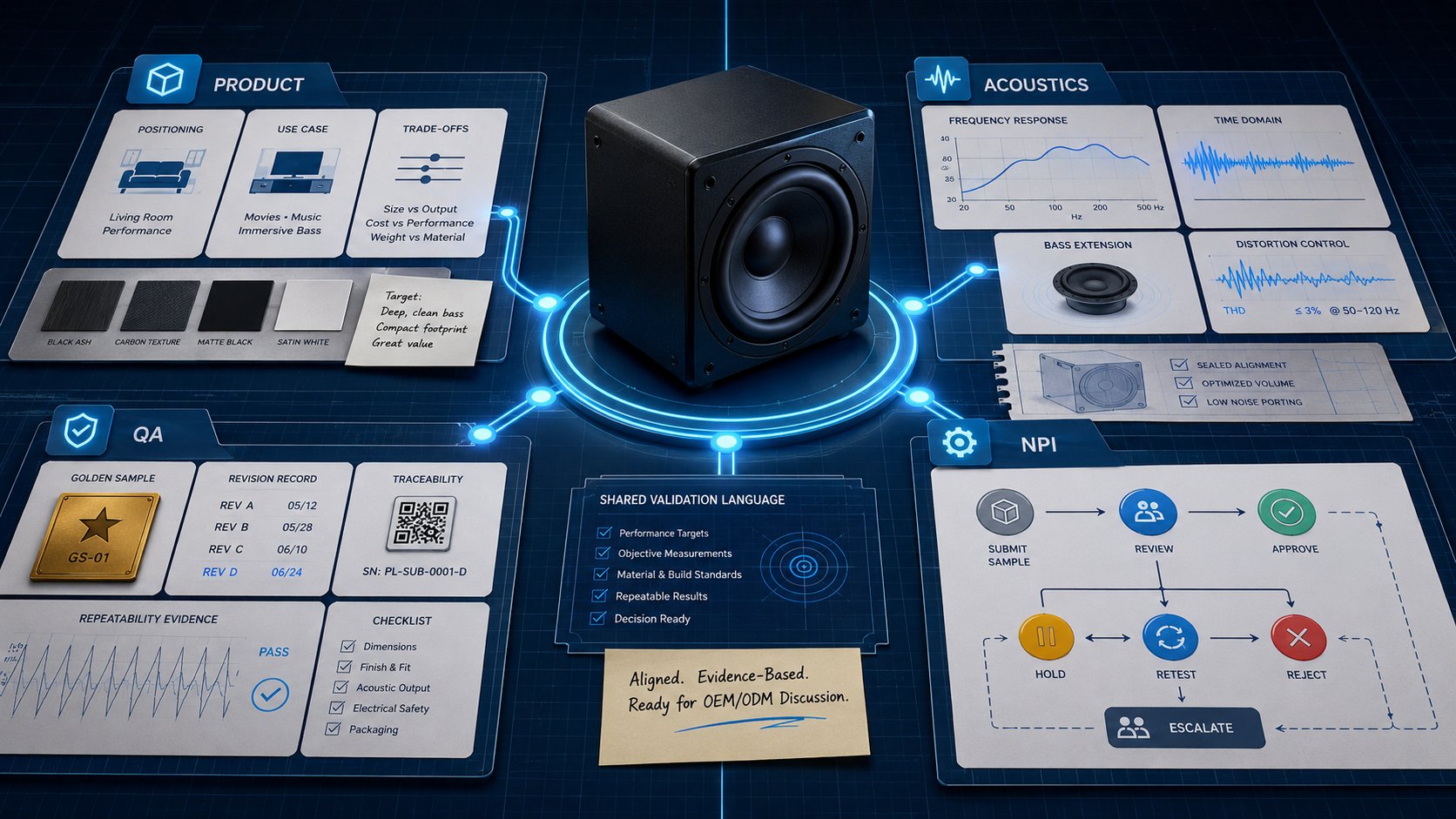
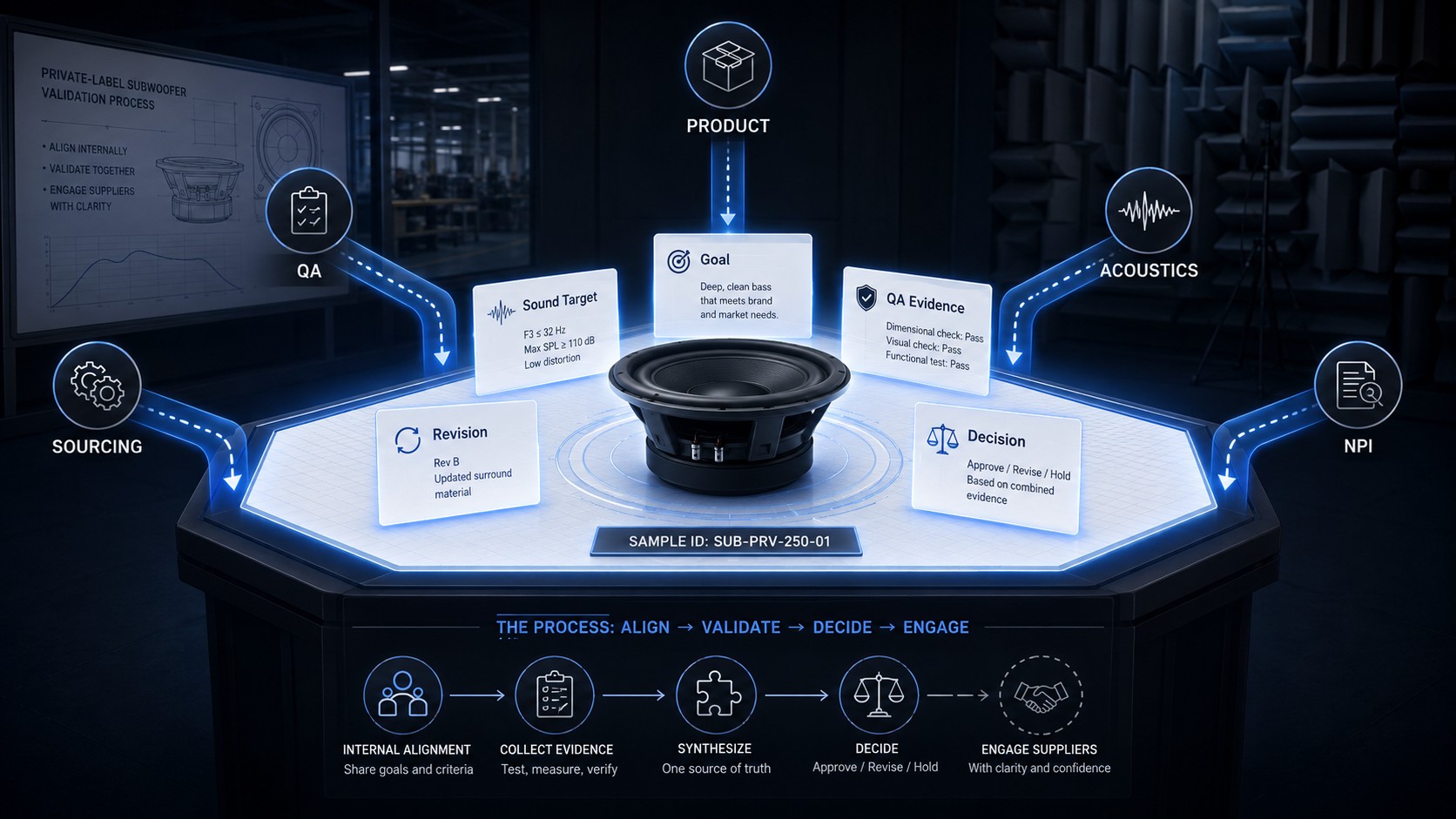
When comparing subwoofer manufacturers, sales teams often sound identical. Engineering capability does not. It shows up in ownership, evidence, and repeatable controls that prevent surprises. Here’s how to separate real manufacturing capability from sales promises, using five questions that reveal whether an Audio OEM has the systems to deliver consistent quality or just the PowerPoint slides to win the bid.
Question 1: Who Is on Your Engineering Team—and What Do They Own?
This isn’t about headcount. You’re trying to determine if the factory has actual design authority or if they’re just coordinating outsourced work.What to ask for: Request a simple org chart showing their engineering structure—confidential details can be redacted. You want to see role coverage across the core disciplines: acoustics, electronics, structural design, and any software integration if relevant to your product. Ask who makes the final call when there’s a design conflict. Request one example of an engineering decision record showing what changed, why it changed, and who approved it.
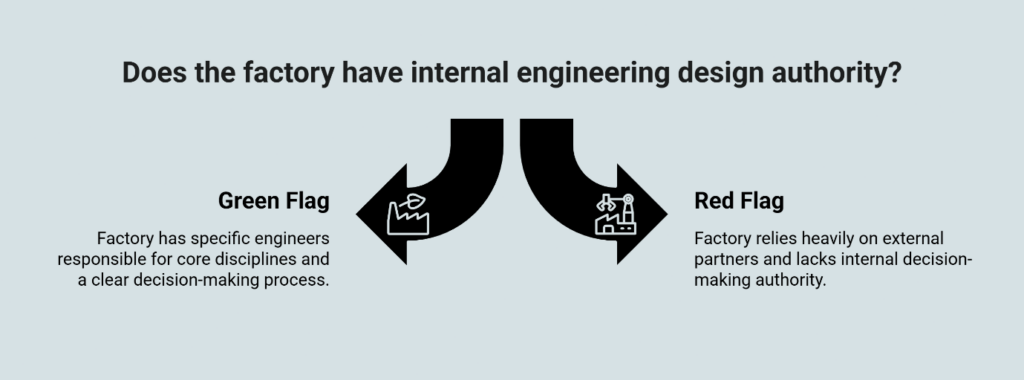
Green flag answer: They can name specific people and explain what each domain owner is responsible for. They describe how engineering supports new product introduction (NPI) and can walk you through a recent decision where their team had to balance competing priorities. Clear links exist between engineering and NPI readiness—design reviews, build readiness checks, and risk assessments. This signals they have internal capability and decision-making authority.
Red flag answer: Vague references to “our partners” or “we work with specialists.” If they only have sales engineers who coordinate external resources, you’re adding a layer of risk. When something goes wrong in production, there’s no one in the building who owns the fix. No trace of decision-making artifacts means everything happens in informal chats.
Follow-up validation: Ask about a recent design change they made based on manufacturing feedback. If they can’t give you a concrete example with specifics about what changed and why, they probably don’t have a real feedback loop between the floor and the design team. Then ask: “If a late change is needed, who can approve it—and who can stop it?”
Question 2: How Do You Turn Requirements Into a Buildable Design?
This question exposes whether they think about manufacturability upfront or discover problems after tooling is cut. You’re probing for Design for Manufacturing (DFM) discipline.
What to ask for: Request an example of their design review process. Ask to see a DFM checklist or change approval workflow—even a redacted version showing one page is sufficient. You want evidence that there are formal gates where the design gets challenged before it goes to production. A sample of revision history or change records demonstrates their documentation control, even with confidential content removed.
Green flag answer: They describe clear review stages with sign-offs from multiple stakeholders—who reviews, what is checked, and what blocks release. They can explain how they prevent late surprises, like discovering that a tolerance you specified requires custom tooling that blows the cost budget. Production feedback is part of the system, not a last-second scramble. They talk about design freezes and what triggers a re-review. Documentation is controlled through versioning, approvals, and consistent access protocols.
Red flag answer: “We can build anything you design” or “just send us the specs.” That’s not engineering confidence; that’s a setup for change orders. Real capability includes the ability to push back early and suggest alternatives that are easier to build consistently. If requirements live only in informal messages and revision control is loose, silent changes become more likely.
Follow-up validation: Ask what happens if your requirement conflicts with their standard manufacturing capabilities. A good partner will tell you upfront and offer options. A risky one will say yes to everything and surprise you later. Then ask: “Describe a recent case where production pushed back on engineering. What changed—and why?”
Question 3: What Test Equipment and Validation Do You Use Before Mass Production?
You’re not looking for a laboratory tour. You’re trying to understand if they measure performance objectively or rely on subjective judgment.What to ask for: Request sample test reports from a recent product—de-identified versions work fine. Ask what they measure, when they measure it, and what the acceptance criteria are. Request an overview of test stations covering incoming, in-process, and final checks. If they mention specific equipment, ask how those measurements tie to your product’s performance claims.
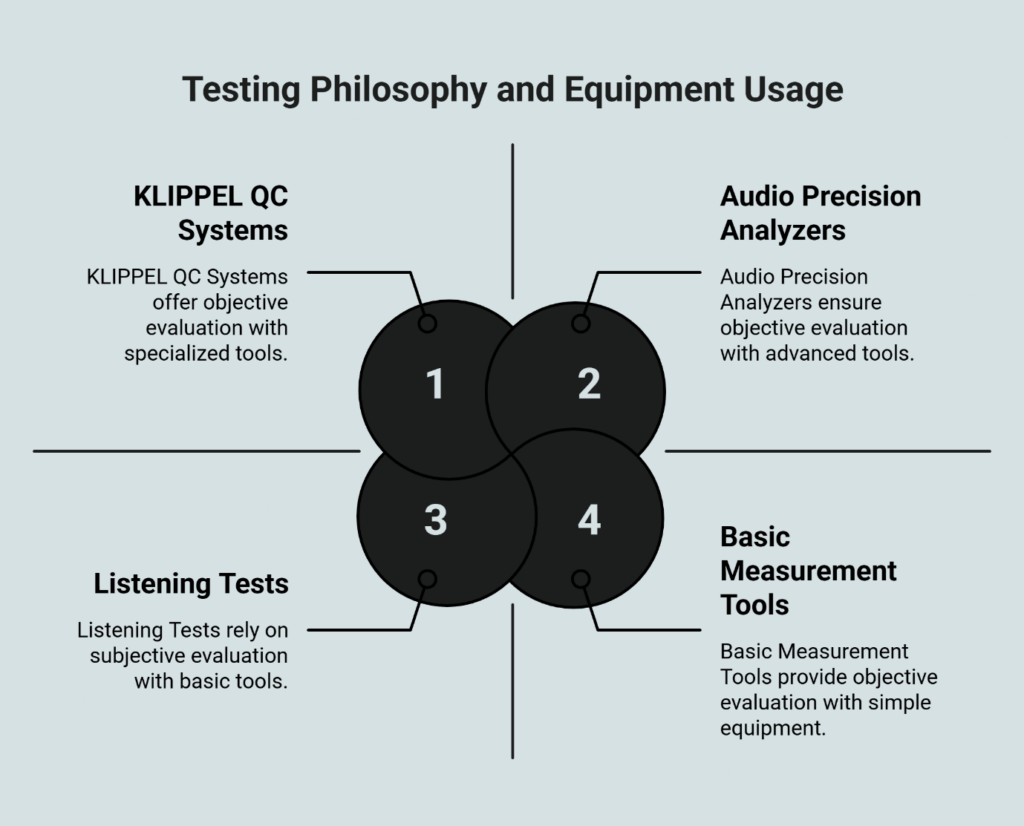
Green flag answer: They can explain the “why” and “when” of testing, not just the “what.” They describe how test results connect to acceptance criteria and what happens when something fails. Pass-fail limits exist and have clear ownership. They treat testing as a quality gate, not a formality. Testing is designed to be repeatable in production conditions, not only in a quiet lab.
Equipment matters less than testing philosophy, but references to serious measurement tools suggest objective discipline. Industry-standard audio validation is frequently conducted using analyzers from vendors such as Audio Precision, particularly for R&D and QA audits. For high-speed production line quality control, systems specifically optimized for end-of-line testing—such as KLIPPEL QC or Listen, Inc.’s SoundCheck—are widely utilized to ensure pass/fail consistency. The key is that they use these tools to drive acceptance decisions based on statistical limits, not just to generate reports.
Red flag answer: “We test by listening” or “our team has decades of experience.” Subjective evaluation has its place, but it’s not repeatable. If they can’t show you data, they can’t prove consistency—and you can’t hold them accountable when a batch sounds different from the Golden Sample. Results may exist but don’t drive acceptance criteria, or there’s no separation between validation (proving the design) and control (keeping it consistent).
Follow-up validation: Ask to see a test report where something failed and what they did about it. If they’ve never documented a failure, they’re either not testing rigorously or not being honest. Then ask: “What is the single most important measurement you use to prevent field issues for this product type?”
Question 4: How Do You Lock the Golden Sample and Prevent Spec Drift?
This is the most critical question for any private label roadmap. The Golden Sample is your contract—the physical proof of what “correct” looks and sounds like. If the factory doesn’t treat it as binding, your production will drift.
What to ask for: Ask about their Golden Sample approval process—who signs off, what gets recorded, and how it’s documented. How do they store it? How is it labeled and protected from swaps or mix-ups? What triggers a requirement to create a new Golden Sample? If they make a component substitution—even a “minor” one—what’s the re-approval process? Request their change triggers list: supplier changes, material changes, tooling changes, firmware updates.
Green flag answer: They treat the Golden Sample as sacred. They describe physical controls (dedicated storage, clear labeling with ID and custody records) and procedural controls (formal change requests, re-validation requirements). A controlled reference unit exists with clear identification. Formal triggers force re-validation—no “silent substitutions” are permitted. They understand that even small changes—a different adhesive, a slightly different magnet grade—can affect performance and require your approval. Change documentation ties back to acceptance criteria and customer approval steps.
Red flag answer: “The prototype is the same as production” or no mention of drift prevention. That’s a guarantee you’ll get surprises. Some factories view the Golden Sample as a sales tool, not a manufacturing standard. If they don’t have a change control process that forces re-validation, they’ll make substitutions without telling you. The Golden Sample may exist, but enforcement is informal.
Follow-up validation: Ask what would happen if a component goes end-of-life mid-production run. A reliable partner has a documented process for evaluation, communication, and approval before making any swap. Then ask: “If a component supplier changes, how is the change detected and blocked from shipment until validated?”
Question 5: How Do You Trace Issues Back to Root Cause When Something Goes Wrong?
Defects will happen. The question is whether the factory can contain the problem, identify the source, and prevent recurrence—or whether they’ll shrug and promise to “be more careful next time.”
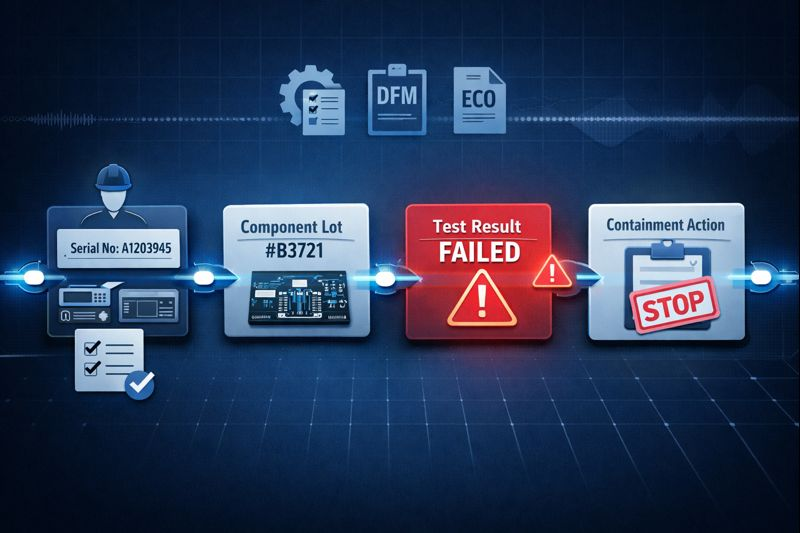
What to ask for: Ask about their traceability approach. How do they track batches through production? If a customer reports a defect, can they trace it back to a specific production run, component lot, or assembly station? Request an example of a corrective action they implemented after finding a quality issue—a de-identified batch record, a traceability example linking serial or lot numbers to key components and process steps, or one CAPA-style record showing problem, cause, corrective action, and verification.
Green flag answer: They describe a data trail—batch records, inspection logs, component lot tracking. Serial or lot numbers link to line, shift or date window, and key component lots. They use systems (ERP or WMS tools, for example) that let them connect finished goods to raw materials. Most importantly, they can show you a closed-loop corrective action: problem identified, root cause found, process changed, effectiveness verified. Containment comes first, then root cause analysis.
While internal factory systems vary (often utilizing Manufacturing Execution Systems or MES), robust traceability frameworks generally align with the principles of the GS1 Global Traceability Standard (GTS).[^1] This ensures that finished goods can be systematically linked back to raw material batches.
Red flag answer: “We’ll check next time” or no documentation trail. That means when you get a bad batch, there’s no way to know if it was one shift, one week, or one supplier. You can’t contain the risk, and they can’t prevent it from happening again. Root cause depends on memory rather than records, and containment scope is unclear, increasing the chance of repeated escapes.
Follow-up validation: Ask about their incoming quality control (IQC), in-process quality control (IPQC), and final quality control (FQC) checkpoints. If they can’t describe at least three distinct inspection gates with different responsibilities, they’re probably inspecting at the end and hoping for the best. Then ask: “Given one serial number, how quickly can the build date window, line, and component lots be retrieved?”
Your Printable Vetting Scorecard
Use this table during calls or factory visits to score each OEM. Rate each area 1-5 (1 = major concern, 5 = strong capability).
| Question | Evidence to Request | Green Flags | Red Flags | Score (1-5) |
|---|---|---|---|---|
| Who owns engineering? | Org chart, discipline coverage, decision record | Named owners per domain; clear decision authority; cross-functional handoffs documented | “We outsource” or sales engineers only; no formal owners; no decision artifacts | |
| How do you handle DFM? | DFM checklist, review gates, revision history | Formal sign-offs; proactive pushback on risky specs; controlled documentation with versioning | “We can build anything”; no formal reviews; revisions are informal | |
| What do you measure? | Sample test reports, equipment list, station overview | Objective data tied to acceptance criteria; repeatable tests; results drive decisions | “We test by listening”; no limits; test data doesn’t drive acceptance | |
| How do you lock the Golden Sample? | Approval process, change controls, storage/labeling | Physical and procedural controls; re-validation rules; changes trigger customer approval | “Prototype = production”; no triggers; Golden Sample not enforced | |
| How do you trace defects? | Batch records, corrective action examples, CAPA record | Data trail from finished goods to raw materials; containment defined; closed-loop CAPA | “We’ll be more careful”; no data trail; no containment plan |
Scoring guide: 20-25 = Strong partner candidate. 15-19 = Proceed with caution; identify gaps to address. Below 15 = High risk; consider other options.
Frequently Asked Questions
Is ISO 9001 enough to prove engineering capability?
ISO 9001 is widely used as a quality management system standard, but certification alone does not prove product-level repeatability. Evidence of controlled change, defined responsibilities, and measurable acceptance criteria still matters. A certificate shows the factory has documented processes; your vetting questions reveal whether those processes actually prevent spec drift.
What if an OEM refuses to share documents or test reports?
Strong partners can often share de-identified excerpts or screenshots that demonstrate process control without exposing confidential details. They can redact proprietary information while still showing you the structure of their systems. Refusal to provide any proof—even anonymized examples—is a practical risk indicator. You’re not asking for their entire quality manual; you’re asking for evidence that one exists and gets used.
How many Golden Samples should exist?
Implementation varies, but a common control principle is to maintain at least one customer-approved reference and one factory-controlled reference, both clearly identified and protected by change control. Some brands keep a third copy in their own facility for dispute resolution. The exact number matters less than having a documented approval process and physical controls that prevent unauthorized changes.
Which matters more: advanced equipment or process discipline?
Both matter, but discipline usually wins. Even excellent equipment cannot compensate for uncontrolled changes or missing acceptance criteria. A factory with basic measurement tools and strong process controls will consistently outperform a factory with the latest analyzers but no change management system. Conversely, disciplined controls often improve outcomes even when tooling differs by factory.
Should I visit the factory in person or can I evaluate remotely?
Remote evaluation can reveal a lot—especially if the factory can produce documentation and answer these questions with specificity. However, an in-person visit lets you observe how the team interacts, see physical controls firsthand, and ask follow-up questions in real time. If you’re placing significant volume or launching a flagship product, the visit is worth the investment. For initial screening, a structured remote call using this scorecard is often sufficient.
You’re Not Buying a Spec Sheet
You’re buying repeatable execution. The factory that can answer these five questions with evidence—not promises—is the one that treats your brand like a technical partnership, not a sales transaction.
Use this scorecard with your internal team. Have your owner or brand lead run the business questions. Have your technical contact (even if that’s you wearing a different hat) dig into the engineering specifics. Have your sourcing lead validate the process documentation. When all three perspectives align on green flags, you’ve found a partner who can scale with you.
If you’re building a private label audio business and need help evaluating potential manufacturing partners, get in touch to discuss your specific requirements and how to structure an OEM relationship that protects your brand. Learn more about our approach and experience on our about page, or request a custom OEM quote to start the conversation.
Disclaimer: This article provides general guidance on evaluating OEM manufacturing capabilities. Specific requirements and evaluation criteria may vary based on your product category, target market, and quality standards. Always conduct your own due diligence and consider consulting with manufacturing specialists for your particular situation.
Our Editorial Process:
Our expert team uses AI tools to help organize and structure our initial drafts. Every piece is then extensively rewritten, fact-checked, and enriched with first-hand insights and experiences by expert humans on our Insights Team to ensure accuracy and clarity.
About China Future Sound Insights Team:
Written by the China Future Sound Insights Team — a group of audio manufacturing and supply chain specialists helping brands build reliable, scalable OEM/ODM programs.
[^1]: GS1 Global Traceability Standard (GTS) 2.0, GS1 AISBL.