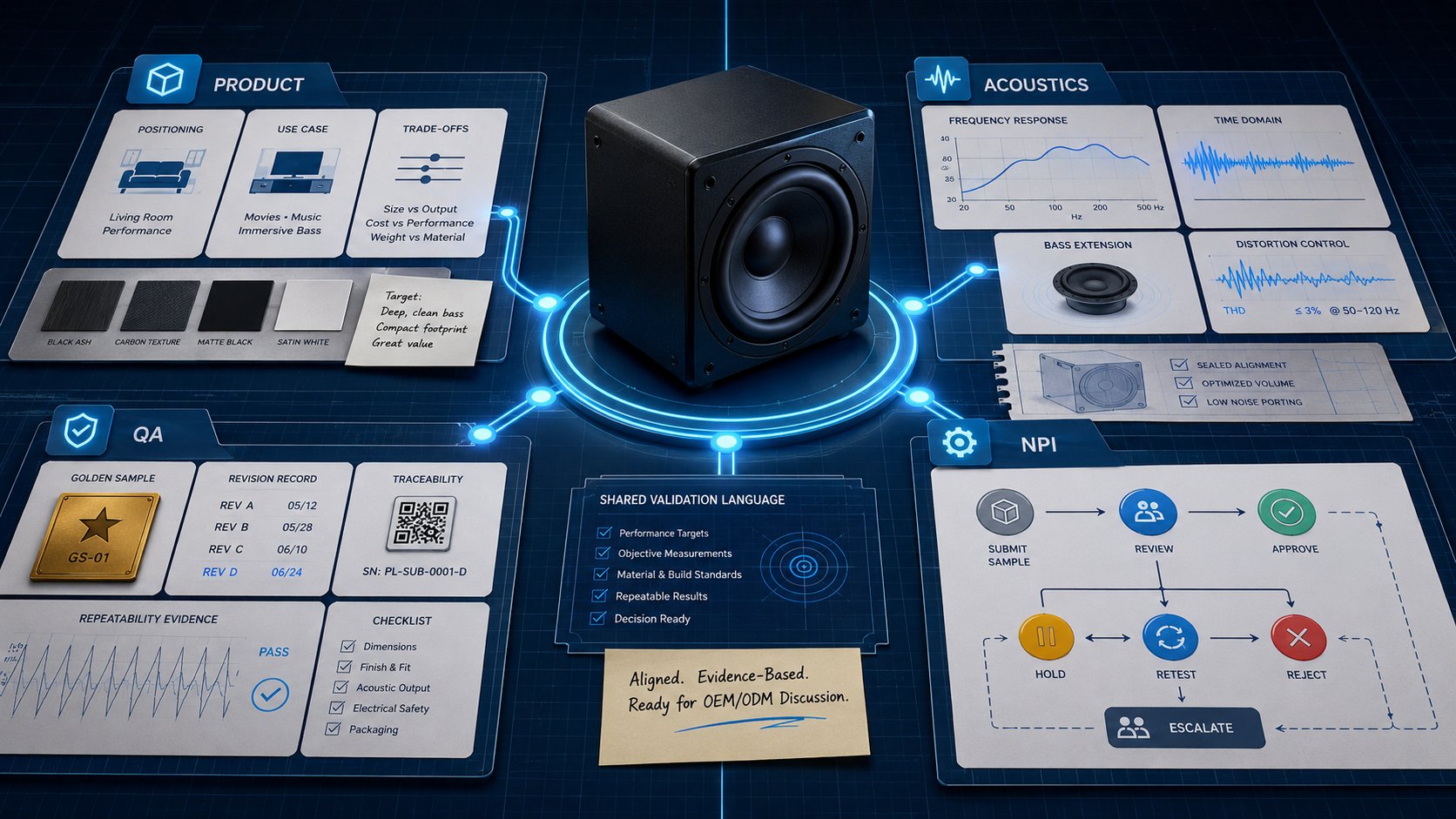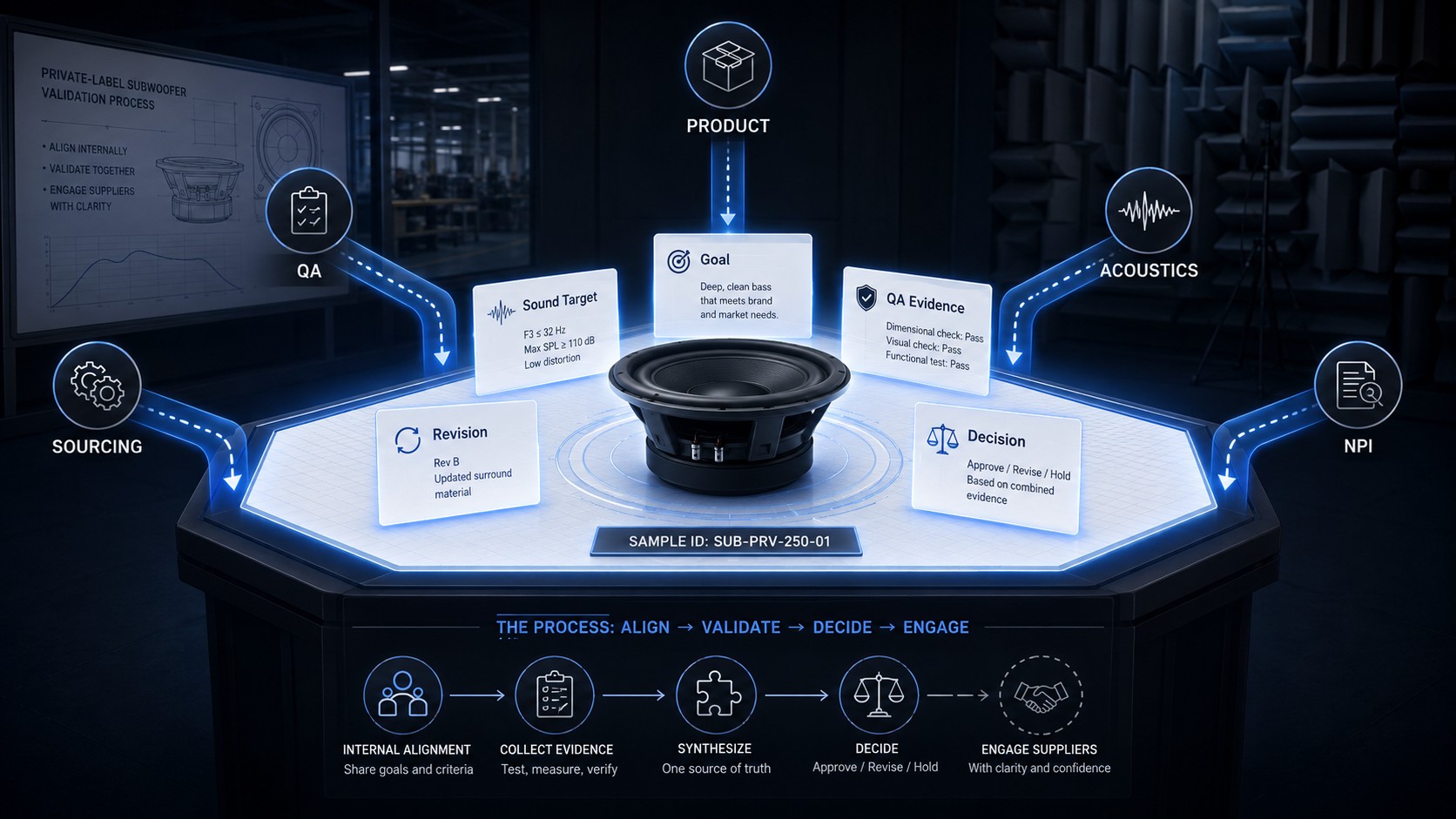
📌 Key Takeaways
Private label audio differentiation survives copycats only when strategic product choices meet repeatable manufacturing discipline.
- Differentiation Dies Without Consistency: Strategic product features mean nothing if factories substitute materials, skip process steps, or drift from approved specifications across production runs.
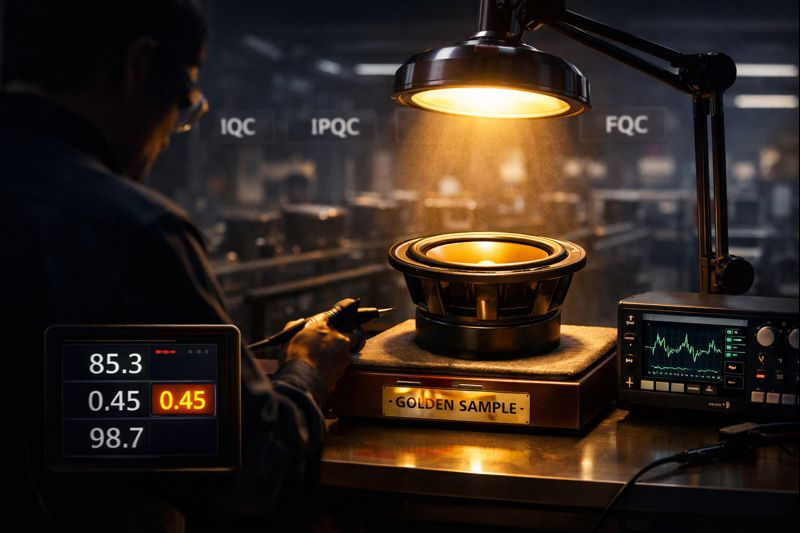
- The Golden Sample Functions as Physical Contract: This approved reference unit defines “correct” across critical parameters—voice coil resistance, mechanical Q factor, excursion limits—and serves as the non-negotiable standard for every quality gate.
- White Space Beats Spec-Sheet Cloning: Mapping competitors on two buyer-relevant dimensions reveals market gaps where meaningful differentiation exists without triggering pure price competition.
- Quality Gates Separate Talk from Enforcement: Factories with documented IQC, IPQC, and FQC processes—who can show pass/fail data and maintain calibrated measurement equipment—enforce consistency that protects brand reputation.
- Thirty Days Launches Defensible Strategy: Building a differentiation matrix, translating strategy into measurable specs, locking the Golden Sample, and aligning product claims to QC capabilities creates executable differentiation in one month.
Differentiation without manufacturing discipline is just a launch event, not a brand foundation.
SME audio brand owners navigating OEM partnerships will gain a strategic framework and quality-control discipline here, preparing them for the manufacturing relationship ahead.
~ ~ ~ ~ ~ ~ ~ ~ ~ ~ ~ ~ ~ ~ ~ ~ ~ ~
It’s 2:00 AM. You’re hunched over your laptop in your home office, squinting at a grainy WeChat video. The factory manager is holding what should be your flagship 12-inch subwoofer up to the camera, pointing at a cone that looks nothing like the Golden Sample you approved three months ago. Through the pixelated connection and broken English, you’re trying to explain why this matters—why this subtle difference will destroy your brand before it even launches.
This is the hidden cost of the “sea of sameness” in private label audio. When every product looks identical, sounds identical, and competes solely on price, quality control becomes impossible to enforce. Your margin evaporates. Your buyers lose trust. And one bad container can kill years of work.
The good news? Differentiation isn’t about having the biggest R&D budget or the flashiest marketing. It’s about making deliberate choices that are hard to copy—and then making those choices repeatable.
Why Private Label Audio Starts to Look the Same
Walk through any audio retailer’s website and you’ll notice something unsettling. The subwoofer descriptions all read like variations of the same spec sheet: dual voice coils, peak power ratings that sound impressive but mean nothing, frequency responses that mirror each other within 5 Hz. Even the product photos look interchangeable—black cones, stamped baskets, generic labels.
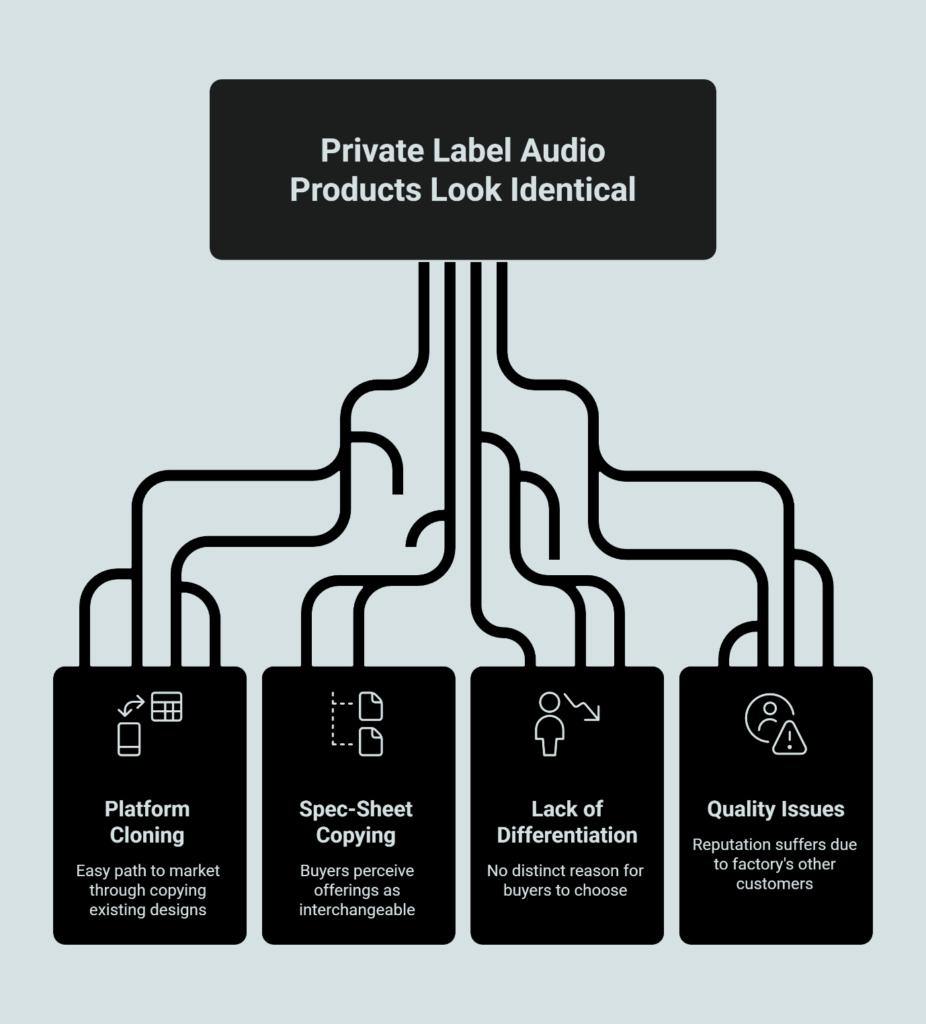
This isn’t coincidence. It’s the “me-too” trap, and it happens because platform cloning and spec-sheet copying are the easiest paths to market. A factory shows you their catalog of existing designs. You pick one, slap your logo on it, and ship. Your competitor does the exact same thing with the same factory—or the factory down the road using the same suppliers. Within six months, you’re both selling functionally identical products.
This pattern appears across B2B product categories whenever buyers perceive offerings as interchangeable. In audio, the pressure intensifies because buyers judge your line not just by the first shipment, but by whether the tenth shipment still matches the promise.
The financial damage is immediate. When buyers can’t distinguish your 12-inch subwoofer from three others at the same price point, they default to the one with free shipping or the one they saw on sale last week. Your margin compresses. You’re forced to match competitor pricing just to stay visible. Worse, you can’t command premium pricing for something genuinely better—because “better” is invisible when everything looks the same.
Brand fragility follows quickly. One quality issue—a batch of speakers with cone defects, amplifiers that fail thermal stress tests—and your reputation suffers the same damage as the factory’s other 47 customers. You have no differentiation to fall back on, no distinct reason for buyers to give you a second chance.
Here’s the practical promise: differentiation that survives copycats exists. It requires making choices about what to change, how to make those changes measurable, and how to ensure the factory can deliver them consistently. That last part—consistency—is where most private label brands fail, but it’s also your biggest opportunity.
Build a Differentiation Matrix to Find Your White Space
Strategic differentiation starts with understanding where everyone else is clustered. The Differentiation Matrix is a simple framework that maps your competitive landscape in two dimensions, revealing the gaps—the “white space”—where you can position your line.
Step 1: List Your Top 5 Competitive SKUs
You don’t need brand names for this exercise. You need products that buyers compare to yours. If you’re launching a 10-inch car subwoofer, list the five models that show up in the same search results, live in the same price tier, and target the same buyer. These are your actual competitors.
Step 2: Choose Two Axes That Matter to Buyers
This is where most differentiation strategies fail—they optimize for dimensions that don’t drive purchase decisions. Pick two variables that buyers explicitly care about and that create real trade-offs. Examples that work:
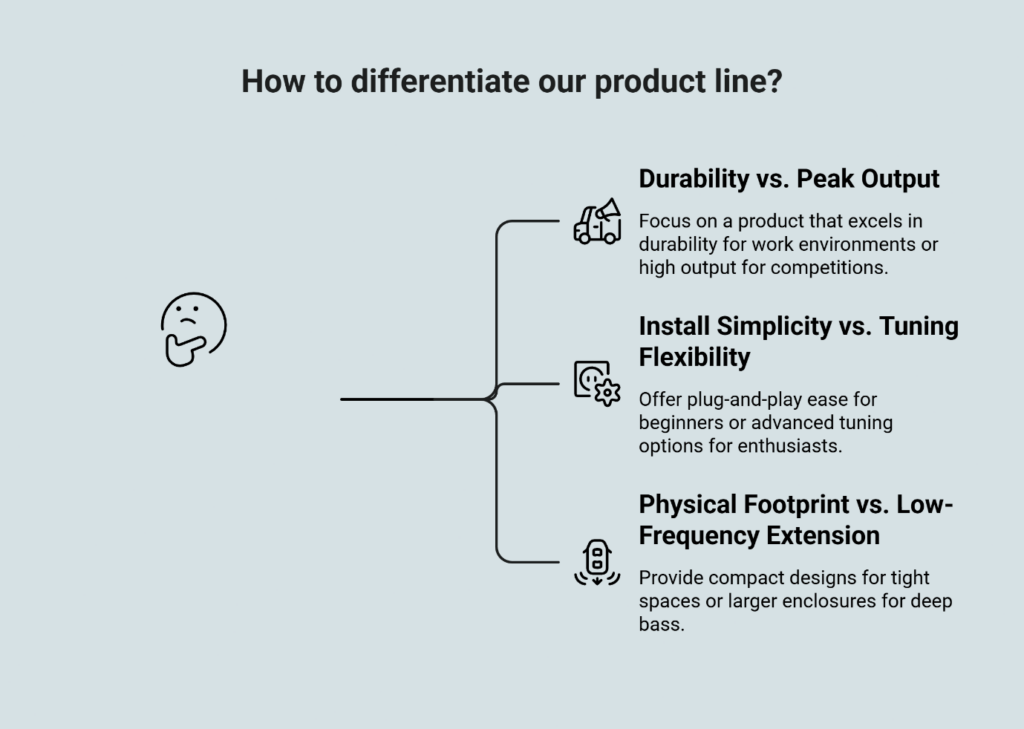
- Durability vs. Peak Output: Some buyers want a speaker that survives daily abuse in a work truck; others want maximum SPL for weekend competitions.
- Install Simplicity vs. Tuning Flexibility: Plug-and-play ease versus the ability to fine-tune crossover points and gain structure.
- Physical Footprint vs. Low-Frequency Extension: Compact enclosures that fit tight spaces versus larger designs that deliver true 20 Hz response.
Step 3: Plot What’s Crowded vs. Open
Create a simple 2×2 grid. Mark where each of your five competitors sits based on your two chosen dimensions. The clusters reveal where the market is saturated. The gaps reveal opportunity.
| Low Durability | High Durability | |
|---|---|---|
| High Output | Crowded (4 competitors here) | White Space |
| Moderate Output | White Space | Some presence (1 competitor) |
Output: Pick 1–2 Defensible Bets
Don’t try to differentiate across ten variables. Choose one “hero” differentiator—the thing your line will be known for—and two supporting differentiators that reinforce the hero. A line positioned in “High Durability, High Output” might make its hero feature a reinforced voice coil former with ceramic coating, supported by an industrial-grade basket design and extended thermal headroom.
The key is making choices that create real trade-offs for competitors. If your differentiation can be added to any existing platform with a $0.50 BOM increase, it’s not defensible.
Choose Differentiation Levers That Are Hard to Copy
Not all product changes create meaningful differentiation. A new logo is easy to copy. A distinctive sound signature that requires custom tooling and weeks of acoustic tuning is not. Focus on levers that have natural barriers to imitation.
Sound Signature and Tuning
What “different” sounds like is measurable, even without lab-level analysis. A subwoofer tuned for precise transient response will have a tighter, more controlled feel compared to one tuned for maximum boom. The frequency response curve tells part of the story—where the peak sits, how steep the roll-off is—but the real differentiation comes from design choices like voice coil inductance, cone material stiffness, and suspension compliance.
These choices aren’t arbitrary. They require iteration: build a prototype, measure it, listen to it in a real vehicle or room, adjust the design, and repeat. Most factories won’t do this work unless you specify it and hold them accountable to measurable outcomes.
Industrial Design and User Experience
Differentiation lives in the details buyers touch. Speaker terminals that accept bare wire, spade connectors, and banana plugs without an adapter. Protection grilles that snap on securely but remove without tools. Amplifiers with recessed controls that don’t get accidentally bumped during transport. Packaging that doubles as a storage case.
These features cost pennies to implement but signal care and thoughtfulness. More importantly, they’re harder to reverse-engineer than a frequency response curve because they require attention to the entire user journey.
Reliability as a Feature
Consistency beats flashy specs. A subwoofer rated at 500 watts RMS that delivers 500 watts RMS in every unit—across every production run—is more valuable than one rated at 600 watts that varies between 550 and 620. Buyers remember the product that worked exactly as promised.
Reliability is a differentiator when treated as a product feature rather than an afterthought. In private label audio, reliability translates into fewer surprises: fewer units outside tolerance, fewer performance shifts across shipments, and fewer disputes about what was approved. This affects Total Cost of Ownership—even when unit cost is similar, total cost changes when engineering time, rework risk, and reputation damage are reduced.
Reliability comes from engineering discipline: tighter tolerances on critical components, additional stress testing at temperature extremes, and strict adherence to approved materials. It’s not exciting, but it’s what keeps customers loyal.
Platform Strategy: Fewer SKUs, Clearer Roles
A portfolio becomes stronger when each SKU has a job. Instead of launching many near-duplicates, define a platform—shared bill of materials and architecture where appropriate—and then create a small number of variants that map directly to distinct buyer needs.
This approach reduces supplier complexity and makes quality control more manageable. Each additional SKU adds validation time and potential points of drift. This is where NPI (New Product Introduction) discipline matters: launching too many variations simultaneously makes it harder to identify root causes when something fails.
Consider how your portfolio could extend into adjacent segments like marine or powersports audio without diluting your core differentiation.
What to Customize First
For SME brands working with limited resources, prioritize changes in this order:
- One “hero” feature that addresses your Differentiation Matrix positioning (e.g., a proprietary cone treatment for durability)
- Two supporting features that reinforce the hero without requiring new tooling (e.g., upgraded tinsel leads and a beefier spider)
- One UX detail that makes the product easier or more pleasant to use (e.g., color-coded terminals)
This approach keeps your landed cost manageable while creating a product that feels distinct in buyers’ hands.
Make Differentiation Repeatable: Stop Spec Drift Before It Ships
Differentiation dies the moment your factory starts substituting materials, skipping process steps, or “improving” your design without approval. This phenomenon—spec drift—is the silent killer of private label brands. It happens because factories optimize for their own efficiency, not your brand consistency.
Golden Sample as a Contract
The Golden Sample is a physical contract. It’s the exact unit you approved—measured, documented, and stored—that represents what “correct” looks like. Every production unit should match the Golden Sample across critical parameters: voice coil DC resistance, mechanical Q factor (Qms), cone excursion limits, and thermal power handling.
This isn’t theoretical. The Golden Sample sits in the factory’s QC lab and serves as the reference for every quality gate. When an inspector measures a production unit and finds the voice coil resistance is 3.6 ohms instead of the Golden Sample’s 4.0 ohms, that unit fails. No negotiation.
Where Factories Lose Consistency
Three failure modes destroy consistency:
- Materials substitution: The approved cone uses a specific paper pulp blend from Supplier A. Production switches to Supplier B’s “equivalent” pulp to save $0.30 per unit. The damping characteristics change. The sound changes. Your differentiation vanishes.
- Assembly variance: Two workers build the same speaker using the same components, but one applies adhesive more liberally and the other rushes the curing time. Mechanical compliance varies by 15%. Half your production sounds tight; the other half sounds loose.
- Test gaps: Final QC checks DC resistance and polarity but skips the frequency sweep that would catch a misaligned voice coil. Defects ship.
What to Ask Your OEM Partner
Before you commit to a manufacturing relationship, verify that quality gates exist and that the factory has the capability to enforce them:
- Incoming Quality Control (IQC): How do they verify raw materials match specifications? Do they batch-test or 100% inspect critical components like voice coils and magnets?
- In-Process Quality Control (IPQC): At what assembly stages do they stop and measure? Can they show you pass/fail data from recent production runs?
- Final Quality Control (FQC): What parameters do they test on every unit versus sample testing? Do they have calibrated measurement equipment like a KLIPPEL analyzer or Audio Precision system?
- Sign-off rituals: Who approves deviations from the Golden Sample? Is there a formal Engineering Change Order (ECO) process, or do line supervisors make judgment calls?
These questions filter out factories that talk about quality versus factories that enforce it. A factory with ISO 9001 certification has documented processes, but you still need to verify they follow them for your SKUs specifically. When discussing verification discipline and test-method clarity, specific industry standards such as IEC 60268-5 or AES2 provide the necessary frameworks for reproducible loudspeaker measurement.
A 30-Day Action Plan to Escape the Sea of Sameness
Differentiation doesn’t require a year-long roadmap. It requires focused execution across four weeks.
Week 1: Build the Matrix and Define Your Non-Negotiables
Dedicate three hours to mapping your competitive landscape using the Differentiation Matrix framework. Be ruthless about identifying where the market is saturated and where genuine white space exists. At the end of this week, you should have a clear answer to: “What is the one thing my line will be known for?”
Document your non-negotiables—the specifications and features that define your differentiation and cannot be compromised. This becomes your negotiating position with factories.
Week 2: Translate Your Strategy Into Specs
Work with your OEM partner to translate your strategic choices into measurable engineering specifications. If your hero differentiator is “high durability,” define what that means in testable terms: voice coil former material, adhesive cure time, thermal stress test duration at specific power levels.
Use Design for Manufacturing (DFM) thinking here. Can your differentiators be achieved with existing tooling, or do they require custom molds that increase cost and lead time? This is where you identify which items drive landed cost the most. The goal is to find the intersection of differentiation and feasibility.
Week 3: Lock the Golden Sample and Define Pass/Fail Criteria
Once your factory produces prototypes, select the unit that best represents your specifications. This becomes the Golden Sample. Measure every critical parameter and document them. Then work with the factory to define pass/fail tolerances for production: DC resistance within ±5%, Qms within ±10%, excursion limits within ±2mm.
These tolerances become the quality standard for every unit.
Week 4: Align Your Product Page Claims to What Your QC Can Prove
Review your product descriptions and marketing claims. Every statement about performance, durability, or sound quality should map to a measurable attribute that your factory tests. If you claim “extended low-frequency response,” your QC process should verify that frequency response extends to the claimed threshold.
This alignment protects your brand. You’re making promises you can keep—and proving you kept them.
At the end of 30 days, you’ll have a differentiated product strategy grounded in manufacturing reality. More importantly, you’ll have the quality infrastructure to make that differentiation repeatable across every production run.
Ready to move from reseller to brand owner with confidence? Our newsletter delivers practical insights on OEM audio manufacturing and private label strategy—no theory, just execution.
Our Editorial Process
Our expert team uses AI tools to help organize and structure our initial drafts. Every piece is then extensively rewritten, fact-checked, and enriched with first-hand insights and experiences by expert humans on our Insights Team to ensure accuracy and clarity.
About The China Future Sound Insights Team
The China Future Sound Insights Team is our dedicated engine for practical, engineering-led guidance on OEM/ODM audio manufacturing and private label product development. We combine structured research with real-world manufacturing experience to help growth-stage audio brands make decisions they can execute confidently.