📌 Key Takeaways
Gross margin percentage is only one component of profitability—pricing flexibility and margin durability determine whether improved margins actually materialize and last.
- Quality Consistency Protects Margins: Private label margins erode quickly when product quality varies between production runs, making verifiable quality systems with measurement-based validation non-negotiable for sustainable profitability.
- Resale Margins Compress Over Time: Manufacturer distribution expansion and competitor price matching create continuous downward pressure on resale margins, while private label margins remain more stable when manufacturing quality stays consistent.
- Differentiation Drives Private Label Success: Generic private label competing solely on price eliminates the margin advantage—successful private label requires distinctive features, design, or performance that justifies customer preference beyond cost.
- Calculate True Break-Even Thresholds: As a conservative benchmark, private label entry becomes risky when the break-even point exceeds roughly 120% to 150% of current category sales without secured capital to support larger inventory commitments.
- Start Small to Validate Execution: Beginning with one to three carefully selected SKUs allows retailers to develop quality oversight processes and prove market acceptance before making larger production commitments.
Control over cost structure and pricing strategy only translates to sustainable advantage when manufacturing consistency prevents the execution failures that destroy margins.
Online audio retailers evaluating their business model will gain decision clarity here, preparing them for the financial and operational considerations that follow.
~ ~ ~ ~ ~ ~ ~ ~ ~ ~ ~ ~ ~ ~ ~ ~ ~ ~
The quarterly numbers tell a familiar story. Revenue is holding steady, but profit margins keep sliding. You’re moving product, managing relationships with major brands, and keeping customers satisfied—yet the bottom line refuses to cooperate.
Many online audio retailers face this exact scenario. Reselling established brands provides stability and credibility, but it also means operating within tightly controlled pricing structures. As market saturation increases and competition intensifies, the question becomes unavoidable: is there a better path forward?
Private label product development offers an alternative worth examining. The potential for improved margins is real, but so are the operational complexities. This analysis breaks down the core financial dynamics of both models, helping you understand when each approach makes strategic sense.
Why This Comparison Matters
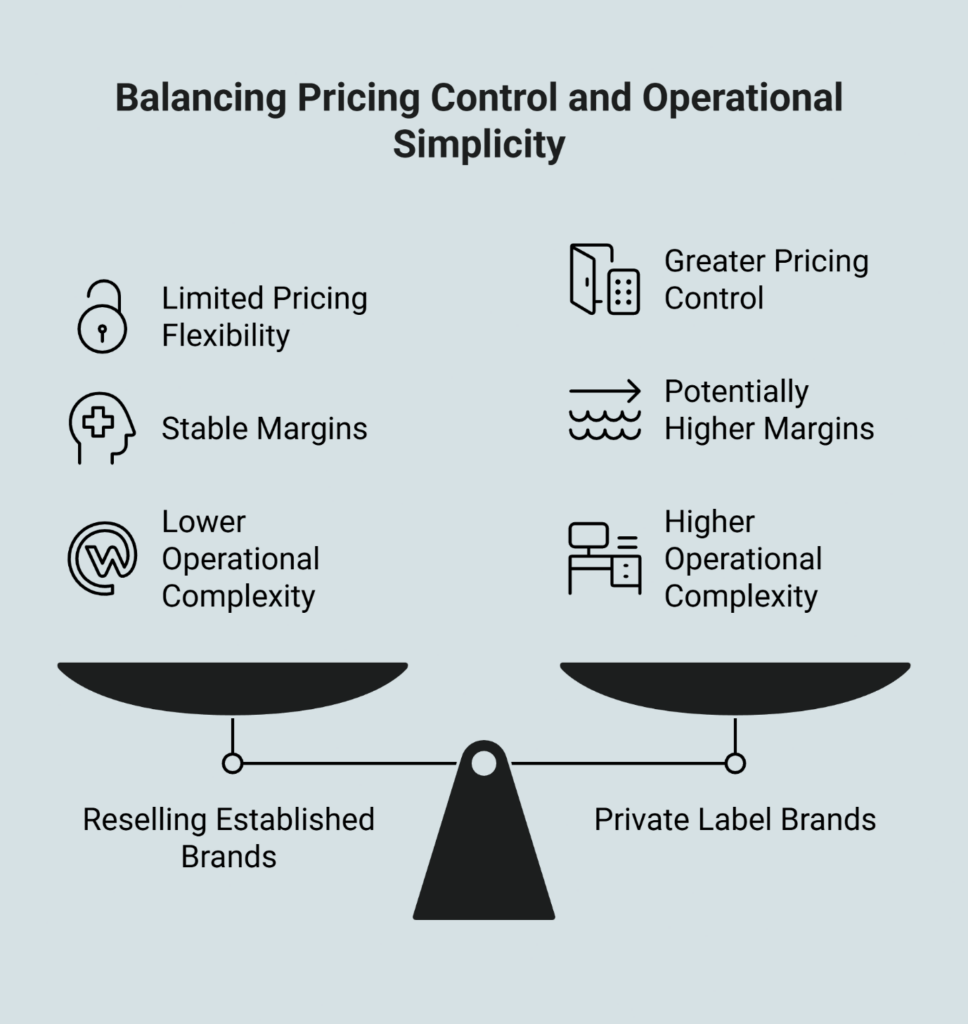
Margin pressure isn’t just a pricing problem—it’s a strategic challenge that affects your business model’s long-term viability. When you’re reselling established audio brands, you operate within predetermined pricing boundaries. Your cost structure is largely fixed, and your pricing flexibility is constrained by manufacturer agreements and market competition.
Some manufacturers impose vertical pricing programs (such as MAP or UMAP) that directly affect your advertised pricing latitude. While the legal specifics can be complex, the business reality is straightforward: resale often carries external constraints that limit your ability to adjust pricing in response to cost changes or competitive pressure.
This creates a predictable but limiting situation. You know your margins will remain relatively stable, but you also know they won’t significantly improve. For many retailers, this stability is valuable. It allows for straightforward financial planning and reduces execution risk.
Private label introduces a different dynamic entirely. You gain control over your cost structure and pricing strategy, which theoretically enables higher margins. However, this control comes packaged with manufacturing oversight responsibilities, quality assurance requirements, and supply chain management complexity.
The decision isn’t simply about choosing higher margins over operational simplicity. It’s about determining whether your business has the resources, expertise, and strategic positioning to capture and sustain those improved margins without introducing execution failures that could erode the very profitability you’re seeking.
The Margin Math You Need to Understand
Before making any strategic decisions, you need a clear framework for comparing these models financially. Gross margin percentage is only one component of profitability—understanding the complete financial picture requires examining multiple metrics together.
Start with the standard definitions. Gross profit equals your selling price minus your cost of goods sold. Gross margin expresses that profit as a percentage of the selling price. These metrics show your profitability per unit sold.
Markup provides a complementary perspective. Markup shows how much room exists over cost by dividing gross profit by your cost of goods sold rather than by selling price. A product with 40% gross margin might have 67% markup—both numbers describe the same financial reality from different angles, and both matter when evaluating your pricing strategy.
Inventory turn measures how quickly your stock converts to sales over a given period. Higher turn typically means less cash tied up in inventory, but the relationship isn’t always straightforward. Very high turn can signal supply instability or stockout risk, while very low turn might indicate overstocking or slow-moving products. The optimal turn rate depends on your specific category and supply chain reliability.
Profit Impact Calculator: Resale vs. Private Label
| Line Item | Resale (Brand-Name Product) | Private Label (Your Brand) |
|---|---|---|
| Retail price (example anchor) | $100 | $100 |
| Your cost of goods (COGS) | Variable (manufacturer price) | Variable (manufacturing + logistics) |
| Gross profit dollars | = Retail price − COGS | = Retail price − COGS |
| Gross margin % | = Gross profit ÷ Retail price | = Gross profit ÷ Retail price |
| Markup % | = Gross profit ÷ COGS | = Gross profit ÷ COGS |
| Inventory turn | Observed from sales velocity | Forecast/observed from sales velocity |
| Price flexibility | Constrained by brand agreements | Higher (if product is differentiated) |
| Control over specifications | Limited to available SKUs | Full control over design roadmap |
| Margin durability risk | Higher (vulnerable to price wars) | Lower (if quality remains consistent) |
The critical insight this framework reveals is that gross margin percentage is only one component of profitability. Two additional factors significantly impact your actual returns: pricing flexibility and margin durability.
When reselling established brands, your pricing is constrained by both manufacturer policies and competitor pricing. If a competitor drops their price on the same Sony speaker you’re selling, your options are limited. You can match their price and accept lower margins, or maintain your price and accept reduced sales volume.
With private label, assuming you’ve successfully differentiated your product, you have more flexibility to adjust pricing based on your cost structure and positioning rather than competitor actions alone. This flexibility becomes valuable when market conditions shift or when you need to respond to supply chain cost fluctuations.
The margin durability factor addresses a longer-term concern. Resale margins tend to compress over time as manufacturers expand their distribution networks and competition intensifies. Private label margins can remain more stable if—and this is the crucial qualifier—your manufacturing quality remains consistent. Inconsistent quality destroys margin durability faster than price competition ever could.
The inventory turn dimension affects your working capital requirements. Private label typically requires larger initial commitments for production runs, which means more cash tied up in inventory. However, if your products move consistently, the improved margins can more than offset the working capital cost. The key is matching your inventory investment to your actual sales velocity rather than optimistic projections.
When Resale Still Makes Strategic Sense
Despite the potential margin advantages of private label, resale remains the correct choice for specific business situations. Understanding these scenarios helps you make a context-appropriate decision rather than chasing margins blindly.
You’re testing market demand for a new product category. If you’re considering expanding into a new audio segment where you lack established customer relationships or proven demand, resale provides a low-risk entry method. You can validate customer interest and refine your positioning before committing to the higher fixed costs associated with private label development.
Your operational bandwidth is constrained. Private label requires active involvement in specification development, quality oversight, and supply chain management. If your team is already stretched managing current operations, adding these responsibilities could compromise execution quality across your entire business. It’s better to operate profitably within your capacity constraints than to overextend and introduce new failure modes.
Brand recognition drives your sales. Some customer segments prioritize established brand names, particularly in the pro audio space where installers and professionals need recognized specifications for their projects. If your customers are specifically seeking name brands and will not readily accept alternatives, forcing a private label transition could damage customer relationships and reduce sales.
Capital requirements exceed your current resources. Private label typically requires larger upfront commitments for initial production runs, tooling, and inventory. If these capital requirements would strain your cash position or limit your ability to respond to other business opportunities, the margin improvement may not justify the financial risk.
The resale model provides predictability and operational simplicity. These aren’t trivial benefits—they’re legitimate strategic advantages in specific contexts. The question isn’t whether resale is inferior to private label universally, but whether it remains optimal for your specific situation.
When Private Label Creates Sustainable Advantage
Private label becomes strategically compelling when specific conditions align. These conditions relate to your business capabilities, market positioning, and ability to manage manufacturing quality consistently. Analysis of private brand strategy confirms that successful private label programs require more than just cost arbitrage—they require genuine differentiation and operational excellence.
You have reliable product differentiation. Generic private label rarely succeeds. The margin advantage only materializes when your product offers something distinctive that justifies customer preference beyond price alone. This might be specialized features for bass enthusiasts, unique aesthetic design, or performance characteristics tailored to specific applications. Without differentiation, you’re simply competing on price, which erodes the margin benefit you’re pursuing.
You can enforce quality consistency standards. This is where many private label initiatives fail. The margin advantage evaporates quickly if product quality varies between production runs. Customer returns, warranty claims, and reputation damage can eliminate any cost-of-goods savings you’ve achieved.
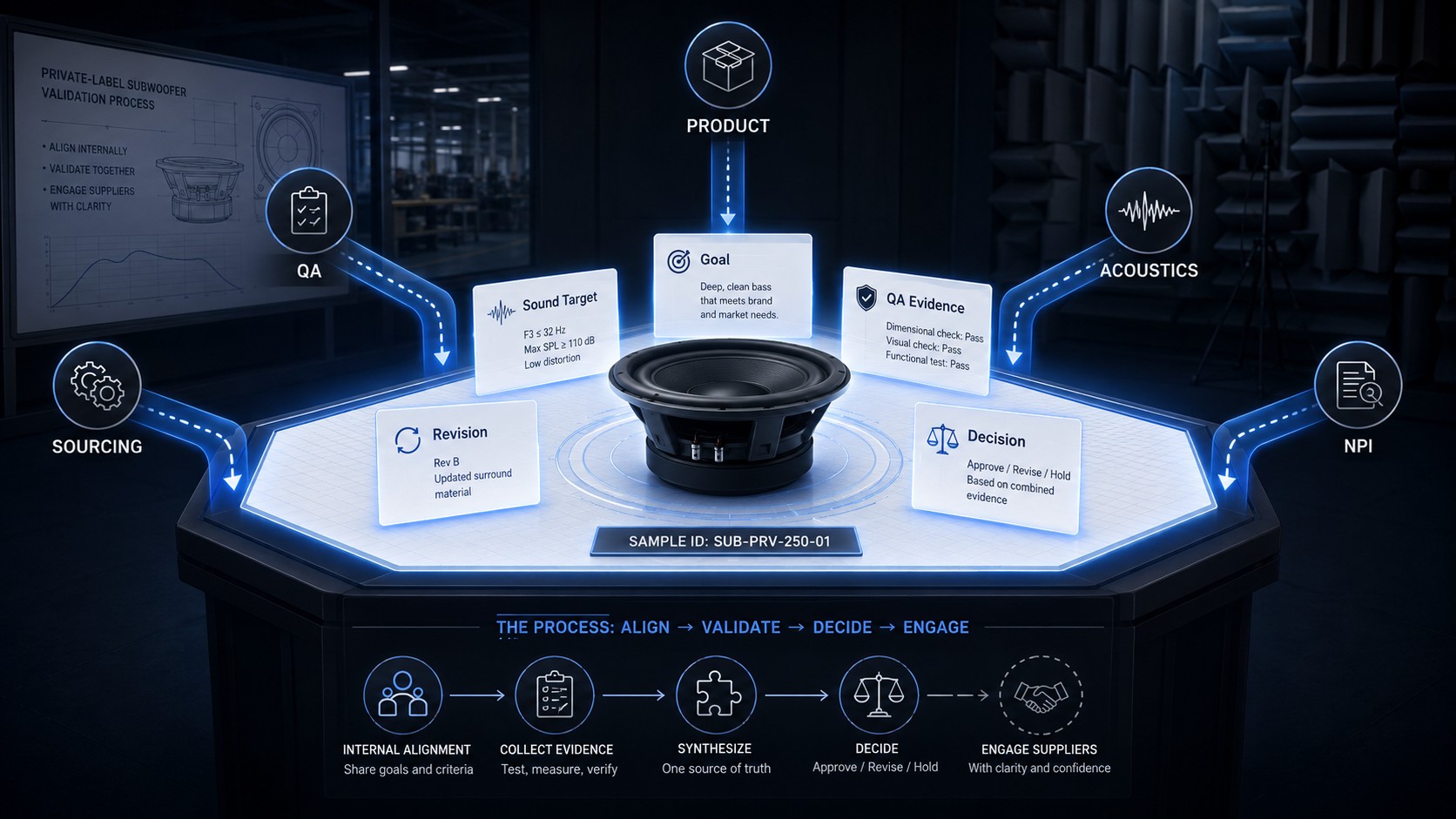
China Future Sound employs a rigorous approach to this challenge through their Golden Sample management system. This methodology establishes a reference standard for each product specification, and every production run must match that standard through verified testing protocols. Their quality management system includes KLIPPEL acoustic measurement capabilities and ISO9001-2015 certification, providing the infrastructure needed to maintain consistency across production batches.
For retailers considering private label, the critical question isn’t whether your manufacturing partner can produce a quality product—it’s whether they will produce that same quality product consistently across every order. This requires verifiable quality systems, not just promises.
Your business model supports the required inventory investment. Private label typically involves minimum order quantities that exceed the unit-by-unit flexibility of resale. You need sufficient sales velocity and inventory turnover to justify these larger commitments without creating cash flow problems or obsolescence risk.
You understand the full cost structure. Many retailers underestimate the non-manufacturing costs associated with private label. These include product liability insurance, compliance testing, warranty reserves, and the staff time required for specification management and quality oversight. Your margin calculation needs to account for these complete costs, not just the per-unit manufacturing price.
When these conditions exist, private label fundamentally changes your business economics. You’re no longer simply marking up someone else’s product—you’re creating a defensible business asset. Your brand equity, customer relationships, and product specifications become valuable assets that competitors cannot easily replicate.
The margin durability advantage becomes particularly significant over time. While resale margins face continuous pressure from manufacturer price changes and competitor actions, private label margins remain more stable as long as your quality systems prevent execution failures. This stability enables more confident long-term planning and investment.
A Practical Decision Framework
Rather than trying to evaluate every possible factor simultaneously, focus on these specific decision points that most directly impact your likelihood of success with each model.
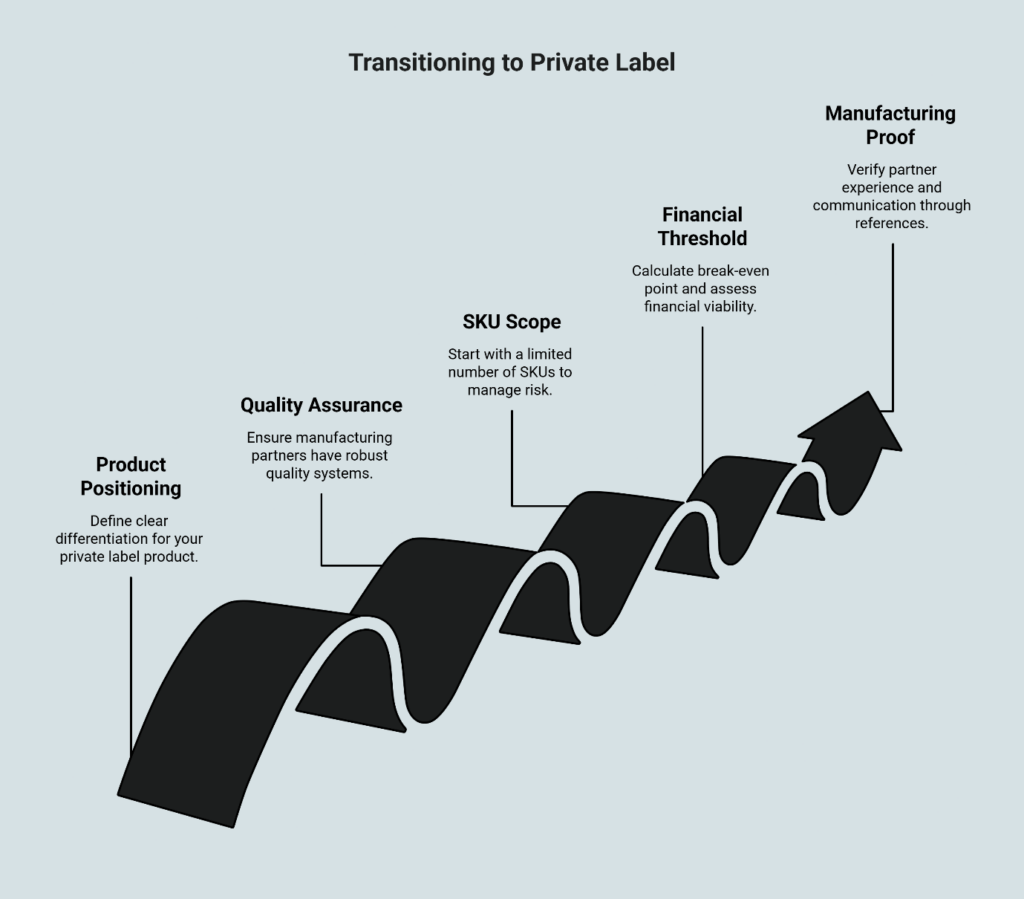
Decision 1: Product positioning clarity. Can you articulate exactly how your private label product would differ from existing alternatives in a way that matters to customers? If you cannot answer this question concretely and specifically, you’re not ready for private label. Start with resale until you’ve developed that positioning clarity through market interaction.
Decision 2: Quality assurance capabilities. Does your potential manufacturing partner have verifiable quality systems that go beyond verbal assurances? Request documentation of their quality management certifications, testing capabilities, and batch consistency protocols. A manufacturer utilizing systems like KLIPPEL testing equipment, comprehensive ERP/WMS with traceability, and documented Golden Sample processes demonstrates the infrastructure required for consistency.
Decision 3: Initial SKU scope. Start with one to three carefully selected SKUs rather than attempting a full product line immediately. This contained scope allows you to develop your quality oversight processes and validate market acceptance before making larger commitments. Choose products where you have existing customer demand and clear differentiation opportunities.
Decision 4: Financial threshold requirements. Calculate your true break-even point including all non-manufacturing costs. Determine the sales volume required to justify the inventory investment and operational overhead. As a general conservative benchmark, if this threshold exceeds roughly 120% to 150% of your current sales in that category, the risk may be too high for initial entry without secured capital.
Decision 5: Manufacturing partner proof points. Beyond quality systems, evaluate their experience with customers similar to your business scale. Request reference contacts from existing clients who operate at comparable volumes. Verify their communication responsiveness and problem-resolution approach through the sales process—this previews how they’ll handle post-sale issues.
These five decisions provide a structured path through what can otherwise feel like an overwhelming evaluation process. Each decision builds on the previous one, allowing you to identify clear go/no-go points before making significant resource commitments.
The resale versus private label decision ultimately comes down to honest assessment of your current capabilities and strategic priorities. There’s no universal right answer—only the answer that fits your specific business context.
If you’re currently operating profitably with resale and don’t have clear answers to the five decision points outlined above, continuing with resale while you develop that clarity is the rational path. Chasing margin improvements before you’ve built the necessary capabilities typically creates more problems than it solves.
If you’ve validated the decision criteria and see a legitimate opportunity to build differentiated products with reliable quality systems, private label can fundamentally strengthen your business model. The margin improvement isn’t just about short-term profitability—it’s about creating sustainable competitive advantage through brand equity and customer relationships that aren’t dependent on someone else’s product line decisions.
For retailers ready to explore the private label path seriously, the most critical first step is establishing a relationship with a manufacturing partner who understands that consistency isn’t negotiable. Quality variability destroys private label economics faster than any other single factor. Learn more about the complete private label development process and how systematic quality management protects your margin investment.
If you’re still evaluating whether private label makes sense for your business, subscribe to receive ongoing guidance on private label strategy and manufacturing risk reduction delivered to your inbox.
Ready to move forward? Get a custom audio solution quote or request a custom OEM quote to discuss how established quality management systems and Golden Sample protocols can support your private label development without introducing the execution risks that typically undermine margin improvements.
Disclaimer: This content is for informational purposes only and does not constitute legal advice. Consult with qualified intellectual property counsel for guidance specific to your situation.
Our Editorial Process
Our expert team at China Future Sound is committed to providing accurate and insightful content. We may use AI tools to help organize or draft information, but every article is reviewed and edited by a human to ensure it meets our quality standards.
About the China Future Sound Insights Team
The China Future Sound Insights Team is our dedicated engine for synthesizing complex topics into clear, helpful guides. While our content is thoroughly reviewed for clarity and accuracy, it is for informational purposes and should not replace professional advice.