📌 Key Takeaways
Starting with exactly three SKUs limits exposure while proving demand, establishing manufacturing consistency, and teaching you how your supply chain performs under real conditions.
- Three SKUs Create Strategic Clarity: Assign each product a specific job—Core Volume for predictable demand, Differentiator for brand signature, Companion for increased order value—forcing clear positioning decisions before capital commitment.
- Golden Sample Discipline Prevents Spec Drift: Define a physically signed reference unit with must-not-change criteria before production begins, creating the binding standard that keeps mass production aligned with your approved product.
- Platform Reuse Reduces NPI Risk: Inheriting a manufacturing partner’s proven enclosure designs and driver platforms compresses qualification timelines and eliminates months of tooling refinement you’d otherwise debug at 2 AM.
- Production Scale Changes Decision Logic: Small batch runs make learning cheaper but hide variability, while mass production shifts risk to process repeatability and change control under volume pressure.
- Limiting Variants Maintains Control: Launching with one specification per SKU lets you establish quality baselines; adding colors, sizes, and optional upgrades on your first run multiplies inspection burden before you’ve proven consistency.
Discipline in the first three products builds the foundation for predictable scaling.
Brand owners and product managers entering private label audio manufacturing will gain a practical framework for risk-managed launches, preparing them for the detailed starter catalog template and sourcing brief guidance that follows.
~ ~ ~ ~ ~ ~ ~ ~ ~ ~ ~ ~ ~ ~ ~ ~ ~ ~
The factory manager’s voice cuts in and out. It is late, and you are squinting at your phone, holding it up to your laptop screen, pointing at a defect photo, hoping the translation app catches it. This is the reality when launching private label audio without a clear plan—too many variables, unclear ownership, and quality issues discovered only after the first production run arrives.
The safest path into private label isn’t building a full product line on day one. It’s starting with exactly three SKUs designed to prove demand, establish manufacturing consistency, and teach you how your supply chain actually performs under real conditions. This approach limits your exposure while giving you the framework to scale confidently once you’ve validated both market fit and supplier reliability.
What Your First 3 SKUs Must Accomplish
Your starter catalog must validate demand, create a customer-understood ladder, and reduce manufacturing risk—three outcomes that determine whether your launch teaches you valuable lessons or just creates expensive problems.
Your starter catalog isn’t about offering customers maximum choice. It’s about creating a controlled experiment that answers three fundamental questions before you commit to deeper inventory and longer production runs.
First, you need to validate demand without overcommitting capital. A three-SKU lineup forces you to make clear positioning decisions early. You can’t hide behind “something for everyone” thinking. Instead, you define a specific customer problem, pick the most defensible solution approach, and test whether your market hypothesis is correct. If one SKU moves and two don’t, you’ve learned something valuable before scaling production.
Second, you must create a ladder that customers immediately understand. When a buyer lands on your product page, they should see a clear progression: a reliable core option, a premium differentiated choice, and a complementary item that increases order value. This isn’t just good merchandising—it’s a forcing function that makes you articulate your brand’s value proposition in the simplest possible terms.
Third, and most critically for subwoofer manufacturers and OEM partners, you need to reduce manufacturing risk by limiting variables. Every additional size, finish, or driver specification you introduce multiplies the points where quality can drift between your Golden Sample and mass production. Starting with three well-defined SKUs lets you establish rigorous quality gates before complexity scales beyond your ability to control it.
The 3-SKU Starter Framework
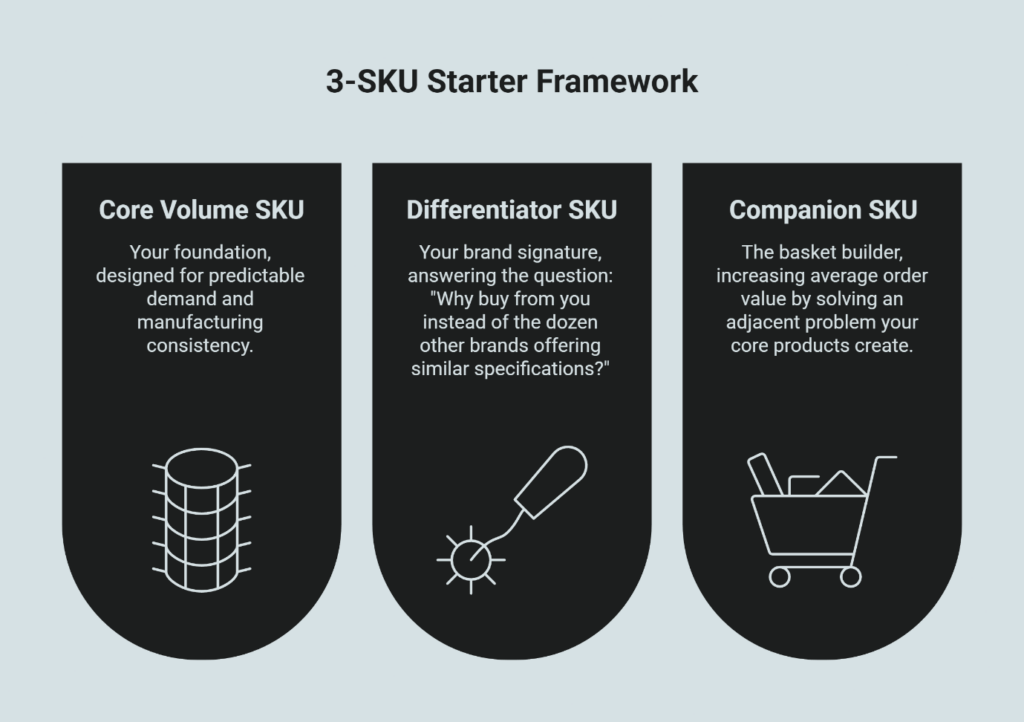
The most effective entry strategy follows a simple architecture: one Core Volume SKU, one Differentiator SKU, and one Companion SKU. This isn’t arbitrary—each role serves a specific function in validating your business model while keeping supplier coordination manageable.
Core Volume SKU: Your Foundation
This is your safest bet, designed for predictable demand and manufacturing consistency. Choose a product where customer requirements are well-understood and the technical specification doesn’t require custom tooling or unproven driver designs. For many pro audio retailers entering private label, this might be a straightforward 12-inch powered subwoofer with specifications that mirror proven market performers.
The Core Volume SKU should leverage platform reuse wherever possible. If your manufacturing partner has an existing enclosure design and driver platform with established production history, you’re inheriting their learning curve rather than creating a new one. Platform reuse reduces new product introduction risk and compresses the timeline from concept to qualified production.
Differentiator SKU: Your Brand Signature
This product answers the question: “Why buy from you instead of the dozen other brands offering similar specifications?” It represents one controlled leap beyond commodity positioning—perhaps a unique DSP tuning, a specific application focus, or a build quality choice that commands a modest premium.
The key constraint is discipline. Your Differentiator SKU should require changing only one or two major variables from proven platforms. If you’re modifying driver specifications, keep the enclosure standard. If you’re introducing a novel cabinet design, use well-characterized drivers. The goal is to create meaningful differentiation without compounding manufacturing complexity to the point where consistency becomes unmanageable.
Companion SKU: The Basket Builder
This item increases average order value by solving an adjacent problem your core products create. It might be a mounting accessory, a signal processor, or a complementary speaker that pairs naturally with your subwoofer lineup. The manufacturing risk here should be minimal—ideally, this is either a simple accessory or another platform-based product with straightforward specifications.
The strategic value isn’t just revenue per transaction. A well-chosen Companion SKU teaches you about your customers’ actual use cases and uncovers opportunities for future product development that pure speculation never would.
Keeping the 3-SKU Plan Low-Risk
Even a focused three-product lineup can spiral into supply chain chaos if you don’t establish clear manufacturing discipline from the start. The difference between a smooth launch and a year of firefighting quality issues comes down to how rigorously you control variability.
Platform Reuse First, Customization Second
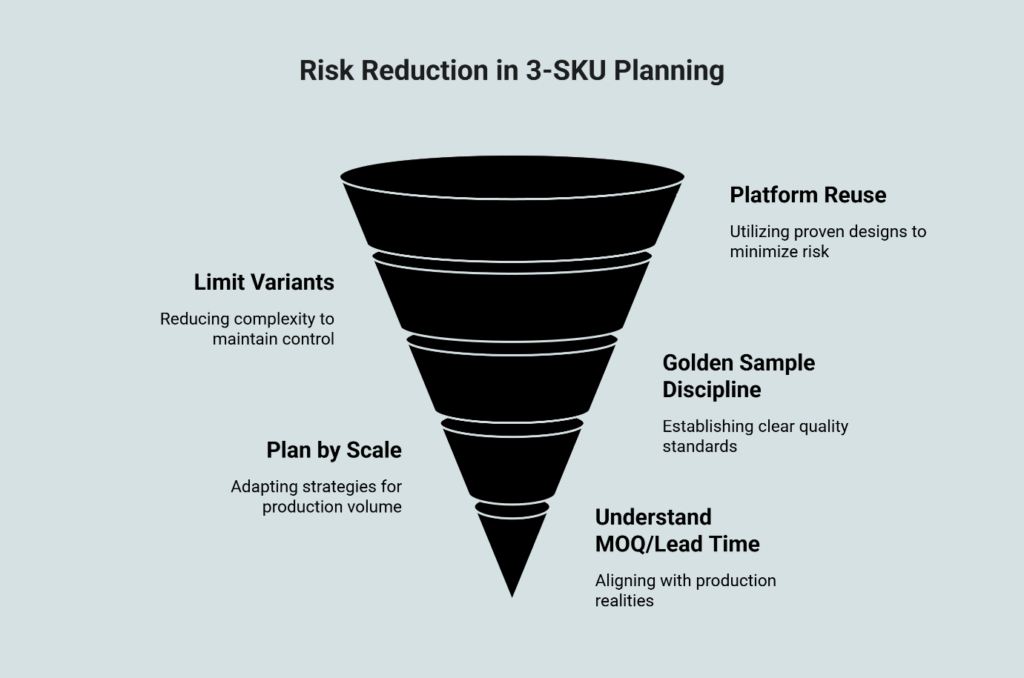
Platform reuse is your most powerful risk-reduction tool. When your manufacturing partner proposes starting from a proven enclosure design or driver platform, that’s not a compromise—it’s inheriting months of tooling refinement, production learning, and validated supply chains. Custom everything sounds exciting in the planning phase; it becomes expensive when you’re debugging cone assembly issues at 2 AM.
This approach mirrors broader manufacturing emphasis on repeatability and measurable controls, principles that organizations like NIST have championed in their work on manufacturing quality and measurement science.
Limit Variants to Maintain Control
Limiting variants is equally critical but harder to enforce when sales pressure builds. Resist the urge to offer three colors, four sizes, and optional upgrades on your first production run. Each variant multiplies your quality control burden and dilutes your ability to establish consistent Golden Sample standards. Launch with one specification per SKU. Prove it works. Then consider expansion.
Golden Sample Discipline: Define What “Match” Means
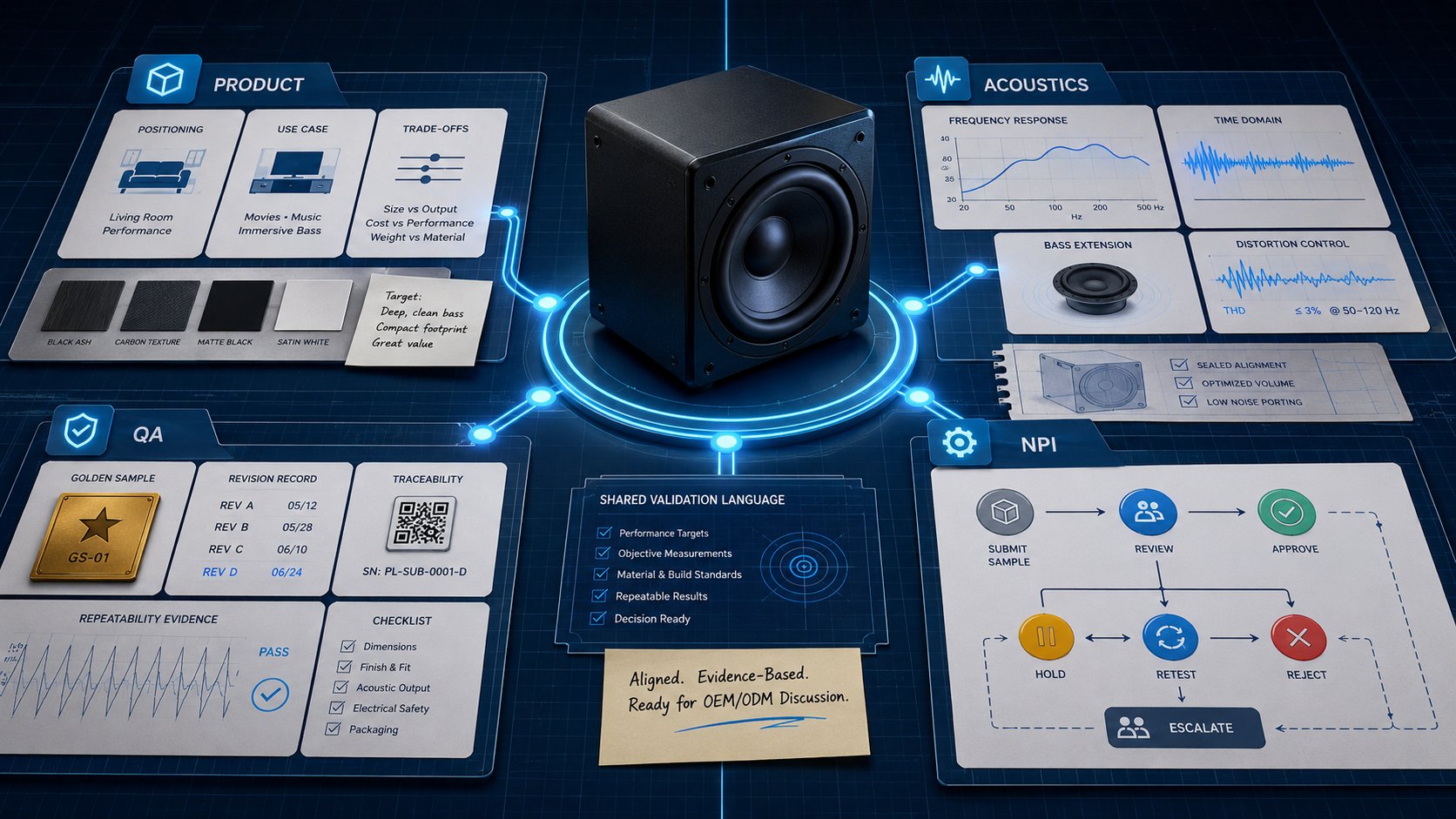
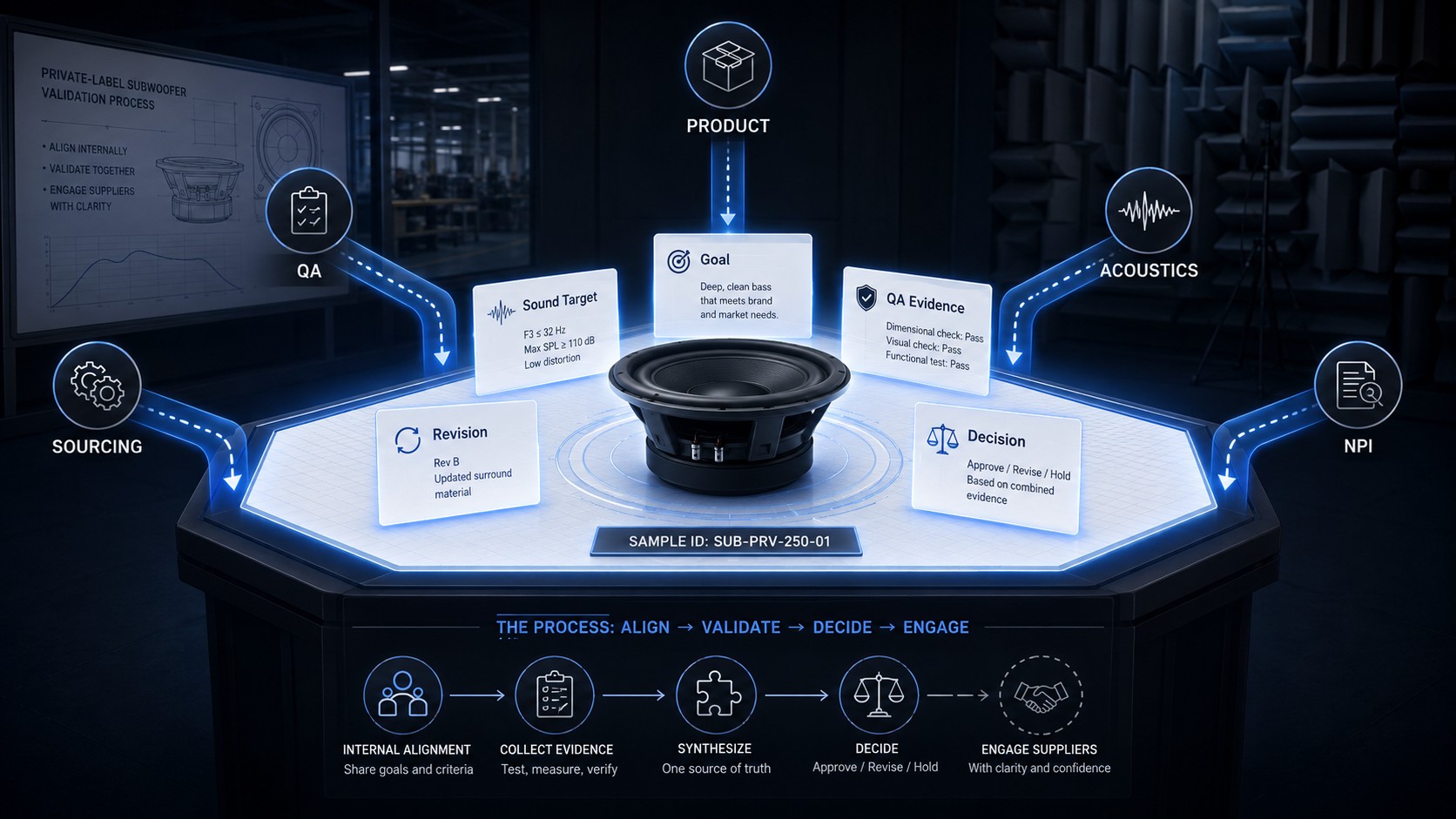
Golden Sample discipline separates predictable programs from chaotic ones. Before any production run, you must physically define what “correct” looks like and establish clear pass/fail criteria. This isn’t a spec sheet—it’s an actual unit that both parties agree represents the target, stored under controlled conditions, and used as the binding reference for every inspection gate.
A practical Golden Sample structure includes a signed reference unit that defines the accepted product, a must-not-change list tied to customer outcomes, clear sign-off ownership for who approves changes, and a controlled change pathway so small tweaks don’t silently alter your product.
Our R&D team of over 20 specialists across Acoustics, Electronics, Structure, and Software Development exists specifically to lock in this consistency between your Golden Sample and mass production units. Using tools like KLIPPEL R&D systems and AP Audio Precision analyzers, we can characterize your reference unit with enough precision that deviation in production becomes immediately detectable rather than discovered after shipment.
Quality gates at IQC (Incoming Quality Control), IPQC (In-Process Quality Control), and FQC (Final Quality Control) are the enforcement mechanism. These shouldn’t be viewed as bureaucratic checkpoints—they’re your early warning system that manufacturing has drifted from the Golden Sample standard. Our ISO 9001:2015 certified quality management system treats these gates as non-negotiable control points, not suggestions.
Plan by Production Scale
Your decision-making should shift based on whether you’re planning for small batch learning runs or mass production volume. Small batch production makes learning cheaper, but variability can hide in the noise—a good batch doesn’t always prove a stable process. Mass production shifts the risk to process repeatability, supplier consistency, and change control under volume pressure.
A low-risk plan explicitly states which SKU is intended to scale first and what evidence is required before ramping volume. Research on project focus consistently shows that narrowing scope early reduces coordination burden across engineering, procurement, and quality systems. As Harvard Business Review notes in their analysis of project management, companies that focus on fewer initiatives see better execution and clearer accountability.
Understand MOQ and Lead Time Realities
MOQ (minimum order quantity) and lead time realities deserve honest attention during planning, not surprise during execution. Many retailers underestimate the production economics that drive partner pricing and delivery schedules. A 500-unit MOQ isn’t arbitrary—it reflects the setup cost, material purchasing minimums, and production efficiency thresholds that make your pricing viable. Fighting these numbers rarely works; planning around them does.
Common Pitfalls in First-Run Planning
The most expensive mistakes in private label launches aren’t technical failures—they’re strategic misjudgments made during planning, before a single unit is built.
Starting with 8-12 SKUs might feel like comprehensive market coverage, but it creates spec drift risk faster than you can establish quality baselines. You’ll be simultaneously debugging three different driver suppliers, managing five enclosure variations, and trying to maintain Golden Sample discipline across a dozen reference units. By the time you identify which products actually sell, you’ve burned months and capital on a lineup that was too complex to manage effectively. Research on SKU rationalization consistently frames complexity as a cross-functional cost driver that affects operations, inventory, and quality systems simultaneously—not merely a planning inconvenience. MIT’s supply chain research documents how SKU proliferation creates cascading costs across the entire value chain.
Letting “spec sheet hype” define your product line is equally dangerous. Choosing features because they sound impressive on paper rather than solving actual customer problems leads to over-engineered products that are difficult to manufacture consistently and don’t command the premium their complexity demands. Start with clear customer outcomes, then specify the simplest technical solution that reliably delivers them.
Unclear Golden Sample ownership is the most common cause of quality inconsistency. If both parties assume the other is responsible for defining and maintaining the reference standard, you end up with production units that meet neither party’s expectations. Before any tooling begins, explicitly document who owns the Golden Sample, where it’s stored, what measurements define “match,” and who has authority to approve deviations.
Writing stricter contracts without establishing physical quality control processes is false security. Legal language doesn’t prevent defects—it only determines who pays for them after they’ve already disrupted your business. The real protection comes from validation gates that catch problems during production, not after your customers discover them.
Stay informed: Subscribe to our newsletter for practical insights on private label audio development, manufacturing best practices, and supply chain strategy.
Converting Your Plan Into Action
Once you’ve defined your three-SKU strategy, the next step is translating it into a sourcing brief that your manufacturing partner can execute against. This document becomes the foundation for everything that follows—pricing discussions, tooling decisions, and production planning.
Starter Catalog Template: Your First 3 SKUs
1. Core Volume SKU (the “safe bet”)
- Target customer use case: ______
- Why it sells (simple value claim): ______
- Platform decision (reuse vs new): ______
- Must-not-change specs (Golden Sample bound): ______
- Pass/fail acceptance check: ______
2. Differentiator SKU (the “brand signature”)
- What it does better (one sentence): ______
- What trade-off you accept (cost, lead-time, MOQ): ______
- What must be proven before scaling: ______
- Golden Sample sign-off owner: ______
3. Companion / Attach SKU (the “basket builder”)
- What it pairs with (SKU #1 or #2): ______
- Why it increases order value: ______
- Complexity limiter (keep variants low): ______
- Manufacturing risk check: ______
Decision Rules:
- Fewer variables beats more features in the first run.
- Reuse a proven platform where possible to reduce NPI risk.
- Golden Sample is the binding standard—define it before you scale.
Your sourcing brief should include your completed Starter Catalog Template, a must-not-change spec list for each SKU, and clear validation gates that define who signs off on the Golden Sample and what tests prove compliance. This creates shared accountability from the start rather than discovering misaligned expectations during production.
For context on how this starter catalog fits into your broader transition from reseller to brand owner, see From Reseller to Brand Owner: The Private Label Roadmap.
The goal isn’t perfection on launch day. It’s establishing a predictable, repeatable process where you understand exactly what you’re getting, can detect deviations early, and have the manufacturing discipline to scale confidently once demand validates your positioning.
Reliable audio brands aren’t built on marketing hype. They’re secured through rigorous Golden Sample consistency and de-risked supply chains, proving that in OEM partnerships, predictability is the ultimate premium. Your first three SKUs are the foundation of that reliability—choose them with the discipline they deserve.
Ready to turn your 3-SKU plan into a manufacturing program? Get in touch with our team to discuss sourcing, quality standards, and production planning for your private label launch.
Our Editorial Process
The China Future Sound Insights Team is our dedicated engine for synthesizing complex topics into clear, helpful guides. While our content is thoroughly reviewed for clarity and accuracy, it is not a substitute for direct consultation with an acoustics engineer or a project manager for your specific application.
About the China Future Sound Insights Team
The China Future Sound Insights Team is a group of audio product specialists and manufacturing experts dedicated to helping brands navigate the complexities of sourcing, development, and quality control. This article was produced by our Insights Team and reviewed by a technical lead to ensure accuracy and practical relevance.