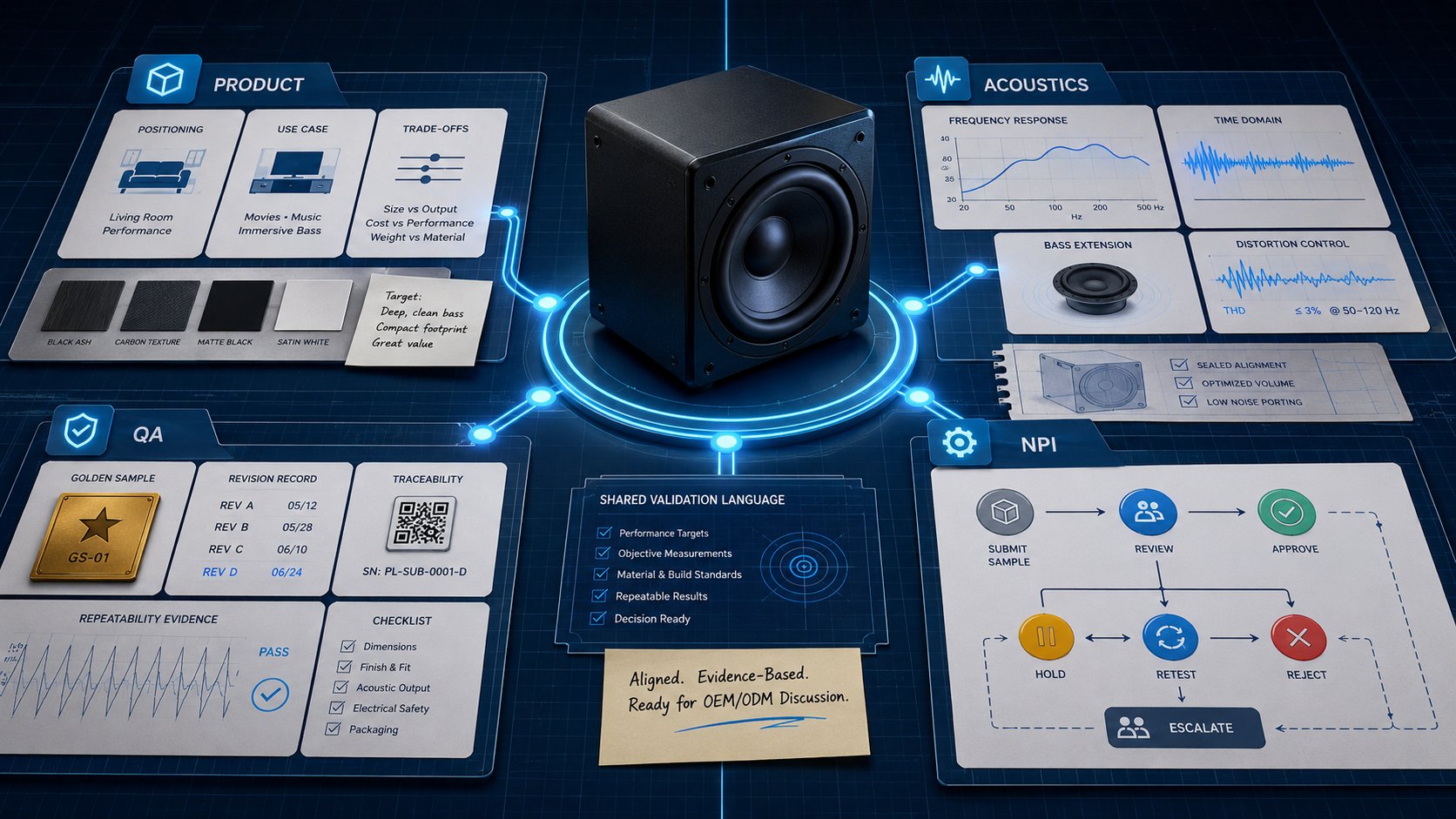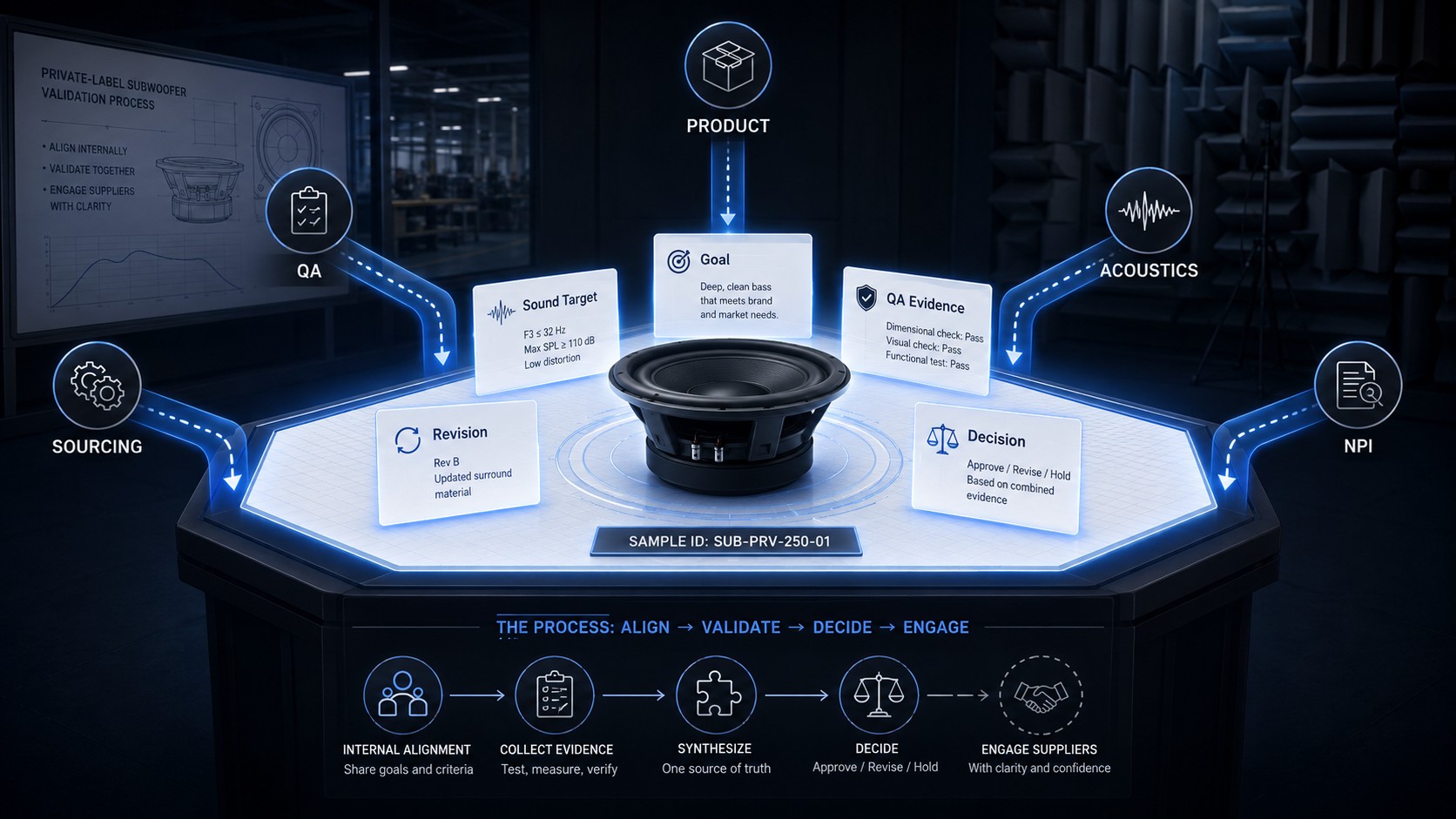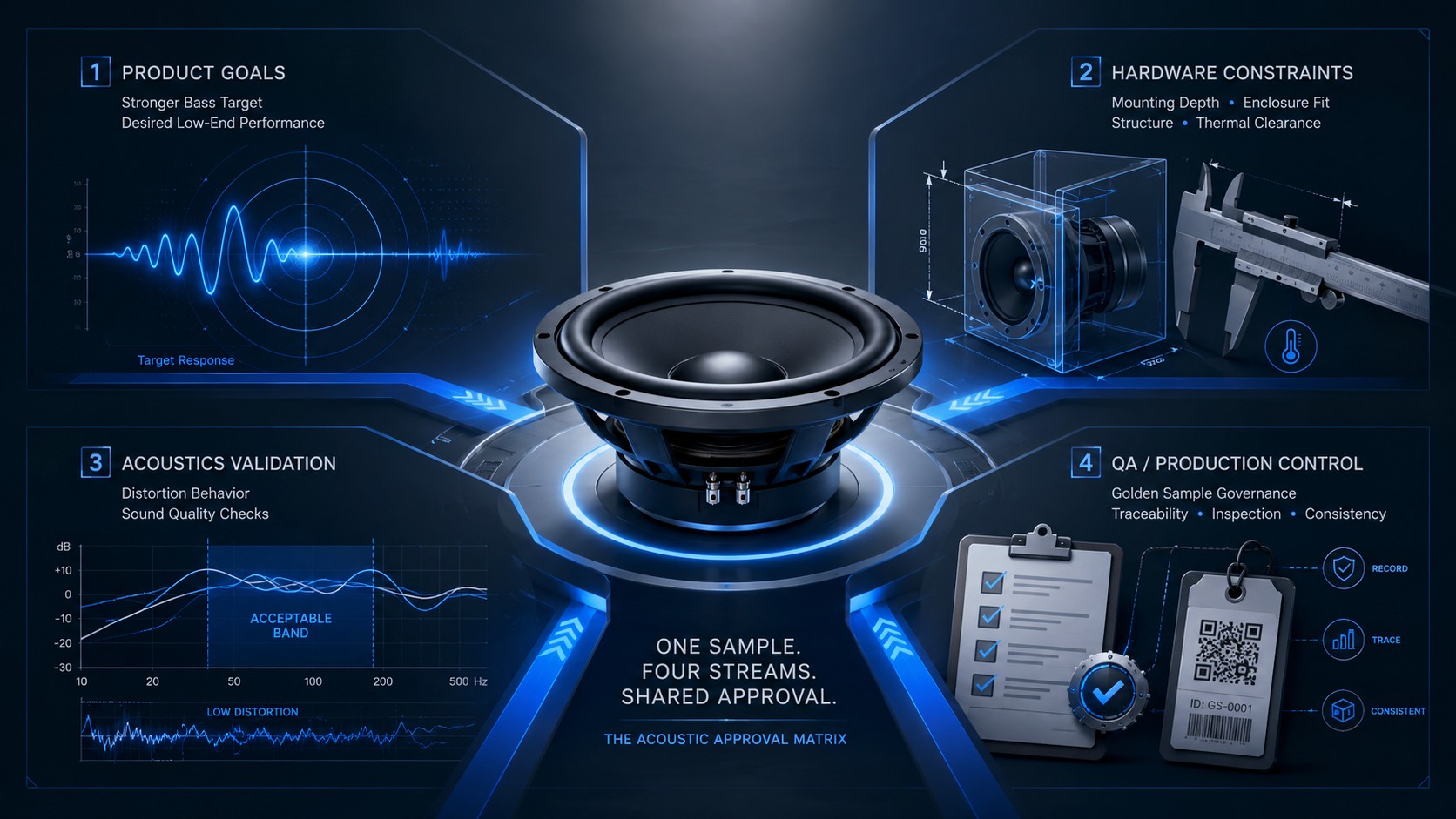
📌 Key Takeaways
Subwoofer samples improve when every team agrees on targets, fixed limits, trade-offs, and review rules before sampling starts.
- Align Before Sampling: Clear review rules prevent vague feedback from slowing the first subwoofer sample.
- Separate Needs Clearly: Teams must sort goals, fixed limits, trade-offs, and checks before briefing the supplier.
- Define Review Owners: Each issue needs the right owner, so feedback goes to product, hardware, acoustics, or QA.
- Respect Physical Limits: Bass goals must fit the approved enclosure, space, power, and heat limits.
- Link Samples To QA: Sample approval should connect listening results to records, checks, and production control.
Better subwoofer samples start with shared language before the first build begins.
Private-label audio teams will gain cleaner sample reviews, preparing them for the detailed overview that follows.
~ ~ ~ ~ ~ ~ ~ ~ ~ ~ ~ ~ ~ ~ ~ ~ ~ ~
Subwoofer OEM sampling can stall before the first sample is built. The problem is usually not a lack of acoustic knowledge. It is a lack of shared validation language.
Product may want stronger low-end impact. Acoustics may be focused on distortion behavior. Hardware may already know the mounting depth, enclosure volume, or thermal clearance cannot move. QA may need criteria that can later connect to inspection records, golden sample control, and production consistency.
Before a private-label subwoofer program moves into OEM/ODM sampling, those expectations need to become reviewable criteria. The goal is not to turn the pre-sampling meeting into a lab procedure. The goal is to define what the sample must prove, what can be adjusted, what cannot move, and who owns each approval decision.
Start By Separating Targets, Constraints, Trade-Offs, And Verification Needs
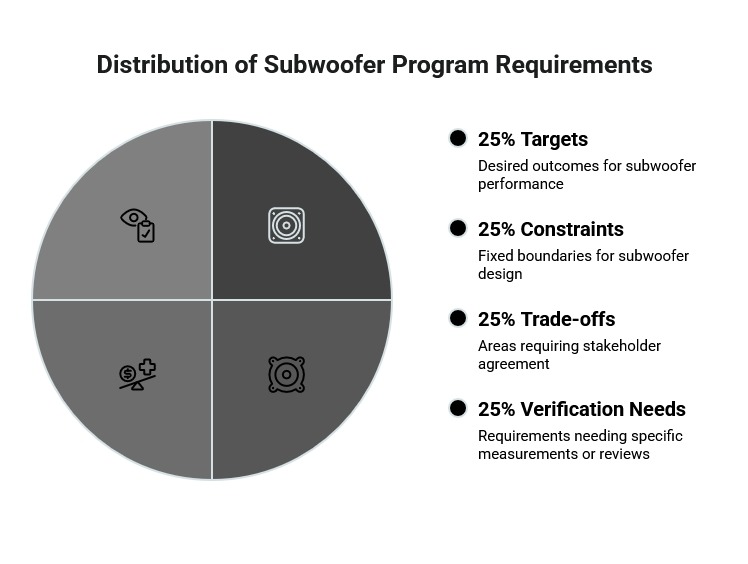
Not every requirement has the same role in a subwoofer program. Treating every preference as a fixed requirement creates confusion for hardware, acoustics, QA, NPI, sourcing, and the OEM partner.
A useful pre-sampling framework separates requirements into four categories.
A target is the desired outcome. For example, bass output may be a target when product wants a stronger low-frequency character for a specific automotive, marine, pro audio, or custom OEM/ODM application.
A constraint is a fixed boundary. Mounting depth, enclosure fit, basket geometry, structural clearance, approved materials, and thermal space may be constraints if the platform or installation envelope cannot change.
A trade-off is an area that requires stakeholder agreement. Bass output, distortion behavior, power handling, cost, enclosure type, and thermal headroom can affect each other. More output may not be meaningful if the result compromises the intended sound quality or exceeds the physical fit envelope.
A verification need is any requirement that depends on a specific limit, measurement condition, or engineering review. Specific SPL targets, THD or THD+N thresholds, frequency response limits, enclosure-volume requirements, excursion limits, and thermal thresholds should be confirmed by qualified acoustic or engineering review before they become sample approval criteria.
This distinction keeps the supplier handoff practical. The OEM does not receive a vague wish list. It receives a clearer map of what the sample should demonstrate and where engineering judgment is required.
Use A Pre-Sampling Validation Matrix Before Feedback Becomes Subjective
A validation matrix helps teams convert broad expectations into shared review language. It should be completed before OEM sampling begins and then used again when the first sample is reviewed.
| Alignment Area | What to Define Before Sampling | Why It Matters | Example Acceptance Language | Review Owner |
|---|---|---|---|---|
| Bass output | Target listening outcome and operating context | Prevents “more bass” from becoming subjective feedback | “Sample should demonstrate target low-frequency character under agreed review conditions.” | Acoustics / Product |
| Distortion | Acceptable distortion behavior at intended operating range | Avoids chasing output at the expense of perceived quality | “Distortion concerns must be reviewed against agreed use case and test condition.” | Acoustics / QA |
| Enclosure / fit | Mounting depth, enclosure type, mechanical envelope, thermal clearance | Avoids late physical redesign | “Design must remain within approved fit envelope before acoustic tuning is finalized.” | Hardware / Structure |
| Power / thermal | Sustained power expectations and heat dissipation constraints | Prevents unrealistic sample expectations | “Power target must be reviewed with thermal and reliability constraints.” | Hardware / QA |
| Sample feedback | What counts as pass, revise, or reject | Prevents circular revision loops | “Feedback must identify whether the issue is performance, fit, material, tuning, or process related.” | NPI / Product |
The matrix is not a substitute for engineering work. It is an alignment tool. Its value comes from making feedback specific enough to route.
For example, if product asks for stronger low-end impact, hardware confirms the enclosure depth is fixed, and acoustics raises concern about distortion at the intended operating range, the team should not send all three comments to the OEM as separate demands. The comments should be reconciled first. The sample requirement might become: maintain the approved fit envelope, demonstrate the target bass character under agreed review conditions, and flag distortion concerns for acoustics and QA review before requesting output increases.
That kind of language gives the supplier a clearer direction and gives the internal team a fairer basis for sample approval.
Align Bass Output With Distortion, Operating Context, And Commercial Positioning
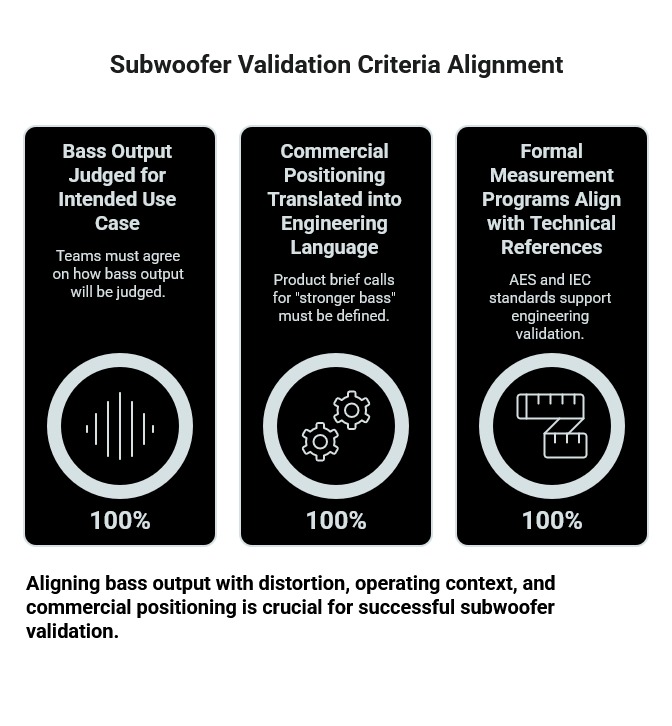
“More bass” is not enough. In a private-label program, the phrase may reflect commercial positioning, competitive intent, or product-line strategy. But acoustically, it still needs context.
Teams should agree on how bass output will be judged for the intended use case. A subwoofer for a space-constrained automotive platform may require a different set of trade-offs than a pro audio subwoofer or a marine audio application. Even within the same category, the desired balance between output, sound quality, thermal behavior, and fit may vary by product tier.
This is where commercial positioning must be translated into engineering language. A product brief may call for “stronger bass than the current platform,” but the sample criteria should explain what that means without inventing unsupported limits. A safer acceptance statement would be: “The sample should demonstrate the intended low-frequency character within the approved enclosure and operating context, with distortion concerns reviewed by acoustics and QA.”
For formal measurement programs, teams may later align specific test methods with recognized technical references, such as the Audio Engineering Society (AES) standard AES2-2012 (r2017) for loudspeaker measurement or IEC 60268-21 for acoustical output-based measurements. Those standards should support engineering validation, not replace product-specific acoustic review. (AES)
Make Enclosure And Fit Constraints Visible Before Acoustic Tuning Begins
Subwoofer performance is strongly shaped by physical limits. Enclosure size, mounting depth, basket geometry, magnet structure, material choices, connector placement, and thermal clearance can all influence what is realistic.
These constraints should be visible before acoustic tuning begins. Otherwise, the first sample may sound promising but fail the mechanical envelope. Or the team may approve a fit direction that later makes the desired acoustic behavior harder to achieve.
For brand teams reviewing subwoofer manufacturing capabilities, this is where customization context matters. The brief-supported CFS context includes customizable subwoofer solutions, including custom designs, enclosure types, impedance options, and power ratings. Those options should still be translated into sample criteria. Customization only reduces NPI risk when the program defines what each custom choice must prove.
A slim subwoofer direction, for instance, should make the space constraint explicit. An SQ subwoofer direction should clarify the intended sound-quality priority. A power-scaled product direction should define how power expectations will be reviewed alongside thermal and reliability constraints. These are general program-planning principles; the exact limits depend on the specific design and engineering review.
Structure The First-Sample Review As Pass, Revise, Or Reject
The first sample should not trigger an open-ended list of impressions. It should be reviewed against the criteria agreed before sampling.
A practical NPI feedback loop has three outcomes:
Pass means the sample demonstrates the agreed criteria closely enough to move toward the next development gate.
Revise means the sample has a defined issue that can be routed to the right owner: acoustic tuning, fit, material, thermal review, power expectation, supplier execution, or documentation.
Reject means the sample fails a fixed constraint or misses a requirement that cannot be resolved through normal tuning or revision.
This structure prevents circular feedback. Instead of saying “bass still needs improvement,” the review should identify whether the issue is the target, the constraint, the trade-off, or the verification method. That distinction helps NPI teams control the revision loop and helps sourcing teams avoid interpreting every sample issue as a supplier capability problem.
Related internal guidance on DFM checklists for pro audio NPI can support this kind of structured handoff before a program moves deeper into validation.
Connect Sample Approval To Qa Evidence And Production Readiness
Sample approval should not rely only on listening impressions or visual approval. In a B2B private-label program, the sample eventually needs to connect to qualification, QA gates, golden sample governance, and production consistency.
CFS-supported capabilities can be framed as evidence artifacts in that process. The brief confirms that CFS has an R&D team with Acoustics, Electronics, Structure, and Software Development groups; uses finite element simulation for magnetic circuit and speaker vibration-system simulation; uses KLIPPEL R&D to test samples against designed performance requirements; conducts short-term destructive power tests and long-term power tests on samples; and uses golden sample management to support consistency between samples and mass production.
On the QA side, the brief also supports ISO9001-2015 quality management, ERP/WMS control, KLIPPEL QC, barcode/QR route control, IQC/IPQC/FQC, and reliability laboratory testing. These should not be presented as guarantees of acoustic outcome or launch success. Their practical value is that they can support sample records, revision history, route-control evidence, and production-readiness review.
For a broader quality-control perspective, teams can also review internal guidance on golden sample integrity.
Conclusion
A stronger subwoofer sample begins with better pre-sampling alignment. Hardware, acoustics, product, QA, NPI, and sourcing teams should define the target, constraint, trade-off, verification need, review owner, and feedback category before asking the OEM to build.
That discipline does not remove engineering complexity. It makes the complexity easier to manage.
Discuss your next subwoofer program with the CFS team before sample requirements are locked: contact China Future Sound.
FAQs
What should teams align before subwoofer OEM sampling?
Teams should align the desired bass outcome, operating context, distortion review expectations, fit envelope, enclosure constraints, power and thermal considerations, review ownership, and pass / revise / reject criteria.
How do teams define subwoofer sample approval criteria?
Sample approval criteria should explain what the sample must demonstrate, under what agreed context, and who reviews each area. Specific numeric limits should be verified by qualified engineering or acoustic review before use.
What causes private-label subwoofer sample revisions to stall?
Revisions often stall when feedback is subjective, commercial goals conflict with physical constraints, QA joins too late, or teams do not distinguish between tuning issues, fit issues, material issues, and supplier execution issues.
Disclaimer: This article is for general informational purposes only and does not constitute compliance, safety, technical, or professional advice. Requirements, risks, and best practices may vary by product design, application, test conditions, supplier process, and program requirements. Confirm important decisions with the appropriate qualified engineering, quality, or technical expert.
Our Editorial Process:
Our expert team uses AI tools to help organize and structure our initial drafts. Every piece is then extensively rewritten, fact-checked, and enriched with first-hand insights and experiences by expert humans on our Insights Team to ensure accuracy and clarity.
About the China Future Sound Insights Team
The China Future Sound Insights Team is our dedicated engine for synthesizing complex topics into clear, helpful guides. While our content is thoroughly reviewed for clarity and accuracy, it is for informational purposes and should not replace professional advice.