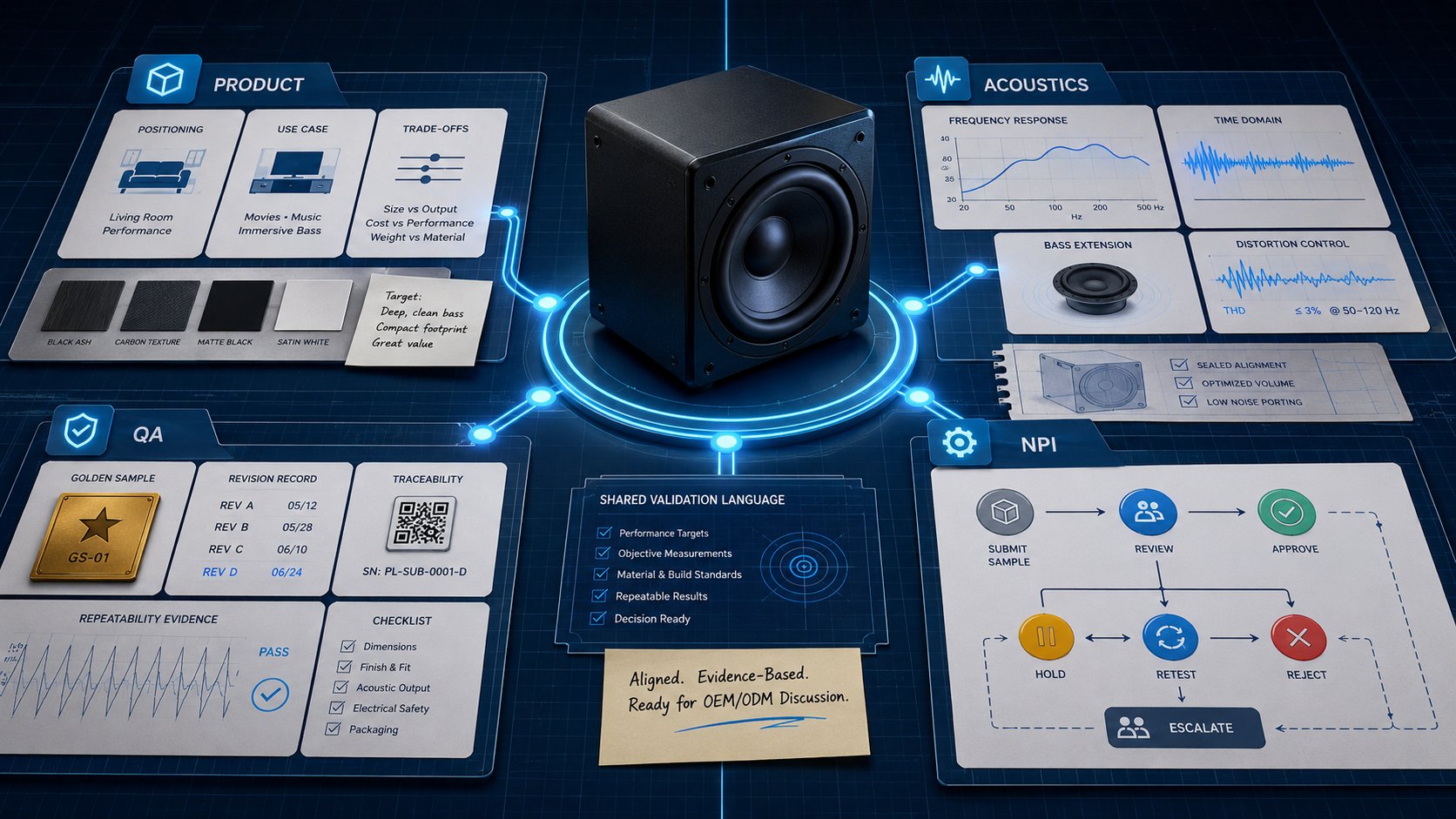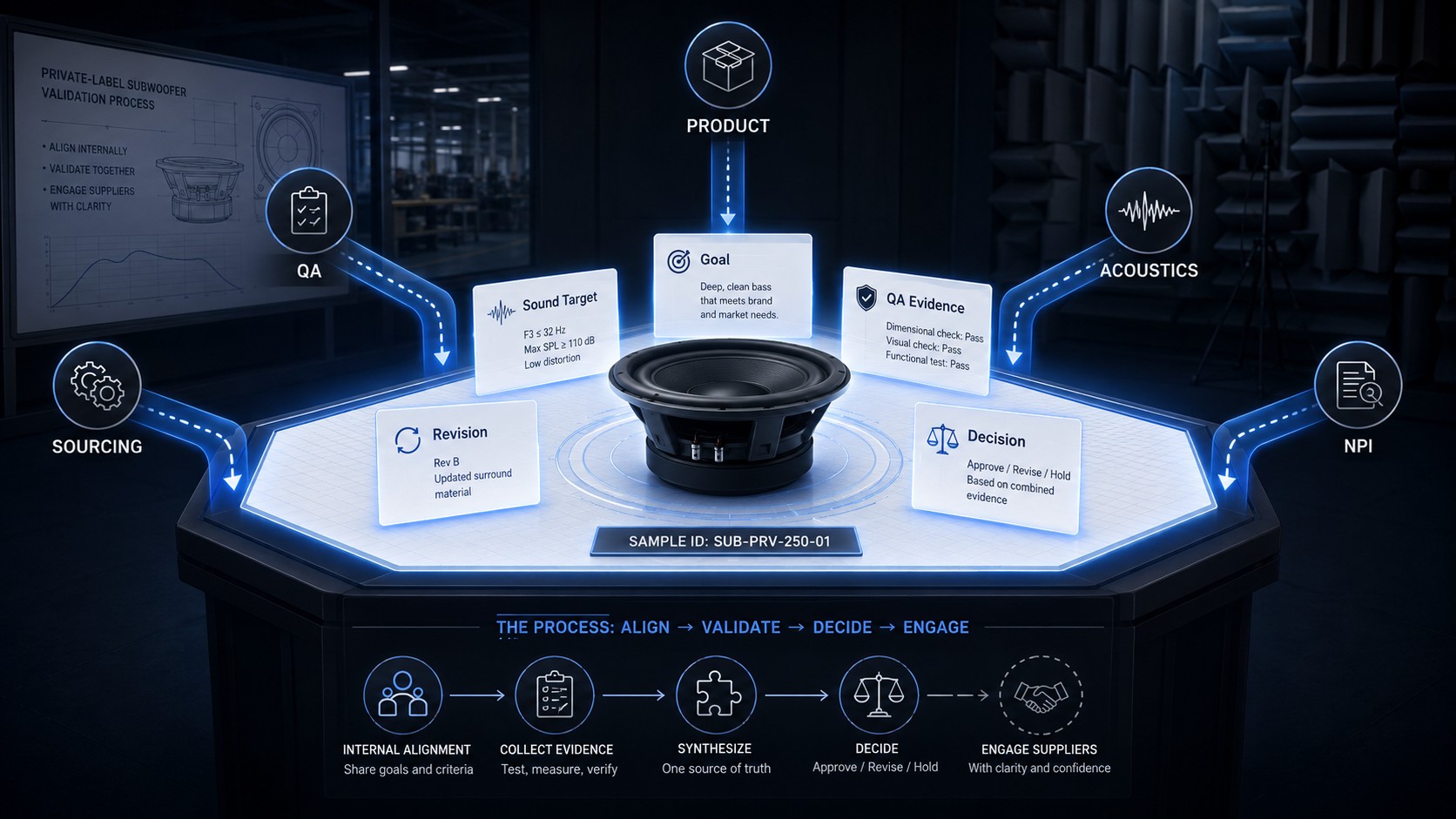
📌 Key Takeaways
A Golden Sample only works when you validate it properly, lock it down, and actually use it to check every unit that leaves the factory.
- Validation Before Approval: Lock your reference sample only after real testing—acoustic, thermal, and reliability—proves the design works at production scale.
- Custody Controls Matter: Store the approved sample securely, document its exact setup, and update it whenever engineering changes happen.
- Production Must Use It: Connect the sample to your factory QC system so every unit gets measured against the same fixed standard automatically.
- Ask the Hard Questions: Before trusting any “approved sample,” ask how it was tested, where it’s stored, and whether production actually references it daily.
- Drift Happens Quietly: Small changes—swapped parts, shifted tolerances—add up when nobody checks against a fixed benchmark.
A sample only protects your brand if the factory floor actually uses it.
Private-label program owners managing overseas manufacturing will gain a clear governance framework here, preparing them for the audit questions and custody protocols that follow.
~ ~ ~ ~ ~ ~ ~ ~ ~ ~ ~ ~ ~ ~ ~ ~ ~ ~
A Golden Sample is the absolute acoustic and structural benchmark for all mass production. It is not a ceremonial prototype or a visual approval artifact. It is the operational reference that removes subjectivity from quality control and gives private-label teams a stable foundation for long-term production consistency.
The approval email is dated six months ago. The production units arriving today are supposed to match. For private-label program owners, this moment carries real weight. A signed sample represents months of engineering decisions, acoustic tuning, and stakeholder alignment. But between that approval and the thousandth unit rolling off the line, something can shift. Components get substituted. Tolerances drift. The unit that earned internal buy-in quietly becomes a unit that generates field complaints.
When Golden Sample Integrity is maintained, every production unit can be measured against a fixed, validated standard—not against memory, opinion, or a spec sheet that the factory interprets differently than you do. When it is treated as a ceremonial milestone, it leaves room for spec drift, hidden variation, and stakeholder backlash.
What Golden Sample Integrity Actually Means
The term “golden sample” appears frequently in OEM conversations, but its meaning varies widely depending on who is using it. Some treat it as the unit that looked good enough to photograph. Others treat it as the unit that passed a listening test in a quiet room. Neither interpretation creates the foundation that private-label programs require.
Why a Golden Sample Is Different from a Prototype
A prototype proves that a design concept can work. It answers the question: Can we build this?
A Golden Sample answers a different question: What exactly should every production unit match?
The distinction matters because prototypes often contain hand-selected components, manual assembly adjustments, and engineering workarounds that cannot scale. A Golden Sample, by contrast, must represent what the production line can actually reproduce. It must reflect validated acoustic performance, validated thermal behavior, and validated reliability—not just validated appearance.
What Makes a Reference Unit Trustworthy
A reference unit earns trust through the validation process that precedes it. Engineering teams that take Golden Sample Integrity seriously use finite element simulation to model magnetic circuits and vibration systems before building physical samples. They verify acoustic performance using measurement systems like KLIPPEL R&D equipment, which captures parameters that listening tests miss. They subject samples to destructive power testing and long-term power testing to simulate real-world usage conditions before declaring a unit ready to serve as the benchmark.
This validation work requires depth across disciplines. A mature R&D operation brings together specialists in acoustics, electronics, structure, and software—teams of twenty or more working to verify that a sample reflects proven performance rather than optimistic intent.
Without this validation, a “golden sample” is just an approved sample—a unit that someone liked, not a unit that proves the design is production-ready.
Why Private-Label Programs Depend on It
Private-label success depends on consistency. Your brand promise is only as reliable as the weakest unit that reaches a customer. When production drifts from the approved benchmark, warranty rates rise, customer trust erodes, and stakeholders start asking uncomfortable questions about supplier governance.
Private-label programs do not fail only when a product is obviously defective. They also fail when approved performance slowly drifts and nobody catches the shift early enough. That risk is especially serious for dealer-owned brands and exclusive SKUs, where an unstable production standard can erode brand trust long before the issue becomes visible in a formal quality report.
How Subjectivity Enters QA Without a Fixed Benchmark
When a factory lacks a validated reference unit, quality control becomes interpretive. Inspectors compare production units against memory, against spec sheets open to interpretation, or against whatever sample happens to be sitting on the shelf that week. Small variations accumulate. A 1 to 2 dB shift in frequency response here, a slight change in thermal behavior there—none of it flagged because no one has a fixed standard to measure against..
This is how component drift turns approved designs into batch failures. The problem is not malicious substitution. The problem is that without a benchmark, “close enough” becomes the de facto standard. That opens the door to arguments such as “this batch is close enough” or “the change does not affect performance.”
Why One Approved Sample Is Not Enough Without Governance
A single approved unit proves capability once. It does not prove consistency at scale. The Golden Sample trap catches program owners who assume that signing off on a sample means the factory will automatically reproduce it faithfully.
Governance is what closes the gap. That means documented acceptance criteria, controlled custody of the reference unit, version discipline when engineering changes occur, and production-line enforcement through traceable QC systems. Without these layers, the approved sample is rendered useless on the factory floor.
The 3-Point Golden Sample Custody Protocol
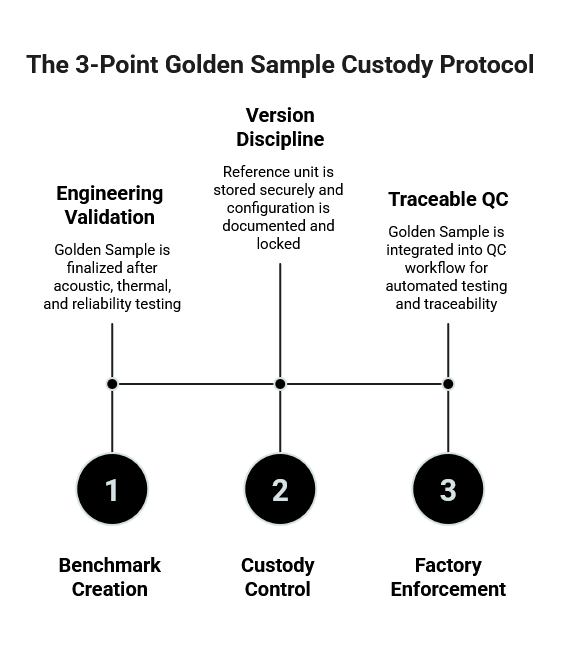
Golden Sample Integrity depends on three interlocking disciplines: benchmark creation, custody control, and production enforcement. Each point addresses a different failure mode.
1. Benchmark Creation After Real Validation
The Golden Sample must be finalized only after engineering validation is complete—not before. This means acoustic testing against objective limits, thermal verification under realistic load conditions, and reliability testing that simulates extended usage. Manufacturing partners with mature development processes use simulation tools, Audio Precision-class measurement systems, and structured destructive testing to validate samples before declaring them production-ready.
A benchmark that has not passed real validation is only a hopeful sample.
2. Controlled Custody and Version Discipline
Once finalized, the Golden Sample requires physical custody control and documentation discipline. The reference unit should be stored under conditions that prevent degradation. Its configuration—BOM revision, firmware version, acoustic tuning parameters—must be documented and locked. When engineering changes occur through an ECO or ECR, the reference unit must be reviewed and re-controlled accordingly. Otherwise, the factory may be producing against a reference that no longer matches the intended program state.
Quiet divergence between the approved sample and the shipped product is one of the most common ways production consistency breaks down.
3. Factory-Floor Enforcement Through Traceable QC
A benchmark only matters if the production line actually uses it. Enforcement requires integrating the Golden Sample into the QC workflow. Systems like KLIPPEL QC combined with golden samples allow production units to be measured against the validated reference automatically. Barcode and QR-code systems bind test data to individual units, creating the traceability needed to identify when and where drift occurs.
This three-point structure—validation, custody, enforcement—transforms a Golden Sample from an approval artifact into an operational governance tool. The custody flow moves in sequence: engineering validation leads to Golden Sample lock, which establishes version-controlled custody, which enables line testing against the benchmark, which produces traceable pass/fail data. That flow is what turns a benchmark from a symbolic approval artifact into an active production control.
How Golden Sample Integrity Connects to NPI, DVT, and PVT
Golden Sample Integrity does not exist in isolation. It sits inside the broader first-article approval framework that governs new product introduction.
Where the Benchmark Is Locked
In a structured NPI process, the Golden Sample is typically locked at the transition from DVT (Design Validation Testing) to PVT (Production Validation Testing). DVT confirms that the design meets performance requirements under controlled conditions. PVT confirms that the production process can reproduce those results at scale. The Golden Sample serves as the bridge—the physical artifact that carries the validated design intent into the production environment.
Locking the benchmark too early creates risk. If the Golden Sample is finalized before DVT is complete, it may not reflect the design’s final validated state. If it is finalized after PVT has begun, production may already be running against an uncontrolled reference.
How the Benchmark Travels from Validation to Production
The handoff from engineering to production is where many programs lose control. A mature manufacturing partner maintains formal handoff protocols: documented first-article approval criteria, explicit acceptance criteria for mass production readiness, and QC integration that ensures the Golden Sample is actively used—not just stored.
This is where quality management systems like ISO 9001 become relevant. The standard requires documented processes and controlled records. When applied to Golden Sample governance, it means the reference unit’s status, location, and configuration are tracked—not assumed. General quality principles from ASQ’s Quality Glossary help define the consistency and control language that underpins these systems.
For adjacent reading on de-risking the validation handoff, see DFM Checklists for Pro Audio NPI: De-risking the EVT/DVT/PVT Handoff.
What to Audit Before You Trust a Factory’s “Approved Sample”
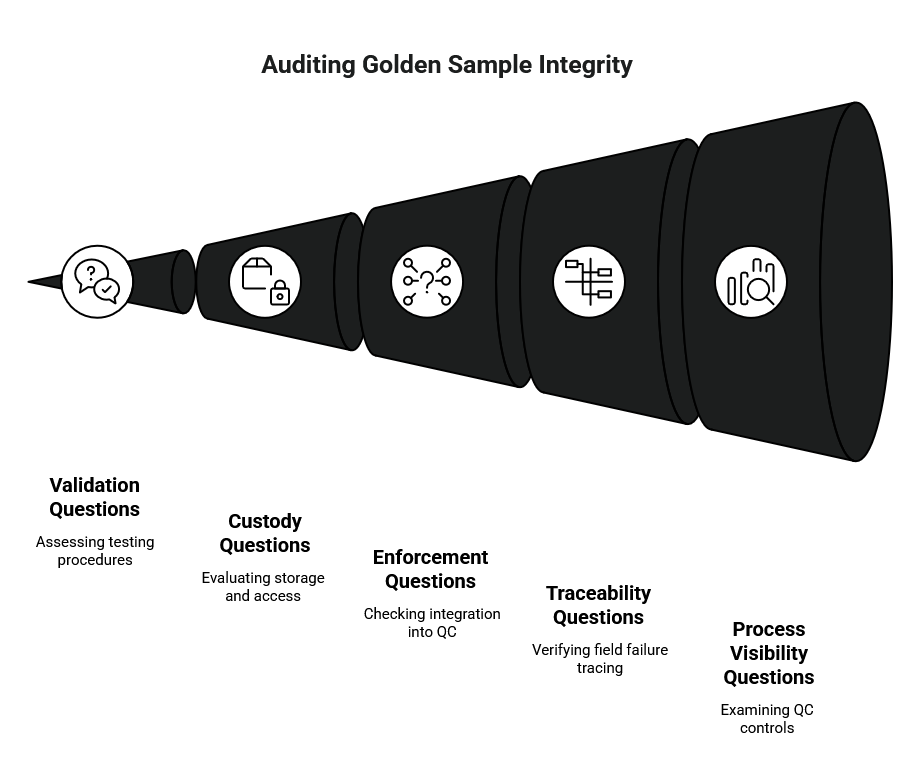
Before accepting a manufacturer’s claim that a sample is production-ready, private-label program owners should ask questions that reveal whether Golden Sample Integrity is operational or merely rhetorical.
Questions about validation: How was this sample validated? What acoustic and thermal testing was performed? What reliability testing confirms it will hold up under real-world conditions?
Questions about custody: Where is the reference unit stored? Who controls access? What happens to the benchmark when an engineering change is released? Is benchmark custody version-locked to the approved program state?
Questions about enforcement: How does the production line use this sample? Is it integrated into automated QC, or does it sit on a shelf? Can you show me the test data binding that links production units to the benchmark? Can production testing route units against the benchmark through controlled QC stations?
Questions about traceability: If a unit fails in the field, how quickly can you trace it back to its production lot and the QC data recorded at the time of manufacture? Does traceability connect each tested unit to barcode or QR-linked process data?
Questions about process visibility: Are IQC, IPQC, FQC, and reliability controls visible in the production system? Is change control strong enough to prevent quiet divergence between the approved sample and the shipped product?
The answers reveal whether “golden sample” is a governance discipline or a marketing phrase.
Building Confidence Through Benchmark Discipline
Golden Sample Integrity is the operational bridge between engineering validation and dependable mass production. It gives private-label teams a fixed reference for quality control, a documented baseline for engineering changes, and a defensible answer when stakeholders ask how production consistency is maintained.
The concept is straightforward. The discipline is not. It requires validation rigor before the benchmark is locked, custody control after it is finalized, and enforcement systems that make the reference unit operationally active on the factory floor.
For program owners planning their next NPI phase, the question is not whether a factory can produce a good sample. The question is whether that sample will remain the standard—or quietly become a memory.
To stay current on quality governance, NPI best practices, and private-label program strategy, subscribe to the China Future Sound newsletter or explore related quality-control resources on the blog.
Our Editorial Process
Our expert team uses AI tools to help organize and structure our initial drafts. Every piece is then extensively rewritten, fact-checked, and enriched with first-hand insights and experiences by expert humans on our Insights Team to ensure accuracy and clarity.
About the China Future Sound Insights Team
The China Future Sound Insights Team is our dedicated engine for synthesizing complex topics into clear, helpful guides. While our content is thoroughly reviewed for clarity and accuracy, it is for informational purposes and should not replace professional advice.