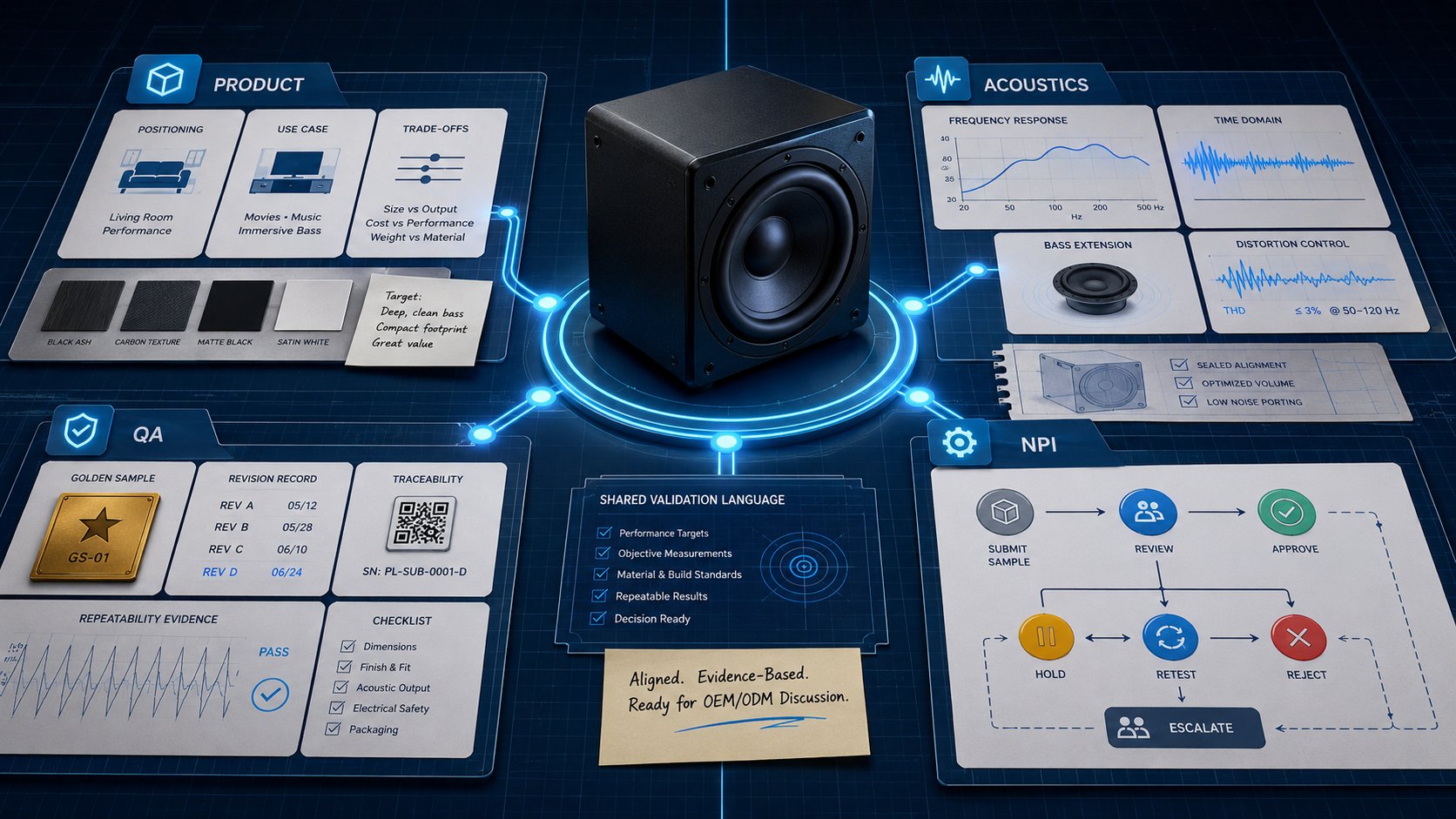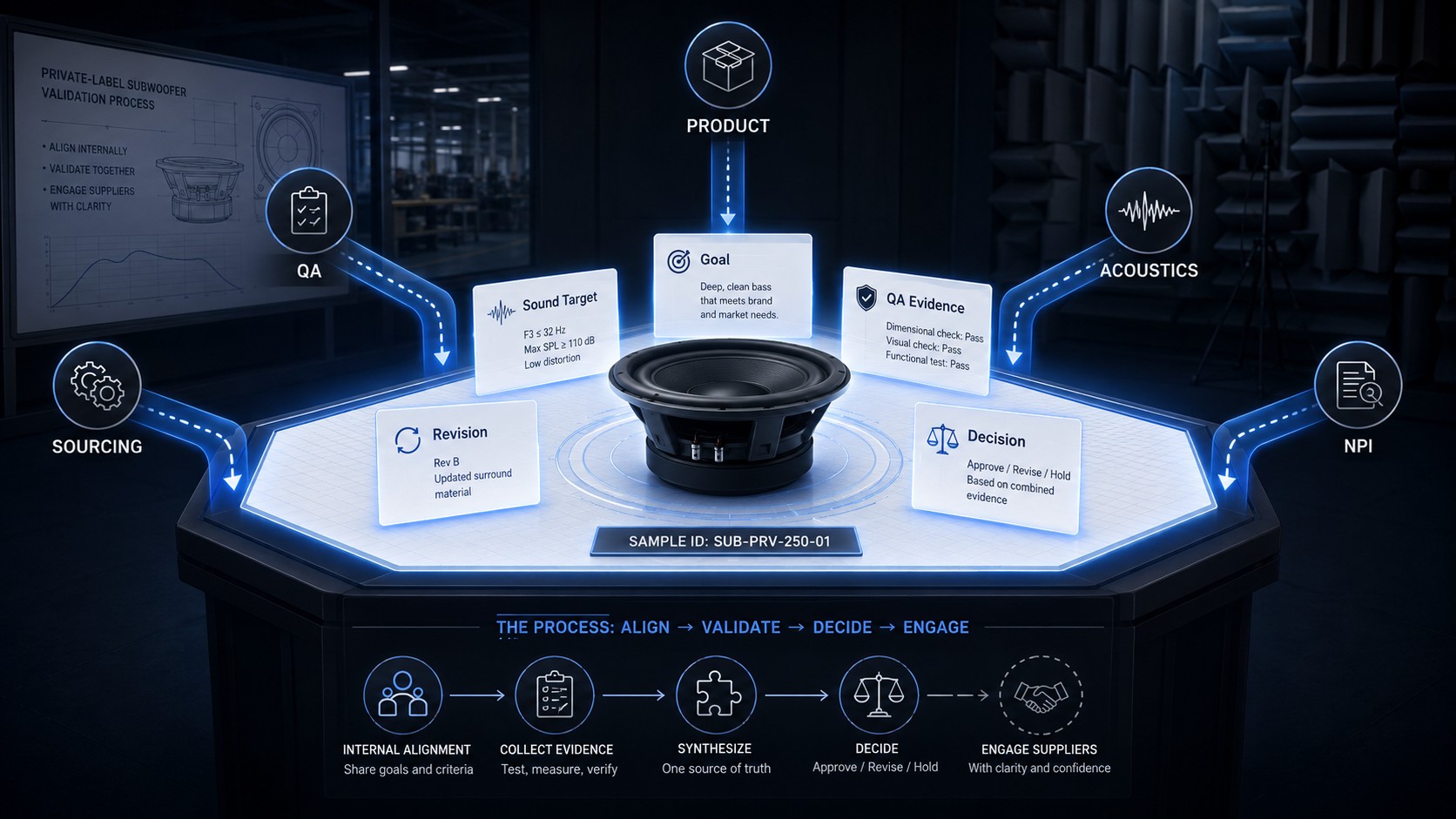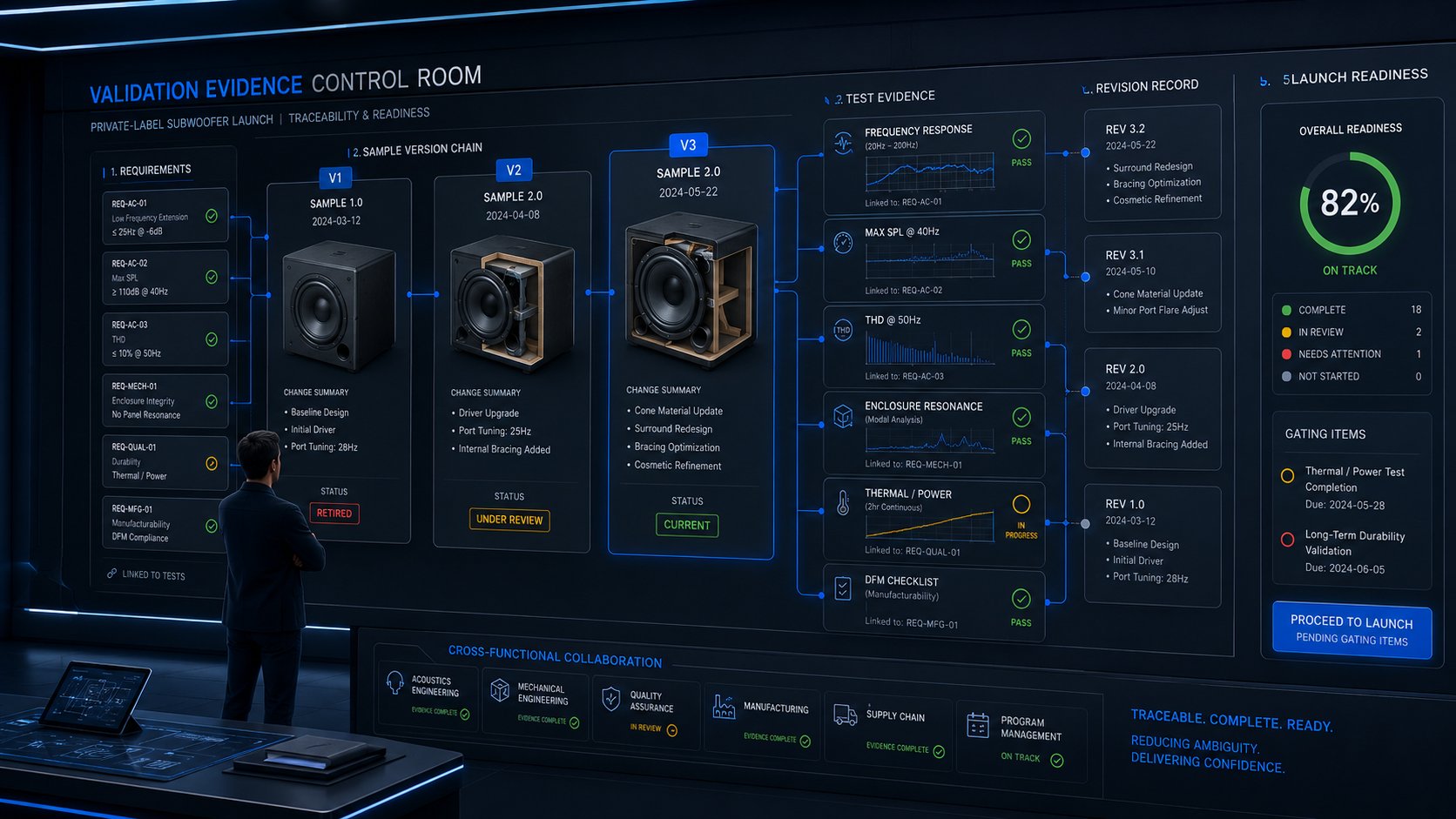
📌 Key Takeaways
Strong subwoofer launches need clear evidence that shows what changed, what was tested, and what still needs review.
- Control The Evidence: QA needs versioned sample records, test notes, and clear links to product needs.
- Separate Roles Clearly: QA checks whether evidence is complete; acoustic experts judge whether the sound data is valid.
- Track Every Change: Each sample update should show what changed, why it changed, and what proof followed.
- Turn Feedback Into Proof: Comments like “needs more bass” matter only when they lead to tracked fixes.
- Report Risk Simply: Green, yellow, and red status labels help teams see evidence gaps before launch.
Better evidence does not remove launch risk; it makes the risk easier to see and manage.
QA Directors managing private-label subwoofer launches will get a clearer evidence-review lens here, preparing them for the detailed overview that follows.
~ ~ ~ ~ ~ ~ ~ ~ ~ ~ ~ ~ ~ ~ ~ ~ ~ ~
Private-label subwoofer launches can become uncertain long before the launch gate. QA, Product, Acoustics, NPI, Hardware, and Sourcing may all review the same supplier sample package, but each team looks for different signals. One team wants to know whether the acoustic tuning supports the product brief. Another wants to know whether the latest sample reflects the requested change. QA needs to know whether the evidence is strong enough to support the next decision.
That does not mean QA Directors need to become acoustic engineers. It means supplier evidence should be complete, version-controlled, reviewable, and clear enough to support cross-functional launch-readiness discussions.
For growth-stage audio companies evaluating private-label subwoofer programs, acoustic validation evidence is most useful when it reduces ambiguity. It cannot guarantee launch success, prove market performance, or replace qualified engineering judgment. It can help the launch team understand what is known, what changed, what remains open, and what needs specialist review.
What Acoustic Validation Evidence Should Mean for QA
Acoustic validation evidence is not just a chart, a test file, or a supplier statement that a sample “passed.” For QA purposes, useful evidence connects product requirements to sample-level findings.
A decision-ready evidence package should show what was tested, which sample version was reviewed, what conditions shaped the result, and what decision the evidence supports. That is different from asking QA to interpret every acoustic measurement. Measurement validity, test setup, acoustic trade-offs, and technical thresholds should remain with acoustic specialists or qualified engineers.
Evidence vs. interpretation:
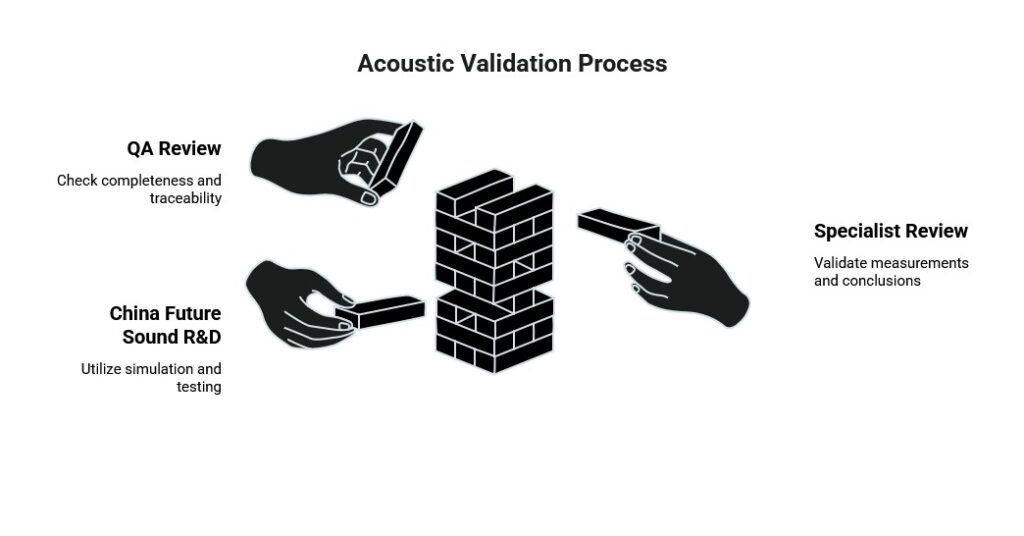
QA can review whether the validation package is complete, traceable, and linked to requirements. Acoustic and engineering specialists should review whether the measurements, conditions, and technical conclusions are valid.
This distinction protects the launch process. It allows QA to act as a cross-functional risk interpreter without becoming the sole technical approver for acoustic design.
China Future Sound has an R&D team that includes Acoustics, Electronics, Structure, and Software Development teams. Its Acoustics Team uses finite element simulation for magnetic circuit and speaker vibration systems, KLIPPEL R&D sample testing against designed performance requirements, and short-term destructive and long-term power tests on samples. These are useful capability signals when the resulting documentation is tied to sample versions, requirements, and revision records. For broader technical reference, KLIPPEL’s official R&D system materials describe loudspeaker testing capabilities such as acoustical tests, parameter measurement, distortion measurement, and power testing. (Klippel)
Acoustic Validation Evidence Review Matrix
A vague pass/fail question rarely gives QA enough context. A better approach is to review the evidence package by decision area.
| Evidence Area | What QA Should Look For | Why It Matters | Who Should Review It |
|---|---|---|---|
| Performance target alignment | Test outputs mapped to agreed product requirements | Prevents vague “sample passed” claims | QA + Acoustics |
| Sample test documentation | Test date, sample version, conditions, and result summary | Helps teams compare revisions | QA + NPI |
| Reliability evidence | Power testing or stress-test summary, where available | Supports durability discussion without guarantees | QA + Engineering |
| Golden sample reference | Approved benchmark tied to measurable criteria | Helps control production consistency | QA + Supplier |
| Revision log | What changed, why, and what evidence changed afterward | Prevents hidden design changes | NPI + Product + QA |
| Production-control link | Connection to QC, traceability, or inspection gates | Helps QA assess scale-up readiness | QA + Operations |
| Open exceptions | Known unresolved issues, owners, and next review step | Prevents silent risk transfer | QA + Product + NPI |
This matrix is a practical internal screening tool, not a formal compliance rating system. Specific acoustic thresholds, tolerances, sample test limits, or pass/fail criteria should be verified by qualified technical reviewers before being used in launch-readiness decisions.
The golden sample row deserves special attention. A good first sample is not enough by itself. Single-sample confidence becomes stronger when the approved reference is connected to version control, production-control checks, and repeatability-oriented evidence. CFS uses golden sample management to support consistency between mass-produced products and samples, and production-stage KLIPPEL QC can be combined with golden samples for consistency control. For more context, see golden sample integrity.
Sample Feedback Should Become Evidence, Not Opinion
Audio sample reviews often include subjective language. That is expected. A reviewer may say a sample “sounds good,” “needs more bass,” or “feels different from the approved version.” Those comments can be useful, but they are not enough for QA sign-off unless they are translated into requirement-linked evidence.
A useful sample-feedback record should identify the sample version, review date, reviewer role, observed issue, likely impact, requested change, and follow-up action. It should also separate subjective listening feedback from measured validation outputs.
For example, if the first sample shows a low-frequency response trade-off, QA does not need to solve the acoustic design. QA needs to see whether the issue was documented, assigned, revised, retested, or accepted as a trade-off by the right technical stakeholders.
A compact flow can keep this disciplined:
Sample feedback → documented issue → revision request → retest or review → decision summary
This prevents a common NPI risk: a concern appears resolved in supplier communication, but the validation package does not show what changed. When that happens, Product may believe the issue is closed, Acoustics may still need to review it, and QA may carry accountability without a clear evidence trail.
Supplier documentation should make that ambiguity visible before the next launch gate.
Revision Evidence Is Where Confidence Improves or Breaks Down
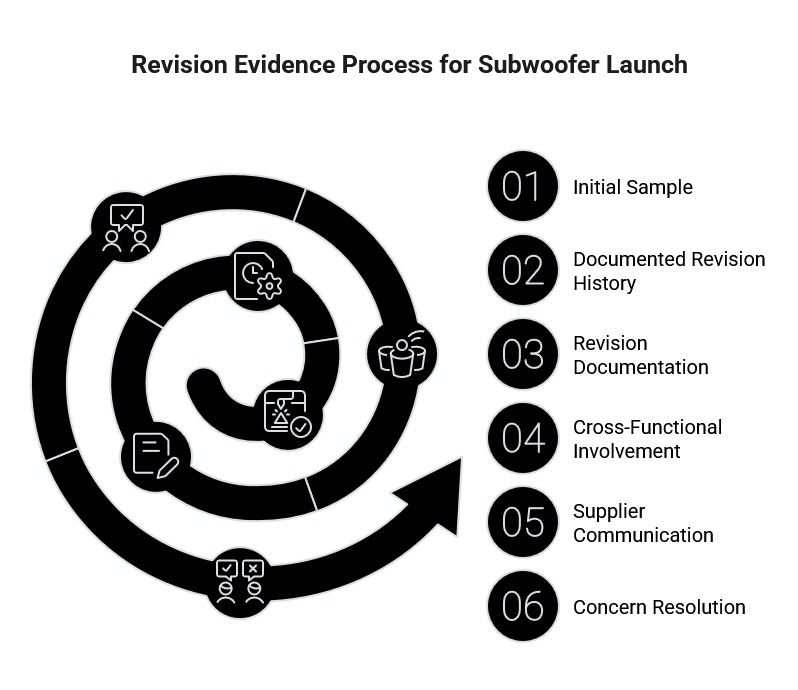
Revision-cycle documentation often determines whether validation evidence supports launch confidence or creates more uncertainty. A first sample can show early capability. A documented revision history shows whether the program is controlling changes.
Each revision should explain what changed, why it changed, who requested it, which sample version reflects the change, and what evidence changed after review. Where relevant, this can follow ECO/ECR-style discipline without creating unnecessary bureaucracy.
This is especially important in private-label and OEM/ODM audio programs, where a small change in acoustic tuning, material selection, structure, or production process may affect more than one team. Product may care about positioning. Acoustics may care about measured response. NPI may care about readiness. QA may care about whether the supplier can show a traceable path from concern to closure.
CFS’s cross-functional R&D structure is relevant here because subwoofer development may involve acoustics, electronics, structure, and software considerations. The point is not that multidisciplinary work removes risk. The point is that revision evidence should show whether the right disciplines were involved and whether supplier communication matches the latest test records.
This helps answer a question that QA Directors often face: was the concern resolved, deferred, or simply renamed?
What QA Should Report Internally
QA reporting should translate supplier evidence into decision-ready status. It should not bury Product, Sourcing, or executive stakeholders in raw acoustic data. A useful internal report should make the evidence position clear enough for the next program decision.
A practical launch-readiness summary can include evidence received, evidence missing, sample versions reviewed, known open risks, decisions supported by evidence, decisions requiring acoustic or engineering review, supplier responsiveness, and confidence level with caveats.
A simple traffic-light model may help:
| Status | Evidence Maturity |
|---|---|
| Green | Evidence supports requirement alignment, sample version control, and revision closure. Remaining questions are minor or assigned. |
| Yellow | Evidence is useful but missing context, test conditions, revision linkage, or specialist interpretation. |
| Red | Evidence is vague, unversioned, non-repeatable, or disconnected from product requirements. |
This is an editorial reporting model, not a compliance system.
For scale-up discussions, QA should also ask how validation evidence connects to production control. CFS holds ISO 9001:2015 Quality Management System certification and uses ERP/WMS, FIFO, KLIPPEL QC with golden samples, barcode/QR traceability, IQC, IPQC, FQC, and reliability laboratory testing as factual quality-system context. ISO describes ISO 9001 as a quality management system standard used to help organizations manage consistent products, services, and customer or regulatory expectations. (ISO)
Where traceability is central to the discussion, internal teams may also review barcode testing route control and aligning sourcing and acoustics on IPQC/FQC protocols as related internal reading.
Questions QA Should Ask Before Recommending the Next Gate
Before recommending next-stage readiness, QA should ask supplier and internal stakeholders a small set of evidence-focused questions:
- Which sample version does this evidence apply to?
- Which product requirements were reviewed?
- What conditions shaped the test or review result?
- Which feedback items led to revision, retest, or accepted trade-off?
- Which open risks still require acoustic or engineering review?
- How does the approved sample connect to golden sample control and production QC?
- Are supplier claims supported by reviewable documentation rather than general statements?
These questions are not meant to slow the launch. They are meant to prevent late ambiguity. A compact review at the sample stage can help reduce rework risk without claiming guaranteed time savings.
Where QA Should Draw the Technical Boundary
QA can evaluate evidence completeness, traceability, version control, documentation quality, and whether findings are decision-ready. QA should not validate every acoustic conclusion independently.
Acoustic specialists should review measurement validity, test conditions, acoustic interpretation, and technical trade-offs. Supplier claims involving compliance, durability, tolerances, or performance limits should be reviewed by qualified stakeholders before they influence publication, certification, or launch decisions.
For formal acoustic measurement or compliance-related questions, teams should rely on appropriate technical sources and professional review. Useful high-authority starting points include AES standards activity for audio engineering standards, IEC electroacoustics standards work, and IEC 60268-21 for acoustical output-based measurement methods where applicable. (AES)
The practical boundary is simple: QA can decide whether the evidence package is controlled and decision-ready. Technical specialists should decide whether the acoustic conclusions are valid.
FAQs
What should QA ask for in subwoofer validation documentation?
QA should ask for sample version history, requirement mapping, test or review summaries, test conditions, revision records, open issues, reviewer ownership, and the next decision supported by the evidence. Specific acoustic thresholds should come from approved internal specifications or qualified technical review.
Is acoustic validation evidence the same as compliance evidence?
No. Acoustic validation evidence supports product-performance and design-confidence discussions. Compliance evidence should be handled separately and verified through appropriate technical, regulatory, certification, or engineering sources.
How much technical detail belongs in a QA report?
A QA report should include enough detail to support decisions and escalation. It does not need to reproduce every raw acoustic measurement for non-acoustic stakeholders. The stronger report explains what evidence was reviewed, what it supports, what remains uncertain, and who owns the next technical judgment.
Better Evidence Makes Launch Conversations More Disciplined
Acoustic validation evidence does not remove every risk. It can help QA Directors clarify what is known, what changed, what remains uncertain, and what needs specialist review before the next launch gate.
This clarity is essential when supplier documentation must satisfy the distinct requirements of cross-functional stakeholders. The right evidence package gives these teams a shared basis for moving forward without overstating certainty.
Use the evidence matrix in the next subwoofer sample-review discussion with QA, Product, Acoustics, and NPI before moving to the next launch gate. To discuss subwoofer validation evidence needs, contact our team.
Disclaimer: This article is for general informational purposes only and does not constitute compliance, safety, technical, or professional advice. Requirements, risks, and best practices may vary by context, jurisdiction, system, provider, or use case. Confirm important decisions with the appropriate qualified professional, authority, or technical expert.
Our Editorial Process:
Our expert team uses AI tools to help organize and structure our initial drafts. Every piece is then extensively rewritten, fact-checked, and enriched with first-hand insights and experiences by expert humans on our Insights Team to ensure accuracy and clarity.
About the China Future Sound Insights Team
The China Future Sound Insights Team is our dedicated engine for synthesizing complex topics into clear, helpful guides. While our content is thoroughly reviewed for clarity and accuracy, it is for informational purposes and should not replace professional advice.