📌 Key Takeaways
Transform Team Conflicts Into Strategic Alignment: The Feature Value Matrix approach can help eliminate the costly tug-of-war between marketing and product teams by plotting potential features on two critical axes—customer appeal versus manufacturing complexity—creating a shared language for objective decision-making.
Four Strategic Quadrants Guide Resource Allocation: Features naturally fall into distinct categories: Quick Wins (high appeal, low cost) for immediate prioritization, Strategic Investments (high appeal, high cost) requiring careful planning, Backlog items (low appeal, low cost) for future consideration, and Resource Drains (low appeal, high cost) to avoid entirely.
Manufacturing Partners Should Actively Participate in Evaluation: A true OEM partner provides engineering insights to accurately assess manufacturing complexity, helping you avoid features that appear simple but become expensive obstacles during production—particularly the often-underestimated “last 10%” of complexity.
Regular Product Line Audits Prevent Bloat: Using the same matrix framework to evaluate existing features can identify candidates for strategic sunsetting, preventing product lines from becoming confusing to customers and draining resources from profitable ventures.
Proactive Planning Prevents Unprofitable Hits: When you discover a popular but margin-destroying feature, you typically have three options: redesign for reduced complexity, position as premium with appropriate pricing, or develop a profitability roadmap through improved processes.
This framework transforms feature selection from political negotiation into collaborative strategic analysis, giving you confidence that decisions support both customer satisfaction and business profitability while building essential consensus-building skills for advancing product management careers.
Introduction: The High Cost of the Marketing vs. Product Tug-of-War
You’re sitting in your office, staring at the calendar reminder that’s been haunting you all week—”Product sourcing meeting with marketing team.” The knot in your stomach tightens as you imagine the familiar scene about to unfold.
It’s a classic scene in product development: Marketing presents a feature that could redefine the brand, while the product team is already calculating the potential cost overruns. The key isn’t to pick a side, but to have a framework for finding the win-win.
When product and marketing teams can’t align on feature selection, the consequences can ripple through your entire operation. You might greenlight a feature that looks amazing on paper but proves prohibitively expensive to manufacture. Or you could launch a product that checks all the cost boxes but fails to resonate with customers because it lacks compelling differentiation.
Strategic OEM feature selection enables defensible brand differentiation—but only when your teams work together using a shared framework rather than operating in silos.
The solution isn’t picking sides in this internal battle. Instead, it’s providing both teams with a practical tool to de-risk product development and prevent bad decisions before they drain your resources.
Introducing the Feature Value Matrix: Your Tool for Consensus
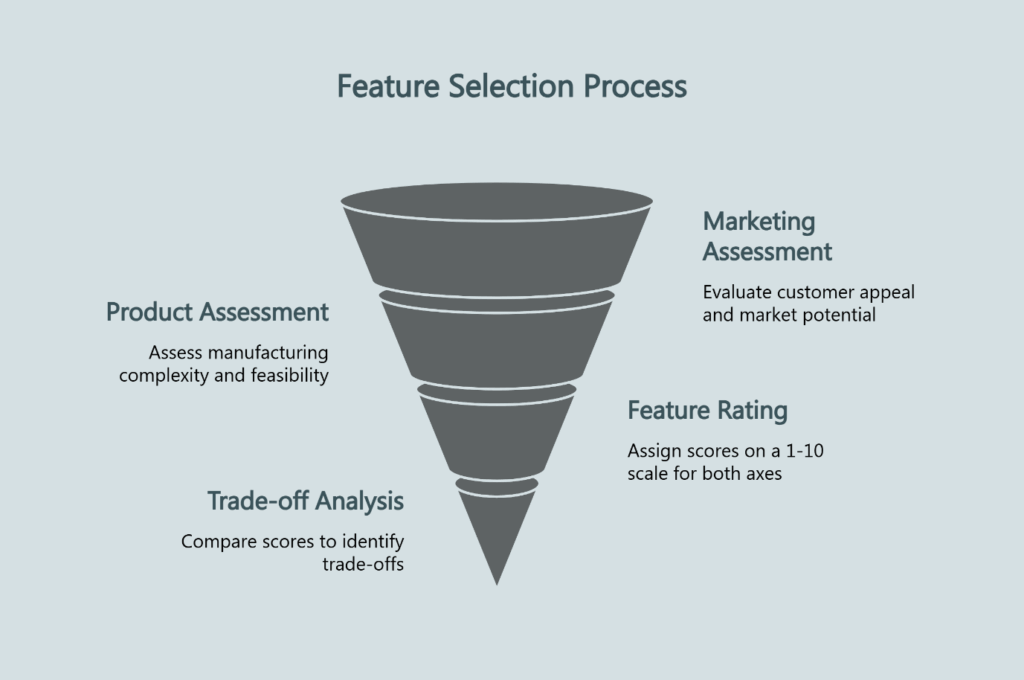
What if you could stop turning feature selection into a political negotiation? We propose a structured approach that transforms subjective debates into objective, data-driven discussions by plotting potential features on two critical axes.
Here’s how this proposed framework works: A shared decision framework reduces internal team conflict by giving every stakeholder—from marketing to product development—a common language for evaluating opportunities.
The Feature Value Matrix: A Proposed Decision-Making Tool
Customer Appeal Score (Marketing Input)
- Market research data
- Customer feedback intensity
- Competitive differentiation potential
- Brand story enhancement value
Manufacturing Complexity Score (Product Input)
- Engineering requirements
- Tooling and setup costs
- Quality control challenges
- Timeline implications
The concept involves rating each potential feature on both axes using a simple 1-10 scale. Marketing would provide the customer appeal assessment based on market research and brand strategy. Product development would evaluate manufacturing complexity considering engineering requirements, tooling costs, and production feasibility.
This approach isn’t about one team overruling the other—it’s about creating transparency around trade-offs so you can make informed decisions together.
Axis 1: Quantifying Customer Appeal (The Marketing Input)
Customer appeal typically goes beyond gut feelings and creative inspiration. Marketing teams generally evaluate features based on concrete criteria that tie directly to business outcomes.
Common starting points include market research data and customer feedback. What are your target customers specifically requesting? (Not what you think they want—what they’re actually telling you they want.) Consider competitive differentiation potential. Does this feature create a meaningful distinction from what’s already available in your market segment?
You might also evaluate brand story enhancement value. Some features might not drive immediate sales but could strengthen your overall brand narrative and customer loyalty over time.
Axis 2: Gauging Manufacturing Complexity (The Product Input)
Manufacturing complexity typically isn’t just about whether something can be built—it’s about whether it can be built profitably and reliably at scale.
Product teams generally need to assess engineering requirements honestly. What new processes, materials, or quality control measures would this feature potentially demand? Consider tooling and setup costs, including any specialized equipment or training your manufacturing partner might need.
Timeline implications often matter enormously. A feature that could delay your entire product launch by several months might not be worth pursuing, regardless of its market appeal.
Business Impact: This dual-axis approach can help prevent costly miscommunications between departments. When marketing understands manufacturing constraints upfront, and product development grasps market imperatives, teams are positioned to make decisions that support both innovation and profitability.
The Four Quadrants: Making Smart, Collaborative Decisions
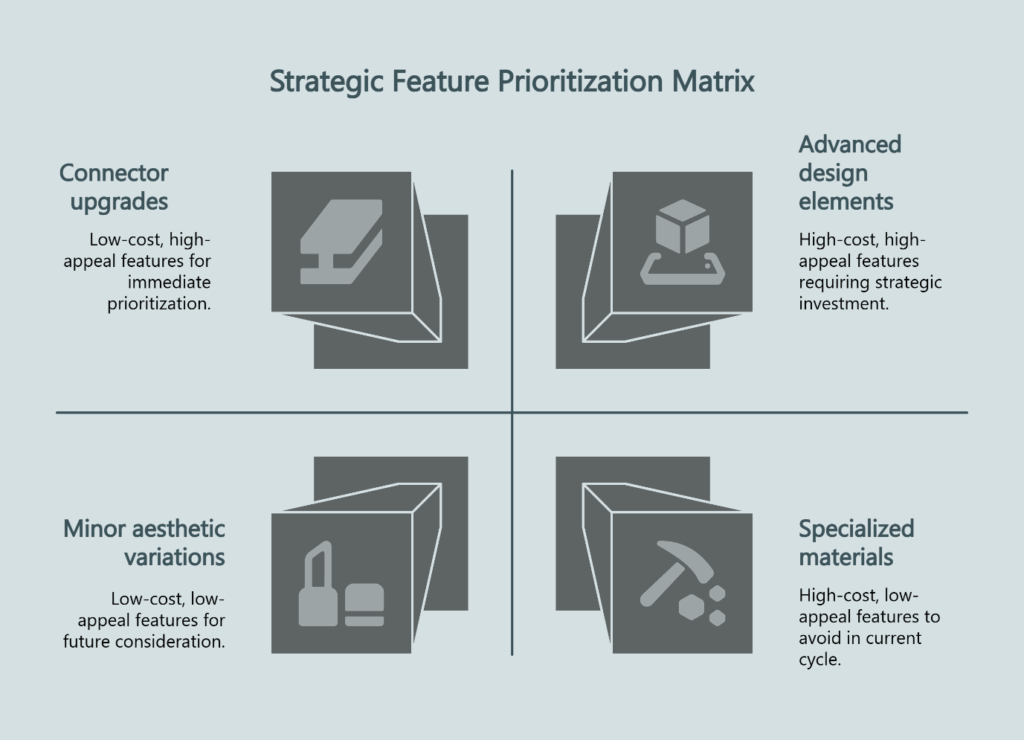
Once you’ve plotted your potential features on the matrix, four distinct quadrants emerge—each suggesting a different strategic approach.
Quadrant 1: The Quick Wins (High Appeal, Low Cost)
Features landing here may deserve immediate prioritization. These represent your China speaker manufacturer opportunities—high customer appeal with manageable manufacturing complexity.
For audio products, this might include certain connector upgrades that improve durability while using standard manufacturing processes, or specific finish options that enhance perceived value without requiring new production equipment.
Quick wins can form the foundation of profitable product lines because they deliver customer value without stretching your resources thin.
Quadrant 2: The Strategic Investments (High Appeal, High Cost)
These features typically require careful consideration and planning. High customer appeal may justify the investment, but significant manufacturing complexity demands strategic timing and resource allocation.
Consider advanced design elements that could differentiate your brand but require substantial engineering development and specialized Amplifier Manufacturers capabilities. These aren’t automatic rejections—they’re strategic decisions that need proper business case development.
Technical Note: When evaluating strategic investments, assess whether the manufacturing complexity is one-time (new tooling) or ongoing (specialized materials). One-time complexity often justifies investment for high-appeal features, while ongoing complexity requires careful margin analysis.
Quadrant 3: The Backlog/Optional (Low Appeal, Low Cost)
Low-cost features with limited customer appeal aren’t necessarily bad—they’re just not priorities. These might include minor aesthetic variations or basic functionality that doesn’t significantly differentiate your product.
Consider these features for future product iterations or as optional configurations that don’t delay your main product launch.
Quadrant 4: The Resource Drains (Low Appeal, High Cost)
It’s generally advisable to avoid these features during your current development cycle. High manufacturing complexity combined with low customer appeal can represent resource waste.
However, don’t discard these concepts permanently. Market conditions change, and manufacturing processes evolve. What’s prohibitively complex today might become feasible tomorrow.
How a True OEM Partner Facilitates This Process
Here’s where many audio retailers discover a crucial insight: Cross-functional alignment prevents unprofitable product launches—but only when you have accurate data for both sides of the equation.
Your marketing team probably has solid customer appeal data. They know your market, understand customer feedback, and can assess competitive positioning. But accurately gauging manufacturing complexity? That requires deep manufacturing expertise most retailers don’t possess internally.
A true manufacturing partner doesn’t just take orders; they provide the engineering and market insight to help you make smarter, more profitable product decisions. Many retailers face challenges with OEM Car Audio Manufacturer relationships where suppliers may not provide honest assessments of feasibility or cost implications.
Day-to-Day Application: During feature evaluation meetings, your OEM partner should actively participate in scoring manufacturing complexity. They should flag potential issues before they become expensive problems and suggest alternative approaches that maintain customer appeal while reducing costs.
This framework represents a key part of a larger strategy for de-risking your supply chain. For a complete guide, see our framework for [REF::when-choosing-an-oem-partner-creates-supply-chain-risk-a-framework-for-vetting-and-securing-your-car-audio-manufacturing].
Common Pitfalls to Avoid When Prioritizing Features
Even with a solid framework, certain mistakes can potentially derail your feature selection process. Here are some problematic approaches that retailers may encounter.
Chasing Trends Instead of Brand Alignment
Market trends capture attention, but they don’t automatically align with your brand strategy or customer base. Before pursuing the latest industry buzzword, honestly assess whether it strengthens your unique market position.
A Pro Audio Equipment Supplier might be tempted to add connectivity features because they’re trending, but if your core customers value pure audio performance over technology integration, you may be pursuing the wrong differentiation.
Underestimating the “Last 10%” of Manufacturing Complexity
Initial feasibility assessments can sometimes miss final complexity details—the small elements that become expensive obstacles during actual production. Quality control requirements, packaging modifications, and regulatory compliance can potentially transform a “simple” feature into a major cost center.
Consider building buffer into your complexity assessments. What seems straightforward in concept can become problematic in execution.
Expert Q&A
Question: How do we balance product cost and marketing features effectively?
Answer: The key isn’t just balancing, but integrating. You balance cost and features by using a shared framework, like the Feature Value Matrix, where both marketing’s customer insights and product’s manufacturing constraints are weighted equally. This shifts the conversation from a tug-of-war to a collaborative analysis of what is both desirable and feasible, ensuring the final decision supports profitability.
Myth: Choosing product features is purely a marketing or a product decision.
Fact: Feature selection is a strategic business decision that requires a unified framework balancing market appeal, manufacturing feasibility, and overall profitability. It’s a team sport, not a solo task.
What If…? Planning for an Unprofitable ‘Hit’ Feature
Your biggest concern might be selecting a feature that customers love but destroys your margins. It’s a legitimate worry that keeps many product managers awake at night—and one that deserves a proactive response plan.
First, recognize that this scenario may be preventable with honest upfront assessment. Unprofitable “hits” can result from inadequate manufacturing complexity evaluation or scope creep during development. Your Feature Value Matrix should help flag these risks before they materialize.
If you do find yourself with a popular but unprofitable feature, you typically have three strategic options. You can redesign the feature to reduce manufacturing complexity while maintaining customer appeal. You can position it as a premium option with pricing that supports the additional costs. Or you can develop a roadmap to make the feature profitable through improved manufacturing processes or higher volumes.
The key is having this conversation during feature selection, not after product launch when your options become much more limited.
A Question You Should Be Asking
The Unasked Question: “How do we strategically sunset features or products that no longer align with our brand or profitability goals?”
Why It Matters: Without a plan for removal, product lines can become bloated, confusing to customers, and drain resources from more profitable ventures.
The Expert Answer: Regularly audit your product line using the same Feature Value Matrix approach. Features that have migrated into the “Low Appeal” quadrants are candidates for being sunsetted. This should be a planned process, not a reactive decision, involving inventory sell-down, marketing communication, and offering a clear upgrade path to a newer, more valuable product.
Conclusion: From Feature List to a Profitable Product Roadmap
The Feature Value Matrix isn’t just a decision-making tool—it’s a foundation for building consensus between teams that historically operated in conflict. When marketing understands manufacturing realities and product development grasps market imperatives, your entire organization makes better decisions.
This framework transforms feature selection from political negotiation into strategic analysis. More importantly, it gives you confidence that your choices support both customer satisfaction and business profitability.
While this framework is ideal for individual product decisions, the next step is to apply this thinking to your entire product portfolio. As you advance in your career toward product portfolio strategy and brand management roles, this collaborative approach to feature evaluation becomes even more critical. The ability to build consensus around data-driven decisions—rather than departmental preferences—will serve as a cornerstone skill as you take on broader strategic responsibilities.
Ready to partner with a manufacturer who understands the balance between market appeal and manufacturability? Request a Custom OEM Quote and let’s build your next winning product together.
Our Editorial Process
This content was drafted with AI assistance and has been reviewed, fact-checked, and edited by the expert humans on our Insights Team to ensure accuracy and clarity.