📌 Key Takeaways
Choose a new subwoofer platform when the product changes the core design, proof needs, production controls, or ownership.
- Judge Meaningful Commonality: Shared parts matter only when the architecture, evidence, production controls, and ownership also remain aligned.
- Protect the Product Role: Each added model should serve a clear use case without creating heavy overlap with nearby products.
- Test Reuse Honestly: Existing proof applies only when new performance targets stay within the conditions that earlier tests covered.
- Control Every Extension: Define what stays fixed, what may change, which evidence needs updates, and who owns the product.
- Pause Unsupported Decisions: Delay classification when teams have not confirmed key assumptions about architecture, tooling, or testing.
Real commonality matters more than shared parts.
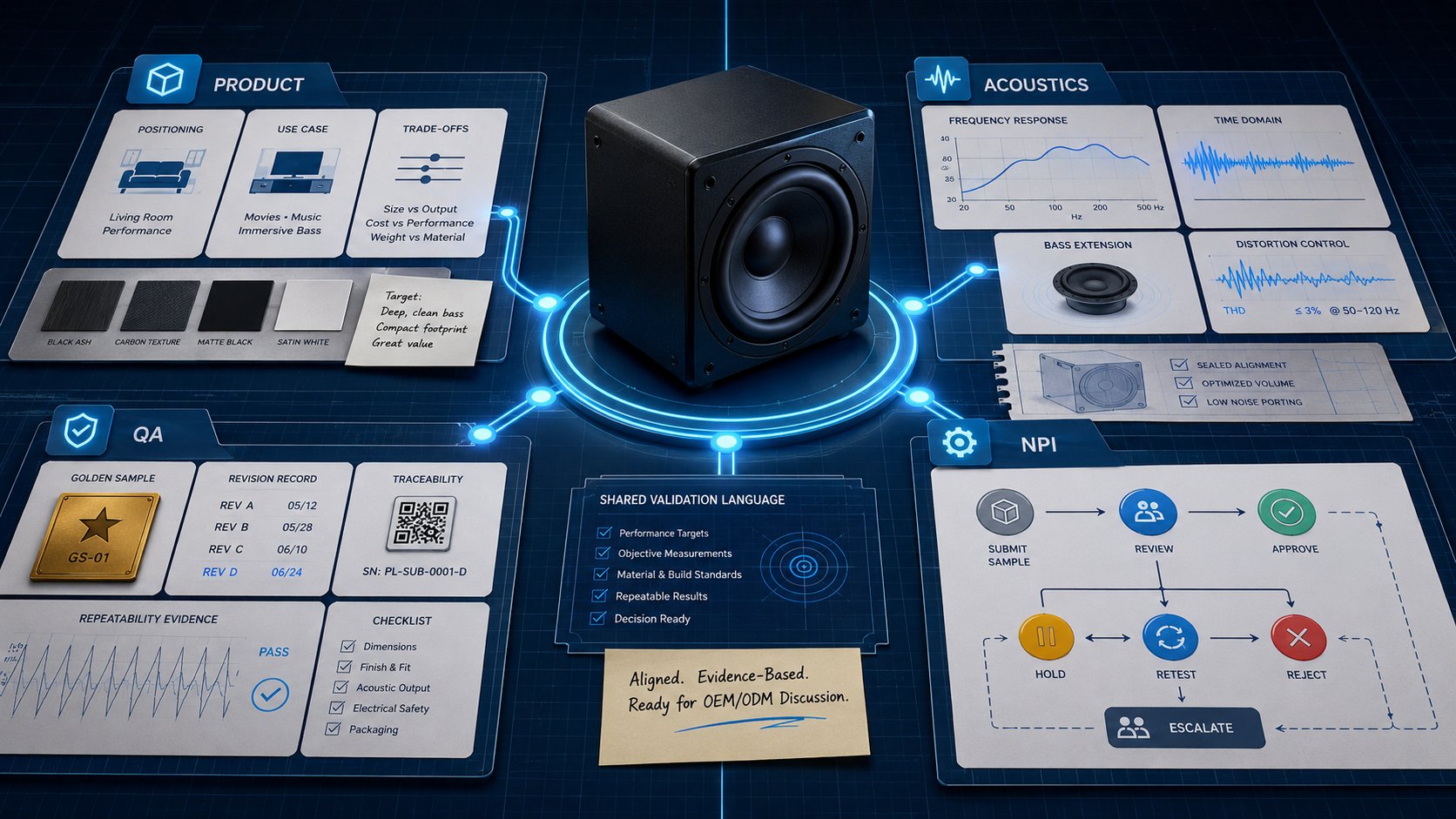
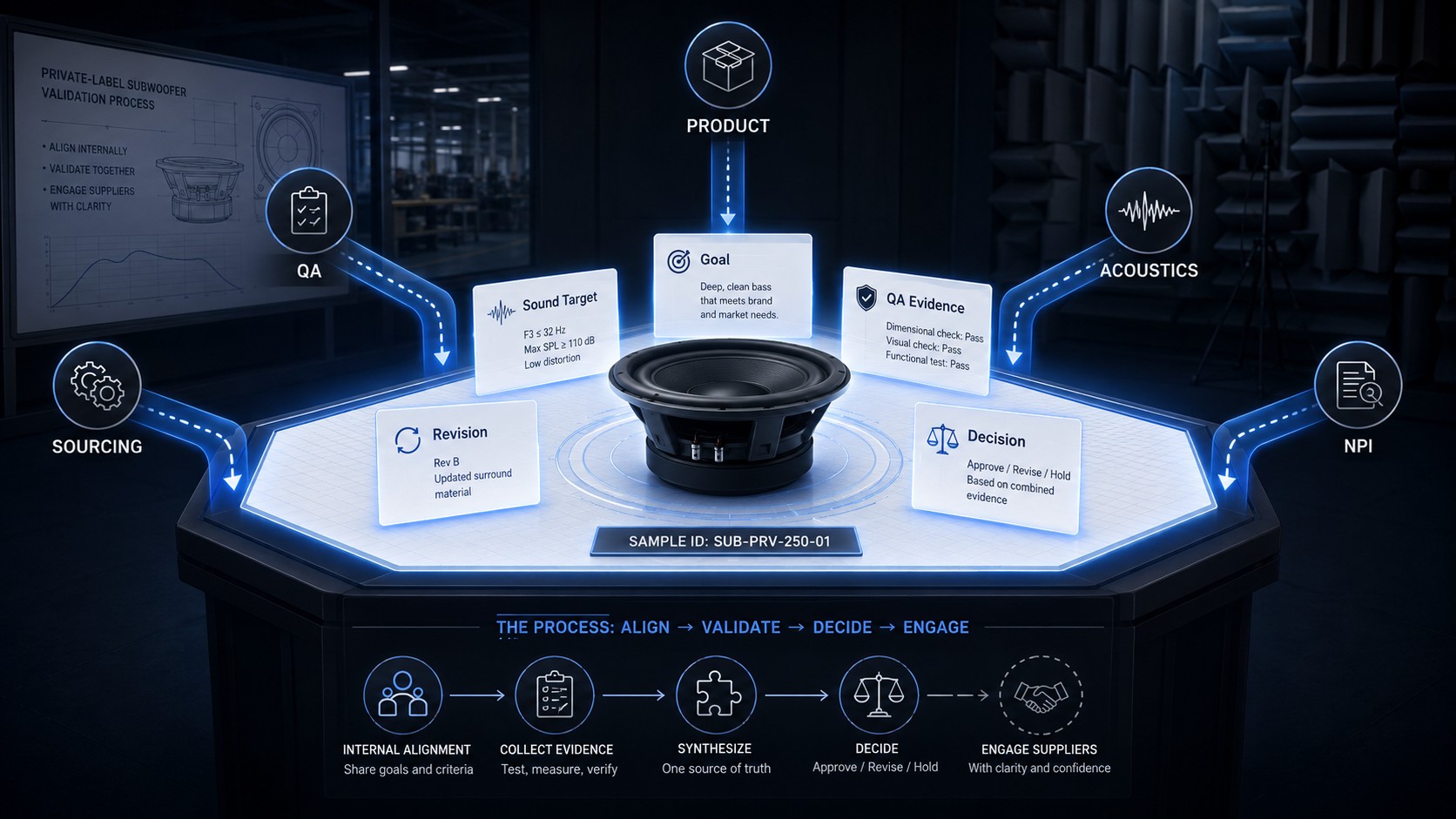
Product, engineering, quality, sourcing, and leadership teams will make clearer roadmap choices using the decision framework below.
~ ~ ~ ~ ~ ~ ~ ~ ~ ~ ~ ~ ~ ~ ~ ~ ~ ~
A proposed subwoofer can appear to be a straightforward derivative because it shares a diameter, basket family, or nominal specification with an existing model. Yet it may create different engineering, QA, sourcing, documentation, and lifecycle obligations.
A controlled line extension is more defensible when the product serves an adjacent use case, preserves a genuinely shared core, and remains inside a manageable validation and governance envelope. A new platform is more defensible when packaging, performance, process, proof requirements, or portfolio role change the underlying design problem.
Neither novelty nor reuse is inherently preferable. The decision is whether commonality remains meaningful and governable. This is an editorial framework, not a universal engineering rule. Any conclusion about a particular architecture, tooling set, or process requires current program evidence and qualified review.
Define the Boundary: Controlled Extension Versus New Platform
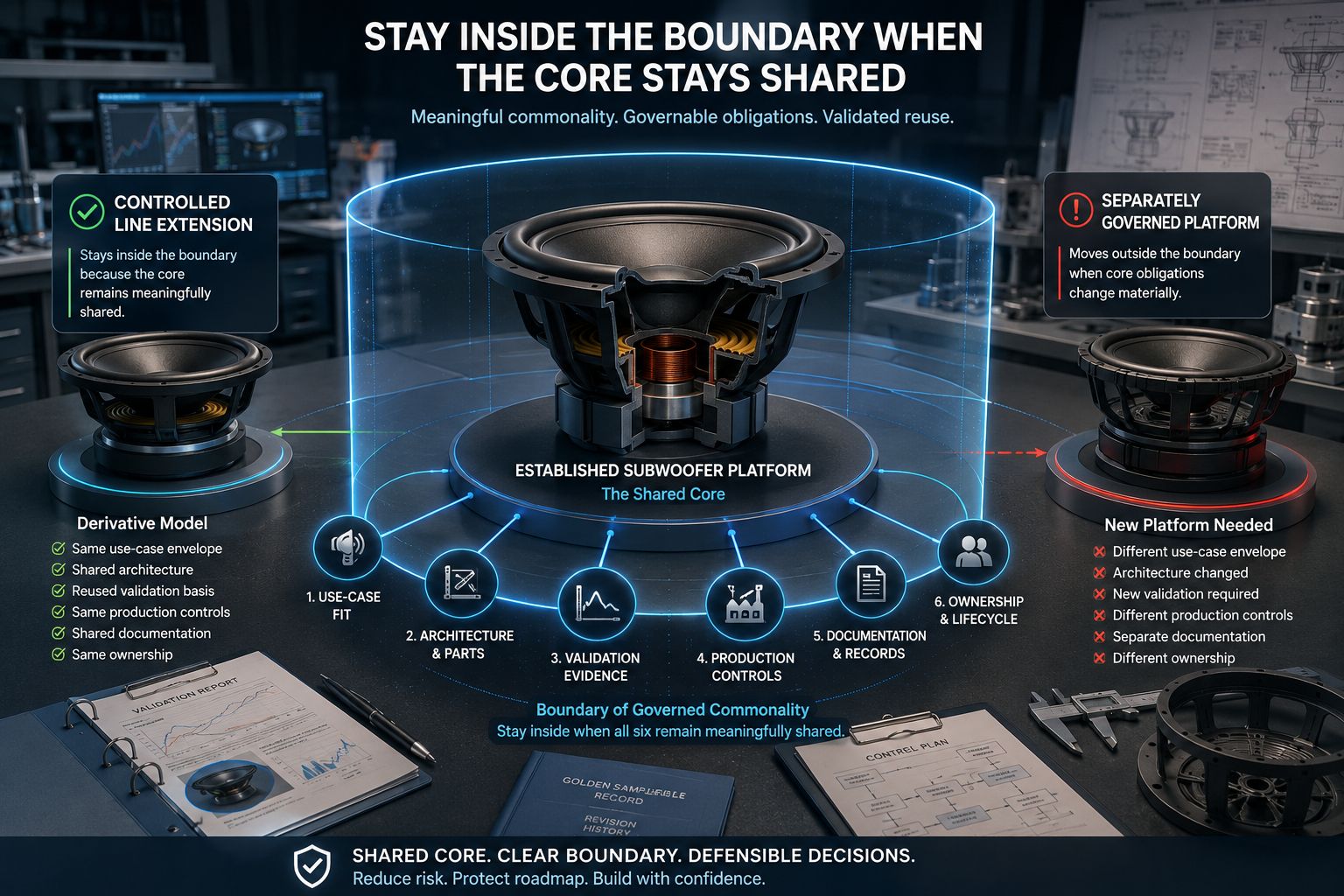
For this framework, a platform is the shared technical and organizational core that allows related products to use substantially common architecture, evidence, controls, documentation, and ownership. A controlled line extension varies within boundaries that have been explicitly defined. A new platform solves a materially different problem and therefore needs separately governed decisions.
| Controlled line extension | New platform |
|---|---|
| Serves the existing use case or a closely adjacent one | Addresses a materially different installation or performance problem |
| Retains a meaningful shared core | Requires major architectural changes or recurring independent design decisions |
| Reuses substantial validation assumptions and manufacturing controls | Introduces materially different proof requirements or process controls |
| Fits existing documentation, ownership, and lifecycle governance | Needs separate documentation, ownership, or lifecycle management |
| Adds clear coverage without blurring nearby product roles | Establishes a durable category or differentiation basis |
Shared appearance, diameter, tooling, or individual components do not settle the classification. A common basket with different thermal, mechanical, or validation demands may represent nominal reuse rather than a coherent platform. Conversely, a new size does not automatically require separate development when the use case, architecture, process assumptions, and evidence remain aligned.
This distinction gives Product, Engineering, Acoustics, QA, Sourcing, and leadership a common vocabulary. Product owns portfolio role, technical teams assess feasibility, QA evaluates proof, Sourcing reviews supplier fit, and leadership judges governability.
Five Conditions That Favor a Controlled Line Extension
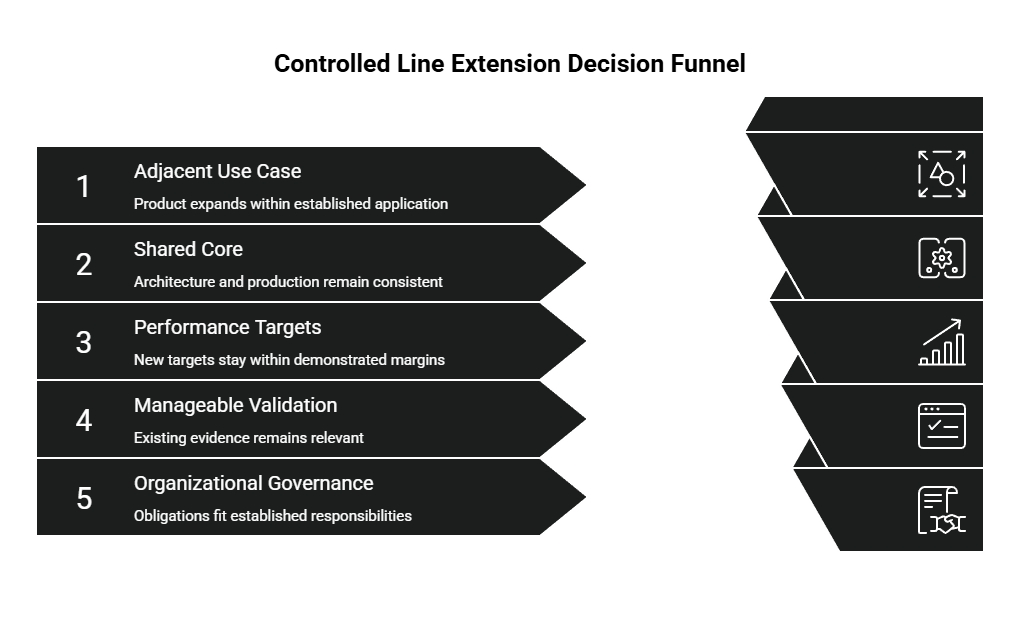
A controlled extension is credible when five conditions point in the same direction.
1. The intended use case is adjacent. The product expands coverage inside an established application instead of solving a fundamentally different installation problem. A narrower cosmetic, impedance, or positioning variation may qualify only when the product’s role remains clear.
2. The shared core remains meaningful. Commonality should include more than visible parts or headline specifications. The architecture, tooling logic, materials strategy, production assumptions, and change controls should remain substantially shared. Program-specific component compatibility must be confirmed from current drawings, specifications, and engineering review.
3. Performance targets remain inside demonstrated margin. Prior evidence is reusable only when the new target stays within the conditions it represents. Similar roadmap numbers do not prove equivalent thermal, mechanical, acoustic, or durability behavior.
4. The validation delta is manageable. An extension is more plausible when existing evidence, golden-sample logic, production controls, and acceptance assumptions remain substantially relevant. Teams should examine how use-case assumptions shape subwoofer validation priorities before assuming a small specification change creates a small proof burden.
5. The organization can govern the added variant. Every derivative creates documentation, ownership, change-control, and lifecycle obligations. The extension remains controlled only when those obligations fit established responsibilities rather than creating separate informal processes.
Consider a hypothetical adjacent derivative: an impedance option or modest finish change preserves the use case, architecture, controls, and validation assumptions. That may support extension classification, provided approval names what stays fixed, what may vary, and what triggers renewed review.
Schedule pressure and tooling investment can make reuse feel inevitable. Neither is sufficient. Reuse is valuable only when the product remains genuinely shared.
Signals That the Use Case Needs a New Platform
A separate platform may be justified when the proposal changes the central design or governance problem.
Installation depth, package geometry, mounting assumptions, or the operating environment can create architectural discontinuity. In a hypothetical slim subwoofer scenario, reduced depth becomes the primary constraint. That constraint may alter architecture, excursion, thermal behavior, materials, and production controls. “Slim” does not automatically mean “new platform”; the classification depends on the actual design and validation delta.
Performance expansion can create a similar break. In a hypothetical high-power scenario, the required mechanical and thermal envelope may depart materially from the current line. If output, durability, or thermal behavior requires separate architecture and proof, the existing platform label may conceal the work. “High-power” is not itself a universal threshold.
Distinct tooling, materials, process controls, supplier capabilities, or failure concerns strengthen the case for separate development. So does a product role that cannot remain clear inside the parent line. Cosmetic changes or a slightly different headline specification are weak foundations when two SKUs still address the same use case.
A hypothetical constrained-platform scenario illustrates the long-term risk. A team repeatedly modifies one architecture for increasingly different products. Accumulated exceptions narrow future options and turn each change into a cross-product negotiation. A new platform may then preserve roadmap flexibility rather than represent unnecessary overengineering.
The strongest discontinuity signals are:
- A materially different use case or package constraint
- Major changes to the shared architecture
- New validation concerns or manufacturing controls
- A separate, durable portfolio role
- Governance needs that no longer fit the parent platform
- Reduced flexibility for future products
These signals guide classification; they do not establish technical feasibility. A specific architecture can be approved only after qualified stakeholders review current product documentation, relevant measurements, and manufacturing implications.
Use the Platform-or-Extension Decision Matrix
Apply the matrix before specifications, supplier commitments, tooling, or sampling harden the decision. Do not assign a universal score. Record evidence, identify owners, and treat unsupported assumptions as unresolved.
| Decision dimension | Favors a controlled extension | Favors a new platform | Evidence or owner |
|---|---|---|---|
| Product use case | Existing or closely adjacent use case | Materially different installation or performance problem | Product or Category |
| Shared architecture | Core architecture and process remain meaningfully common | Major redesign or recurring independent design decisions | Engineering |
| Performance envelope | Targets remain inside demonstrated margin | Substantially different thermal, mechanical, or acoustic demands | Acoustics and Engineering |
| Validation delta | Existing evidence and controls remain substantially reusable | New failure concerns or materially different proof requirements | QA |
| Tooling and process | Changes fit established tooling and production assumptions | Distinct tooling, materials, controls, or supplier capabilities | Engineering and Sourcing |
| Portfolio role | Fills a clear gap without heavy overlap | Creates a durable category or differentiation basis | Product or Category |
| Organizational ownership | Fits existing documentation and lifecycle controls | Requires separately governed ownership and records | Product, QA, and Sourcing |
| Future roadmap | Preserves options for the parent platform | Constrains later products or overloads the shared core | Leadership and Product |
The pattern across rows matters more than one favorable answer.
- Extension is more plausible when the use case is adjacent, technical commonality is real, validation remains substantially reusable, and ownership is clear.
- A new platform is more plausible when the use case changes materially, the core requires redesign, and validation or governance becomes independent.
- Classification should pause when the commercial role appears attractive but architecture, tooling, or validation assumptions remain unverified.
A hypothetical overlapping derivative might share most components yet offer no distinct use case. Strong technical commonality and weak portfolio clarity may indicate that the SKU should not exist.
Cost and speed may inform the business case, but neither should override fit. A separate platform is not automatically innovative, and reuse is not automatically efficient. Sampling cannot repair an unclear product role or ownership model.
For broader portfolio context, see Planning Your First 3 SKUs and Escaping the “Sea of Sameness”.
For measurement terminology, consult primary or official resources such as the Audio Engineering Society’s standards resources. KLIPPEL’s official measurement overview can clarify vendor-specific capabilities, but it should not be treated as independent proof.
Govern the Extension Before It Becomes Platform Proliferation
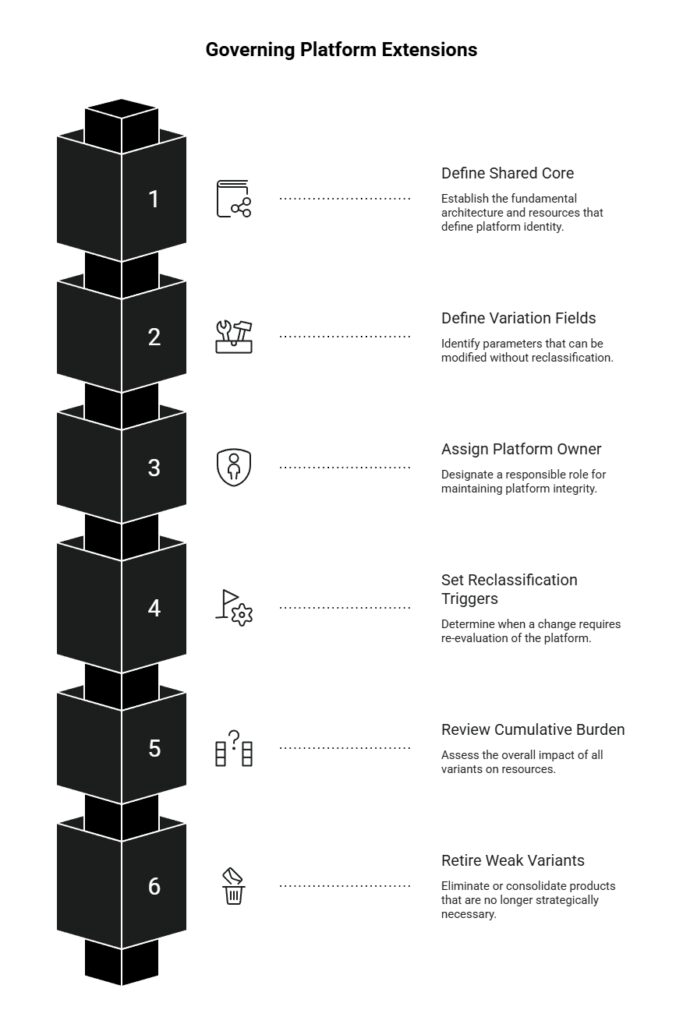
Approval is the beginning of variant governance, not the end. Repeated exceptions can fragment documentation, validation assumptions, supplier controls, and lifecycle ownership.
Use six governance rules:
- Define the fixed shared core. Record which architecture, tooling, materials, process, and validation assumptions preserve platform identity.
- Define controlled variation fields. State which parameters may change without automatic reclassification.
- Assign an owner for platform integrity. One accountable role must be able to challenge a derivative that weakens commonality or portfolio clarity.
- Set reclassification triggers. Renew the decision when a change crosses the application envelope, creates new proof requirements, alters production controls, or changes the primary product role.
- Review cumulative burden. Assess all variants together rather than assuming each additional SKU creates negligible work.
- Retire or consolidate weak variants. Existing files, tooling, or historical investment do not make an overlapping product strategically necessary.
This is executive governance, intended to preserve platform clarity and cross-functional accountability.
Document four items for every extension: what remains shared, what may vary, what evidence must be refreshed, and who owns the lifecycle. A supplier’s initial “possible” answer is not production-readiness evidence; unresolved items remain open until qualified review is complete.
Frequently Asked Questions
Does a New Subwoofer Size Automatically Require a New Platform?
No. Size is one decision input. A new size may remain a controlled extension when the use case, shared core, process assumptions, validation basis, and portfolio role remain aligned. It may require separate development when the size creates materially different packaging or performance demands.
How Much Commonality Is Enough for a Controlled Line Extension?
There is no universal percentage. Part counts can hide differences in performance margin, tooling, validation, or ownership. Commonality is sufficient when the shared core remains technically meaningful and the derivative can be governed without parallel informal systems.
When Should a Slim or High-Power Subwoofer Become a Separate Platform?
When the packaging or performance target materially changes the architecture, proof burden, manufacturing controls, product role, or future roadmap. The category label alone is not decisive. Program-specific classification requires current evidence and qualified technical review.
Decide the Platform Boundary Before Specifications Harden
Platform reuse is valuable when commonality remains real, the product role is distinct, and the added obligations stay governable. Separate development is justified when the use case changes the core design, validation, or ownership problem.
Before supplier work advances, apply the matrix and document the fixed core, controlled variables, unresolved assumptions, evidence owners, and reclassification triggers. That record gives Product, Engineering, Acoustics, QA, Sourcing, and leadership a defensible basis for the roadmap decision.
Get in Touch to discuss platform fit for a defined automotive bass use case.
Disclaimer: This article is for general informational purposes only. It is not a substitute for advice from a qualified professional, provider, or official source relevant to your situation. Always verify important decisions with the appropriate expert, authority, or service provider.
Our Editorial Process:
Our expert team uses AI tools to help organize and structure our initial drafts. Every piece is then extensively rewritten, fact-checked, and enriched with first-hand insights and experiences by expert humans on our Insights Team to ensure accuracy and clarity.
About the China Future Sound Insights Team
The China Future Sound Insights Team is our dedicated engine for synthesizing complex topics into clear, helpful guides. While our content is thoroughly reviewed for clarity and accuracy, it is for informational purposes and should not replace professional advice.