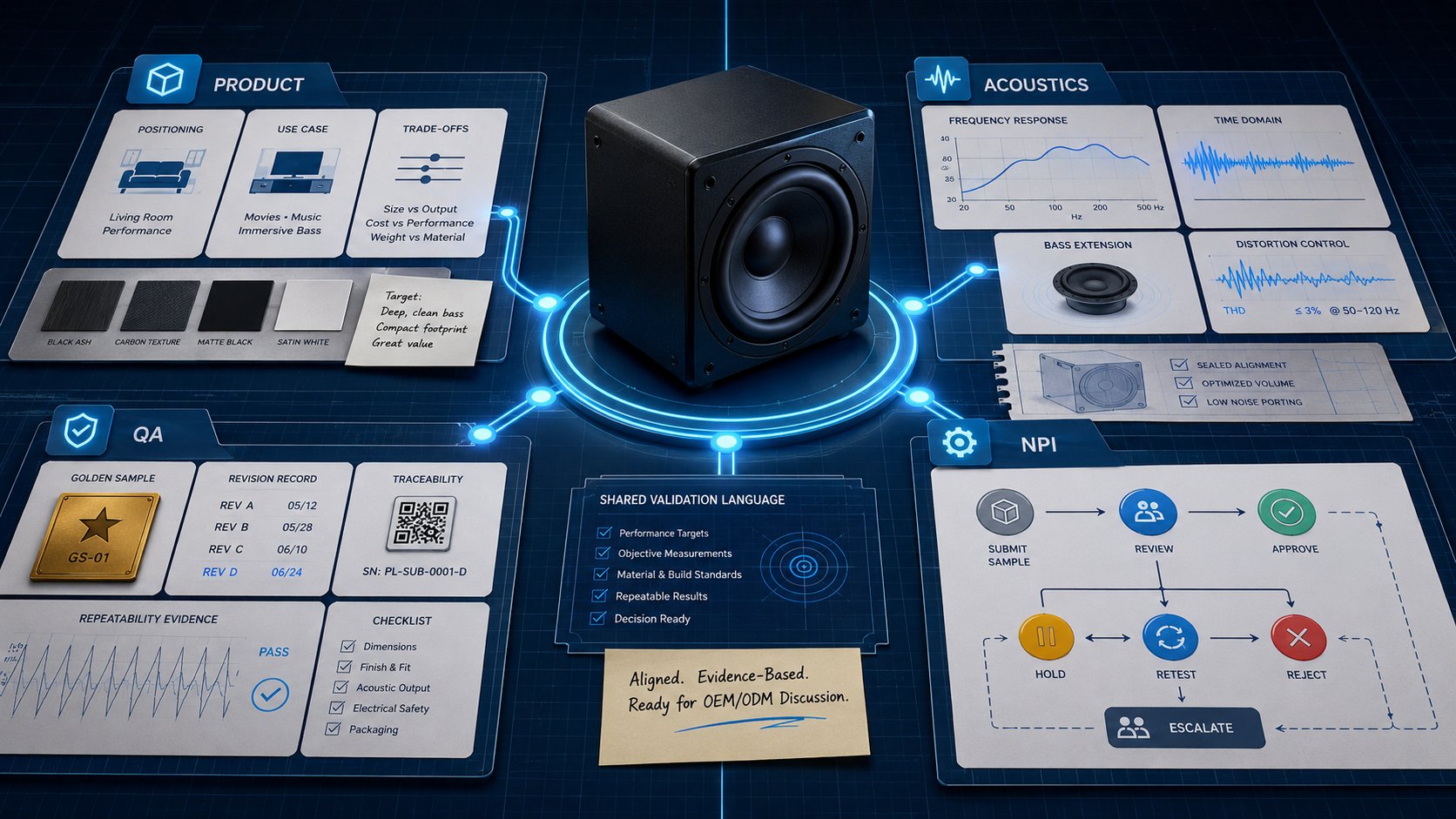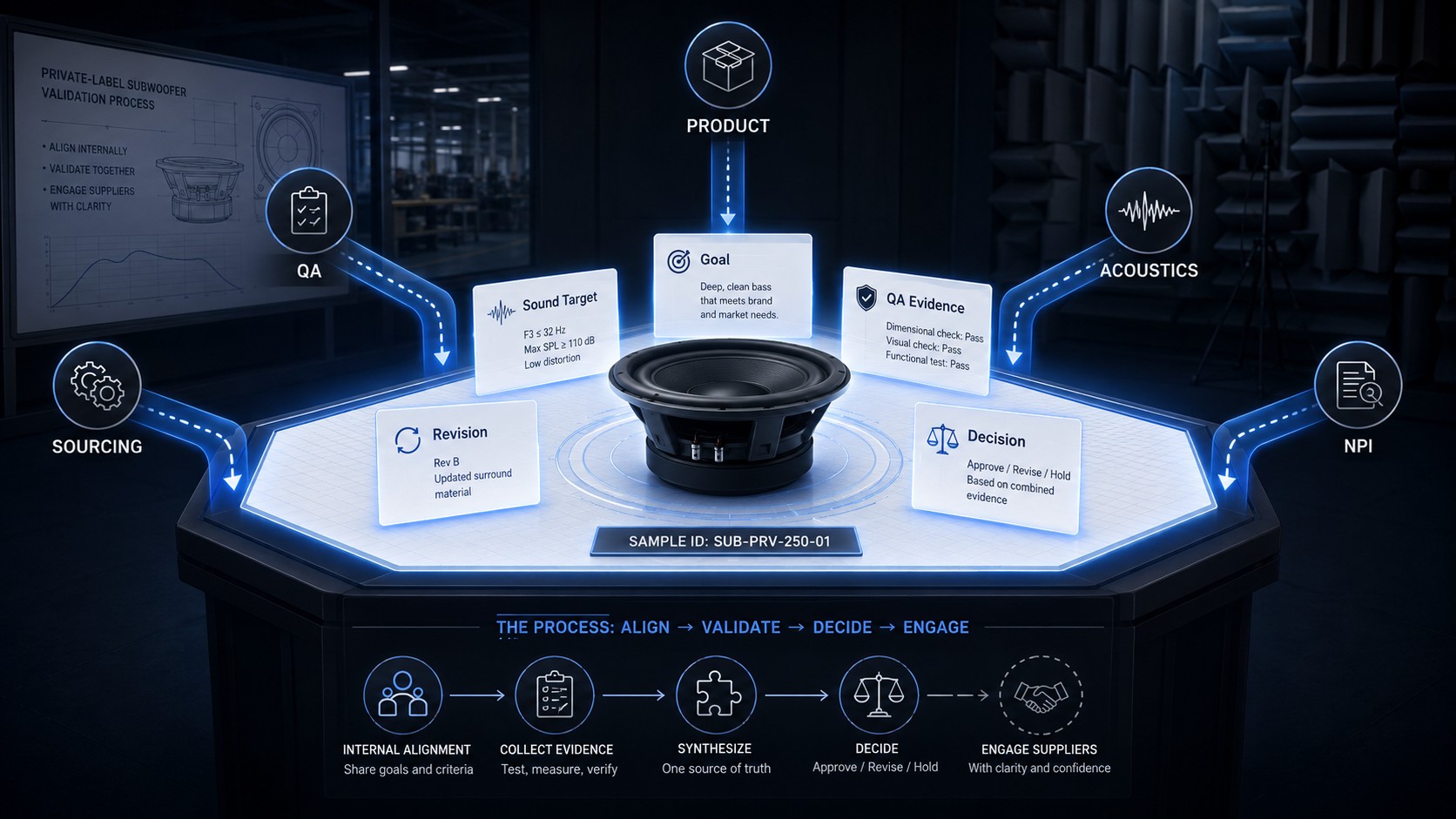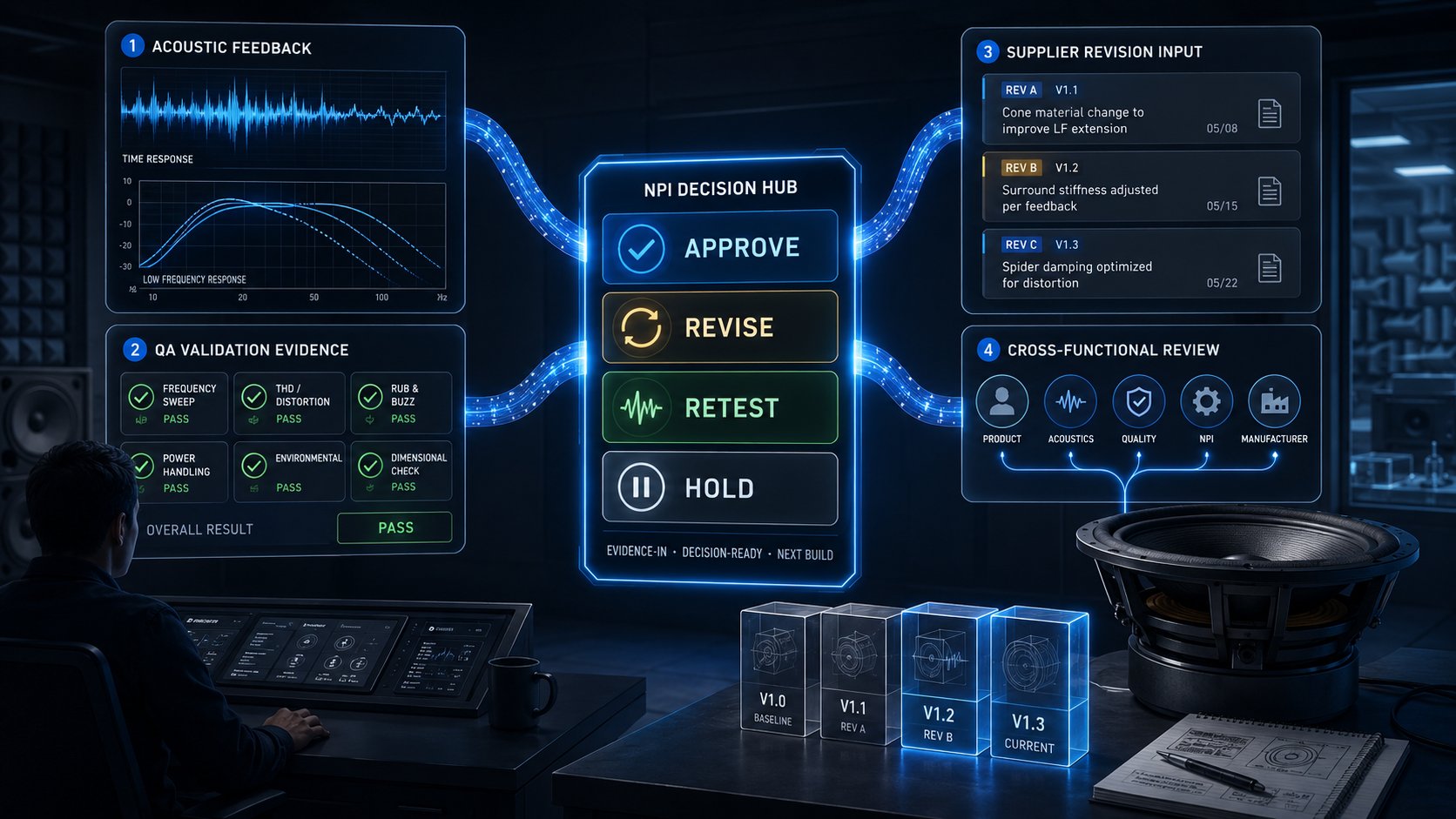
📌 Key Takeaways
Sample review works best when every sound, quality, and product concern leads to a clear next decision.
- Decide The Purpose: Every sample round should answer one question: approve, revise, retest, or hold.
- Make Feedback Buildable: Turn vague sound comments into clear requests the manufacturer can test and act on.
- Keep Evidence Together: Shared notes, test references, and open risks help teams avoid scattered opinions.
- Track Every Change: Revision logs show what changed, why it changed, and how success will be checked.
- Align Before Building: Product, acoustics, quality, NPI, and the manufacturer should agree before the next sample.
Clear evidence turns sample review from opinion-sharing into better product decisions.
Audio brand teams managing private-label sample reviews will gain a cleaner review process, preparing them for the detailed overview that follows.
~ ~ ~ ~ ~ ~ ~ ~ ~ ~ ~ ~ ~ ~ ~ ~ ~ ~
A sample can sound promising and still be difficult to approve.
In New Product Introduction, or NPI, sample review often breaks down when feedback is scattered across listening impressions, acoustic measurements, QA concerns, and supplier comments. Acoustics may focus on tuning and distortion. QA may look for repeatability, reliability direction, and inspection evidence. Product may care about whether the sample supports the intended brand position. NPI has to turn all of that into a clear next decision: approve, revise, retest, or hold.
For private-label audio and subwoofer programs, sample review should not end with comments such as “bass feels weak” or “the sample sounds close.” It should produce decision-ready evidence, a manufacturer-ready revision request, and clear ownership before the next sample round.
The goal is not to turn the review into a lab procedure. It is to create a controlled sample review loop where acoustic feedback, validation evidence, QA confidence, and manufacturer revision cycles stay connected.
1. Define What the Sample Is Supposed to Prove
Every sample round should have a decision purpose. Without that purpose, teams may judge the same sample against different definitions of “ready.”
A first acoustic sample may only need to show whether the tuning direction is close enough to continue development. A later sample may need to show whether a revision solved a specific distortion concern. A pre-production sample may need stronger evidence around build consistency, process control, or golden sample readiness.
For NPI teams, the useful question is simple: what decision should this sample support?
Common sample-review purposes include:
| Sample review purpose | What the team is trying to decide |
|---|---|
| Acoustic direction | Whether the tuning, low-frequency behavior, and listening character support the intended program position |
| Fit, form, or mechanical build | Whether the sample supports the required enclosure, mounting, packaging, or integration constraints |
| Target performance range | Whether acoustic behavior appears close enough to agreed review targets under defined conditions |
| Reliability concern | Whether early power, thermal, or mechanical concerns need more validation before the next gate |
| Golden sample readiness | Whether the sample is stable enough to become a controlled reference candidate |
| Revision verification | Whether a previous change addressed the intended issue without creating a new trade-off |
| Supplier process confidence | Whether the manufacturer can explain what changed, why it changed, and how the next sample will be controlled |
This distinction helps prevent premature approvals. A sample may be acceptable for acoustic direction but not yet ready for broader qualification. Another may pass a mechanical review while still needing QA evidence before the program advances.
For teams managing subwoofer manufacturing capabilities or broader private-label audio platforms, that clarity matters because acoustic tuning, enclosure fit, power behavior, and production consistency may mature at different points in the program.
2. Translate Acoustic Feedback Into Revision-Ready Language
Acoustic feedback can start as a listening impression, but it should not stay there. “Bass feels soft,” “it breaks up loud,” or “make it tighter” may reflect a real concern. The problem is that those comments are hard for a manufacturer to act on.
Revision-ready feedback connects the observation to the condition, the expected behavior, the evidence source, and the requested action.
| Feedback type | Weak version | Better manufacturer-ready version |
|---|---|---|
| Listening impression | Bass feels soft | Low-frequency output does not meet the agreed target range in the intended enclosure condition; review motor, enclosure, or tuning options. |
| Distortion concern | It breaks up loud | Confirm distortion behavior at the agreed review condition and identify whether the issue appears thermal, mechanical, or tuning-related. |
| Consistency concern | Samples do not match | Compare sample-to-sample parameter spread against the agreed acceptance range before approving the next build. |
| Revision ambiguity | Improve it | State what must change, what must remain unchanged, and what evidence will confirm the next sample. |
Avoid feedback that cannot be built. A supplier cannot reliably act on comments that do not define the problem, the boundary, or the confirmation method. The stronger version gives the manufacturer a target and protects the brand team from vague revision loops.
This is where acoustic feedback boundaries matter. Acoustic teams should define what the sample demonstrates about response, distortion, tuning, or enclosure behavior. QA should clarify whether the evidence supports repeatability or reliability direction. Product should confirm whether the proposed change still fits the program position.
China Future Sound states that its R&D team includes Acoustics, Electronics, Structure, and Software Development functions. The company reports utilizing finite element simulation software, KLIPPEL R&D systems, and standard durability protocols, including short-term destructive power tests, long-term power tests, and golden sample management, as part of its development process. These are useful examples of evidence-producing capabilities when the project scope calls for them, not proof of any guaranteed outcome. Officially, KLIPPEL describes its R&D System as supporting acoustic tests, parameter measurement, distortion measurements, accelerated life and power testing, simulation, and related loudspeaker evaluation work. (Klippel)
3. Build a Shared Evidence Packet Before the Revision Meeting
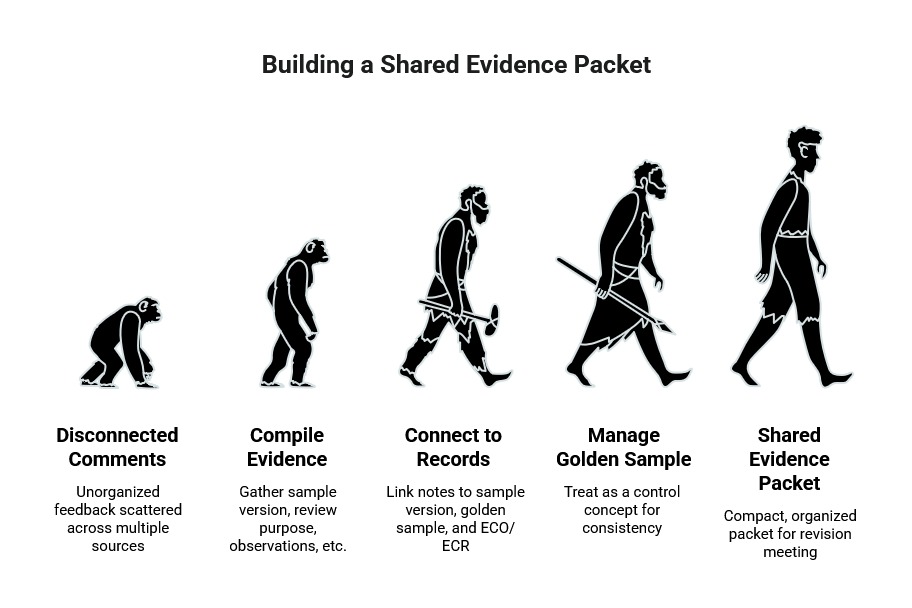
NPI teams should not send the manufacturer a pile of disconnected comments. A compact evidence packet gives the revision meeting a shared basis.
A practical evidence packet may include the sample version, review purpose, key acoustic observations, available measurement references, QA concerns, product decision criteria, required revision, change owner, open risks, decision requested from the manufacturer, and next-sample acceptance criteria.
This does not need to be lengthy. It needs to keep revision notes connected to the sample version, golden sample reference, and ECO/ECR record. ECO/ECR means Engineering Change Order or Engineering Change Request; in this context, it refers to the change-control logic used to track what changed and why.
Golden sample management should be treated as a control concept, not a one-time approval ceremony. A golden sample helps teams discuss which version is being referenced, what characteristics should remain stable, and how future production consistency may be checked. For related context, see China Future Sound’s article on golden sample integrity.
| Feedback item | Evidence artifact | Decision owner | Manufacturer action requested | Next verification step |
|---|---|---|---|---|
| Low-frequency output appears below the agreed direction | Listening notes plus acoustic review reference | Acoustics + Product | Review tuning, motor, or enclosure options without changing agreed fit constraints | Confirm low-frequency behavior in the next sample under the same review condition |
| QA needs evidence Product did not request | Inspection note, parameter comparison, or reliability concern | QA | Provide supporting data or clarify whether more testing is needed | Decide whether the next gate is revise, retest, or hold |
| Leadership needs a concise risk summary | Evidence packet and open-risk list | NPI | Confirm what changed, what remains open, and what risk is still unresolved | Summarize the decision without overstating readiness |
| Revision request may affect brand positioning | Product brief and acoustic target | Product | Confirm expected trade-offs before changing tuning direction | Product and Acoustics approve the revised boundary |
| Revision notes are disconnected from sample history | Sample ID, revision log, golden sample reference, ECO/ECR record | NPI + Manufacturer | Link the change to the correct sample version and rationale | Verify sample version control before the next build |
This matrix addresses a common NPI friction: different teams may be right about different parts of the same sample. The matrix does not force every issue into one category. It clarifies who owns the decision and what the manufacturer needs to do next.
4. Use Revision Cycles to Control Decisions, Not Just Changes
A manufacturer revision cycle should clarify three things: what changed, why it changed, and how the next sample will prove whether the change worked.
Without that discipline, teams can re-litigate the same issue in every review. One meeting focuses on low-frequency output. The next revisits distortion. A later review discovers that the earlier change affected fit, consistency, or another acoustic trade-off.
A revision log should capture the sample version, issue, evidence, change rationale, owner, and next decision gate. This keeps supplier communication specific. It also helps NPI teams explain technical risk to leadership without oversimplifying it.
For programs that need a deeper change-control model, China Future Sound’s article on engineering change control in OEM/ODM amplifier programs is a relevant internal reference.
Standard industry quality-system elements often include ISO 9001:2015, ERP/WMS, FIFO, Klippel QC, barcode/QR traceability, IQC, IPQC, FQC, and standardized reliability testing protocols. In general terms, ISO 9001:2015 is the ISO quality management systems requirements standard; it should not be treated as a substitute for program-specific validation evidence. (ISO)
5. Align Product, Acoustics, QA, NPI, and the Manufacturer
Before the next sample is built, each function should clarify what it is approving, questioning, or holding.
Product should confirm whether the acoustic direction supports the intended brand or program position. Acoustics should confirm whether feedback is tied to reviewable acoustic behavior. QA should clarify whether the evidence supports confidence in repeatability or reliability direction. NPI should confirm whether the revision request, owner, and next decision gate are clear. The manufacturer should explain feasibility, trade-offs, and verification method.
A useful decision statement is:
“Based on this sample round, the team is approving acoustic direction but requesting one revision to [issue], supported by [evidence], owned by [role], and to be verified in [next sample/test condition].”
That statement keeps approval, revision, ownership, and validation evidence separate. It also prevents the next sample round from starting with unresolved assumptions.
What to Ask Before the Next Revision Round
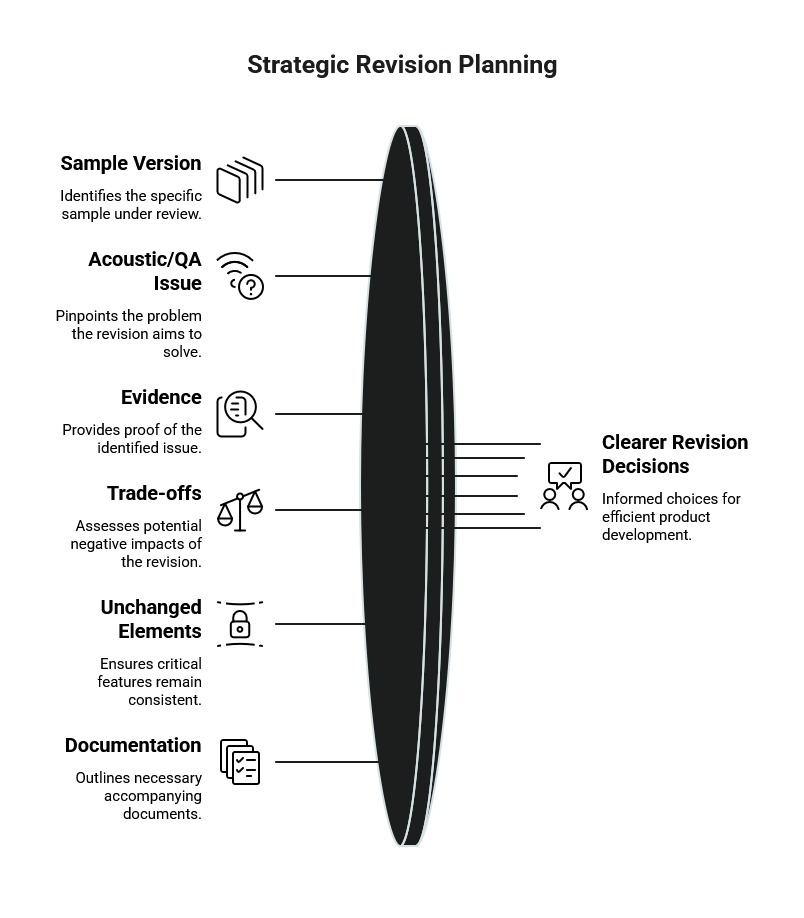
Use these questions before authorizing the next sample build:
- Which sample version is being discussed?
- What acoustic or QA issue is the revision intended to address?
- What evidence confirms the issue?
- What trade-off could the revision introduce?
- What must remain unchanged?
- What documentation will come with the next sample?
- What evidence will decide whether the next sample passes this gate?
- How will the revision be tracked against sample history or golden sample control?
These questions help teams move faster with less ambiguity. They do not remove every technical risk, but they can make the next decision clearer.
FAQ
What should NPI teams document after a sample review?
Document the sample version, review purpose, acoustic observations, evidence references, QA concerns, open risks, requested revisions, owner, and next verification step. The goal is to make the next action clear to both internal stakeholders and the manufacturer.
How can acoustic feedback be made more actionable for a manufacturer?
Tie feedback to observable behavior, target conditions, affected component or tuning area where known, and acceptance criteria for the next sample. Subjective comments can be useful, but they should be translated into revision-ready feedback before becoming supplier instructions.
What is the difference between sample approval and validation readiness?
Sample approval may confirm that a design direction is acceptable for the next step. Validation readiness requires enough documented evidence to support the next decision gate, such as deeper qualification, revision verification, or production-readiness review.
How should teams handle disagreement between Product, Acoustics, and QA?
Start by clarifying the purpose of the sample round. Then separate subjective preference from measurable or reviewable concern. If disagreement remains, document the unresolved risk and decide whether the next action is approve, revise, retest, or hold.
Conclusion: Sample Review Is a Confidence-Building System
Sample review is not only about whether a subwoofer or audio sample sounds good. It is a system for building cross-functional confidence before deeper qualification or production-readiness decisions.
When acoustic observations, QA evidence, product expectations, NPI ownership, and manufacturer revision requests move together, each sample round becomes easier to judge. Teams know what changed, why it changed, what remains open, and what evidence will determine the next gate.
For audio brand teams developing private-label programs, a manufacturing partner with acoustic review, sample validation, revision communication, and quality-control discipline can help make each sample round more decision-ready. Teams reviewing car audio production programs or broader DFM checklists for pro audio NPI can use the same principle: align evidence, ownership, and revision decisions before moving forward.
Working through a private-label audio sample review? Discuss your next program with China Future Sound to explore how acoustic review, revision documentation, and quality evidence can support a more controlled NPI process.
Disclaimer: This article is for general informational purposes only and does not constitute compliance, safety, technical, or professional advice. Requirements, risks, and best practices may vary by program, product category, test environment, supplier process, and use case. Confirm important decisions with the appropriate qualified engineering, quality, compliance, or manufacturing professional.
Our Editorial Process:
Our expert team uses AI tools to help organize and structure our initial drafts. Every piece is then extensively rewritten, fact-checked, and enriched with first-hand insights and experiences by expert humans on our Insights Team to ensure accuracy and clarity.
About the China Future Sound Insights Team
The China Future Sound Insights Team is our dedicated engine for synthesizing complex topics into clear, helpful guides. While our content is thoroughly reviewed for clarity and accuracy, it is for informational purposes and should not replace professional advice.