📌 Key Takeaways
Strong supplier documents should help teams decide what passed, what changed, and what risk still needs attention.
- Compare Evidence, Not Polish: Clean formatting matters less than clear proof tied to the right sample and revision.
- Link Tests To Decisions: Test results only help when teams understand what product promise or risk they support.
- Track Sample Changes: Teams need clear version history before trusting results from any supplier document.
- Control Golden Samples: A golden sample works best when production units are compared against it.
- Ask Sharper Questions: Missing details should trigger focused follow-ups, not a heavier lab-style review.
Clear documents beat thick document packs.
Audio brand teams comparing subwoofer suppliers will gain faster review clarity, preparing them for the detailed overview that follows.
~ ~ ~ ~ ~ ~ ~ ~ ~ ~ ~ ~ ~ ~ ~ ~ ~ ~
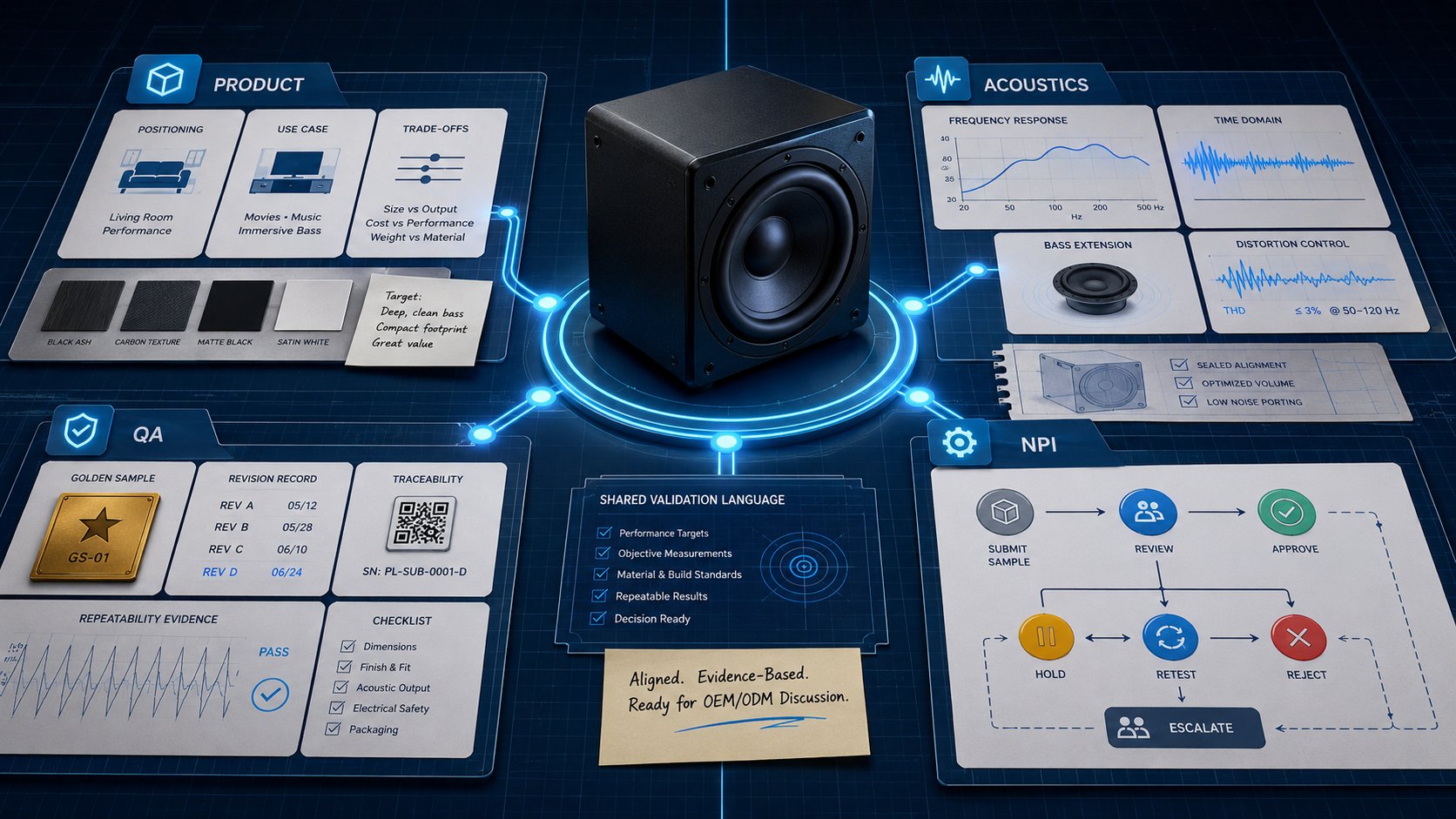
Growth-stage audio companies often receive subwoofer supplier documentation that creates more questions than answers. One supplier sends a clean summary with little evidence behind it. Another sends raw technical outputs that Product, QA, Acoustics, and NPI teams struggle to translate into a supplier decision.
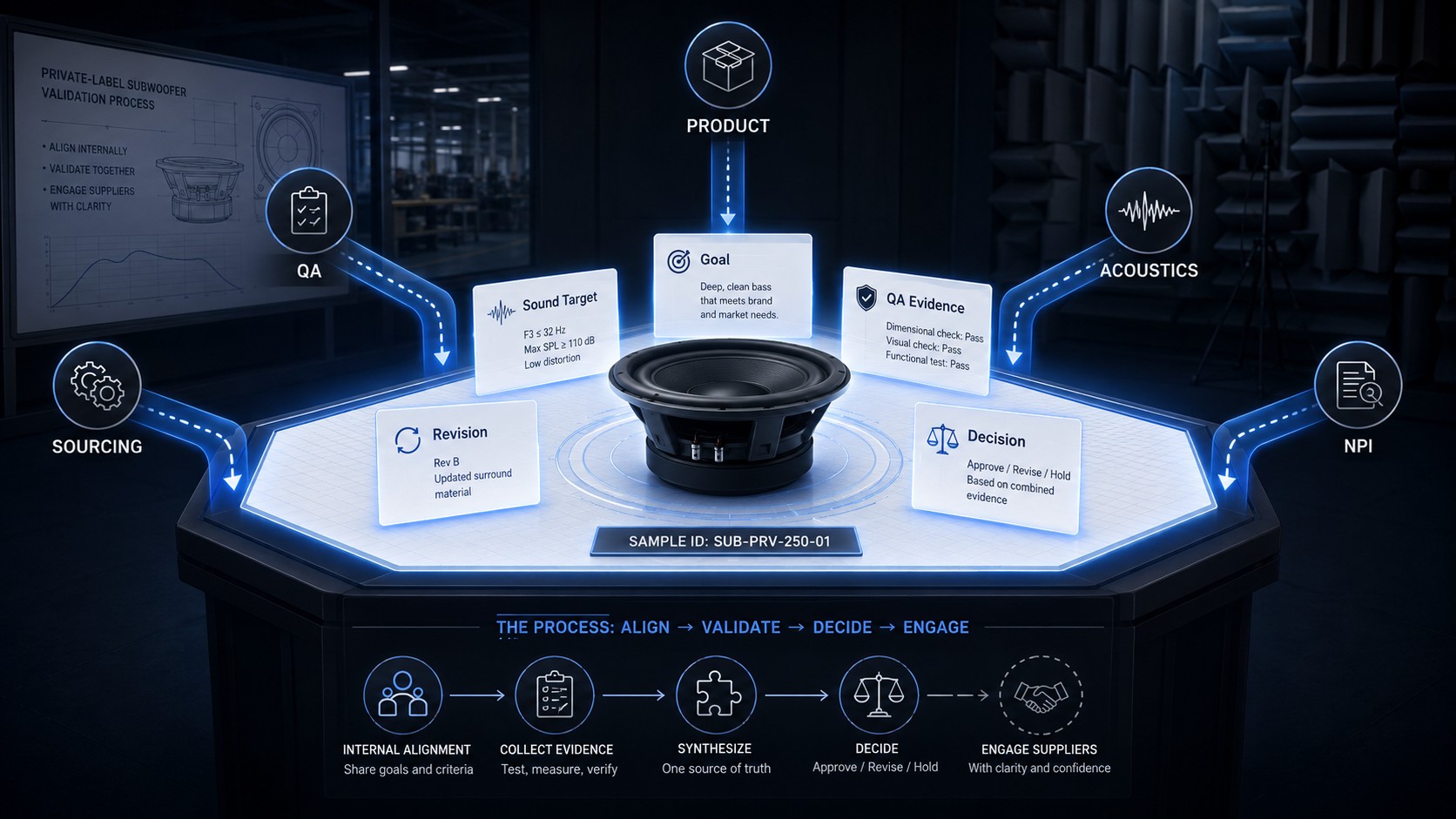
The goal is not to turn supplier review into an acoustic, electrical, reliability, or compliance lab procedure. The goal is to decide whether the supplier documentation package gives cross-functional stakeholders enough decision-useful evidence to proceed, pause, or ask sharper follow-up questions.
Poor validation documentation can slow sample approval, create rework, weaken QA confidence, and cause stakeholders to mistake a polished packet for real validation discipline. Good documentation helps the team compare sample-readiness, revision context, production controls, and supplier communication quality without overstepping into test engineering.
What Validation Documentation Should Help Your Team Decide
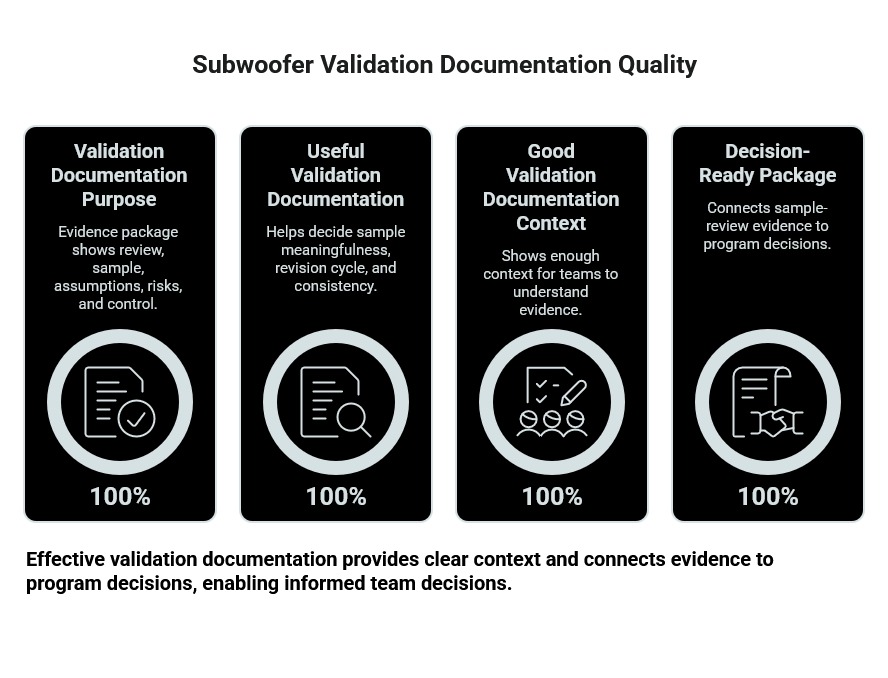
For this article, validation documentation means the evidence package a subwoofer manufacturer provides to show what was reviewed, which sample or revision the evidence belongs to, what assumptions shaped the review, what risks remain open, and how the supplier intends to control consistency after approval.
Useful validation documentation is not just a pile of test files. It should help a brand team decide whether a sample is meaningful, whether the revision cycle is understandable, and whether the OEM/ODM manufacturing partner can maintain sample-to-production consistency after qualification.
Good validation documentation does not need to teach your team how to run the test. It needs to show enough context for Product, QA, Acoustics, NPI, and Sourcing teams to understand what the evidence means.
That context matters because supplier documents often arrive in inconsistent formats. One package may emphasize acoustic tuning. Another may focus on QA gates. Another may contain reliability testing notes without explaining sample identity or open issues. A decision-ready package connects sample-review evidence to program decisions, supplier scorecards, and internal decision memos.
If the documentation cannot answer “what changed, what was validated, and what risk remains,” the team may have evidence, but not enough clarity.
Compare Evidence Categories, Not Just Test Results
The most useful way to compare subwoofer manufacturer validation documentation is to review evidence categories across suppliers, not document length or formatting polish.
Start with sample identity and revision status. The documentation should identify the sample version, build status, revision history, and whether the sample represents intended production assumptions. Without this link, a team may not know whether the evidence applies to the unit under review or to an earlier build.
Next, examine performance evidence context. The question is not simply whether results exist. The supplier should explain the measurement scope, test conditions at a decision level, and whether results connect to the design requirements or intended product promise. This is especially important for private-label audio programs where acoustic tuning, component strategy, and platform expectations may shape the final product.
Then review reliability and stress evidence. China Future Sound source materials describe short-term destructive power tests and long-term power tests on samples, as well as reliability laboratory testing according to design requirements. That kind of evidence is useful when it shows what usage risk the supplier intended to evaluate, not when it appears as an isolated “passed reliability testing” statement.
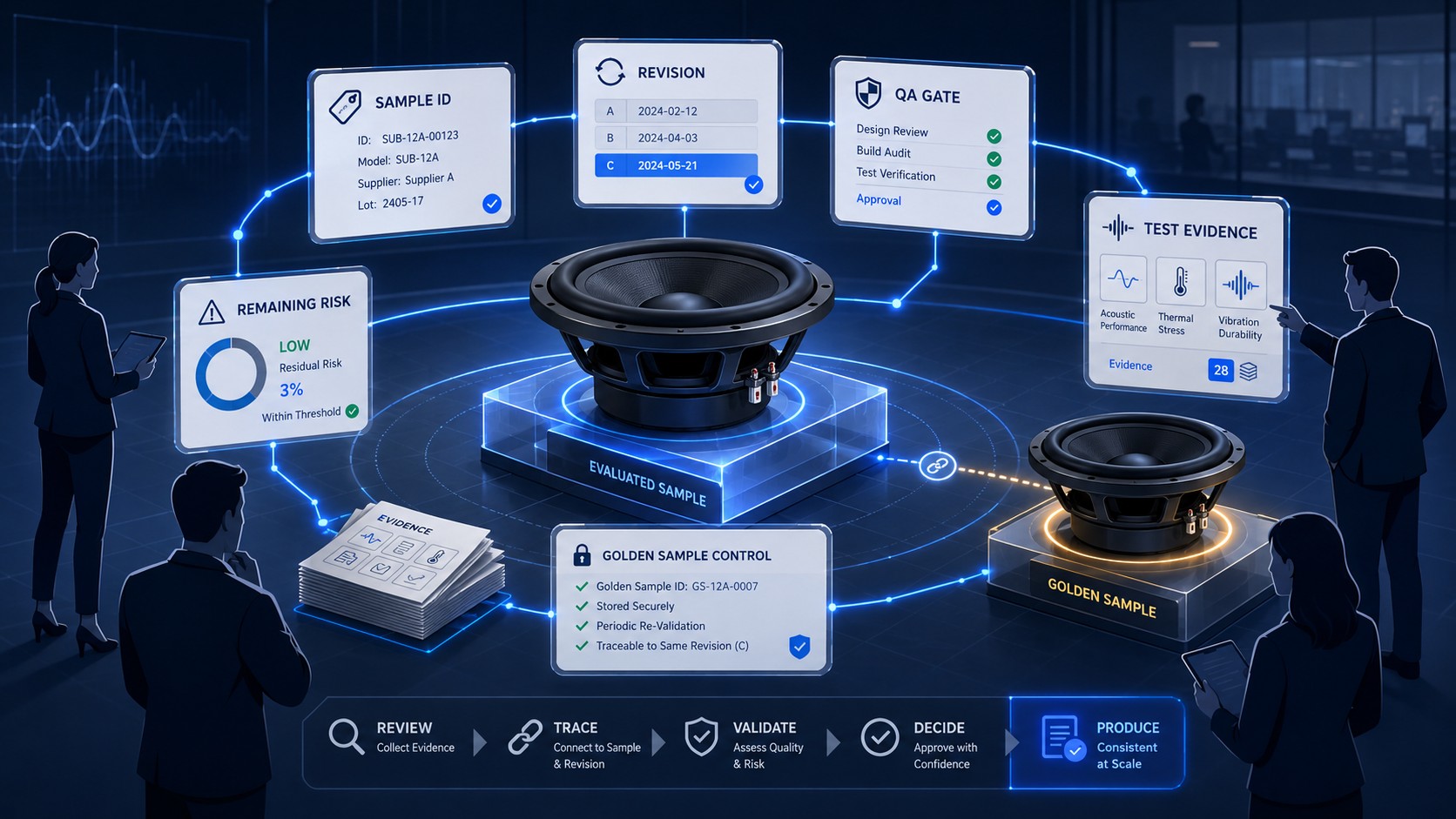
The next category is golden sample and production consistency control. A golden sample is most useful when it is governed as a benchmark for production comparison. China Future Sound source materials describe golden sample management and KLIPPEL QC combined with golden samples for production consistency control. For a deeper related resource, see this guide to golden sample integrity.
Finally, compare traceability and QA-gate evidence. China Future Sound source materials describe barcode/QR route control, test-data binding, IQC, IPQC, FQC, ERP/WMS/FIFO controls, and ISO 9001:2015 Quality Management System certification. These details should be treated as quality-system context, not as a guarantee of outcomes. For general external context, ISO identifies ISO 9001 as a quality management systems requirements standard. (ISO)
IEC loudspeaker standards may also be relevant in some engineering contexts, but applicability should be verified carefully. The 2003 version of IEC 60268-5 is now withdrawn. The industry has moved toward more specialized standards for modern loudspeaker measurement, such as IEC 60268-21 and IEC 60268-22. Consequently, referencing outdated versions should be avoided; teams should verify which current standards specifically apply to their product’s design, application, and intended market requirements.
Translate Documentation Quality for Each Stakeholder
The same supplier documentation package has to answer different questions for different teams. A strong review process acknowledges those differences instead of forcing every stakeholder to read the evidence the same way.
| Stakeholder | What They Need From Validation Documentation | Red Flag |
|---|---|---|
| Product | Confidence that the evidence supports the intended product promise, positioning, and brand program | Results with no connection to design intent |
| QA | Objective controls, traceability, ownership, and consistency mechanisms | “Passed” statements without criteria or accountability |
| Acoustics / Engineering | Enough method context to interpret sample evidence, conditions, and revision impact | Test outputs with unclear conditions or revision status |
| NPI | Clear open issues, change history, and handoff readiness before scale-up | Late changes not tied to ECO/ECR logic |
| Sourcing / Leadership | A decision-ready summary of supplier maturity and NPI risk | Documentation that cannot be summarized beyond “supplier says it passed” |
This is where overly technical documentation can become just as risky as thin documentation. Raw test outputs may be valuable to engineering teams, but cross-functional stakeholders still need a short interpretation: what changed, what risk remains, and what decision the evidence supports.
Useful validation evidence links the story together. A supplier package that connects sample test evidence, revision notes, golden sample control, and production QA gates is more decision-useful than isolated pass statements. It gives the team a clearer view of whether the supplier is communicating risk in a way that supports confident partner selection.
Documentation Gaps That Should Prompt Follow-Up
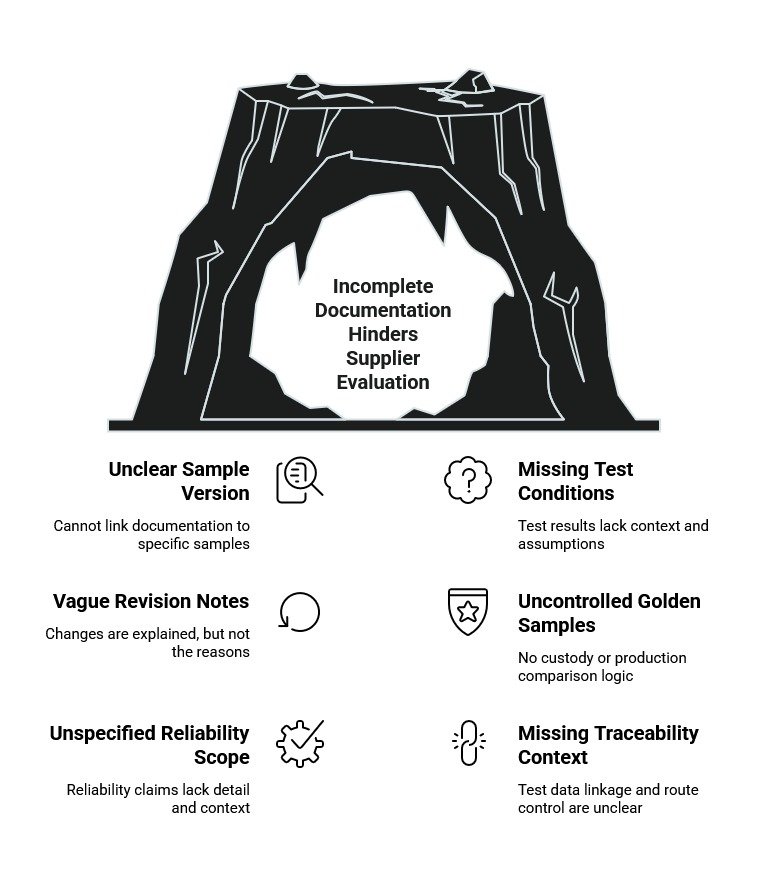
A documentation gap does not automatically mean a supplier is weak. It does mean the team should clarify the issue before using the evidence in a supplier scorecard or NPI decision.
Common risk signals include unclear links between sample version and documentation, test results without conditions or assumptions, revision notes that explain what changed but not why, and golden sample references without custody or production-comparison logic.
Reliability claims deserve particular care. If a supplier says a sample “passed reliability testing” but does not identify the sample version, evidence category, testing scope, or design requirement, the claim may not be useful for qualification. The right response is not to demand a full lab procedure. The better follow-up is: “Which sample does this apply to, what risk was evaluated, and how should this be reflected in our supplier scorecard?”
Traceability claims also need context. If documentation mentions traceability but does not explain test-data linkage, route control, or inspection gates, QA and NPI teams may struggle to understand how evidence connects to production units.
If a missing detail affects sample identity, revision context, reliability scope, golden sample control, ECO/ECR ownership, or traceability, treat it as a follow-up question before scale-up. If the gap only affects formatting or document layout, compare the underlying evidence category before escalating it.
Subwoofer Validation Documentation Comparison Matrix
Use this lightweight supplier validation checklist to compare documentation quality without turning the review into a lab procedure.
| Review Area | What Strong Documentation Shows | Follow-Up Question |
|---|---|---|
| Sample identity | Version, build status, and revision path are clear | Which sample does this data represent? |
| Performance evidence | Results are tied to design requirements and review context | What requirement does this evidence support? |
| Reliability evidence | Stress or durability evidence is described at a decision level | What usage risk was this evidence meant to reduce? |
| Golden sample control | Approved benchmark and production comparison logic are documented | How is production compared against the approved sample? |
| Traceability / QA gates | Inspection and test-data linkage are visible | Can records be tied to units, lots, or routes? |
| Cross-functional summary | Evidence can be summarized for Product, QA, Acoustics, and NPI | What decision does this documentation support? |
This matrix should support better review conversations, not replace qualified technical judgment. For teams comparing subwoofer manufacturing capabilities, it can also help separate documentation polish from real validation evidence.
FAQs
What should subwoofer validation documentation include?
At a decision level, it should include sample identity, test context, reliability evidence, revision history, golden sample control, QA and traceability evidence, and an open-issue summary.
Does validation documentation replace technical testing?
No. It supports supplier evaluation and cross-functional decision-making. Technical testing, compliance review, and expert engineering judgment may still be required depending on product design, application, program stage, and market requirements.
How do you compare two suppliers if their documentation formats differ?
Compare categories of evidence, not document layout. Focus on sample identity, performance context, reliability evidence, golden sample control, traceability, revision communication, and whether the package can support a leadership-ready supplier decision.
Compare for Confidence, Not Complexity
Strong subwoofer manufacturer validation documentation should make supplier review clearer, not heavier. The goal is not to turn validation into a lab exercise. The goal is to make supplier evidence comparable, credible, and useful across Product, QA, Acoustics, NPI, Sourcing, and leadership.
When documentation connects sample-review evidence, revision context, reliability testing, golden sample control, QA gates, and open issues, teams can ask sharper questions before committing more resources.
Discuss your next subwoofer program with our team.
Disclaimer: This article is for general informational purposes only and does not constitute compliance, safety, technical, or professional advice. Validation requirements, risks, and best practices may vary by product design, application, supplier, program stage, and market requirements. Confirm important decisions with the appropriate qualified engineering, QA, compliance, or technical expert.
Our Editorial Process:
Our expert team uses AI tools to help organize and structure our initial drafts. Every piece is then extensively rewritten, fact-checked, and enriched with first-hand insights and experiences by expert humans on our Insights Team to ensure accuracy and clarity.
About the China Future Sound Insights Team
The China Future Sound Insights Team is our dedicated engine for synthesizing complex topics into clear, helpful guides. While our content is thoroughly reviewed for clarity and accuracy, it is for informational purposes and should not replace professional advice.