📌 Key Takeaways
Private-label subwoofer teams avoid sample delays when they turn vague bass goals into clear approval checks.
- Define Proof Early: Clear approval checks help teams agree on what a sample must show before supplier work moves forward.
- Translate Vague Feedback: Comments like “stronger bass” need clear review conditions, not open-ended supplier requests.
- Fix Constraints First: Enclosure size, power limits, and fit rules should be agreed before teams judge sound quality.
- Use Shared Ownership: Product, acoustics, quality, sourcing, and supplier engineers should each own the checks they understand best.
- Protect Production Readiness: One good sample can guide future quality checks, but it cannot prove full production is ready.
Clear checks turn better bass from a loose opinion into a shared approval decision.
Private-label subwoofer teams will gain clearer sample approval language here, preparing them for the detailed overview that follows.
~ ~ ~ ~ ~ ~ ~ ~ ~ ~ ~ ~ ~ ~ ~ ~ ~ ~
Private-label subwoofer programs often begin with language that sounds clear in a product meeting but becomes difficult to approve during sample review.
“Stronger bass,” “cleaner output,” “compact fit,” and “premium feel” may all describe valid commercial goals. They do not, by themselves, define what the subwoofer must demonstrate before supplier work progresses.
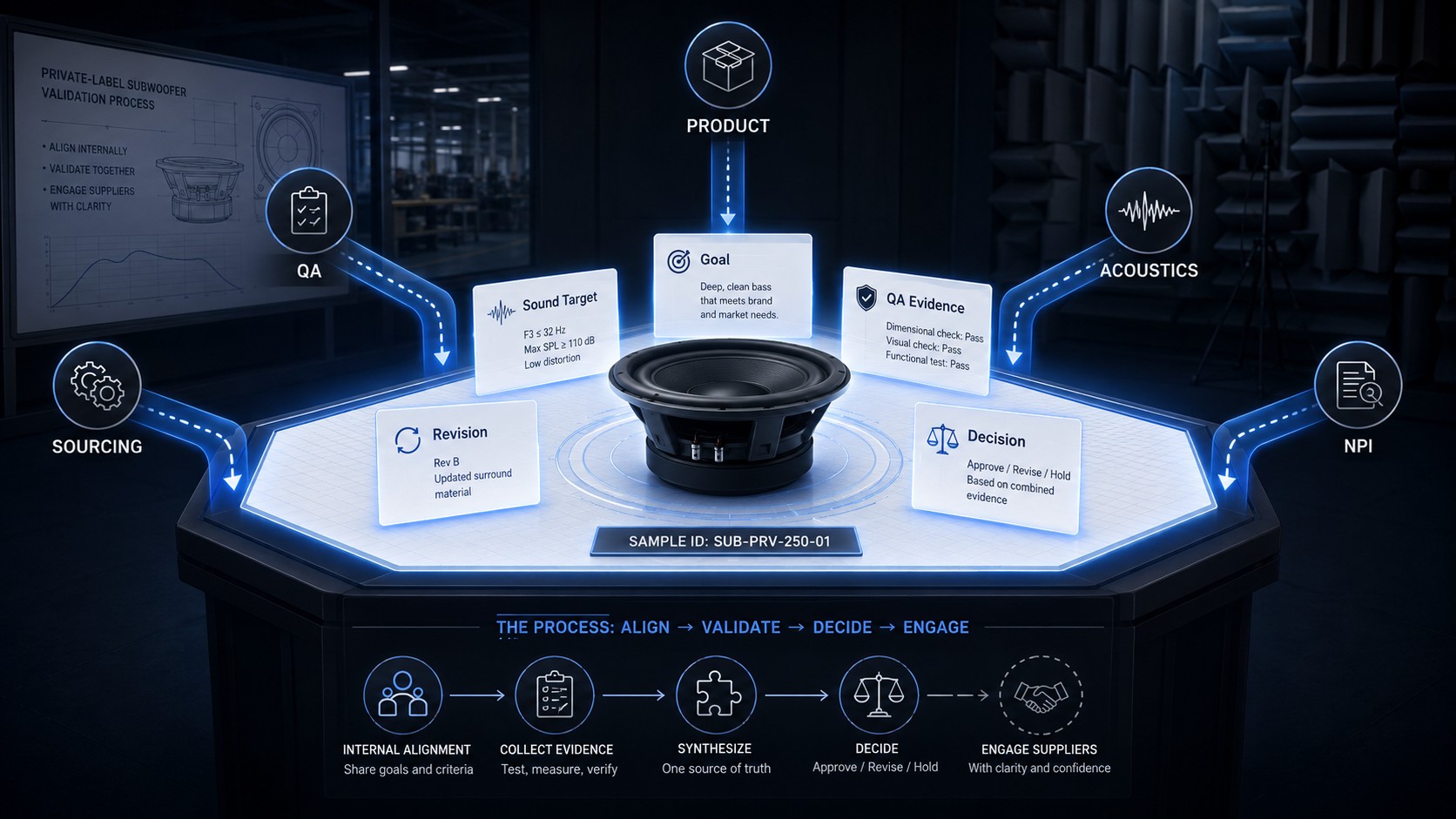
That gap creates NPI risk. Product, sales, acoustics, QA, sourcing, and manufacturer-side engineering may all use the same words while expecting different evidence. One team may judge the sample by listening impression. Another may focus on enclosure constraints, distortion concerns, power assumptions, or production consistency.
A practical acoustic validation framework gives those teams shared acceptance language. It turns broad expectations into manufacturer-facing validation criteria that can support sample approval, qualification planning, and clearer supplier alignment.
Start by Separating Product Goals From Validation Criteria
A product goal describes the commercial or user-experience intent. A validation criterion describes what must be demonstrated, reviewed, or agreed before the program treats a sample as acceptable.
“More bass” is a goal. It may reflect market positioning, brand preference, or a desired listening impression. A stronger validation statement would be: “Low-frequency output should be reviewed under agreed enclosure and amplifier assumptions before sample approval.”
That wording still does not create an exact SPL target. Exact acoustic thresholds should be defined and reviewed by qualified engineering stakeholders. The value is that the team has moved from preference language to reviewable acceptance language.
A useful validation model separates four elements:
| Element | What it means in a private-label subwoofer program |
|---|---|
| Product goal | The commercial or user-experience intent |
| Validation criterion | What the sample must demonstrate or make reviewable |
| Evidence | How the team knows whether the criterion is met |
| Approval decision | Who signs off and under what assumptions |
This model helps non-acoustic stakeholders participate without pretending to run lab engineering. Product can define the intended experience. Acoustics can translate that intent into acoustic review language. QA and NPI can define what evidence is needed before the sample moves closer to production planning.
Translate the Highest-Risk Subwoofer Goals First
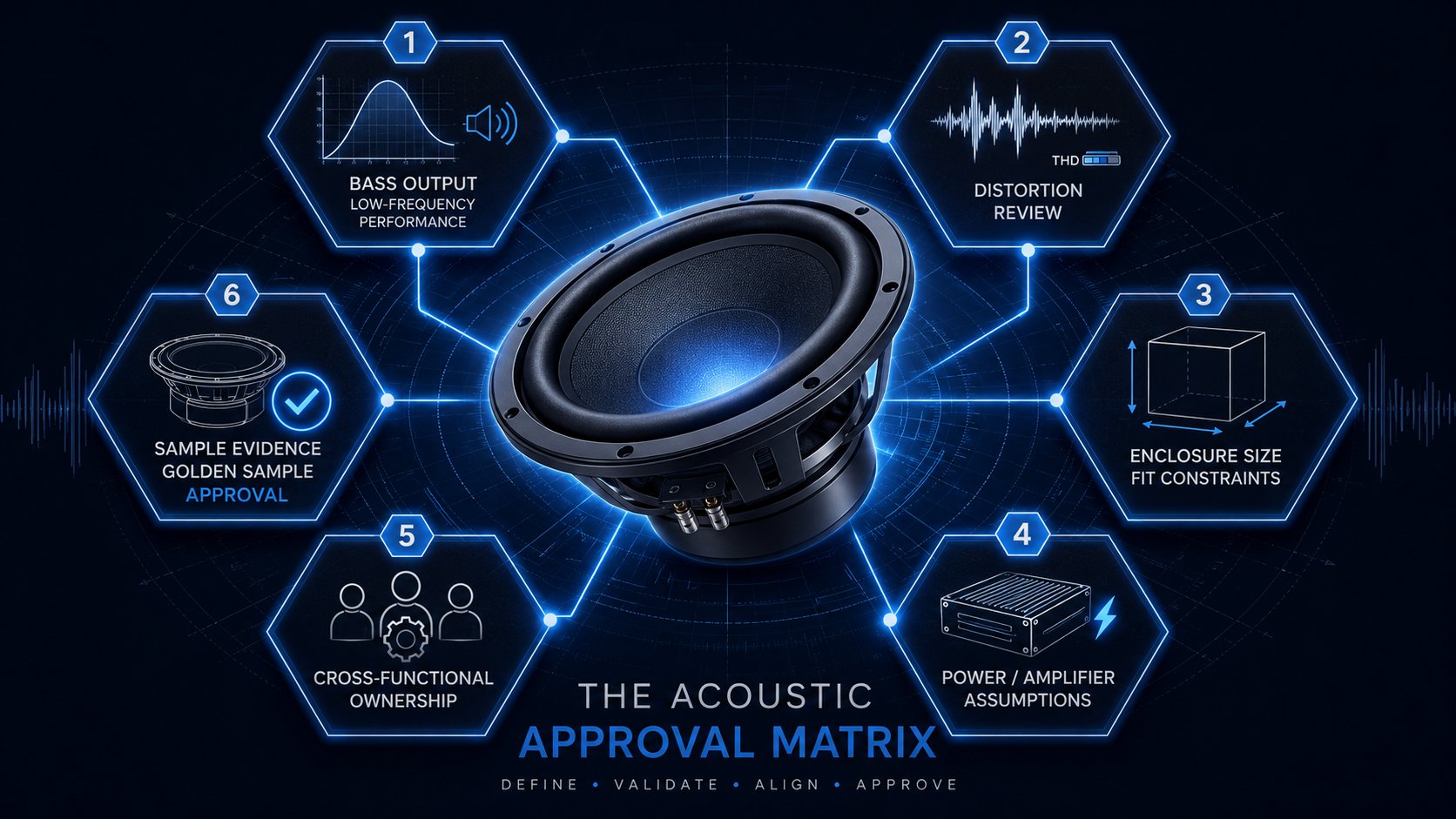
The first criteria to define are the ones most likely to cause revision loops or late disagreement.
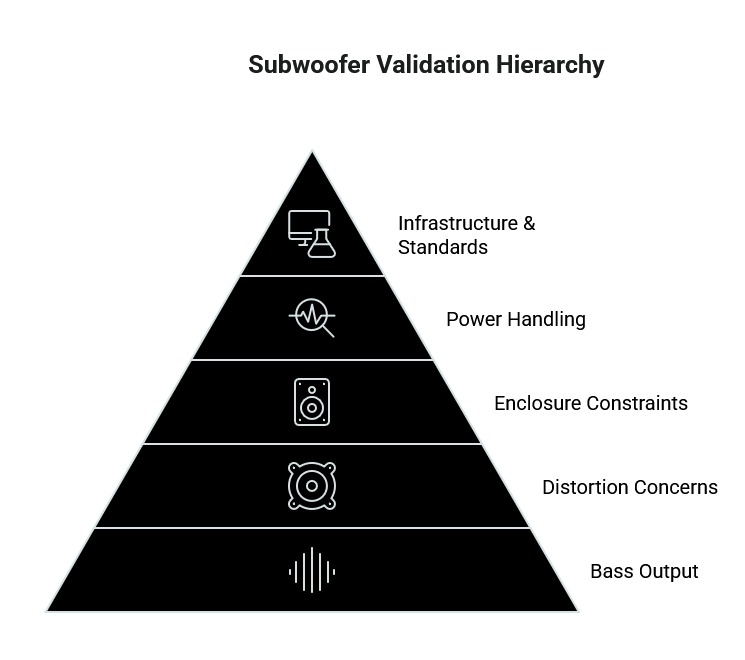
Bass-output expectations usually come first. “Deep bass” can mean low-frequency extension, perceived punch, higher output in a specific range, or a tuning direction that supports the brand’s target sound. The team should define the listening or measurement context before asking the supplier to revise the sample.
Distortion concerns need similar care. “Cleaner bass” may point to distortion, resonance, crossover or tuning behavior, enclosure interaction, or output expectations that exceed the available package. The criterion should make the concern diagnosable.
Enclosure and fit constraints are equally important. Mounting depth, enclosure volume, available space, and installation envelope can all shape acoustic options. In automotive, pro audio, marine, or custom OEM/ODM programs, the same bass goal may need different acceptance language because the application context changes the trade-offs. For automotive projects, OEM car audio production constraints may differ from marine or pro audio programs where packaging, environment, and use case vary.
Power handling, thermal assumptions, tuning direction, and reliability expectations should also be documented before approval language hardens. These criteria may affect qualification and warranty risk, but exact limits require engineering review.
Executing these criteria requires capable infrastructure. Key evidence is typically generated through finite element simulation (for magnetic circuits), KLIPPEL R&D sample testing, destructive power testing, and ISO9001-2015 compliant quality management routing (IQC/IPQC/FQC).. Teams that need shared terminology can also consult high-authority technical references such as the Audio Engineering Society standards program and KLIPPEL’s official R&D System documentation.
Use Sample Feedback Language That Engineers and Suppliers Can Act On
Sample feedback should identify the condition, evidence need, and likely trade-off. Subjective feedback can be useful, but only after it is translated into revision-ready language.
The examples below are illustrative, not universal specifications.
| Subjective feedback | More actionable feedback |
|---|---|
| “Make it hit harder.” | “Review low-frequency output under the agreed enclosure and amplifier assumptions; confirm whether the current sample is limited by driver behavior, enclosure constraint, or tuning target.” |
| “Bass sounds muddy.” | “Identify whether the concern is distortion, resonance, crossover/tuning behavior, or enclosure interaction before requesting a revision.” |
| “The compact version does not feel premium enough.” | “Confirm which performance expectations are fixed for the compact enclosure and which are negotiable before changing driver, tuning, or mechanical assumptions.” |
| “This sample seems weaker than expected.” | “Compare the sample against the agreed bass-output expectation, power condition, enclosure assumption, and listening review criteria before approving a supplier revision.” |
This style of feedback reduces supplier communication gaps. It also protects the program from approving one interpretation of “good bass” while another team expects different evidence later.
Build a Cross-Functional Validation Criteria Matrix
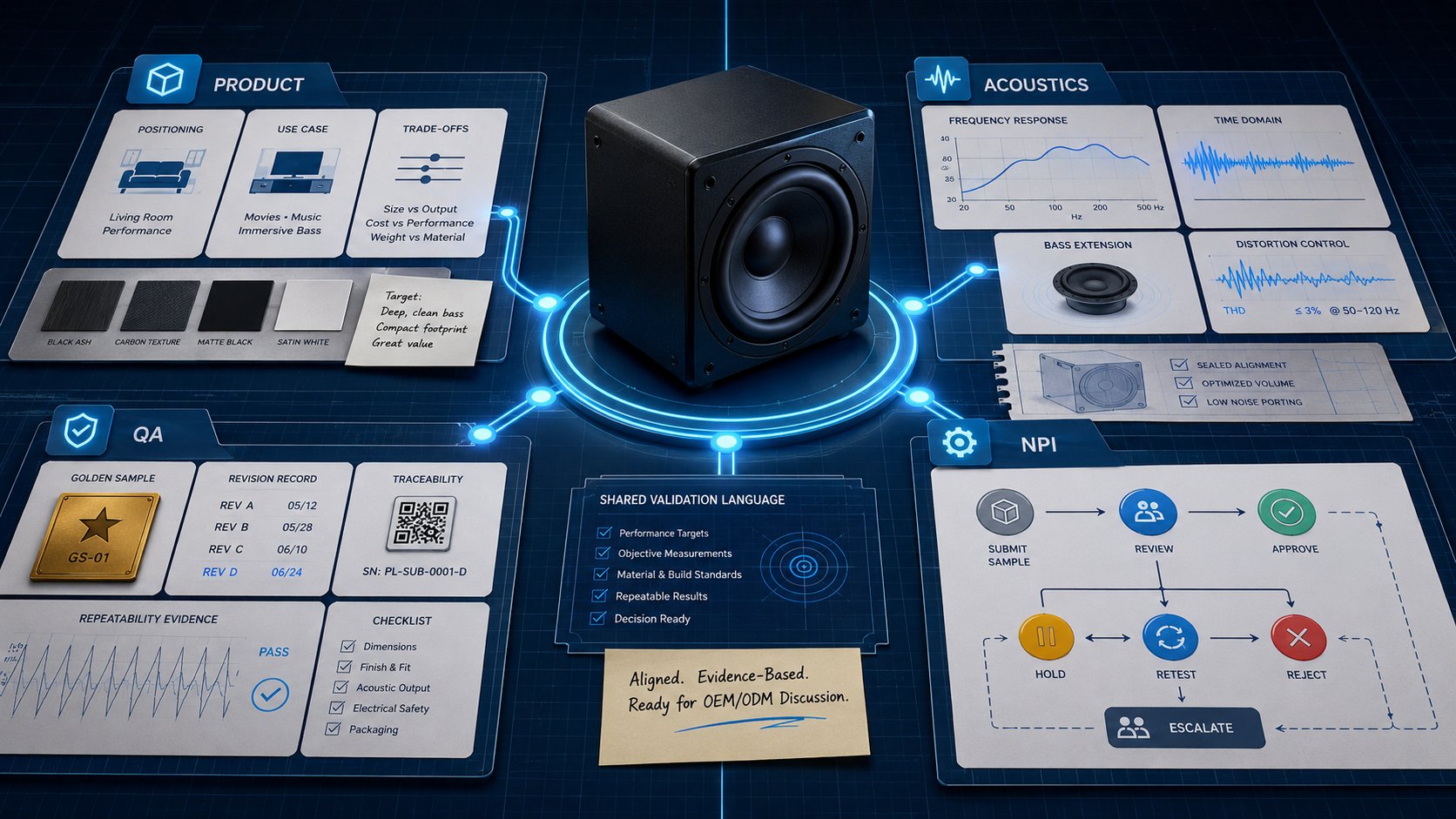
A validation criteria matrix gives product, acoustic, QA, structure, sourcing, NPI, and supplier-side engineering teams a common approval framework. It should be compact enough to use during sample review and precise enough to reduce vague revision cycles.
| Product goal | Validation criterion | Evidence needed | Stakeholder owner | Sample feedback language | Verification status |
|---|---|---|---|---|---|
| Stronger low-end perception | Bass-output goal under agreed enclosure and power assumptions | Acoustic review and structured listening review | Product / Acoustics | “Output is acceptable only when reviewed under agreed enclosure and power conditions.” | Requires engineering-defined target |
| Compact fit | Mounting depth, package, and enclosure constraints | Mechanical drawing and prototype fit check | Structure / Product | “Do not approve acoustic changes that require unapproved enclosure growth.” | Requires mechanical constraint approval |
| Cleaner output | Distortion concern under defined operating condition | Engineer-defined measurement criterion and listening review | Acoustics / QA | “Avoid subjective ‘cleaner bass’ feedback; define the condition and evidence required.” | Requires acoustic review |
| Supplier-ready sample feedback | Revision request tied to condition, evidence, and owner | Sample review notes and supplier response | Sourcing / Manufacturer-side engineering | “Confirm whether the requested change affects driver, enclosure, tuning, or qualification assumptions.” | Requires supplier review |
| Production consistency | Validated sample attributes can be carried into QC planning | Golden sample criteria, QC route expectations, and inspection plan | QA / NPI / Supplier engineering | “Confirm which validated attributes become part of golden sample governance.” | Requires QA/NPI alignment |
| Reliability confidence | Power, thermal, and use-case assumptions reviewed before approval | Reliability plan or engineering review | QA / Acoustics / NPI | “Do not treat one acceptable sample as proof of production readiness.” | Requires technical review |
Golden sample management and QC consistency can support production alignment, but a single golden sample should not be treated as proof that production is ready. To ensure continuity, teams should formally integrate these validated criteria into their broader frameworks for golden sample integrity and cross-functional quality alignment.
Decide What Must Be Agreed Before Supplier Work Progresses
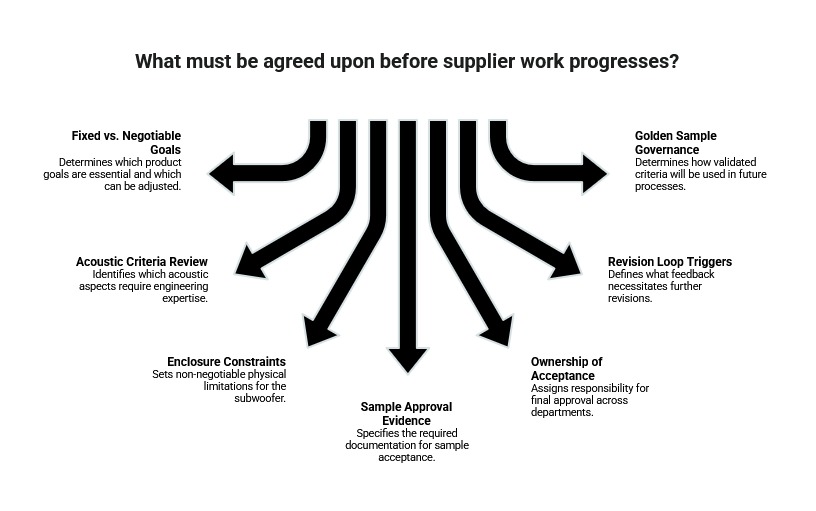
Before supplier work advances, the team should agree on the decisions that shape acoustic validation and sample approval.
The most important questions are straightforward:
- Which product goals are fixed, and which are negotiable?
- Which acoustic criteria need qualified engineering review?
- Which enclosure and fit constraints cannot move?
- What evidence is needed before sample approval?
- Who owns final acceptance across Product, Acoustics, QA, Structure, Sourcing, NPI, and supplier-side engineering?
- What type of feedback triggers another revision loop?
- Which validated criteria become part of golden sample governance, QC routing, or later qualification?
This is not a lab procedure. It is a program alignment step.
A team may still need formal test plans, DFM/DFX review, reliability testing, and qualification work later. But those steps become easier to coordinate when early validation criteria are already written in terms of decisions, evidence, ownership, and trade-offs. For teams reviewing the manufacturing context around private-label programs, subwoofer manufacturing capabilities can be a useful starting point.
FAQ
What is the difference between a subwoofer performance goal and a validation criterion?
A performance goal describes the intended product experience, such as stronger low-end perception or cleaner output. A validation criterion defines what must be reviewed or demonstrated before the team treats the sample as acceptable.
Who should approve private-label subwoofer validation criteria?
Approval should typically involve Product, Acoustics, QA, Structure or Mechanical, Sourcing, NPI, and supplier-side engineering. The exact ownership may vary by program, but no single function should own every criterion alone.
Should validation criteria include exact acoustic thresholds?
Yes, but only when those thresholds are defined and reviewed by qualified engineering stakeholders. Exact SPL, distortion, enclosure, thermal, reliability, and pass/fail limits should not be invented during general sample review.
How does a golden sample relate to validation criteria?
Validated criteria can inform golden sample governance by clarifying what the sample represents. A golden sample can support consistency control, but it does not automatically prove production readiness on its own.
Conclusion
Private-label subwoofer acoustic validation criteria help brand teams move from subjective sample approval to clearer supplier alignment. By establishing this framework, cross-functional criteria ensure that commercial intent, acoustic expectations, enclosure constraints, and NPI readiness are systematically verified before production planning advances.
Review your sample approval criteria before supplier planning. Discuss your next program or request a quote to review your subwoofer requirements.
Disclaimer: This article is for general informational purposes only and does not constitute acoustic engineering, compliance, safety, technical, or professional advice. Validation criteria, test methods, and approval thresholds vary by product design, application, enclosure, supplier process, and program requirements. Confirm important decisions with qualified acoustic, QA, engineering, and manufacturing stakeholders.
Our Editorial Process:
Our expert team uses AI tools to help organize and structure our initial drafts. Every piece is then extensively rewritten, fact-checked, and enriched with first-hand insights and experiences by expert humans on our Insights Team to ensure accuracy and clarity.
About the China Future Sound Insights Team
The China Future Sound Insights Team is our dedicated engine for synthesizing complex topics into clear, helpful guides. While our content is thoroughly reviewed for clarity and accuracy, it is for informational purposes and should not replace professional advice.