📌 Key Takeaways
A strong subwoofer sample means little unless the supplier can protect that result through full production.
- Proof Beats Samples: Compare suppliers by how they turn sample results into production checks and records.
- Align Before Comparing: Product, QA, acoustics, NPI, and sourcing need shared stop/go rules before supplier talks deepen.
- Control The Reference: Golden samples must have clear custody, revision locks, storage rules, and comparison methods.
- Map Every Limit: Each approved trait should link to a QC route, inspection owner, traceability field, and response plan.
- Judge Trade-Offs Clearly: Price, lead time, MOQ, and capacity matter more when evidence gaps are visible.
A good sample is not a production standard.
Growth-stage audio brands will choose safer subwoofer partners, using the supplier-readiness questions and proof checks below.
~ ~ ~ ~ ~ ~ ~ ~ ~ ~ ~ ~ ~ ~ ~ ~ ~ ~
Growth-stage audio brands often shortlist subwoofer manufacturers using visible signals: sample quality, response speed, capability decks, price range, and customization claims. These signals are useful for screening, not approval. The real question is whether the supplier can preserve the approved acoustic, mechanical, and reliability profile through pilot and mass production.
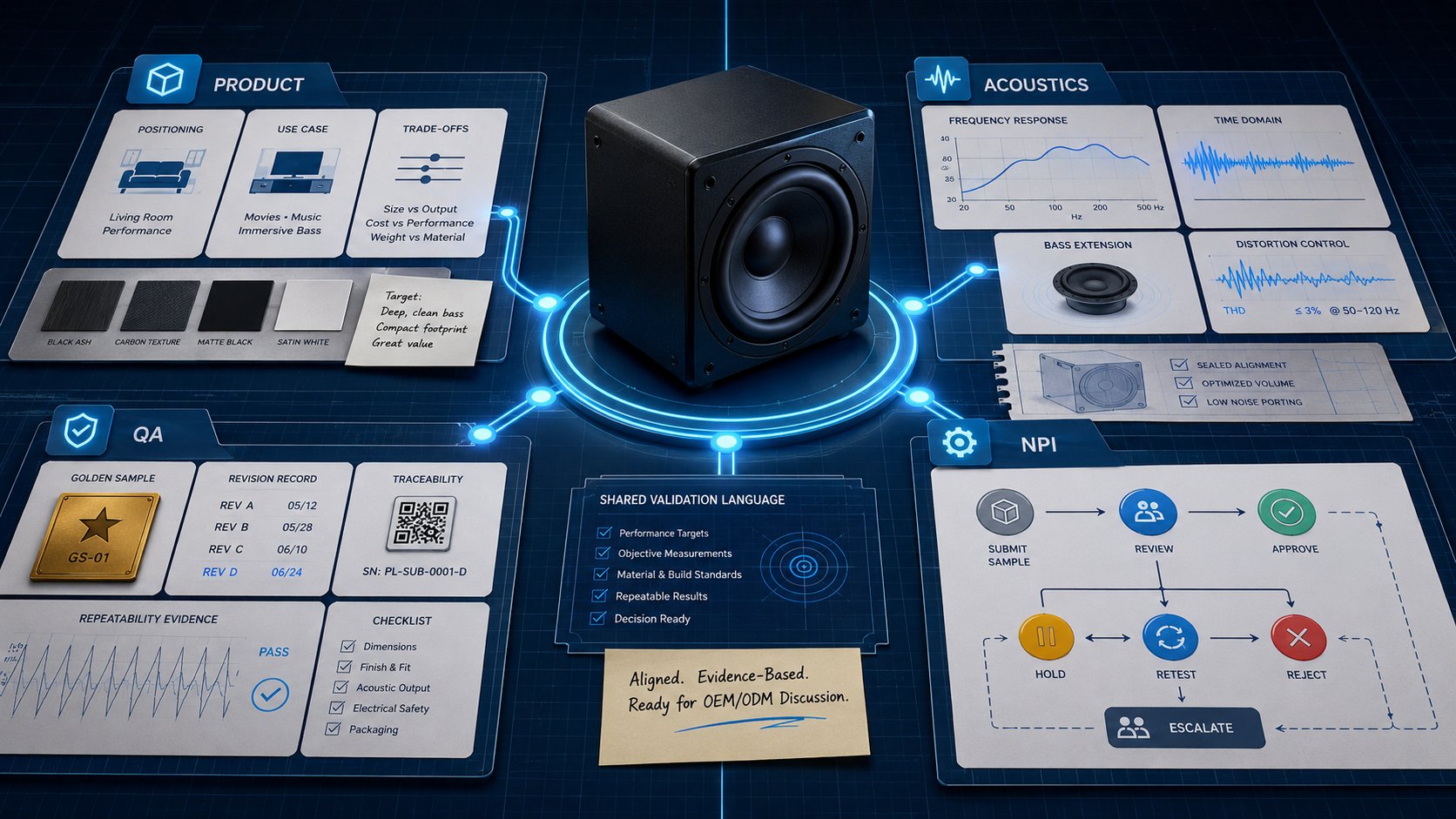
Readiness breaks down when each function uses a different approval threshold. The Product team may prioritize target use cases, SKU positioning, and feature trade-offs. Acoustics engineers may focus on the SPL window, distortion behavior, enclosure loading, thermal margin, and excursion assumptions. QA may prioritize tracking tolerance drift, golden sample custody, inspection limits, and escape prevention. The NPI team may focus on whether the BOM, sample revision, tooling assumptions, and process route are stable enough for the next build.
Validation readiness gives these teams a shared supplier-comparison question: can the evidence survive scale-up?
For private-label subwoofer programs, this keeps manufacturer evaluation grounded before RFQ, MOQ, lead-time, and pricing conversations dominate the decision.
Validation Readiness Is an Evidence Chain, Not a Lab Manual
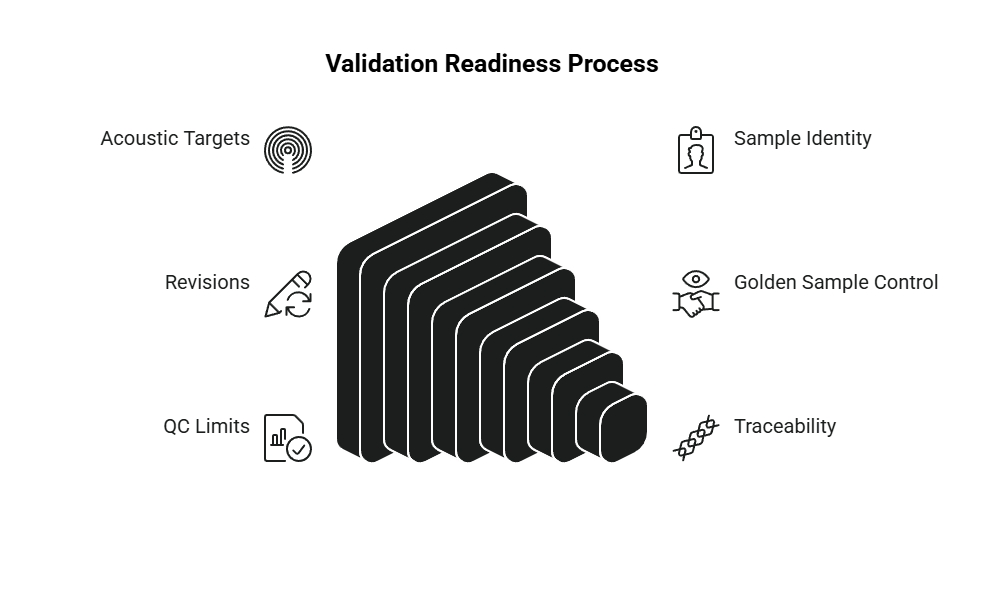
Validation readiness means the brand and supplier can link product intent, acoustic targets, sample identity, revisions, golden sample control, QC limits, and traceability into one approval path.
This does not mean turning an early supplier conversation into a test-lab procedure. It means asking whether the manufacturer can trace how a requirement becomes a sample result, a production limit, a QC route, and a retained record.
A strong listening sample matters less if the Product, Acoustics, QA, NPI, and Sourcing teams cannot use the same evidence to approve, hold, or revise it. “We test our products” is too broad to evaluate supplier maturity. In weak systems, testing means an end-of-line pass. In mature systems, testing connects the approved sample to revision control, process gates, serial or batch traceability, and exception handling.
A validation-ready discussion should clarify four points:
- What the subwoofer must prove before approval
- Which sample evidence supports that decision
- Which revision and golden sample controls protect the approved state
- Which production checks prevent uncontrolled drift
The sharper audit question is not “Do you test?” It is: where does the approved sample become a controlled production limit?
Internal Alignment Should Come Before Supplier Comparison
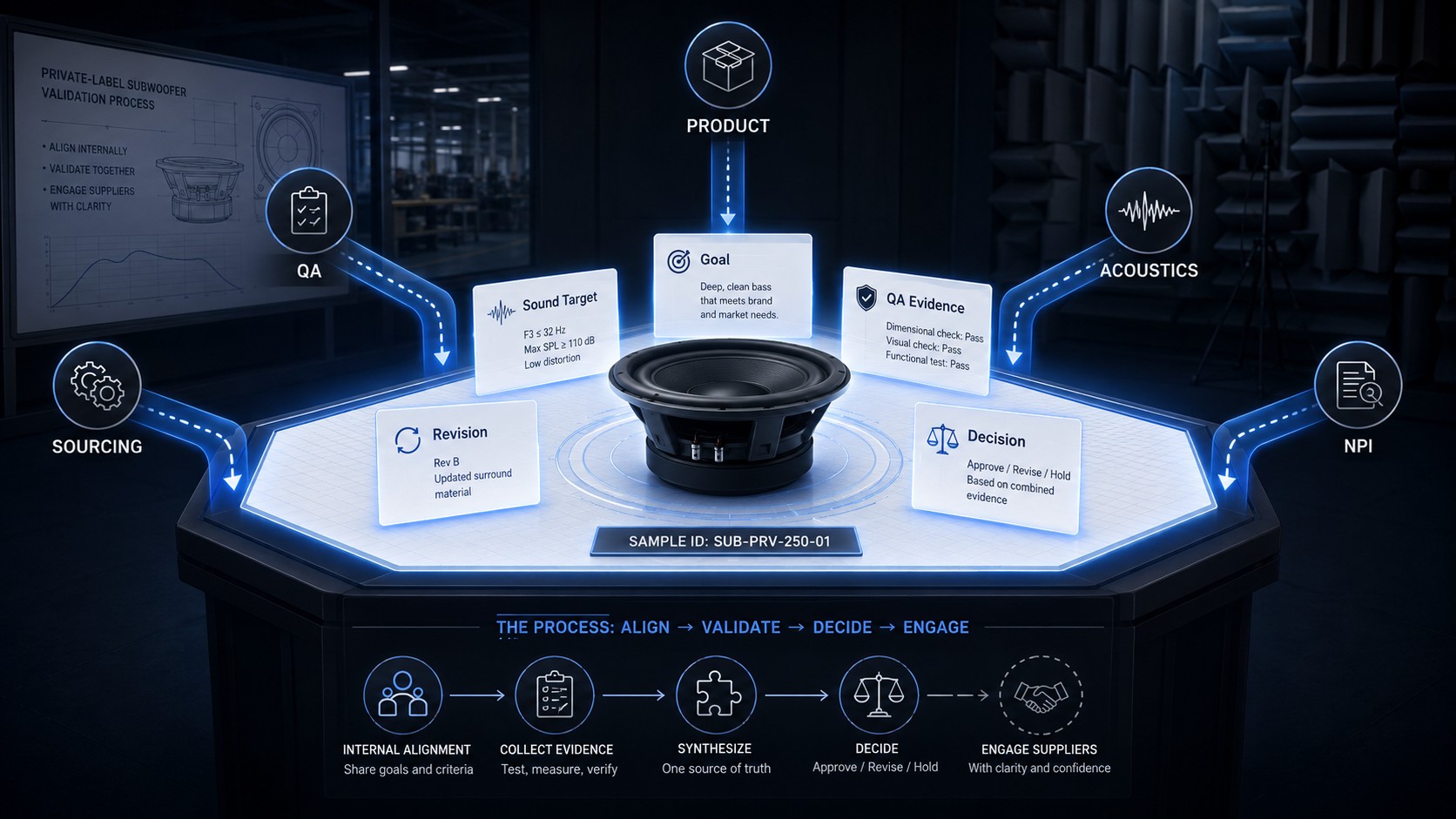
Supplier comparison should start with internal exit criteria. Without shared stop/go logic, manufacturer evaluation becomes opinion arbitration.
Product may favor the prototype with the strongest listening impression. QA may block the same prototype because no one has defined how production units will be judged against it. Sourcing may compare price and timeline before QA has named the non-negotiable evidence gaps.
The goal is not checklist volume. The goal is shared approval logic.
| Stakeholder | What they may care about | Alignment question |
|---|---|---|
| Product | Market fit, SKU positioning, feature priorities | What must this subwoofer prove to support the intended product strategy? |
| Acoustics / Hardware | Bass output, distortion, enclosure assumptions, excursion, thermal and mechanical limits | Which acoustic and physical targets need evidence before sample approval? |
| QA | Repeatability, golden sample governance, defect prevention | What evidence shows the approved result can be repeated in production? |
| NPI | Build stability, revision control, handoff clarity | What must be locked before the next build or pilot stage? |
| Sourcing | Supplier fit, timeline, commercial feasibility | Which validation gaps are acceptable risks, and which are deal-breakers? |
This alignment changes supplier questions from generic capability checks to evidence requests. Instead of asking every manufacturer, “Do you have acoustic testing?” the brand can ask: which test result controls which production gate, and who owns deviations?
For teams still defining sample approval logic, CFS’s related guide on aligning subwoofer validation criteria before OEM sampling can support the internal discussion.
The Strongest Comparison Is the Evidence Chain
Equipment lists are inputs, not proof. Acoustic testing, QC systems, reliability checks, and traceability tools only matter if they are connected across the program.
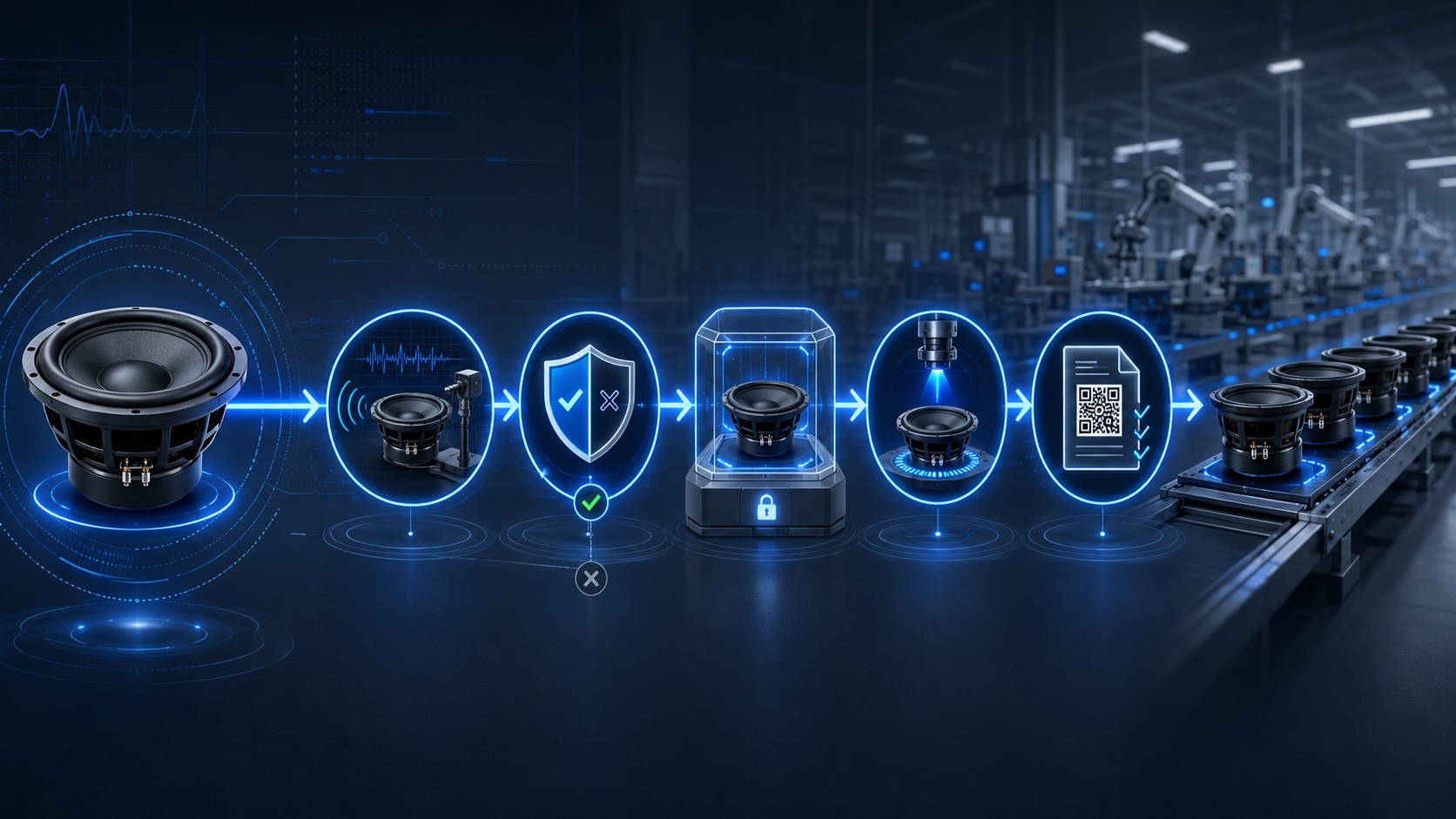
A stronger comparison follows the evidence chain:
Sample test → approval limit → golden sample → QC route → traceable production record
China Future Sound, for example, maintains an R&D team of over 20 specialists across acoustics, electronics, structure, and software development. Its acoustics workflow includes finite element simulation for magnetic circuit and speaker vibration system evaluation, KLIPPEL R&D sample testing, short-term destructive power tests, long-term power tests, and golden sample management.
On the production-quality side, CFS operates under ISO9001-2015 quality management, uses ERP and WMS systems for FIFO material control, applies KLIPPEL QC with golden samples for production consistency, binds test data to barcode/QR route control, and uses IQC, IPQC, FQC, and reliability laboratory practices.
These capabilities are strongest when framed as evidence categories: simulation, sample validation, power testing, golden sample control, production QC, route control, and traceability. They should not be treated as a universal checklist for every supplier. A mature partner should be able to explain which controls protect bass output, distortion, power handling, fit, and reliability after the sample leaves engineering review.
Treat standards and tools as verification infrastructure, not supplier proof. ISO 9001:2015 is relevant only if the supplier can show how documented procedures control the subwoofer program’s actual revision, inspection, and exception records. KLIPPEL QC is relevant only if the supplier can show production limits, route enforcement, golden sample correlation, and retained test data for the program.
Certificates and instruments reduce ambiguity only when tied to program-specific pass/fail limits.
Where Strong Samples Still Fail as Control Objects
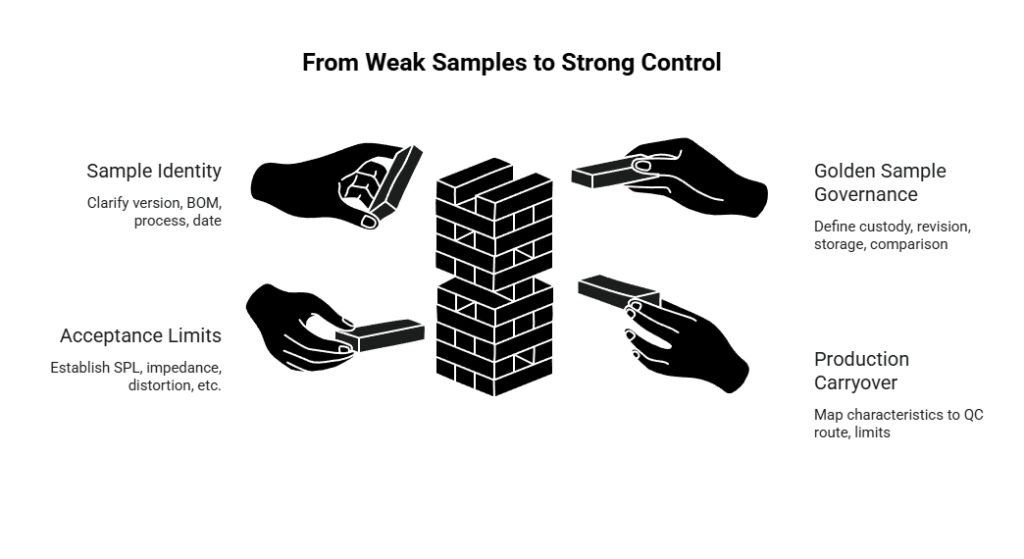
A review sample may reflect engineering attention that normal production will not receive. The risk is not whether the sample was good. The risk is whether the factory knows which variables made it good.
Four gaps deserve close review.
Gap 1: sample identity. If sample version, BOM state, process route, and test date are unclear, feedback cannot be reused safely. A suspension, cone, motor, enclosure, adhesive, or process-route change can invalidate earlier acoustic evidence.
Gap 2: golden sample governance. A golden sample should function as a controlled reference, not a trophy unit. If custody, revision lock, storage condition, and comparison method are undefined, the golden sample cannot govern production drift.
Gap 3: acceptance limits. Listening impressions should trigger measurement, not replace it. Depending on the program, approval may need limits for SPL window, impedance behavior, distortion, excursion, thermal load, fit, cosmetics, and reliability exposure.
Gap 4: production carryover. The supplier should map each approved characteristic to a QC route, limit, inspection owner, traceability field, and containment response. Unit- or batch-level traceability does not eliminate defects; it reduces the time and scope of root-cause investigation.
For teams comparing documentation quality without turning the process into a lab review, CFS’s guide on subwoofer manufacturer validation documentation provides a relevant next read.
Validation Readiness Improves Commercial Evaluation
Validation readiness does not outrank price, lead time, MOQ, or capacity. It changes how those trade-offs are judged.
A lower price is less attractive if the supplier cannot show how sample approval converts into controlled production evidence. A faster lead time may create risk if sample identity, golden sample custody, and production test limits remain unresolved. A flexible MOQ may matter less if the supplier cannot explain how pilot findings will influence the next build.
Use five dimensions before formal score carding:
| Dimension | What to ask |
|---|---|
| Validation fit | Can the supplier validate the specific acoustic, mechanical, thermal, and reliability risks of this program? |
| Evidence clarity | Can Product, Acoustics, QA, NPI, and Sourcing interpret the same records without translation? |
| Production carryover | Does each approved sample characteristic have a matching production control? |
| Stakeholder fit | Does the evidence support commercial, acoustic, quality, and ramp decisions at the same time? |
| Risk transparency | Does the supplier name unresolved assumptions before the brand discovers them during pilot build? |
This is most useful before RFQ, when supplier perception is still easy to correct. Brand teams do not need lab-level expertise; they need evidence-chain literacy. That literacy shows which supplier deserves commercial negotiation and which one needs more proof before price discussion.
For programs where the validation approach depends on the OEM or ODM model, CFS’s article on matching subwoofer validation to OEM/ODM program type can support the next layer of evaluation.
Better Supplier Comparison Starts With Controlled Evidence
Do not let a single good sample become a supplier’s entire business case. Growth-stage audio brands need a shorter, sharper test: can the supplier protect the approved design through revision control, golden sample governance, QC limits, and traceable production data?
Validation readiness gives Product, QA, Acoustics, NPI, and Sourcing a common stop/go language. It shifts supplier comparison from “Who made the best sample?” to “Who can prove the sample can become a controlled production standard?”
Discuss your next subwoofer program with China Future Sound to review sample evidence, golden sample controls, QC-route expectations, and production-readiness risks before supplier commitment.
Disclaimer: This article is for general informational purposes only. It is not a substitute for advice from a qualified professional, provider, or official source relevant to your situation. Always verify important decisions with the appropriate expert, authority, or service provider.
Our Editorial Process:
Our expert team uses AI tools to help organize and structure our initial drafts. Every piece is then extensively rewritten, fact-checked, and enriched with first-hand insights and experiences by expert humans on our Insights Team to ensure accuracy and clarity.
About the China Future Sound Insights Team
The China Future Sound Insights Team is our dedicated engine for synthesizing complex topics into clear, helpful guides. While our content is thoroughly reviewed for clarity and accuracy, it is for informational purposes and should not replace professional advice.