📌 Key Takeaways
Product leaders should share support systems, modularize key differences, and separate parts that protect each subwoofer line’s purpose.
- Reuse Below Differentiation: Share tools, records, and quality controls when they do not limit a product line’s core purpose.
- Protect Line-Defining Parts: Installation fit, performance goals, testing limits, and future upgrades often need modular or separate designs.
- Plan For Shared Changes: One shared-part revision can trigger testing, document updates, and approval reviews across every dependent product line.
- Govern Every Variant: Each named variant needs a clear purpose, owner, approval rules, records, and long-term plan.
- Choose Layer By Layer: Classify each element as shared, modular, or separate based on its effect on product promises.
Intentional reuse protects efficiency and meaningful product differences.
Product, engineering, QA, sourcing, and NPI leaders can use these rules to assess the platform boundary matrix below.
~ ~ ~ ~ ~ ~ ~ ~ ~ ~ ~ ~ ~ ~ ~ ~ ~ ~
A shared subwoofer platform can reduce duplicated development work while making several product lines dependent on the same constraints, revisions, and validation assumptions. Complexity does not disappear merely because products share architecture.
Reuse is most valuable below the differentiation boundary. Development infrastructure, documentation systems, production controls, and selected architectural elements can remain common if they do not dictate the line’s core purpose. Elements that define installation fit, performance priorities, validation limits, or future roadmap freedom usually need modular or dedicated treatment.
The practical choice is therefore not “reuse versus custom.” Product leaders should decide, layer by layer, whether to share, modularize, or separate.
A Shared Platform Is Not a Single Yes-or-No Decision
Teams often use “platform” to describe different levels of commonality. One stakeholder may mean shared development tools, while another means nearly identical product architecture.
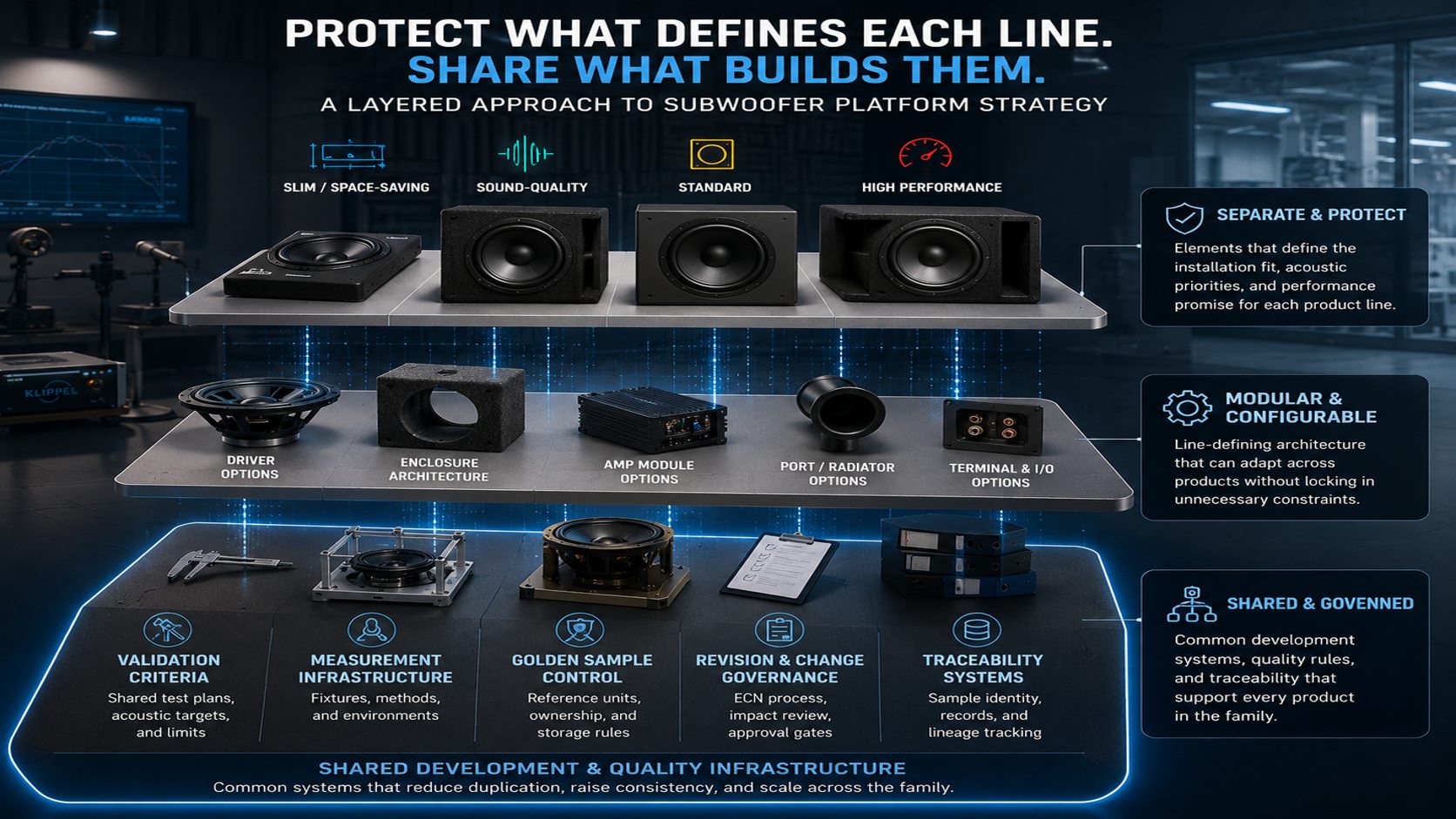
A useful model separates three layers:
- Shared development and production infrastructure: engineering resources, simulation and measurement tools, documentation systems, revision control, sample governance, traceability, and production-quality controls.
- Shared or modular product architecture: a common core, selected physical elements, controlled interfaces, or configurable modules.
- Line-specific product promise: the installation role, performance priority, acceptance criteria, and future development direction that justify the product line.
Products can share one layer without sharing all three. A common measurement system does not require identical acceptance limits. One supplier can support dedicated architectures. Sharing a physical element does not make two products strategically equivalent.
A line-defining element materially affects installation fit, intended use, performance priorities, validation requirements, or future roadmap options. Those elements establish the differentiation boundary.
Development ownership also matters. The distinction between OEM and ODM audio programs can affect how much architectural control a brand retains, but the development model alone does not determine what should be shared.
Where Reuse Usually Creates Useful Leverage
Commonality is generally safest where it supports several product programs without fixing their individual promises.
Development and quality infrastructure often fits this description. Centralizing these foundational engineering and quality control resources allows multiple product lines to operate under a unified standard without constraining their individual acoustic targets.. Each line can still retain independent requirements.
China Future Sound’s product-development documentation states that its acoustics work uses finite-element simulation and KLIPPEL R&D. The same documentation describes golden-sample management, KLIPPEL QC, barcode or QR-code traceability, and several production-inspection stages. These are verified company-specific examples of reusable infrastructure, not evidence that particular subwoofer models share physical components or acceptance limits.
Official KLIPPEL documentation similarly distinguishes between its R&D System, which supports development and measurement work, and its QC System, which supports repetitive manufacturing and quality-control applications. These tools illustrate how common test infrastructure can serve multiple products without proving that their technical targets should be identical.
Supplier-management infrastructure may also be standardized. Common evidence formats, revision records, deviation rules, change-notification expectations, and traceability requirements can give product, engineering, QA, sourcing, and NPI teams a shared operating language.
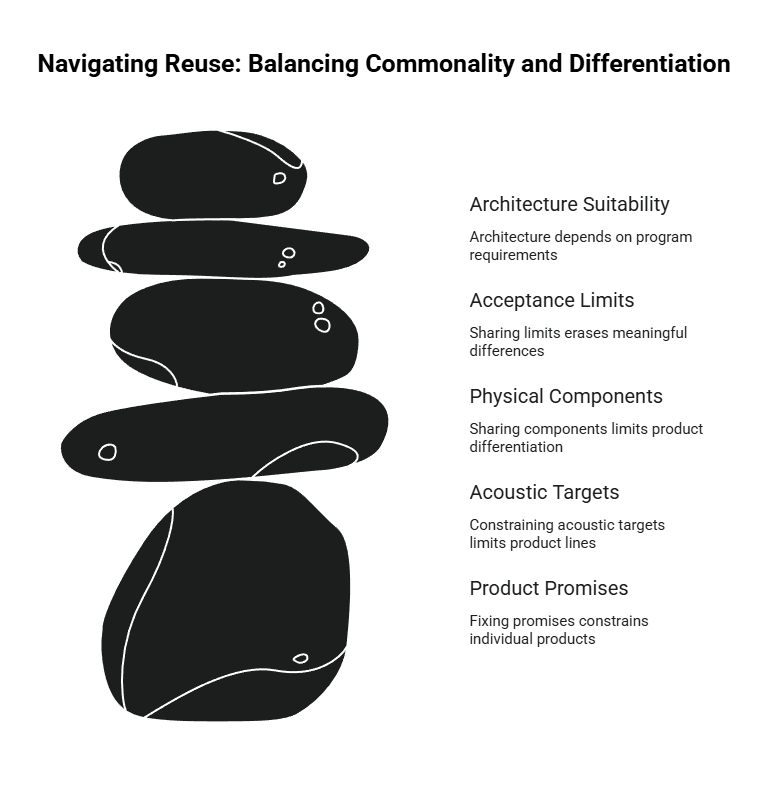
Selected architecture may be reused when it remains below the differentiation boundary. No specific basket, motor, magnetic circuit, cone, suspension, voice coil, or tooling arrangement is universally safe to share. Suitability depends on the requirements of the actual program.
A practical test is:
If this element changed, would the brand need to reconsider the promise, validation limits, or future roadmap of more than one line?
A “no” answer suggests relatively low coupling. A “yes” answer indicates that the element needs stronger change governance, modular isolation, or dedicated development.
This separation between common infrastructure and distinct product criteria is also relevant when aligning subwoofer validation criteria before OEM sampling.
Where Reuse Begins to Erase Meaningful Differences
Commonality becomes restrictive when the shared architecture determines attributes central to the product promise. Depending on the program, these attributes may include:
- Installation depth or physical envelope.
- Intended application.
- Acoustic priorities.
- Power-handling intent.
- Thermal or excursion demands.
- Tuning range.
- Acceptance criteria.
- Future performance upgrades.
China Future Sound’s public product structure separates standard, slim, and sound-quality subwoofer categories. That verifies the existence of distinct category presentations, but it does not prove that the categories use separate platforms or reveal which components may be common.
As a general product-positioning principle, a slim line is organized around space-constrained installation, while an SQ line places greater emphasis on sound-quality priorities. A high-power line has another performance emphasis, and a standard line may provide broader application coverage. The precise engineering requirements behind these roles vary by brand, use case, and product program.
Published specifications alone do not establish meaningful differentiation. A revised rating can create another SKU without creating a durable reason for the line to exist. Conversely, products with some similar specifications may remain meaningfully distinct when they solve different installation or performance problems.
Consider a growth-stage brand offered one core architecture for standard, slim, and high-power products. Sharing the core could reduce some duplicated documentation. However, if it fixes the installation depth, thermal capacity, excursion envelope, or validation ceiling, one line may inherit constraints from another.
The correct response would not necessarily be to reject all commonality. A modular boundary might preserve the reusable core while isolating the line-defining portion. Separate development becomes justified when modular isolation cannot protect the intended role.
A Variant Can Still Carry Nearly Independent Work
A small physical change does not automatically create a small organizational burden.
Once a variant receives a separate name and product promise, it may require its own role definition, requirement owner, sample identity, acceptance criteria, revision records, documentation, supplier communication, QA decision, and lifecycle plan. For an organization with 51–250 employees, the same product, engineering, QA, sourcing, and NPI specialists may support several such programs.
Shared elements also create change propagation. A revision to a common element can require impact review across every dependent line. The organization may need to reconsider validation coverage, update documentation, control sample identity, and decide whether all products adopt the revision together.
Peer-reviewed product-platform research has examined change propagation as an explicit consideration in modular platform design. The detailed methods differ by industry and implementation, but the underlying management lesson is relevant: commonality creates both leverage and dependency. This open-access research on change propagation in modular product-platform design provides further technical context.
Before approving a “simple variant,” ask:
Which decisions, records, and approvals remain shared, and which become independently owned?
If that answer is unclear, the roadmap may be adding a separate product identity without establishing the capacity to govern it. Disciplined scope decisions, such as those discussed in planning the first three SKUs, can help keep product coverage aligned with ownership capacity.
Platform Reuse Boundary Matrix
This matrix is a leadership screen, not a technical approval tool. It identifies where deeper engineering evidence may be required before architecture is committed.
| Candidate element or layer | Product-promise dependence | Validation dependence | Change propagation | Modular isolation | Future optionality | Recommended treatment |
|---|---|---|---|---|---|---|
| Development and test infrastructure | Usually low | Methods may be common while limits differ | Low to medium | Usually straightforward | Usually preserved | Share |
| Documentation and revision systems | Low | Supports control rather than setting limits | Medium | Straightforward | Usually preserved | Share |
| Supplier quality and traceability controls | Low | Supports evidence across lines | Medium | Straightforward | Usually preserved | Share |
| Selected non-line-defining architecture | Program-dependent | May affect several criteria | Medium to high | Often possible | Must be assessed | Share or modularize |
| Installation-envelope elements | Often high | Usually affects fit-related approval | High | Sometimes possible | May constrain future formats | Modularize or separate |
| Performance-priority elements | Often high | Can affect line-specific limits | High | Program-dependent | May restrict future tiers | Modularize or separate |
| Product-role definition and acceptance criteria | High | Directly governs approval | Medium to high | Must remain independently controlled | Protects line direction | Keep separate |
Three interpretation rules keep the matrix practical.
Share low-coupling elements. Use commonality when the element does not define the product promise, validation requirements remain compatible, and one owner can manage family-wide changes.
Modularize line-defining differences. Retain a common core when the dedicated portion can be configured, revised, and validated without forcing the same constraints onto every line.
Separate when the promise cannot be protected. Use dedicated development when physical requirements, performance priorities, validation criteria, or future direction conflict with the shared core.
The matrix cannot prove that a proposed architecture will work. It identifies the questions that must be answered with program-specific engineering evidence.
Govern the Family Before Approving Another Extension
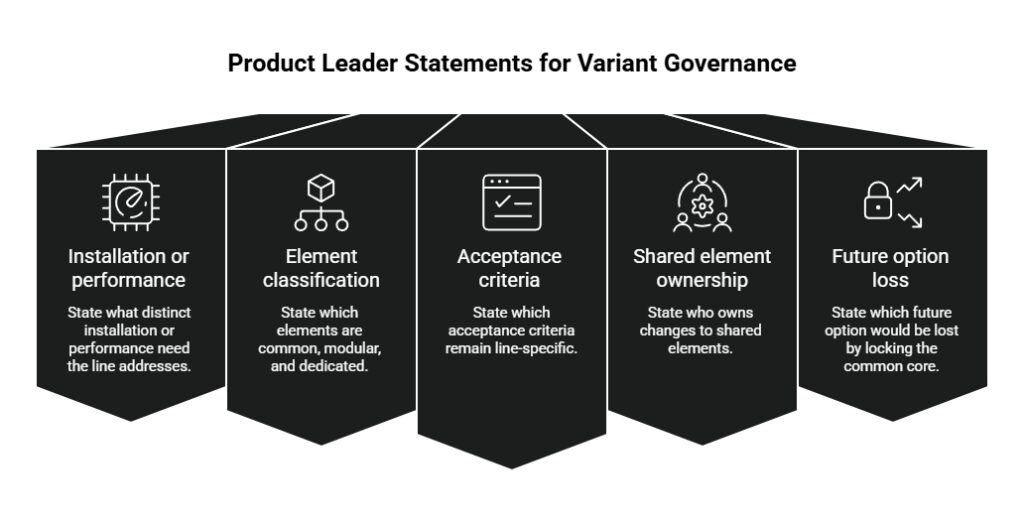
Variant governance means making product purpose, ownership, and change consequences visible before a line becomes a committed roadmap item.
Product leaders should be able to state:
- What distinct installation or performance need the line addresses.
- Which elements are common, modular, and dedicated.
- Which acceptance criteria remain line-specific.
- Who owns changes to shared elements.
- Which future option would be lost by locking the common core.
Several warning signs suggest platform proliferation rather than useful coverage. The line may be differentiated mainly by a minor specification change. Multiple variants may need different market explanations while remaining bound by identical constraints. Acceptance criteria may have been copied because the hardware appears similar. The supplier may also be unable to distinguish what is common, configurable, and dedicated.
Supplier availability is an input, not a product strategy. A credible platform-family proposal should make architecture boundaries, validation implications, revision dependencies, and ownership visible. It should not merely present a catalog of possible variants.
Frequently Asked Questions
Can SQ and high-power subwoofers share a platform?
They may share development infrastructure or selected architecture. Complete reuse is appropriate only when the common core does not force conflicting product promises, physical constraints, or validation limits. In some programs, modularity may preserve more flexibility.
Can slim and standard subwoofers use the same architecture?
Selected elements may be reusable. However, installation depth and physical-envelope requirements can make modular or separate development necessary. The answer depends on the product requirements rather than the category names alone.
Does sharing a basket, motor family, or tooling make two products the same platform?
Not by itself. Platform identity depends on the full set of common elements, controlled interfaces, independent requirements, validation dependencies, and the way revisions propagate across the family.
Is platform reuse mainly an engineering decision?
No. Engineering feasibility is essential, but the decision also affects product role, brand differentiation, QA ownership, supplier dependency, documentation, organizational capacity, and future roadmap flexibility.
Protect the Reason Each Line Exists
The goal is not maximum commonality or maximum uniqueness. It is intentional commonality.
Share elements that provide leverage without defining the product promise. Modularize differences that need controlled independence. Choose separate development where a shared core would compromise the line’s role, validation logic, or future direction.
Before approving another line extension, classify the proposed common elements as share, modularize, or separate—and document which product promise each decision protects.
Disclaimer: This article is for general informational purposes only. It is not a substitute for advice from a qualified professional, provider, or official source relevant to your situation. Always verify important decisions with the appropriate expert, authority, or service provider.
Our Editorial Process:
Our expert team uses AI tools to help organize and structure our initial drafts. Every piece is then extensively rewritten, fact-checked, and enriched with first-hand insights and experiences by expert humans on our Insights Team to ensure accuracy and clarity.
About the China Future Sound Insights Team
The China Future Sound Insights Team is our dedicated engine for synthesizing complex topics into clear, helpful guides. While our content is thoroughly reviewed for clarity and accuracy, it is for informational purposes and should not replace professional advice.