📌 Key Takeaways
Subwoofer samples only matter when tests match the real program assumptions.
- Match The Use: A passed sample still leaves risk when tests miss the real use case.
- Ask Better Questions: Supplier reviews should connect sound goals, stress tests, materials, and production checks.
- Separate Proof Types: Sample results, use-case fit, and production control each answer a different risk.
- Check By Program: Automotive, marine, pro audio, and custom OEM subwoofers need different proof.
- Control Production Drift: Golden samples and quality checks help keep mass production close to the approved sample.
A good supplier review proves the test plan fits the product, not just that a sample passed.
Brand-side Product, QA, Sourcing, and Acoustics teams will gain sharper supplier-review questions, preparing them for the detailed overview that follows.
~ ~ ~ ~ ~ ~ ~ ~ ~ ~ ~ ~ ~ ~ ~ ~ ~ ~
A subwoofer sample can perform well in an early review and still leave the wrong risk unresolved. For brand-side Product, QA, Sourcing, and Acoustics teams, the central question is not simply, “Did the sample pass testing?” The better question is, “Was it validated against the right program assumptions?”
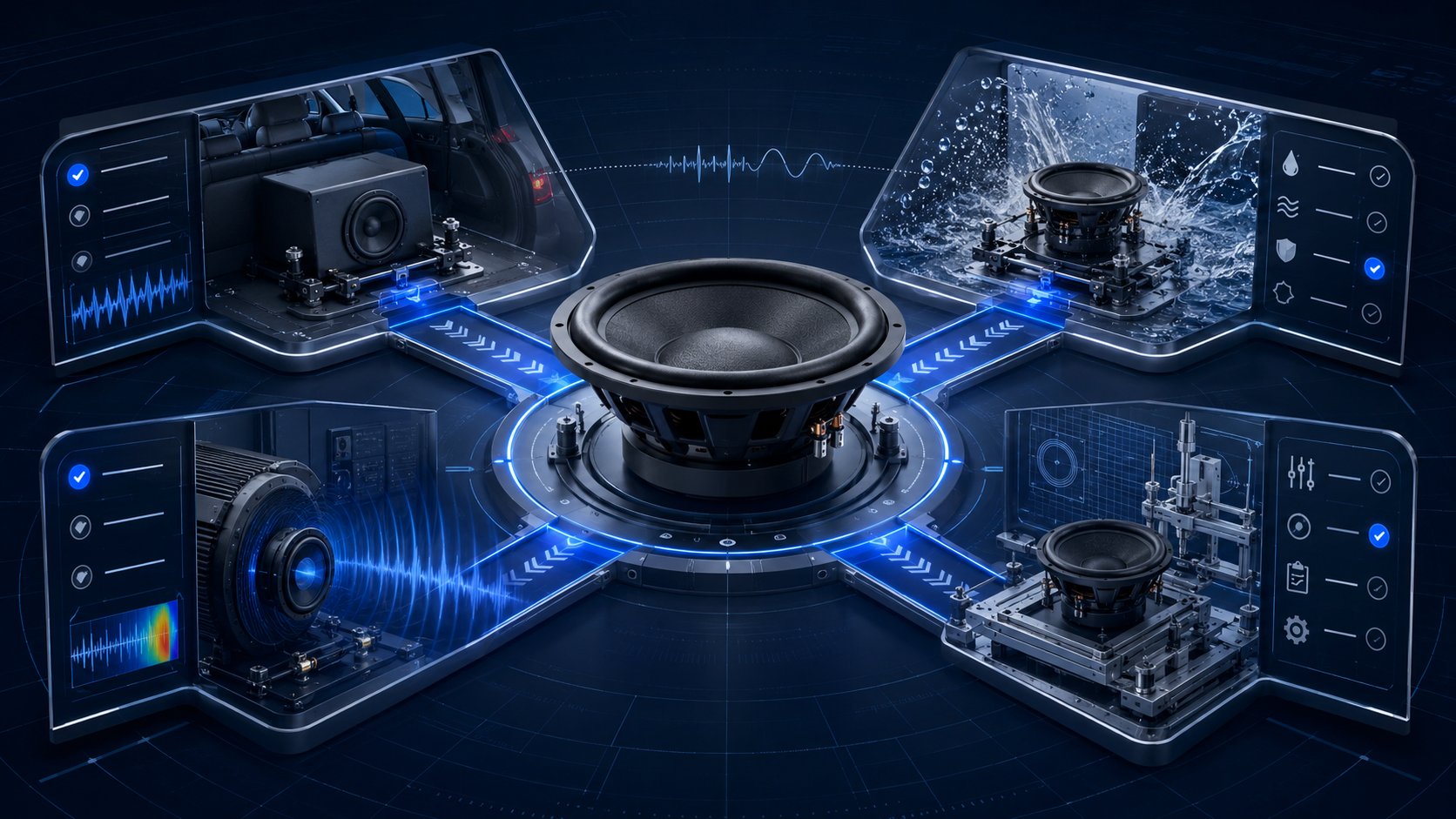
Those assumptions change by application. An automotive subwoofer, a marine subwoofer, a pro audio subwoofer, and a custom OEM subwoofer may differ in enclosure constraints, acoustic tuning goals, environmental exposure, duty-cycle expectations, serviceability needs, and production-control requirements.
This article uses three levels of certainty. China Future Sound capability references are based on source-provided company information. Broader validation guidance reflects generally accepted product-development and QA principles. Exact standards, thresholds, and pass/fail limits vary by program and should be verified before sign-off.
For teams evaluating subwoofer manufacturing capabilities, the goal is to move beyond equipment lists and ask for supplier evidence that connects the approved sample, the intended use case, and the mass-production quality plan.
What “Validation Fit” Means In A Subwoofer Program
Validation fit is the match between the intended application, performance target, environmental exposure, duty cycle, physical constraints, test evidence, and production controls.
Effective validation transcends simple laboratory results. It is evidence that the design, sample, qualification criteria, and production process are aligned with the actual program context. A useful validation conversation should connect acoustic goals, reliability testing, material choices, golden sample governance, and production consistency.
That discussion should separate three proof types:
| Proof Type | What It Shows | Why It Matters |
|---|---|---|
| Sample-stage proof | The sample met defined checks under specific conditions | Helpful, but not enough on its own |
| Application-fit proof | The checks reflect the real use case and program assumptions | Reduces the risk of validating the wrong scenario |
| Mass-production consistency proof | Production units can be checked against the approved sample and criteria | Helps control sample-to-production consistency |
CFS source materials support capabilities such as finite element simulation for magnetic circuits and speaker vibration systems, KLIPPEL R&D sample testing, short-term destructive power tests, long-term power tests, golden sample management, KLIPPEL QC, barcode/QR-code route control, IQC/IPQC/FQC inspection, and reliability laboratory testing. These capabilities are relevant evidence categories, but they should still be reviewed against the specific program plan.
Supplier review callout: Do not accept a test-equipment list as proof of application fit. Ask what assumptions shaped the validation plan and how the supplier will control production against the approved sample.
A Quick Matrix: How Validation Questions Change By Program Type
| Program Type | Main Validation Concern | Questions to Ask | Evidence to Request |
|---|---|---|---|
| Automotive | Integration, enclosure assumptions, thermal/vibration context, vehicle-use constraints | What installation and enclosure assumptions shaped the acoustic target? How were sample results tied to production limits? | Frequency response data, sample report, golden sample reference, IPQC/FQC plan |
| Marine | Moisture, UV exposure, corrosion risk, open-air use, material durability | Which material and assembly assumptions address high-humidity or outdoor exposure? | Material documentation, environmental test plan, reliability test summary |
| Pro Audio | Sustained output, duty cycle, thermal behavior, mechanical stress, serviceability | How does validation account for repeated high-output use and inspection after stress? | Power-test summary, thermal observations, mechanical inspection criteria |
| Custom OEM | Unique acoustic target, fit constraints, brand-specific tuning, DFM/DFX readiness | How are custom specs translated into testable acceptance criteria before tooling or ramp? | DFM notes, golden sample agreement, test limits, ECO/ECR process |
Automotive Subwoofer Programs: Ask About Integration Assumptions
Automotive subwoofer validation should clarify the assumed enclosure, amplifier pairing, mounting constraints, vehicle-use context, and target acoustic profile. The purpose is not to turn the review into an installation guide. It is to confirm whether the supplier’s validation assumptions fit the intended platform.
For OEM car audio programs, brand teams should ask what enclosure assumptions were used during tuning and sample validation. They should also ask whether thermal and vibration considerations were evaluated at the design or sample stage, what parameters are locked in the golden sample, and how FQC will detect drift from the approved acoustic target.
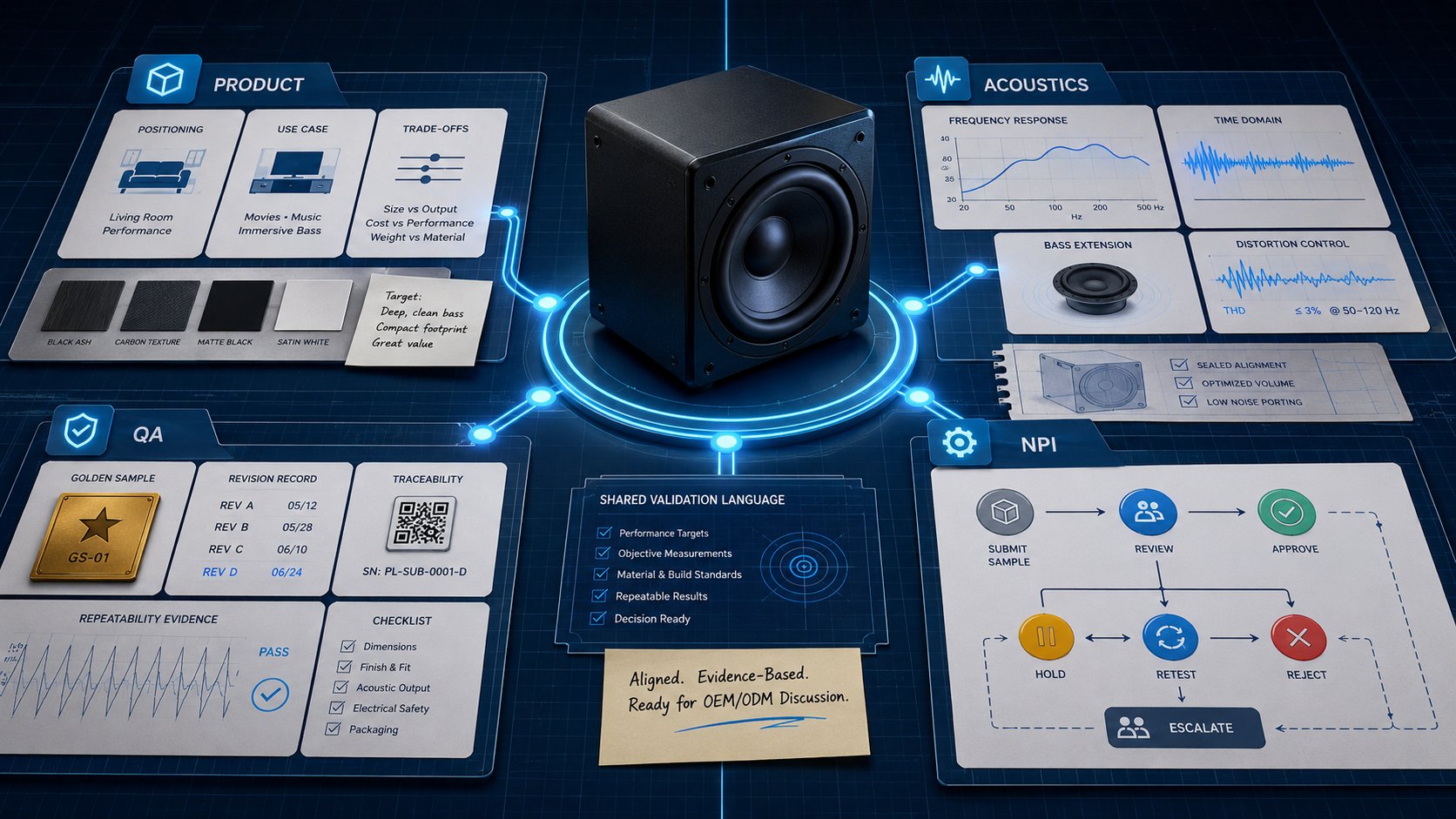
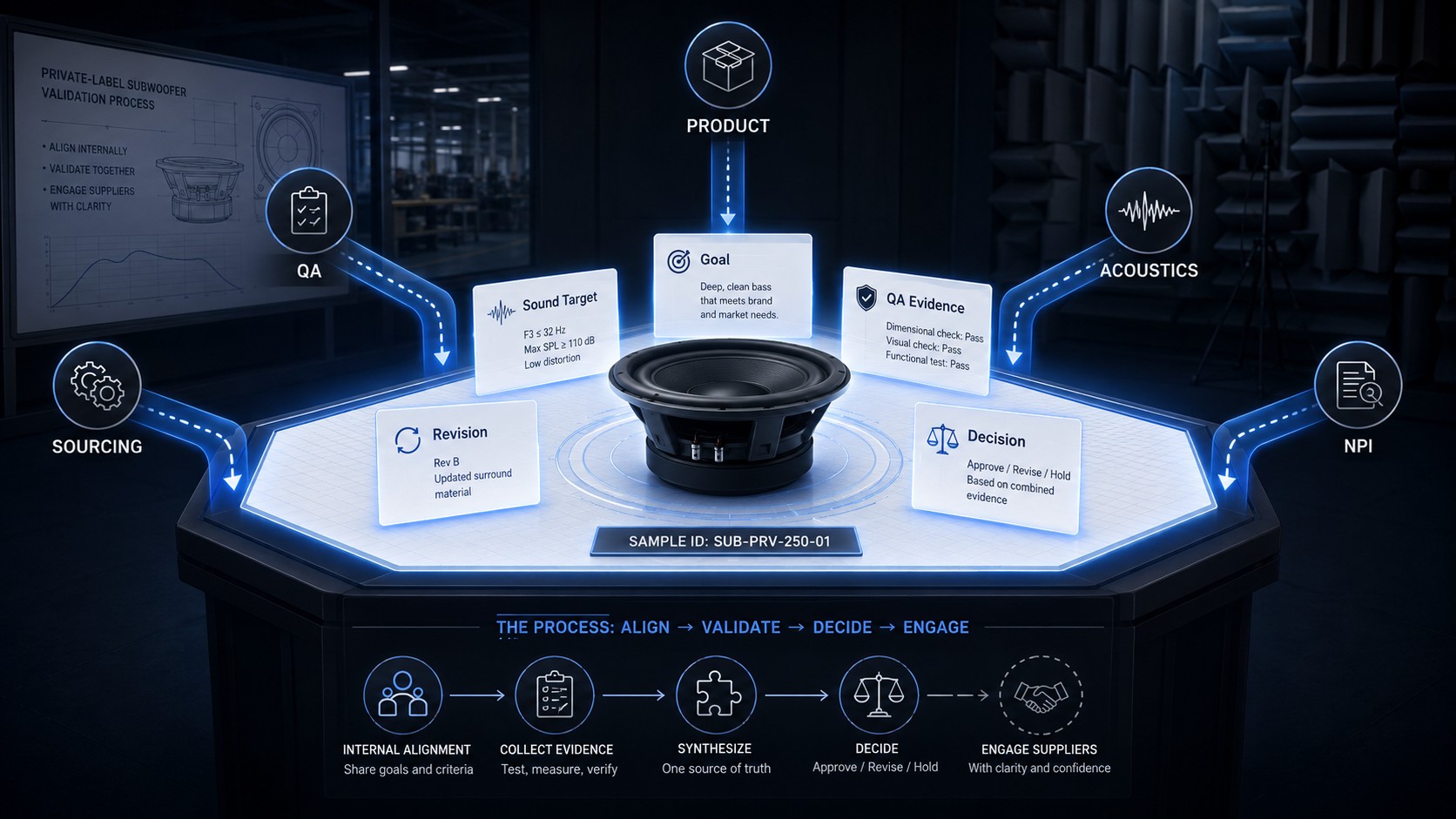
This is where Product, QA, Sourcing, and Acoustics should align before supplier approval. Product may care about market fit, QA may care about repeatability, Sourcing may care about supplier readiness, and Acoustics may care about measurement confidence. A strong validation plan gives all four teams a shared evidence base.
Marine Subwoofer Programs: Ask How Exposure Changes Evidence
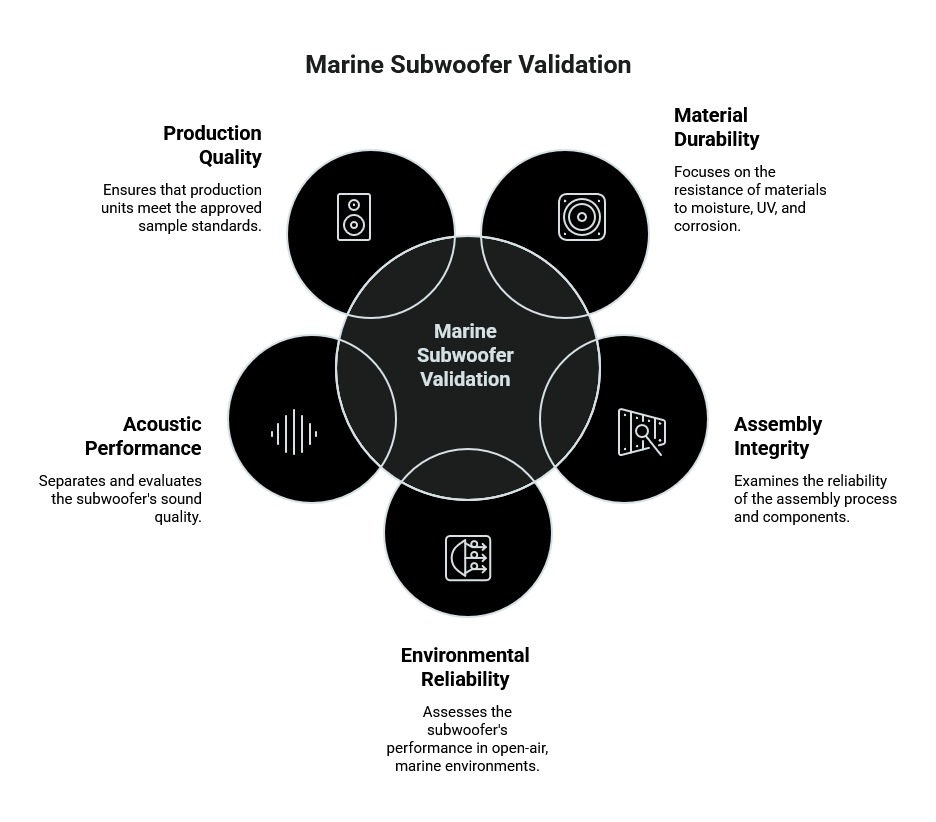
Marine validation should focus on material, assembly, and reliability assumptions for moisture, UV exposure, corrosion risk, and open-air environments. This text omits specific marine standards, as these must be validated against precise program requirements.
For marine subwoofer programs, supplier questions should separate acoustic performance from environmental durability. Which material choices were made for marine-use exposure? How are grille, cone, surround, basket, coating, adhesive, and enclosure assumptions considered? Which reliability checks are completed before production approval? How are production units compared against the approved sample?
When exact marine requirements are needed, teams should consult the applicable customer specification or official standards source rather than relying on supplier shorthand. ABYC, for example, publishes official marine standards and technical information reports, but applicability must be confirmed for the specific product and program. (The American Boat & Yacht Council)
Pro Audio Subwoofer Programs: Ask About Sustained-Use Assumptions
Pro audio validation often requires closer attention to repeated high-output use, duty cycle, thermal behavior, mechanical durability, serviceability expectations, and lot-to-lot consistency. The supplier does not need to invent universal limits. It does need to explain how the validation plan reflects the intended use case.
For pro audio applications, useful questions include: What duty-cycle assumptions shaped the validation plan? How are short-term destructive power tests and long-term power tests used? What thermal, suspension, voice-coil, adhesive, or mechanical risk areas are watched? What should service teams inspect if a unit is stressed in the field? How does QC compare production units against the golden sample?
If exact acoustic measurement methods, maximum output claims, or professional audio standards become part of the acceptance criteria, verify them through official audio engineering references. AES maintains an official standards program for audio engineering standards and interoperability work. (AES)
Custom Oem Programs: Ask Whether Requirements Are Testable Before Tooling Or Ramp
Custom OEM validation is not only about performance. It is about turning brand-specific requirements into measurable acceptance criteria before NPI risk compounds.
Requirements often evolve during development. Acoustic targets, fit constraints, materials, cosmetics, packaging, and production tolerances may shift as the design moves from concept to sample to production. That is why DFM/DFX, golden sample approval, ECO/ECR governance, and traceability should be discussed before tooling or ramp.
Brand teams should ask which requirements are testable, what must be locked before golden sample approval, which sample-stage results become production-stage QC checks, and what traceability connects unit data, test route, and production batch. For related production-readiness thinking, teams can review quality gate alignment for OEM audio programs and golden sample consistency.
Supplier-Question Checklist Before Validation Sign-Off
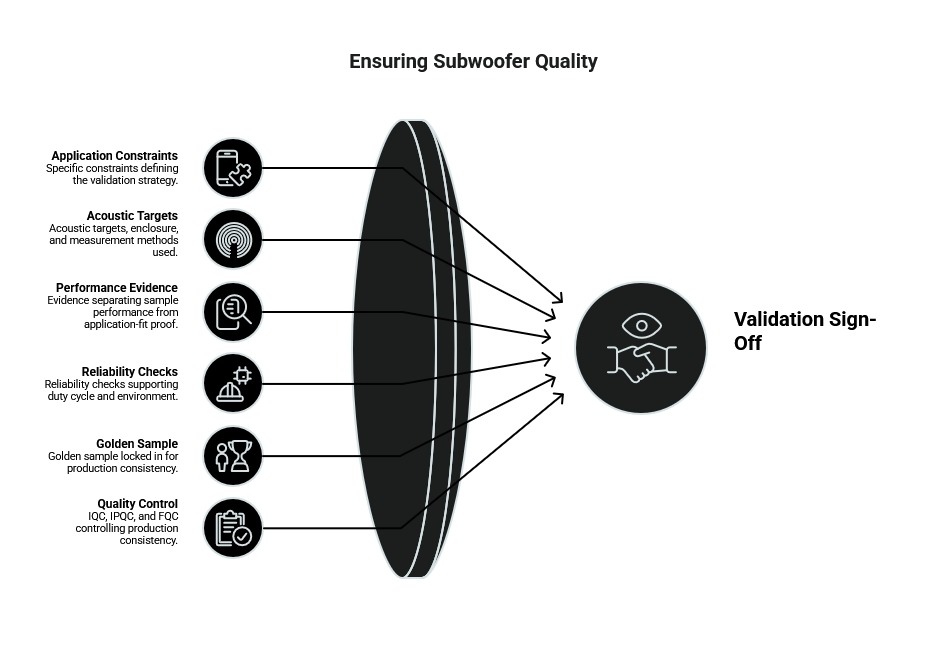
Before approving a supplier or moving toward qualification, brand teams should ask:
- Which specific application constraints defined the validation strategy?
- Which acoustic target, enclosure condition, and measurement method were used?
- What evidence separates sample performance from application-fit proof?
- Which reliability checks support the intended duty cycle and environment?
- What is locked in the golden sample?
- How will IQC, IPQC, and FQC control production consistency?
- How is test data connected to unit identity, batch, or production route?
- What ECO/ECR process governs changes after sample approval?
- Which validation limits, open issues, or unresolved assumptions remain?
- Which claims require customer approval, external lab review, or standards verification before publication?
This final inquiry is critical. Exact SPL limits, thermal thresholds, vibration limits, salt-fog results, IP ratings, duty-cycle claims, warranty-reduction claims, and compliance statements should not be made without verified support.
Useful External References For Verification
When exact standards, compliance claims, or acceptance methods matter, use official sources rather than informal supplier language. ISO’s official ISO 9001 page is relevant for understanding the quality-management-system standard, while SAE, AES, and ABYC provide official standards resources that may be relevant depending on automotive, audio, or marine program requirements. Applicability must be confirmed case by case. (ISO)
Conclusion: Choose Validation Evidence That Matches The Program
A strong subwoofer validation discussion should be specific to the application. Automotive, marine, pro audio, and custom OEM programs ask different questions, but all should connect program assumptions, sample evidence, golden sample control, and production QC.
The supplier review should make clear what was tested, why those conditions were chosen, how acceptance criteria were defined, and how production units will remain aligned with the approved sample. That is how a team moves from “the sample passed” to a more useful conclusion: the validation plan fits the program.
Use these questions in your next supplier review, or discuss your next subwoofer program with an engineering team that can connect acoustic targets, sample validation, and production quality controls.
Disclaimer: This article is for general informational purposes only and does not constitute compliance, safety, technical, or professional advice. Requirements, risks, and best practices may vary by program context, jurisdiction, system, provider, or use case. Confirm important decisions with the appropriate qualified professional, authority, or technical expert.
Our Editorial Process:
Our expert team uses AI tools to help organize and structure our initial drafts. Every piece is then extensively rewritten, fact-checked, and enriched with first-hand insights and experiences by expert humans on our Insights Team to ensure accuracy and clarity.
About the China Future Sound Insights Team
The China Future Sound Insights Team is our dedicated engine for synthesizing complex topics into clear, helpful guides. While our content is thoroughly reviewed for clarity and accuracy, it is for informational purposes and should not replace professional advice.