📌 Key Takeaways
Approve a subwoofer variant only when its customer value clearly outweighs the added decisions, testing, coordination, and long-term upkeep.
- Count Decisions, Not SKUs: Complexity lives in distinct decisions across teams, not in the number of commercial SKUs.
- Give Every Model Purpose: Every model needs a unique use case, clear message, responsible owner, and plan for future changes.
- Reuse Platforms Wisely: Reuse a platform when core needs and testing assumptions remain shared, while controlling smaller differences.
- Separate When Roles Suffer: Choose separate development when shared design would weaken the product’s fit, performance promise, testing, or ownership.
- Review Before Development: Review each proposal first, then reuse, separate, merge, or delay it based on clear evidence.
Every variant must earn its roadmap cost.
Private-label subwoofer leaders will make sharper portfolio choices by using the variant review questions and decision matrix that follow below.
~ ~ ~ ~ ~ ~ ~ ~ ~ ~ ~ ~
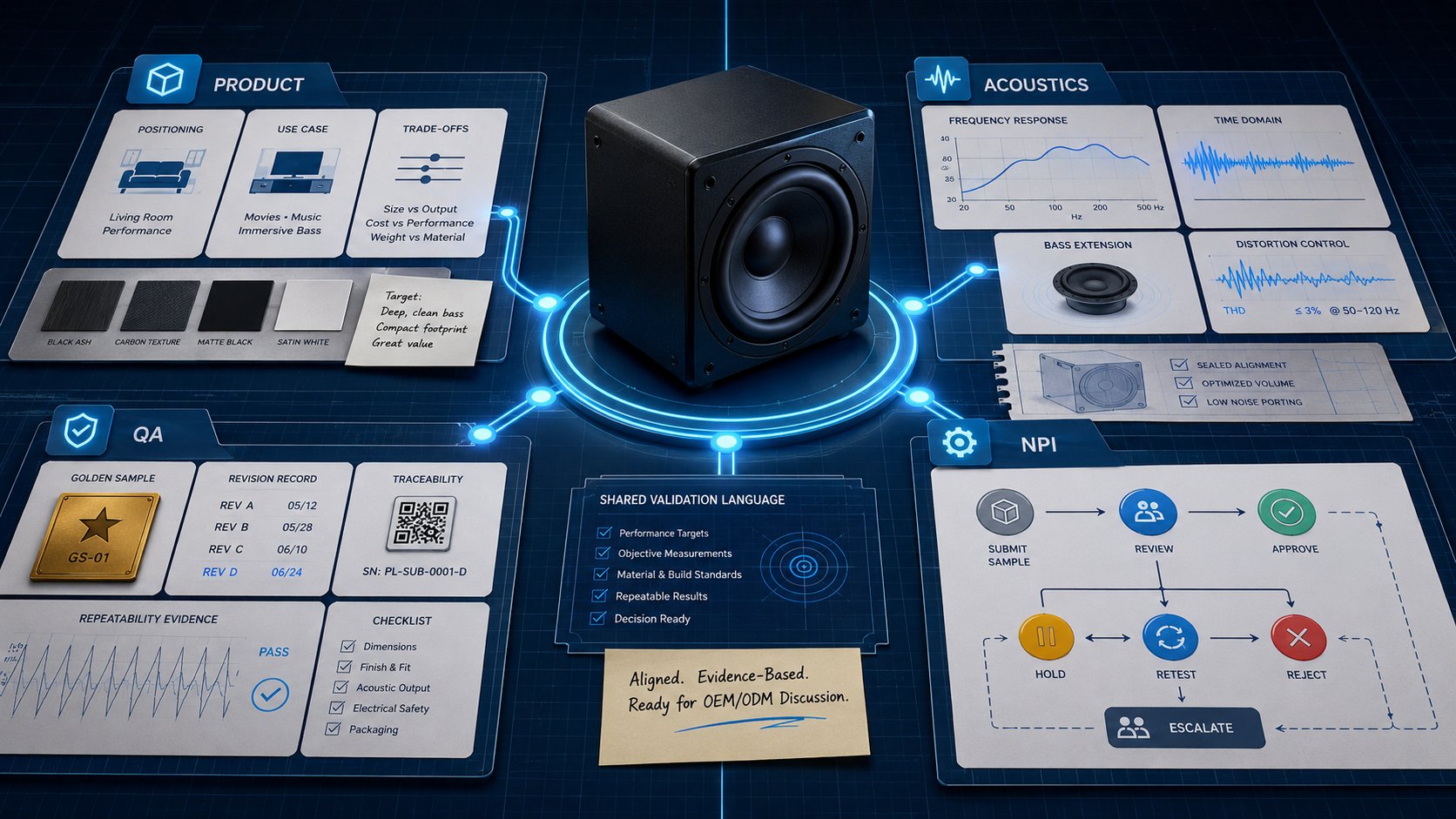
A private-label subwoofer portfolio often expands one reasonable request at a time. A core bass line gains an SQ-oriented model, a slim version, another power position, a cosmetic option, or a customer-specific configuration. Each addition may appear manageable when reviewed alone.
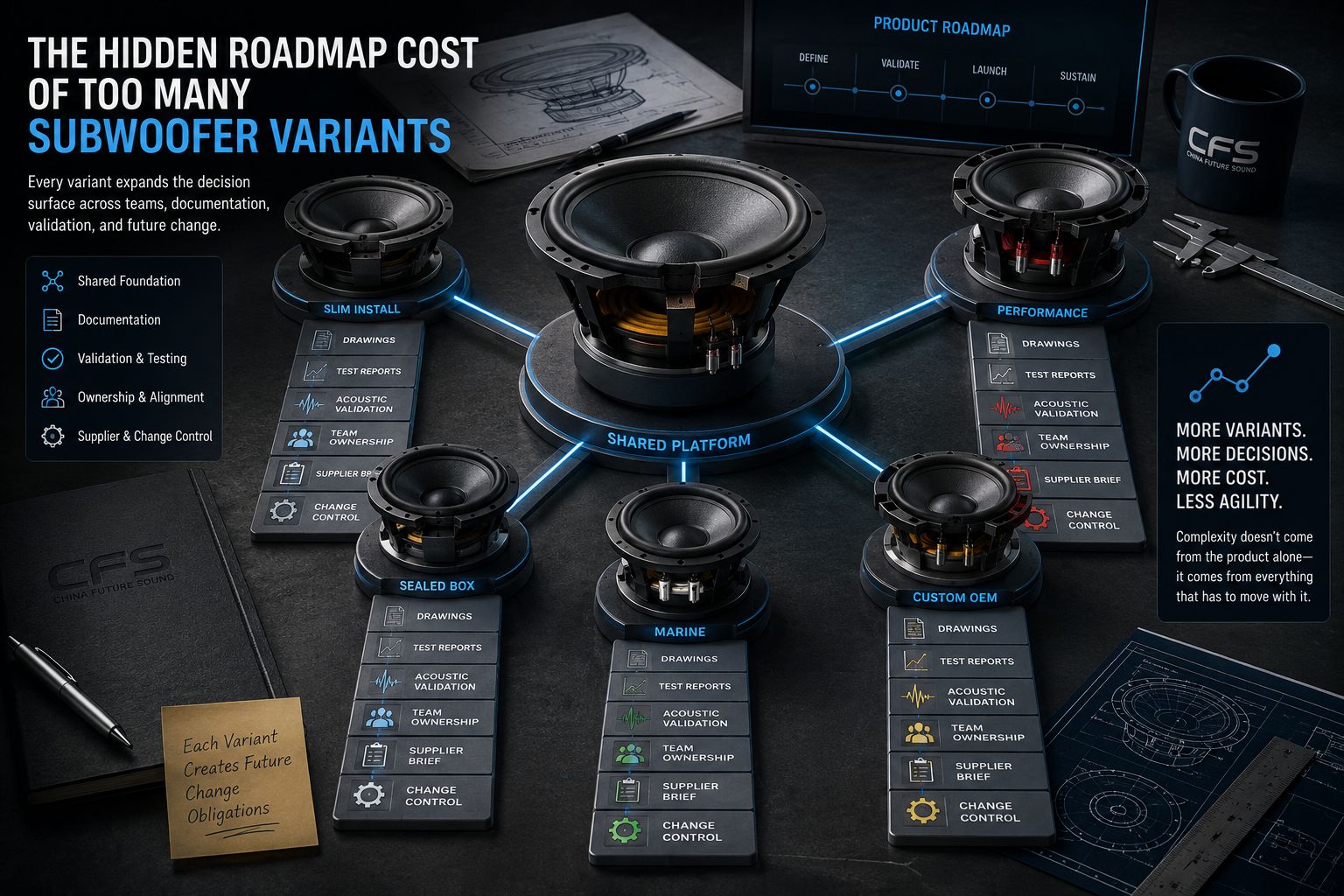
The difficulty emerges when the organization can no longer explain which use case, product promise, or development decision belongs uniquely to each model. The hidden roadmap cost is therefore not the catalog count itself. It is the growing number of assumptions, approvals, dependencies, and future changes that Product, Engineering, QA, Sourcing, and Commercial teams must coordinate.
This is not an argument for an artificially small product line. The central question is whether a proposed variant creates enough customer and portfolio value to justify its added roadmap, development, validation, and governance burden.
The Real Unit of Complexity Is the Decision, Not the SKU
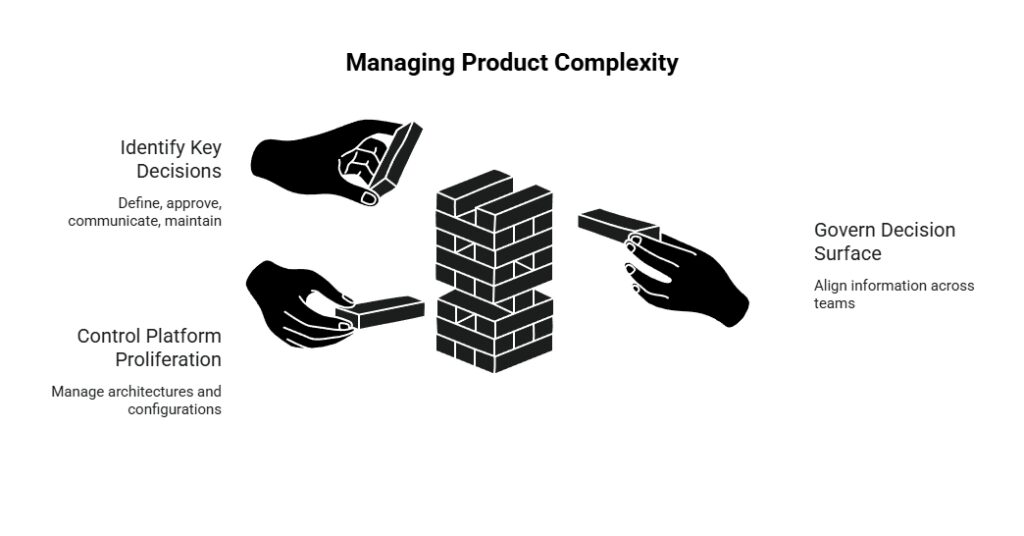
A SKU is a commercial identifier. A development decision is a commitment that the organization must define, approve, communicate, and maintain.
A new variant may need a distinct portfolio role, performance target, supplier brief, sample decision, validation assumption, positioning statement, document set, owner, and change history. Not every variant requires a completely separate workflow, but every meaningful difference must be identified and governed somewhere.
That collection of commitments can be described as the product’s decision surface. For example, a ‘simple’ cosmetic variant might only require two hours of engineering design, but it can easily consume fifty hours of cross-functional time for supplier onboarding, QA validation, packaging localization, and lifecycle documentation. As the decision surface grows, more information must remain aligned across teams and across the product life cycle.
SKU count versus decision count: Two commercial SKUs may share almost all engineering decisions while differing in finish, branding, or packaging. Two models that share several components may still require separate product promises, approval criteria, and validation paths. The number of products therefore reveals less than the number of distinct decisions attached to them.
Platform proliferation occurs when product families accumulate architectures, configurations, or variants faster than the organization can define their roles and maintain their relationships. The problem is not variety by itself. The problem is unmanaged variety.
Variant Complexity Accumulates in Four Places
The burden attached to a line extension is distributed, which makes it easy to overlook. No single department sees the entire coordination load.
Definition: What problem does the variant solve?
A proposed model needs a clear portfolio role: the specific application, constraint, performance objective, customer program, or tier that it owns within the product family.
A specification difference is not automatically a role. Product names can clarify an established distinction, but naming cannot create a strategic purpose that the underlying product does not support.
Consider a roadmap that contains three proposed models with adjacent power positioning, similar installation assumptions, and the same intended use case. The specifications form a logical sequence, yet the team cannot describe each model’s unique purpose in one sentence. The issue is not that power steps are inherently unnecessary; it is that the roles remain unresolved.
Development: Which decisions and evidence actually differ?
A new variant can reopen choices involving common architecture, configuration, samples, supplier instructions, validation scope, documentation, and approval responsibility.
Supplier availability may reduce the apparent effort required to obtain a product, but availability does not complete the roadmap case. A readily available model can still create internal work if its role, requirements, claims, and ownership are distinct.
Shared components can create the opposite misunderstanding. Products may look technically similar while serving different applications or carrying different promises. Common parts do not guarantee that every approval assumption remains common.
Communication: Can the distinction be explained consistently?
A useful product difference should survive outside the product team. Product, Sales, Sourcing, Engineering, and QA should be able to describe why adjacent models exist without relying entirely on minor specification changes.
When each function gives a different explanation, messaging begins to substitute for product strategy. This creates ambiguity for supplier briefs, positioning, documentation, and future roadmap decisions.
Maintenance: What must remain synchronized?
Approved variants become part of ongoing change control. A component revision, documentation update, positioning change, or shared-platform modification may affect one model, several models, or the entire family.
General configuration-management guidance reinforces the importance of identifying product configurations and controlling changes throughout the life cycle. ISO 10007:2017, for example, provides organizational guidance for configuration management from concept onward; it does not prescribe a particular subwoofer architecture or require certification for this decision framework.
Without clear ownership, legacy models can remain active because no one is responsible for consolidation. The roadmap then expands through inertia rather than deliberate renewal decisions.
A Shared Platform Helps When the Core Decisions Remain Common
A shared platform is a common technical foundation used across related products. It can reduce repeated coordination when the products genuinely share their central requirements.
At a broader systems-engineering level, the INCOSE Product Line Engineering Working Group describes product-line engineering as managing related products through shared assets while controlling variation. That principle supports the governance logic here, although it does not determine whether any specific subwoofer models should share an architecture.
Good candidates for reuse usually have several characteristics in common:
- The installation envelope and intended application are substantially aligned.
- Core performance requirements overlap.
- Major validation assumptions remain applicable.
- Differences can be introduced without destabilizing adjacent products.
- Shared changes can be governed through clear ownership and change control.
Reuse may allow teams to carry forward architecture decisions, documentation structures, supplier instructions, manufacturing controls, and portions of the validation logic. It does not eliminate sampling, review, or validation. The exact work still depends on what changes and what the product is expected to claim.
For instance, a customer-specific version might change branding, finish, or packaging while retaining the same application and core architecture. The commercial SKU still requires controlled naming, documents, ownership, and change history, but it may not justify a separate engineering program.
The development model also affects the amount of commonality available. Teams evaluating an existing foundation against a more customized program may find the distinction between OEM versus ODM program fit useful when defining the scope.
Reuse Becomes Limiting When It Weakens the Product Role
A shared platform stops being helpful when commonality compromises the reason a product exists.
Separate development may be justified when a difference materially changes the intended application, installation depth, enclosure constraints, acoustic objective, output target, durability environment, thermal assumptions, power assumptions, component architecture, validation criteria, packaging constraints, or brand-tier promise. No single difference automatically proves that separation is required; the effect depends on the program.
To illustrate, suppose a slim model prioritizes installation depth while an SQ-oriented model prioritizes a different performance objective. A common platform may remain possible, but the team must determine whether the shared architecture preserves both roles or pushes each product toward an unclear compromise.
| Difference that may fit a shared platform | Difference that may justify separation |
|---|---|
| Branding, finish, or packaging variation | Materially different intended application |
| Minor configuration change within one use case | Different installation depth or enclosure constraint |
| Adjacent positioning with common requirements | Distinct acoustic or output objective |
| Shared validation assumptions with targeted review | Different durability, thermal, or power assumptions |
| A clear message supported by common architecture | A promise that the common architecture cannot support credibly |
| Controlled documentation variation | A materially different validation path |
This table is a practical comparison, not a universal engineering standard. Product-specific evidence is still needed before deciding that a component, specification, or configuration change requires separate architecture.
Further guidance on how use-case assumptions affect subwoofer validation can help teams connect the intended application to the evidence required for approval.
Separate architecture also does not guarantee differentiation. It creates design freedom, but a product still needs a defensible role, coherent requirements, and a message the organization can maintain.
Make Every Variant Earn Its Place in the Roadmap
Leaders must ask a critical question before proceeding: What product role would disappear if this proposed variant were not approved?
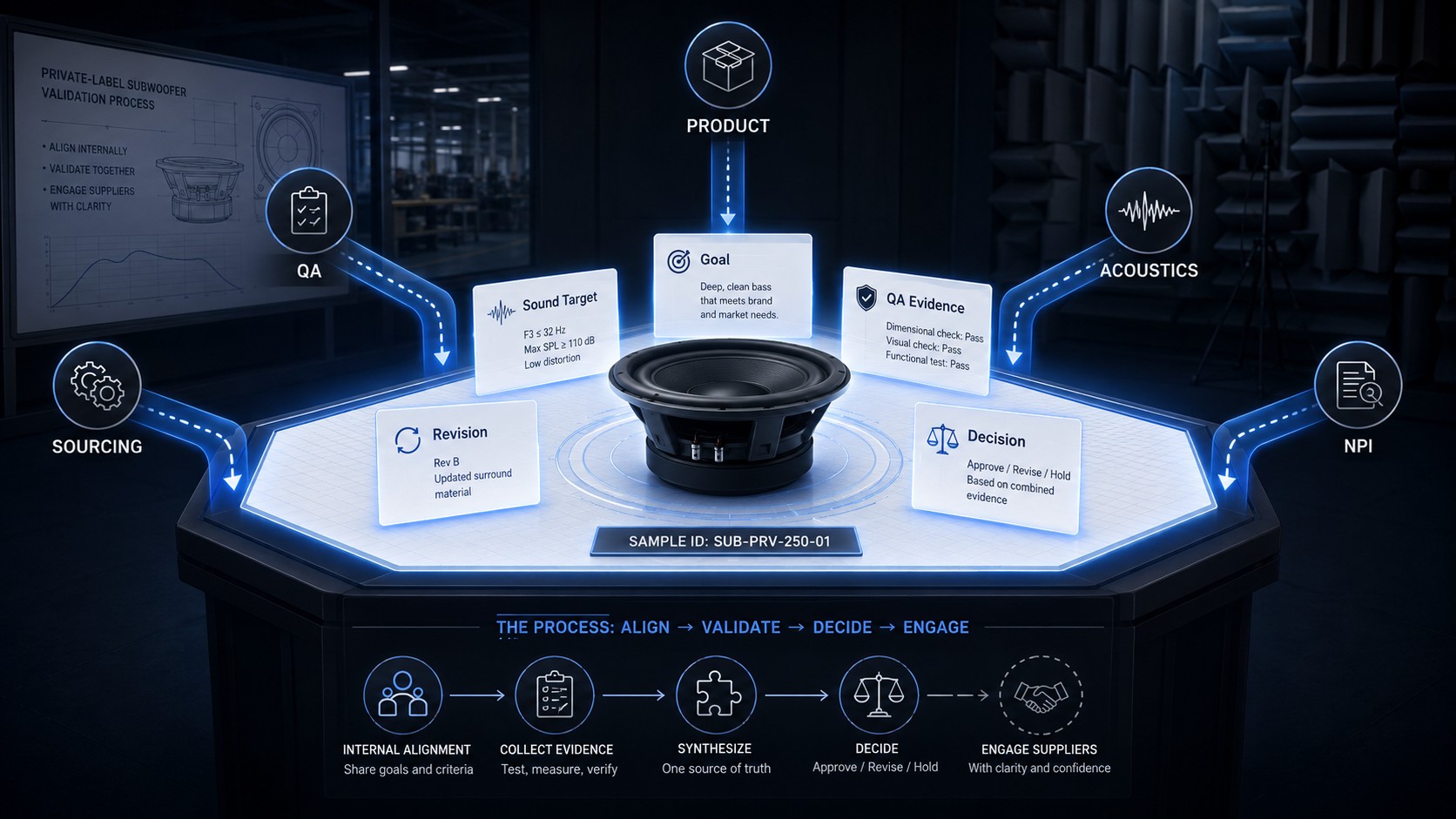
Variant governance is the decision standard used before a line extension enters detailed development. It should expose assumptions early enough for leaders to choose among four legitimate outcomes: reuse an existing platform, create a separate program, merge the proposal with an existing variant, or defer it until the role is clearer.
The following Variant Justification Matrix is an editorial decision aid rather than a scoring standard.
| Proposed Variant | Portfolio Role | Distinct Use Case | Shared Architecture Available? | Material Performance or Fit Difference? | Distinct Validation Path? | Distinct Message? | Clear Owner? | Decision |
|---|---|---|---|---|---|---|---|---|
| Adjacent power model | Unclear | No | Yes | Limited | No | Weak | Yes | Merge with existing variant |
| Slim application model | Space-constrained option | Yes | Possibly | Yes | Possibly | Yes | Yes | Review for reuse or separation |
| Cosmetic customer version | Program-specific presentation | No | Yes | No | Limited review | Yes | Yes | Reuse platform |
| Proposed model with undefined role | Not established | Not established | Unknown | Unknown | Unknown | No | No | Defer pending clearer role |
Use the matrix to support a structured discussion:
- What clear portfolio role does the variant own?
- Which application or customer need is not already served?
- Which development decisions are genuinely unique?
- What remains common enough to reuse?
- Does the distinction require a different validation path?
- Can Product, Sales, and Sourcing explain the difference consistently?
- Who owns the variant and its future changes?
- What should be merged, retired, or deferred if the proposal is approved?
Retiring a variant requires its own governance path: establishing clear end-of-life milestones, updating engineering documentation, and redirecting future demand to supported baseline platforms to prevent orphaned variants from indefinitely taxing the product roadmap.
Supplier tooling, an available catalog model, or a single commercial request can strengthen a proposal, but none should replace these questions.
For brands still establishing their initial portfolio logic, planning the first three strategic SKUs provides an earlier-stage framework for assigning product roles before the line expands.
Control Scope Before Scope Controls the Team
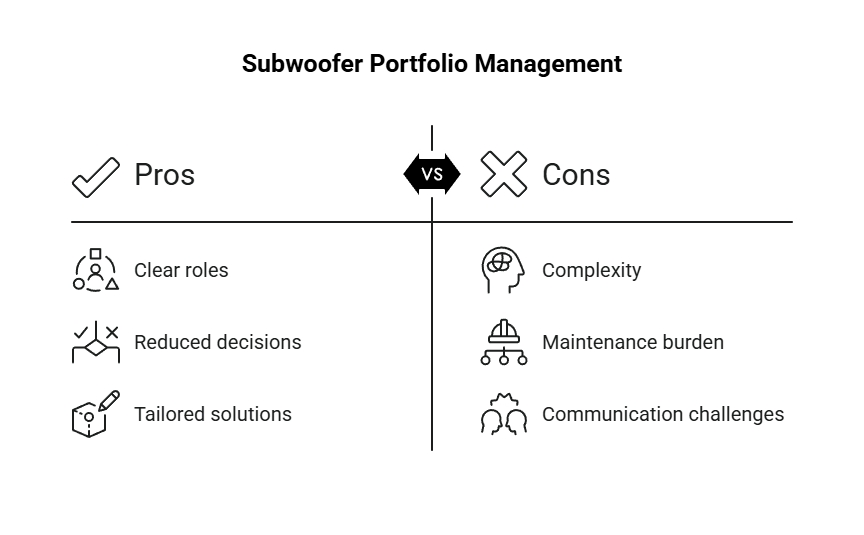
A broad subwoofer portfolio can be useful when every product has a role the organization can explain, support, and maintain. Shared platforms are valuable when they preserve those roles while reducing repeated decisions. Separate development is appropriate when common architecture would compromise the application, fit, performance promise, validation path, or long-term ownership model.
Review the next proposed variant with the matrix before it enters the roadmap. The right outcome may be reuse, separation, consolidation, or deferral.
For an active private-label subwoofer program that requires clearer platform scoping, Get in Touch to discuss the development context.
FAQs
How many private-label subwoofer variants are too many?
There is no universal threshold. Complexity becomes difficult to manage when teams cannot explain each product’s role, maintain distinct requirements, assign ownership, or coordinate shared changes without reopening the same decisions.
Does every new power level need a separate subwoofer platform?
Not necessarily. A new power position may fit an existing platform when the use case, architecture, validation assumptions, and product promise remain substantially common. Separate development may be appropriate when the change materially affects those factors.
Can cosmetic or branding changes stay on a shared platform?
Often, yes. Branding, finish, or packaging changes may not require separate core architecture, although the commercial SKU still needs controlled naming, documentation, ownership, and change management.
When should a brand create a separate subwoofer platform?
Separate development may be justified when intended application, installation constraints, performance promise, durability assumptions, component architecture, or validation requirements differ enough that reuse would weaken the product role. The conclusion depends on the specific program.
Disclaimer: This article provides general educational information about private-label product portfolio planning. Specific roadmap, engineering, sourcing, and validation decisions depend on the product requirements, organization, and manufacturing program.
Our Editorial Process:
Our expert team uses AI tools to help organize and structure our initial drafts. Every piece is then extensively rewritten, fact-checked, and enriched with first-hand insights and experiences by expert humans on our Insights Team to ensure accuracy and clarity.
About the China Future Sound Insights Team
The China Future Sound Insights Team is our dedicated engine for synthesizing complex topics into clear, helpful guides. While our content is thoroughly reviewed for clarity and accuracy, it is for informational purposes and should not replace professional advice.