📌 Key Takeaways
A slim subwoofer needs its own roadmap only when several key product and management decisions repeatedly differ from the parent line.
- Depth Alone Is Insufficient: A shallower design shows a format difference, but it does not prove the need for separate ownership.
- Look For Repeated Differences: Distinct use cases, promises, designs, priorities, testing, and portfolio choices together support a separate platform.
- Focus On Decision Rules: Separate governance makes sense when parent-line priorities would repeatedly lead teams toward the wrong product choices.
- Allow Shared Architecture: Slim and standard products can share parts and engineering resources while following different roadmaps and lifecycle decisions.
- Use Evidence, Not Scores: A decision matrix reveals patterns and open questions, but assumptions or arbitrary totals cannot prove platform independence.
Separate the roadmap only when decision logic truly separates.
Subwoofer product leaders will make clearer ownership choices by applying the platform boundary tests and decision matrix that follow.
~ ~ ~ ~ ~ ~ ~ ~ ~ ~ ~ ~ ~ ~ ~ ~ ~ ~
A shallower subwoofer can be a variant. A strategically different slim family can be a platform. The distinction depends on what must be governed independently.
Slim products often begin with a physical constraint, but reduced mounting depth does not determine roadmap structure. Product leaders need to ask whether the format repeatedly changes the target use case, product promise, architecture choices, specification priorities, validation needs, tier logic, and lifecycle decisions.
When several of those dimensions diverge together, keeping the range inside a standard automotive roadmap can force conflicting priorities into one planning system. When they remain aligned, a separate roadmap adds ownership and coordination without clarifying the portfolio.
Therefore, the decision requires a threshold based on recurring product and governance differences—not a product name, basket profile, or SKU count.
A Slim Format Is Not Automatically a Separate Platform
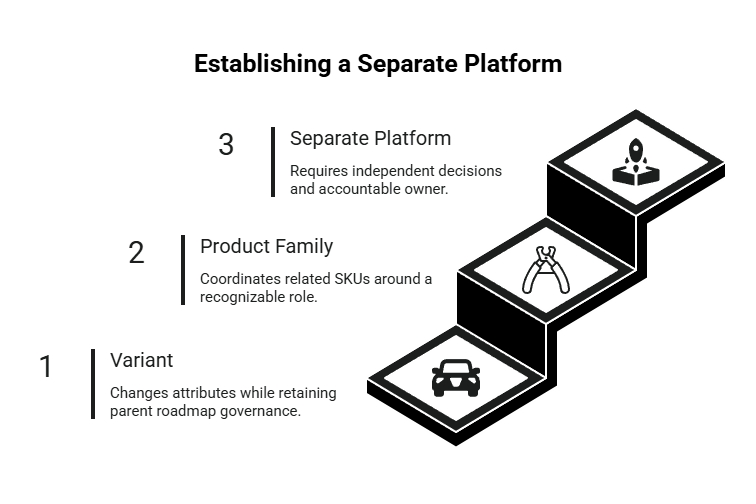
For roadmap discussions, practical working definitions are more useful than abstract platform theory.
| Classification | Working definition | Governance implication |
|---|---|---|
| Variant | Changes selected attributes while retaining the parent line’s use case, product promise, tier logic, and decision rules | Remains governed through the parent roadmap |
| Product family | Coordinates related SKUs around a recognizable role and progression | May have dedicated documentation and accountability while sharing broader roadmap ownership |
| Separate platform | Requires recurring independent decisions about requirements, architecture, tiers, validation, investment, and lifecycle | Needs an explicit platform boundary and accountable owner |
These working definitions help teams distinguish visible product differences from differences in decision logic.
Shared components do not prove that two product families belong under one roadmap. The reverse is also true: a different structure or reduced depth does not automatically justify separation. The useful boundary question is: Which decisions can no longer be made correctly under the parent platform’s priorities?
Illustrative scenario—mainly a variant: A proposed slim SKU addresses the same application, follows the same value proposition, occupies a clear place in the existing tier ladder, and uses the same approval and lifecycle rules. Its format differs, but its governance remains derivative. Unless that pattern changes for future products, the line can remain within the broader subwoofer platform portfolio.
Six Signals That the Slim Line Has Become Strategically Distinct
No single signal proves that a slim range deserves independent roadmap ownership. The case becomes stronger when several dimensions diverge repeatedly and influence one another.
1. The Target Use Case Is Meaningfully Different
Begin with the problem the product is intended to solve. A one-time request for reduced depth is weak evidence of a new platform. A recurring application pattern that changes priorities across several planned products is more significant.
Technical implications vary by design. At roadmap level, ask whether the family repeatedly addresses a different integration, space, or system problem from the parent line.
2. The Product Promise Requires Its Own Tradeoff Hierarchy
A distinct platform should have a promise that can be stated without calling it merely a thinner version of another product.
That promise should clarify which outcomes and constraints take priority when teams face competing choices. It should not assign universal performance characteristics to slim products. Instead, it should explain what the family is intended to accomplish and which tradeoffs govern approval.
When the parent line and slim range use the same promise with different adjectives, the strategic boundary remains weak.
3. Architecture Constraints Repeatedly Change Development Decisions
A single modified part does not establish strategic independence. The stronger signal is persistence: do the use-case constraints repeatedly lead to different architecture decisions across the planned family?
Specific mechanisms need technical verification before becoming product claims or acceptance criteria. For example, if reduced depth requires an inverted motor structure or specialized front-venting that fundamentally changes assembly methods, the architecture has structurally diverged. The roadmap question is whether differences are structural and recurring or optional modifications to shared design logic. Architecture reuse can remain sensible even when requirements or lifecycle decisions need separate control.
4. The Specification Hierarchy No Longer Matches the Parent Line
Product teams often compare individual numbers when they should compare the order of priorities.
A different target value may still fit the parent platform if it occupies a clear position in the existing ladder. Strategic divergence appears when the slim family needs different acceptance logic, priority ordering, or tier progression.
A useful test is whether the same specification hierarchy would misrepresent what matters most when approving the slim product.
5. Validation and Lifecycle Decisions Need Dedicated Governance
At roadmap level, validation defines required evidence, revision authority, review triggers, and change governance.
If the slim family repeatedly needs different approval logic or change priorities, shared governance may create conflict even when some methods remain common. Product leaders should examine how use-case assumptions shape validation priorities before treating one evidence package as suitable for every bass-platform role.
The objective is to separate decisions that would otherwise be judged against the wrong product promise.
6. The Line Requires Recurring Independent Portfolio Decisions
This is the strongest governance signal. Separate ownership becomes more defensible when the family needs its own tier choices, investment sequence, refresh cadence, expansion logic, and cross-functional tradeoffs.
One unusual launch is weaker evidence than a repeatable family. Separate accountability does not require another department; one team can govern multiple platforms when boundaries and escalation rules are explicit.
Six-signal summary: Look for repeated divergence across the use case, product promise, architecture, specification hierarchy, validation and lifecycle, and portfolio governance. Evidence in one dimension starts the discussion; a recurring pattern across several dimensions supports a stronger platform boundary.
Test the Slim Line Against Standard, SQ, and High-Power Roles
Once these six signals reveal potential divergence, the next step is to test the proposed slim platform against adjacent roles to ensure its product promise doesn’t overlap with existing lines. Standard automotive, SQ, slim, and high-power labels may describe different dimensions rather than mutually exclusive platforms. “Slim” can identify a packaging or integration constraint, while “SQ” or “high-power” can express a product promise. A single product may carry more than one ambition.
The roadmap must define which promise governs when constraints conflict. Otherwise, teams can create products that differ in naming but not in buyer problem, tier role, or approval logic.
| Platform label | Intended primary role | Adjacent overlap risk | Boundary question |
|---|---|---|---|
| Standard automotive | Define the brand’s core application and tier logic | Slim becomes a dimensional duplicate | What problem remains owned by the standard line? |
| SQ | Define the brand’s sound-quality-oriented promise without assuming a universal architecture | SQ and slim rely on similar claims with unclear priority | Which promise controls approval when priorities conflict? |
| Slim | Define the recurring space, integration, or system problem the family addresses | The range becomes a thinner copy of another tier | Can the slim role be explained independently? |
| High-power | Define the brand’s high-output-oriented role without treating it as incompatible with other attributes | Slim tiers become weakened versions of the high-power line | Does each family have distinct decision logic? |
For each role, identify the primary problem, governing promise, tier ownership, shared architecture, and distinct lifecycle choices. Each family should be explainable without vague adjectives.
Illustrative scenario—possible platform candidate: A planned slim family repeatedly serves different application assumptions, uses a distinct promise, requires another priority order for specifications, and needs separate revision and lifecycle decisions. Some components and engineering resources may still be shared. In this case, architectural reuse does not eliminate the case for distinct roadmap governance.
This role-first approach prevents teams from constructing a complete ladder before the initial products have clear jobs. As with assigning clear roles to early SKUs, coverage should follow role clarity.
Use a Roadmap Threshold Matrix Before Assigning Ownership
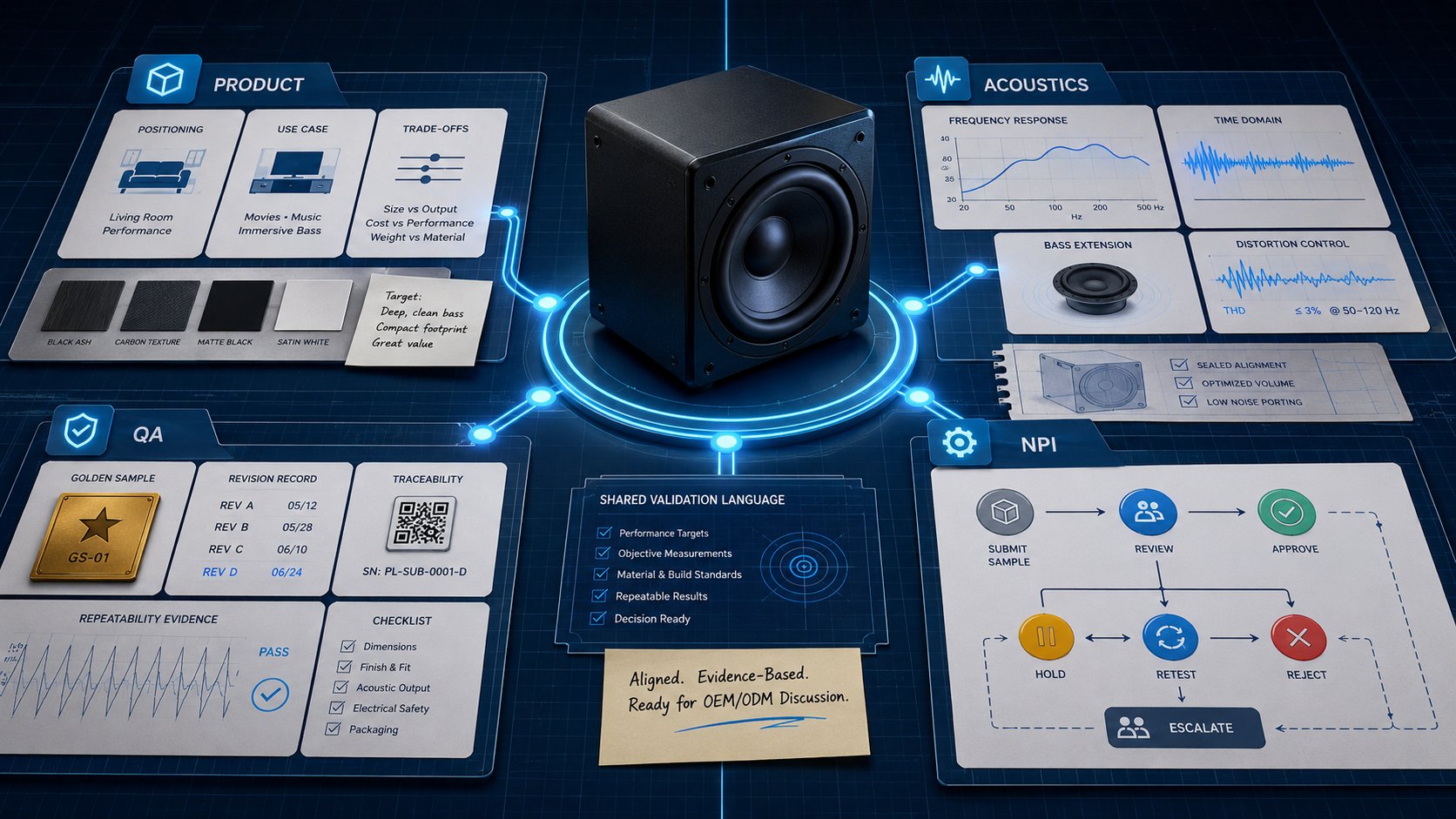
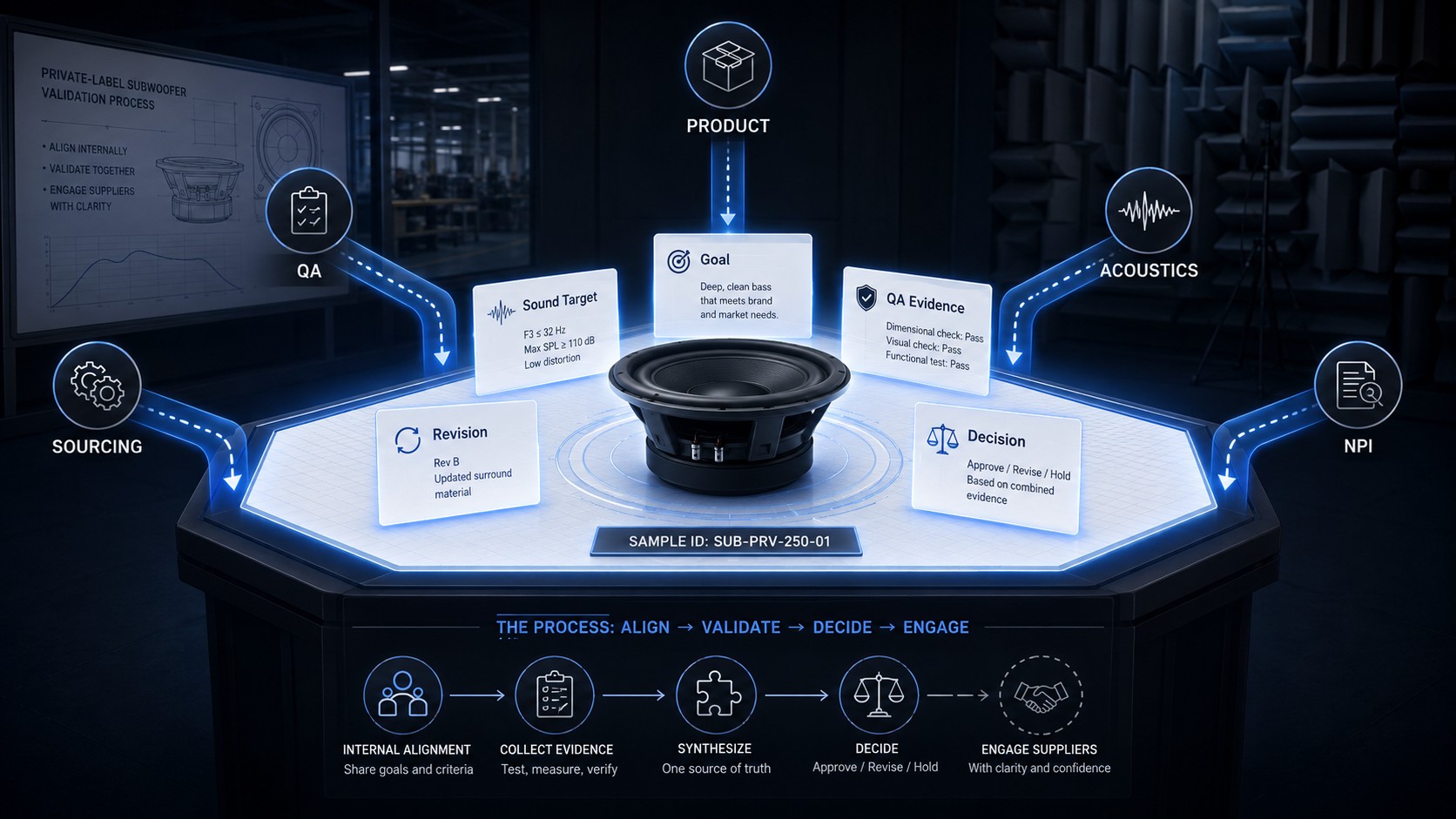
The Slim Platform Roadmap Threshold Matrix is a discussion tool, not a universal scoring standard. Complete it with Product, Acoustics, Engineering, QA, and relevant stakeholders. Separate evidence from assumptions, then record what can remain shared and what requires independent governance.
| Decision dimension | Evidence it is mainly a variant | Evidence it may be a distinct platform | Decision question |
|---|---|---|---|
| Target use case | Same application and problem as the parent line | Different space, integration, or system assumptions define the product | Is the product solving a distinct problem? |
| Product promise | Same value proposition with reduced depth | A separate promise governs priorities and tradeoffs | Can the promise be stated without referring to another line? |
| Architecture | Predominantly shared design rules and components | Persistent constraints require different architecture decisions | Are the differences structural or optional? |
| Specification hierarchy | Similar target ladder and acceptance logic | Different priorities or tradeoff hierarchy govern approval | Would the same hierarchy misrepresent the product? |
| Validation and lifecycle | Same evidence, revision, and change logic | Different risks and change decisions require dedicated control | Would shared governance create recurring conflict? |
| Portfolio and governance | Clear placement inside an existing tier | Separate tiers, investment decisions, and owners are needed | Does the line require recurring independent decisions? |
Read the completed matrix as a pattern.
A variant remains governed by the parent line across most dimensions. A defined family has a recognizable role, but major decisions remain mostly shared. A separate platform shows recurring divergence across several dimensions and needs clear accountability.
Do not force a numerical score unless the organization has approved a meaningful method. A matrix filled with assumptions identifies open questions; it does not prove independence.
When a Separate Roadmap Adds More Complexity Than Value
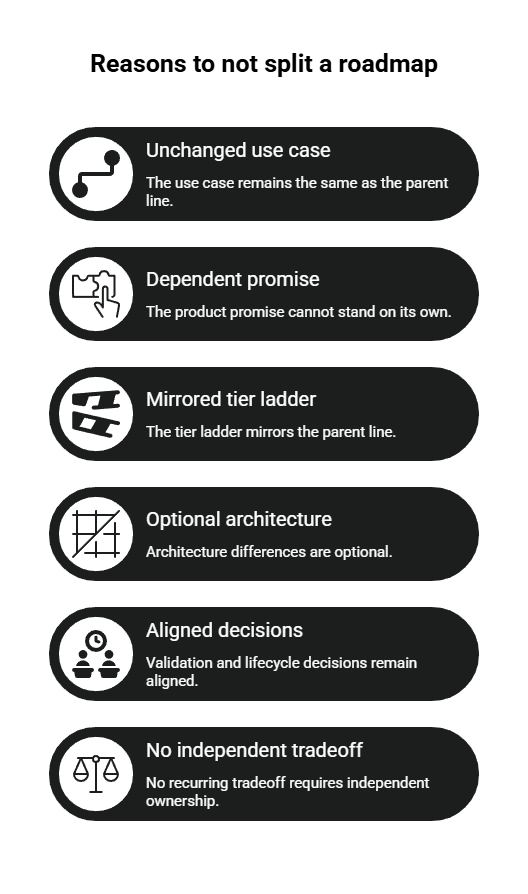
Separation is premature when the slim line differs mainly in dimensions, repeats the parent promise, duplicates its tier progression, and uses substantially the same approval and lifecycle logic.
An isolated SKU may deserve clear documentation and an accountable lead, but it does not establish a recurring platform role.
Do not split yet: The use case is unchanged; the promise cannot stand on its own; the tier ladder mirrors the parent line; architecture differences are optional; validation and lifecycle decisions remain aligned; or no recurring tradeoff requires independent ownership.
A defined family can provide the middle position: distinct naming, requirements, decision records, and accountability within a broader roadmap.
The opposite risk also matters. When different priorities remain subordinate to the parent platform, products may be judged against unsuitable criteria. Centralized governance is useful only while it represents the product accurately.
Frequently Asked Questions
Does Shallow Mounting Depth Alone Justify a Separate Product Roadmap?
No. Reduced depth may introduce meaningful constraints, but separate ownership becomes more defensible only when multiple product and governance dimensions diverge together. Depth alone shows a format difference, not strategic independence.
Can Slim and SQ Subwoofers Share the Same Platform?
They may. “Slim” can describe an integration constraint, while “SQ” can describe a positioning priority. Shared governance may work when the promise, specification hierarchy, and lifecycle logic align. Separation may be needed when those rules repeatedly conflict.
How Many Slim-Subwoofer SKUs Justify Separate Roadmap Ownership?
There is no universal SKU threshold. Several products can remain variants under the parent platform’s logic. A smaller family may justify independence when it creates recurring decisions across requirements, architecture, tiers, validation, investment, and lifecycle.
Make the Boundary Explicit Before the Roadmap Expands
Depth alone does not define a product platform. Separate roadmap ownership should follow repeated divergence across linked decisions, not the appearance of differentiation.
Shared architecture and independent governance can coexist. A recognizable slim family can also remain inside a broader roadmap when its priorities, tiers, validation, and lifecycle logic still align with the parent line.
Map each bass platform against use case, product promise, shared architecture, validation needs, and governance burden before assigning separate roadmap ownership.
Disclaimer: This article is for general informational purposes only. It is not a substitute for advice from a qualified professional, provider, or official source relevant to your situation. Always verify important decisions with the appropriate expert, authority, or service provider.
Our Editorial Process:
Our expert team uses AI tools to help organize and structure our initial drafts. Every piece is then extensively rewritten, fact-checked, and enriched with first-hand insights and experiences by expert humans on our Insights Team to ensure accuracy and clarity.
About the China Future Sound Insights Team
The China Future Sound Insights Team is our dedicated engine for synthesizing complex topics into clear, helpful guides. While our content is thoroughly reviewed for clarity and accuracy, it is for informational purposes and should not replace professional advice.