📌 Key Takeaways
Engineering change control prevents mixed builds and schedule disruption by formalizing how component swaps, firmware updates, and design modifications enter production.
- ECO Workflow Protects Timelines: A formal Engineering Change Order process with cross-functional review prevents surprise validation delays during ramp.
- Cut-In Plans Prevent Mixed Builds: Defining exactly when and where changes enter production stops units with different configurations shipping under one SKU.
- Traceability Enables Fast Containment: Linking ECO records to serial numbers lets you identify affected units within minutes when field issues emerge.
- Evidence Gates Match Risk Level: Component substitutions require thermal and protection threshold verification; firmware changes need regression testing against the Golden Sample.
- Split Revisions Maintain Schedule: Running a controlled pilot lot with the new change while continuing the approved version preserves delivery commitments without introducing unknown risk.
Controlled changes = predictable ramps and lower warranty exposure.
Product managers and sourcing directors evaluating amplifier manufacturers will gain immediate clarity on partner discipline, preparing them for the supplier evaluation framework that follows.
Engineering change control is a disciplined management process used in electronics manufacturing to ensure that every modification to a product’s design, components, or software is documented, verified, and approved before implementation. Think of it as air-traffic control for product decisions: changes can still happen, but they land in an orderly sequence instead of colliding midair.
The dashboard loads. The spinning wheel. You stare at the screen as a notification pops up: a critical component is now out of stock, and the factory is suggesting a “drop-in” replacement. The pilot run starts in forty-eight hours, and the launch date is non-negotiable. Without a clear process, you are left wondering if this substitution will alter the thermal profile or create a subtle DSP glitch that only shows up in the field. To protect your timeline, you must verify that your manufacturing partner has a formal Engineering Change Order (ECO) workflow and a clear cut-in plan before the first unit hits the SMT line.
Engineering change control in OEM/ODM amplifier programs reduces late surprises by preventing mixed builds and schedule disruption during ramp. By establishing clear gates for documentation and evidence, brands can move from prototype success to stable, repeatable volume production.
Key Definitions the Whole Team Should Align On
Engineering change control (plain language): a set of rules for how changes are requested, reviewed, approved, and released so production stays consistent with what was tested and approved.
ECR vs ECO vs ECN: An ECR (Engineering Change Request) proposes a change and explains why it is needed. An ECO (Engineering Change Order) is the approved instruction to implement the change, with scope, approvals, and timing defined. An ECN (Engineering Change Notice) communicates the released change to all stakeholders who must act on it—manufacturing, quality, procurement, documentation, and logistics.
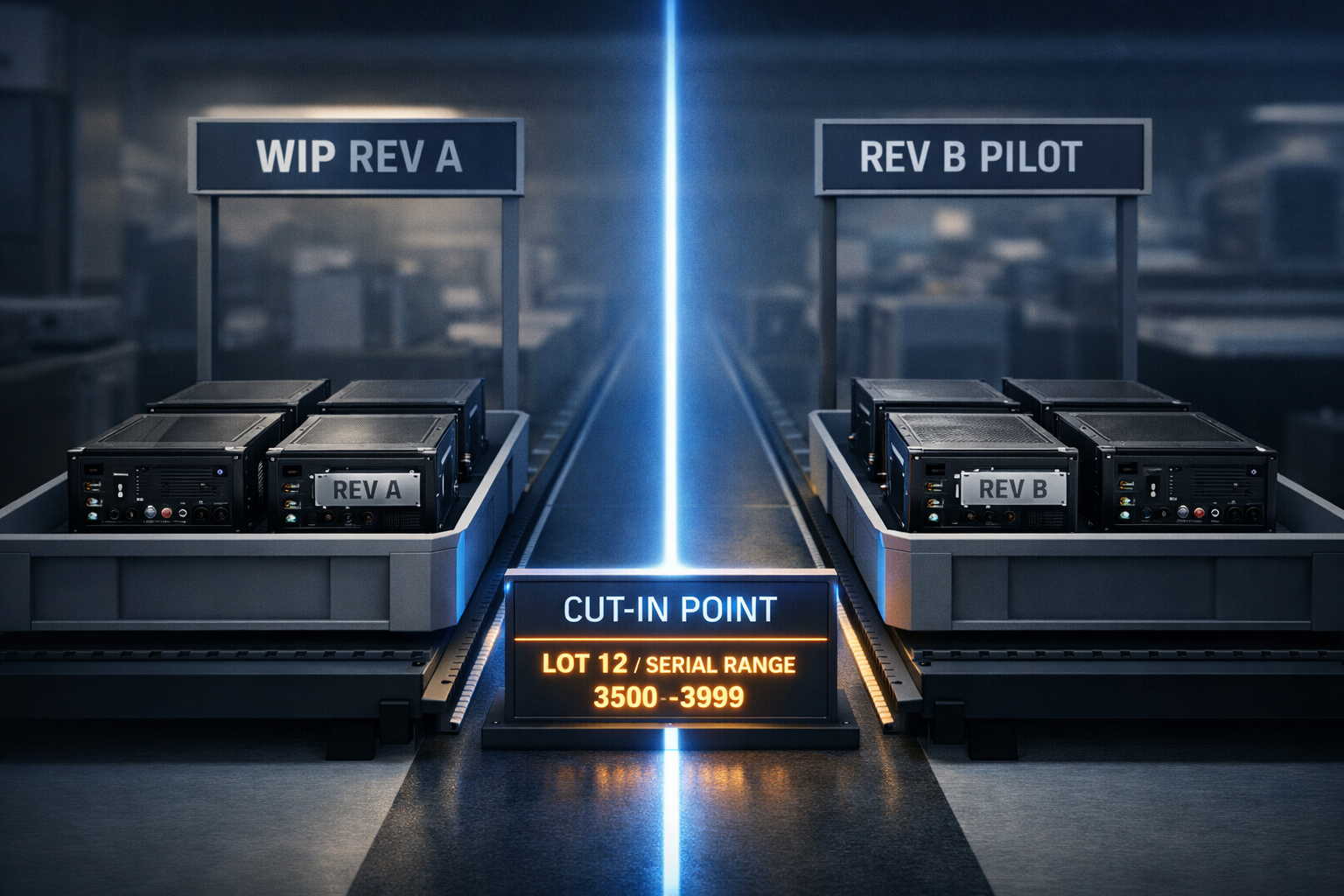
Cut-in plan (plain language): the agreed “when and where” a change enters production so old and new configurations do not mix unintentionally. Concrete example: “Approved change cuts in at the start of Lot 12. Lots 1–11 remain Rev A; Lot 12 onward is Rev B. Carton label and unit ID include Rev to keep field returns attributable.”
Mixed build (plain language): units sold under one SKU that contain different internal revisions (parts, PCB, firmware, test flow), leading to inconsistent performance, harder troubleshooting, and higher warranty risk.
What Goes Wrong When Changes Arrive Late
Late changes carry hidden impacts beyond the immediate part number or file revision. A late change request typically hides a cascade of impacts that can derail a program. For example, swapping a capacitor might seem minor, but it necessitates an update to the Automated Optical Inspection (AOI) parameters and may trigger new component lead times. While AOI updates are often quick, a procurement lead-time mismatch can force a line-down situation, potentially delaying the Start of Production (SOP) by weeks or requiring a completely new lot schedule.
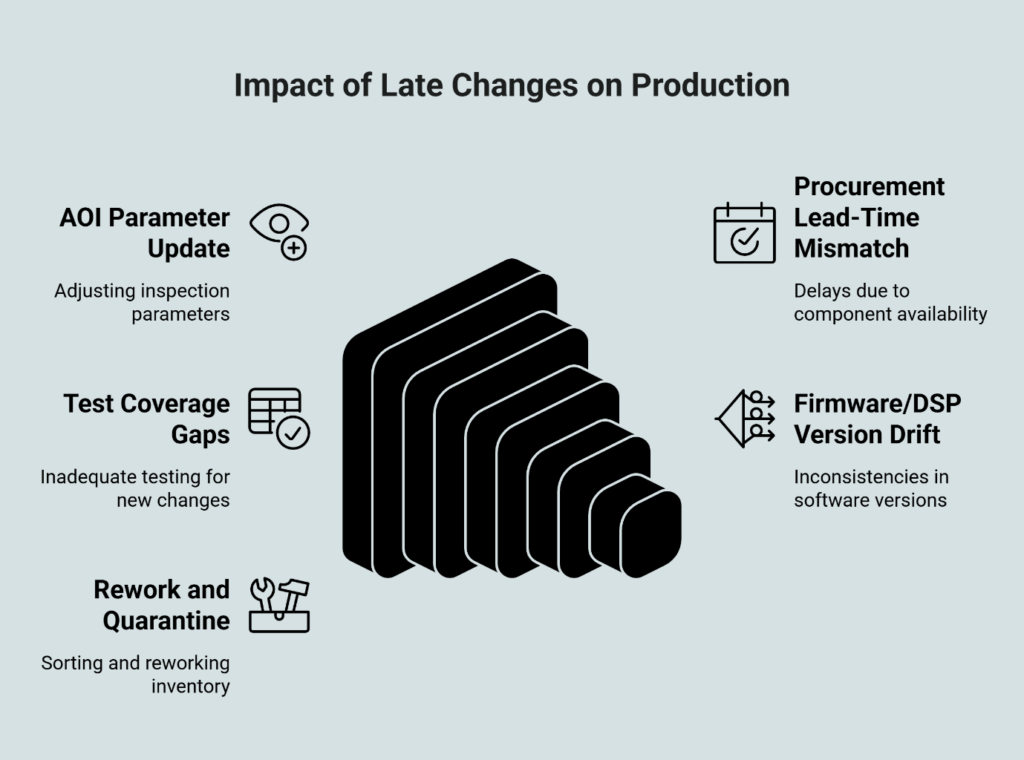
The operational failure modes are predictable:
- Test coverage gaps: a change that “shouldn’t matter” may invalidate prior test evidence if the test plan did not cover the new corner case
- Firmware/DSP version drift: hardware changes often require firmware or DSP updates (or at least re-validation) to preserve behavior
- Lead-time and pack-out impacts: labeling, cartons, manuals, and regulatory marks may need updates to stay consistent with the build
- Rework and quarantine: without a clear rule for what changes when, teams end up sorting inventory, reworking units, or holding shipments
Uncontrolled changes frequently lead to the creation of a mixed build—a production run where units with different internal configurations are shipped under the same SKU. This is more than a documentation error; it represents a latent failure liability with undefined exposure. If a batch of amplifiers begins failing in the field, but you cannot distinguish which units received the unverified component, your containment costs will skyrocket.
Change Control Is Schedule and Consistency Control
For many growth-stage brands, change control is mistakenly viewed as “corporate paperwork” that slows down innovation. Functionally, it functions as a critical-path contingency protocol. Configuration management practices exist precisely to keep the physical product aligned with its defining information and approvals. Disciplined amplifier manufacturers use these controls to ensure that the “Golden Sample” you approved is exactly what consumers receive.
Prototype success is a baseline, but it does not guarantee stable behavior at scale. When late changes enter the system without an impact assessment, they introduce variables that undermine your approved reference. Professional program management involves using these gates to mitigate “delivery churn” and prevent internal fire drills that distract your engineering team from their next roadmap priority.
For amplifier programs, the operational mandates are:
- Protect the timeline (avoid “surprise validation” during ramp)
- Prevent mixed builds (avoid shipping multiple behaviors under one SKU)
- Preserve the approved reference (the golden/approved configuration stays identifiable and reproducible)
- Enable fast containment (if something goes wrong, affected units/lots are immediately traceable to the change)
This is why growth-stage teams should evaluate amplifier manufacturers based on change discipline and evidence gates—not just spec sheets or factory tours.
The Minimum Viable ECO Workflow
A functional change-control system requires rigor, not complexity. For most OEM/ODM programs, the workflow follows a standard progression: intake and triage, cross-functional impact assessment, and decision with clear approval authority.
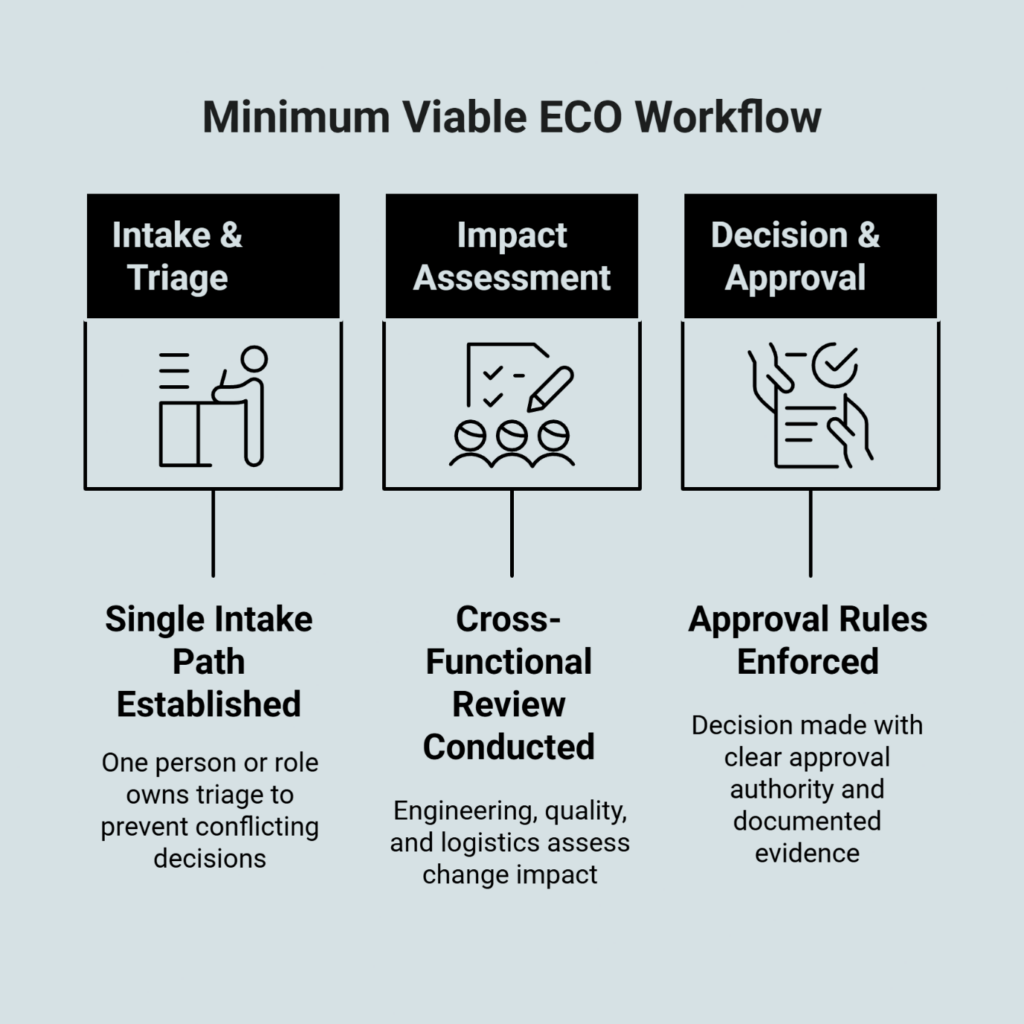
1. Single Intake Path + Named Owner
One person (or role) owns triage. No backdoor approvals via chat, email threads, or informal “OKs.” This single point of control prevents conflicting decisions and ensures every change receives proper evaluation.
2. Cross-Functional Impact Assessment (Fast, But Complete)
Before any change is released, an impact assessment should be conducted across engineering, quality, and logistics. At minimum, review these functions: engineering (hardware, firmware, DSP), procurement, quality, test, documentation/labeling, and logistics/pack-out. This prevents a firmware update from being pushed before the test fixtures are ready to validate the new code.
3. Decision Rights and Approval Rules
Define who must sign and what evidence is mandatory. This prevents “approval by urgency.” Every change must land in one of four buckets:
- Approve for near-term cut-in
- Defer to next revision
- Reject
- Split (partial approval now, remainder later)
A disciplined ECO workflow requires these elements to function as intended. Configuration management best practices consistently emphasize identification, status accounting, and verification as foundational functions.
Example: Component Substitution Decision
A MOSFET substitute is proposed due to supply risk. Even if electrical specs appear equivalent, the ECO should explicitly call out re-validation needs—thermal behavior, protection thresholds, EMC sensitivity—and define whether firmware/protection parameters remain unchanged or require a controlled firmware release.
ECO Minimum Required Fields Checklist
To ensure your partner provides the transparency you need, integrate these fields into your shared program management tools:
Basic Information:
- Change title (short, descriptive)
- Change type: component substitution / PCB revision / firmware-DSP update / test procedure change / packaging-labeling change / other
- Reason for change (why now): cost reduction, obsolescence, bug fix, performance improvement
- Requested by / date
Technical Scope:
- Affected items (be specific):
- BOM references and AVL items
- PCB revision(s)
- Firmware version / DSP profile ID
- Test procedure(s) / fixture version
- Labels, cartons, inserts, markings
Risk & Evidence:
- Risk & impact summary (qualitative): performance / reliability / compliance / lead time / cost / schedule
- Evidence required before release: specific test data (e.g., thermal logs, Audio Precision sweeps) that must be verified before approval; comparison to approved reference required
- Approvals required: engineering / quality / procurement / program management
Implementation:
- Cut-in plan: lot/date/serial number range; how old versus new configurations are segregated
- Traceability updates needed: what identifiers change; where recorded in manufacturing systems
- Containment plan if results diverge: hold rules, quarantine scope, communication owners
- Rollback plan: how to revert and how to prevent re-introduction
Communication:
- ECN distribution list: who must be notified on release (downstream teams, quality, logistics, customer-facing teams)
This checklist operationalizes the core configuration management principle: controlling changes while maintaining integrity and traceability of the product configuration.
Cut-in Planning to Prevent Mixed Builds
A cut-in plan is the specific schedule for when an approved change actually enters the production line. For example, if you approve a new heat sink design, the cut-in plan might specify that it only applies to orders shipped after October 15th. This prevents the “silent substitution” of parts that can lead to inconsistent product behavior in the same shipment.
A practical cut-in plan answers five questions:
- Where does the change enter? Prototype / pilot / first-article / SOP / next lot
- How is segregation enforced? Physical segregation + labeling + system records
- What is the unit of control? Lot, serial range, work order, or date code
- What happens to WIP? Finish as-is, rework, or scrap (rules defined before release)
- What happens under must-ship pressure? Defer, split shipments by revision, or hold (pre-agreed)
Example: Firmware/DSP Tuning Update
A DSP profile is updated to address a field complaint. If the update is released without a cut-in rule, some units ship with the old tuning while others ship with the new tuning under the same SKU. The customer experience becomes inconsistent, and support cannot reliably reproduce the reported behavior. The cut-in plan prevents that by tying firmware/DSP version to a defined serial/lot boundary and enforcing ECN communication to downstream teams.
Cut-in Decision Tree
When a late change appears during ramp, use this decision sequence:
Start: A late change appears during ramp.
- Is the change safety/compliance critical or preventing shipment blockage?
- Yes → Proceed to Step 2 with expedited evidence gate + explicit segregation rules
- No → Proceed to Step 3
- Can minimum evidence be produced before the ship date (per ECO requirements)?
- Yes → Approve ECO with a strict cut-in boundary + updated traceability fields
- No → Defer change OR split: ship Rev A now, schedule Rev B next lot with full evidence
- Does the change alter performance, reliability, or firmware/DSP behavior?
- Yes → Require re-validation against approved reference; no silent cut-in
- No → Still require documentation + cut-in boundary to prevent uncontrolled mixing
- Can production enforce segregation (label/serial number/lot control) with high confidence?
- Yes → Controlled cut-in allowed
- No → Hold release until segregation is feasible (mixed builds are worse than delay)
When a late change cannot be fully proven before a critical deadline, you have three professional options:
- Defer: Push the change to the next production run or a future revision
- Split: Run a small pilot lot with the change while the main line continues with the known-good configuration (this is sometimes called “split revisions”)
- Hold: Stop production until the evidence is verified
At China Future Sound, we recommend that brands prioritize consistency over speed. Shipping a known, stable configuration is always superior to shipping an unknown “improvement” that hasn’t been through a full reliability gate.
Change Type Impact Matrix: Evidence to Request
Different change types carry different hidden risks and require specific validation approaches:
| Change Type | Typical Hidden Impacts | Evidence to Request |
|---|---|---|
| Component substitution | Thermal margin shifts, protection threshold changes, EMI sensitivity variations, supplier-to-supplier variability | Comparison to approved reference; targeted stress/thermal checks; updated traceability fields |
| PCB revision | Layout-dependent noise, grounding path shifts, test fixture alignment issues | Side-by-side validation against approved reference; updated test plan/fixture compatibility sign-off |
| Firmware/DSP tuning update | Behavior drift from approved reference, protection interaction changes, field reproducibility issues | Versioned release notes; regression test versus approved reference; controlled cut-in boundary with version tracking |
| Test procedure change | False pass/fail drift, coverage gaps, loss of comparability to historical data | Rationale document + correlation plan; baseline comparison to prior method; change notice to all stakeholders |
| Packaging/labeling change | Receiving holds at distribution centers, mislabeling leading to customer confusion | Label master approval from brand; carton/label samples; ECN distribution confirmation to logistics |
Traceability as the Backbone of Containment
Change control is only as strong as your traceability. At a minimum, your manufacturing partner should link ECO records to specific unit serial numbers or lot codes. If an issue is discovered three months after launch, you should be able to identify every unit impacted within minutes.
Advanced amplifier manufacturers use barcodes or QR codes to bind test data directly to the unit’s digital record. This ensures that if a firmware change was intended to improve signal-to-noise ratios, the test results for those specific units confirm the outcome.
This is not about perfection. The operational standard is real-time traceability (often referred to as ‘Live Status Accounting’) that allows for an immediate query response to: ‘Which units contain the change, and which test outputs confirm performance against the approved reference?
Minimum Practical Traceability Fields
Your OEM/ODM partner should track these minimum fields:
- Unit identity: Serial number (or equivalent) tied to work order/lot
- Configuration identifiers: PCB revision, BOM/AVL revision, firmware version, DSP profile ID
- Process identifiers: Test procedure revision, fixture ID, station ID (where relevant)
- Change linkage: ECO number tied to the units/lots where the change cut in
Questions to Ask Your Partner Before Ramp
Before you commit to a high-volume ramp, ask these questions to gauge a supplier’s operational discipline:
- “Can you walk me through your ECO intake and triage process—who owns it, and who has final approval authority?”
- “What evidence is required for a component substitution versus a firmware/DSP change?”
- “What are your cut-in rules, and how do you prevent mixed builds under schedule pressure?”
- “How do you document deviations, and how are stakeholders notified when changes release (ECN process)?”
- “Can I see a sample traceability report linking an ECO to specific unit test outputs?”
For broader context on supplier evaluation, see our guides on supplier due diligence and RFQ-to-SOP timing.
Frequently Asked Questions
What is the difference between ECR, ECO, and ECN?
An ECR is a proposal for a change. An ECO is the formal plan and approval for that change, including scope, evidence requirements, and timing. An ECN is the notification that the change is being implemented on the production floor, distributed to all stakeholders who need to act on it.
How should firmware and DSP tuning changes be handled?
Treat them as first-class configuration items, just like hardware components. Any update to code or tuning parameters must go through the same ECO process, including version control, evidence gates, and validation against the Golden Sample. If firmware/DSP changes are allowed to “float” without a cut-in plan, mixed builds become likely.
How can we avoid mixed builds without stopping the program?
Use split revisions with clear segregation rules: continue producing the current approved version for immediate orders while running a small, highly controlled pilot lot for the new change. This allows you to collect real-world data without risking your entire shipment. Schedule the full cut-in for the next lot once evidence is complete.
Does every change need a full re-qualification?
Not always. The point is proportionality: your impact assessment drives the evidence gate. A controlled ECO process exists precisely to decide “how much proof is enough” before volume release. Minor changes with low risk receive lighter validation; changes affecting performance, reliability, or safety receive more extensive verification.
Recap
Late changes are not the problem—late decisions without a cut-in plan are. A minimum viable ECO workflow, combined with cut-in discipline and traceability, keeps OEM/ODM amplifier programs predictable, prevents mixed builds, and reduces ramp-era fire drills.
The essential elements:
- Single intake path with named ownership
- Cross-functional impact assessment before approval
- Clear evidence requirements matched to change type
- Defined cut-in boundaries preventing unintentional mixing
- Traceability linking changes to specific units and test outputs
When these elements work together, engineering changes become manageable events rather than program risks.
By China Future Sound Editorial Team
China Future Sound publishes risk-first, evidence-led guides for OEM/ODM and private-label amplifier programs—focused on predictable ramps, controlled change, and warranty protection.
Disclaimer: This article is for informational purposes only. When managing complex engineering programs, you should consult with qualified hardware and quality assurance professionals to review the latest official regulations and industry standards.