📌 Key Takeaways
Stop arguing about “ready” by giving Sourcing and Acoustics the same checklist to measure against.
- Define “Ready” Once: When both teams use different meanings for the same word, every meeting becomes a fight nobody wins.
- Split Testing Into Two Jobs: Check the process while building (IPQC) and verify the finished product matches the approved sample (FQC)—you need both.
- One Perfect Sample Isn’t Proof: A golden sample shows what’s possible, but you still need data proving the factory can make it the same way every time.
- Document Every Change: Small swaps in parts or suppliers add up quietly—tracking them prevents mystery failures months later.
- Pre-Agree on Stop Points: Decide before problems happen what failure rate pauses production, so crises become procedures instead of debates.
Shared definitions turn negotiations into decisions.
Product managers and NPI leads balancing launch deadlines with quality requirements will find a ready-to-use framework here, preparing them for the detailed gate structure that follows.
~ ~ ~ ~ ~ ~ ~ ~ ~ ~ ~ ~ ~ ~ ~ ~ ~ ~ ~ ~ ~ ~ ~ ~ ~ ~ ~ ~ ~ ~ ~ ~ ~ ~ ~ ~ ~ ~ ~ ~ ~ ~ ~ ~ ~ ~ ~ ~ ~ ~ ~ ~
The clock shows 2:47 PM. Fourteen minutes into the weekly NPI sync, and the meeting is already off the rails.
“We can’t slip the launch date again,” the Sourcing Director says, staring at the project timeline. “Channel partners are expecting product in eight weeks.”
“And I can’t sign off on units we haven’t properly validated,” the Acoustics Manager replies. “One thermal failure in the field and we’re looking at a recall.”
The PM sits between them, watching the same argument unfold for the third consecutive sprint. Here we go again.
This friction isn’t a personality conflict. It’s a definitions conflict. Both sides want the same outcome—a successful launch—but they’re measuring success against completely different criteria. Sourcing optimizes for schedule protection. Engineering optimizes for the acoustic brand promise. Without a shared verification framework, every NPI meeting becomes a negotiation between two legitimate but competing priorities.
The solution isn’t choosing sides. It’s creating a shared language that satisfies both.
What This Framework Delivers
A shared definition of “ready” that both Sourcing and Acoustics can measure eliminates the recurring argument. This framework distills alignment into six core decisions: defining IPQC and FQC as distinct risk-control functions rather than duplicative inspections; formalizing a Quality Gate Charter with inputs, gates, owners, evidence requirements, and change control; specifying how a golden sample is created, protected, and validated against process capability; agreeing on minimum evidence artifacts for each gate; running a single alignment meeting with a clear agenda and decision log; and treating “ready for SOP” as a sign-off checklist rather than a feeling.
The framework also provides clear IPQC protocols that catch process drift before it becomes a field failure, FQC verification standards that confirm finished units match approved intent, an evidence artifacts checklist specifying what must exist before sign-off, change control rules that prevent the prototype from silently becoming a different product, and a 3-slide Executive Alignment Deck you can use in your next cross-functional meeting.
The Meeting That Breaks NPI Predictability (And Why It Keeps Happening)
Speed vs. Rigor Is a Definitions Conflict
When Sourcing says “we’re ready,” they typically mean the supplier confirmed capacity, materials are staged, and the production window is locked. When Acoustics says “we’re not ready,” they typically mean the team hasn’t verified that mass production will replicate the approved golden sample’s performance under real-world thermal and mechanical stress.
Both definitions are valid. Neither is wrong. The problem is that “ready” means two different things to two different stakeholders, and neither has made their criteria explicit.
This ambiguity creates a predictable pattern. Sourcing pushes to release because the schedule is at risk. Engineering pushes back because the data isn’t complete. The PM ends up arbitrating a decision that should be governed by objective evidence, not negotiating leverage.
NPI predictability breaks when quality is treated as a downstream test instead of a staged decision system. In that model, Sourcing is pushed to freeze suppliers and materials early, while Acoustics is forced to accept late discoveries as inevitable. The result is a cycle of rushed builds, surprise rework, and strained vendor relationships.
Predictable NPI happens when quality gates function as decision points. Earlier gates reduce uncertainty by constraining variability and clarifying definitions. Later gates confirm that what was defined earlier is actually being produced consistently. The practical goal is not more inspection—it’s fewer arguments and fewer surprises because both functions are evaluating the same evidence at the same time.
What Each Side Is Optimizing For
Sourcing Directors operate under real constraints. Channel commitments have financial penalties. Missing a market window can cost more than a marginal quality issue. Their job is to protect the launch date while managing supplier relationships and logistics complexity.
Acoustics Managers operate under equally real constraints. A product that performs beautifully as a prototype but drifts in mass production creates warranty exposure, brand damage, and field failures that are expensive to diagnose and painful to explain. Their job is to protect the acoustic performance targets by ensuring that what ships matches what was approved.
The framework that follows doesn’t ask either side to abandon their priorities. It creates objective gates where both priorities are satisfied simultaneously.
Define the Shared Language: What IPQC and FQC Are (And What They Are Not)
Before diving into the framework itself, both teams need to agree on what these terms actually mean in practice. IPQC and FQC are complementary controls that reduce different types of risk.
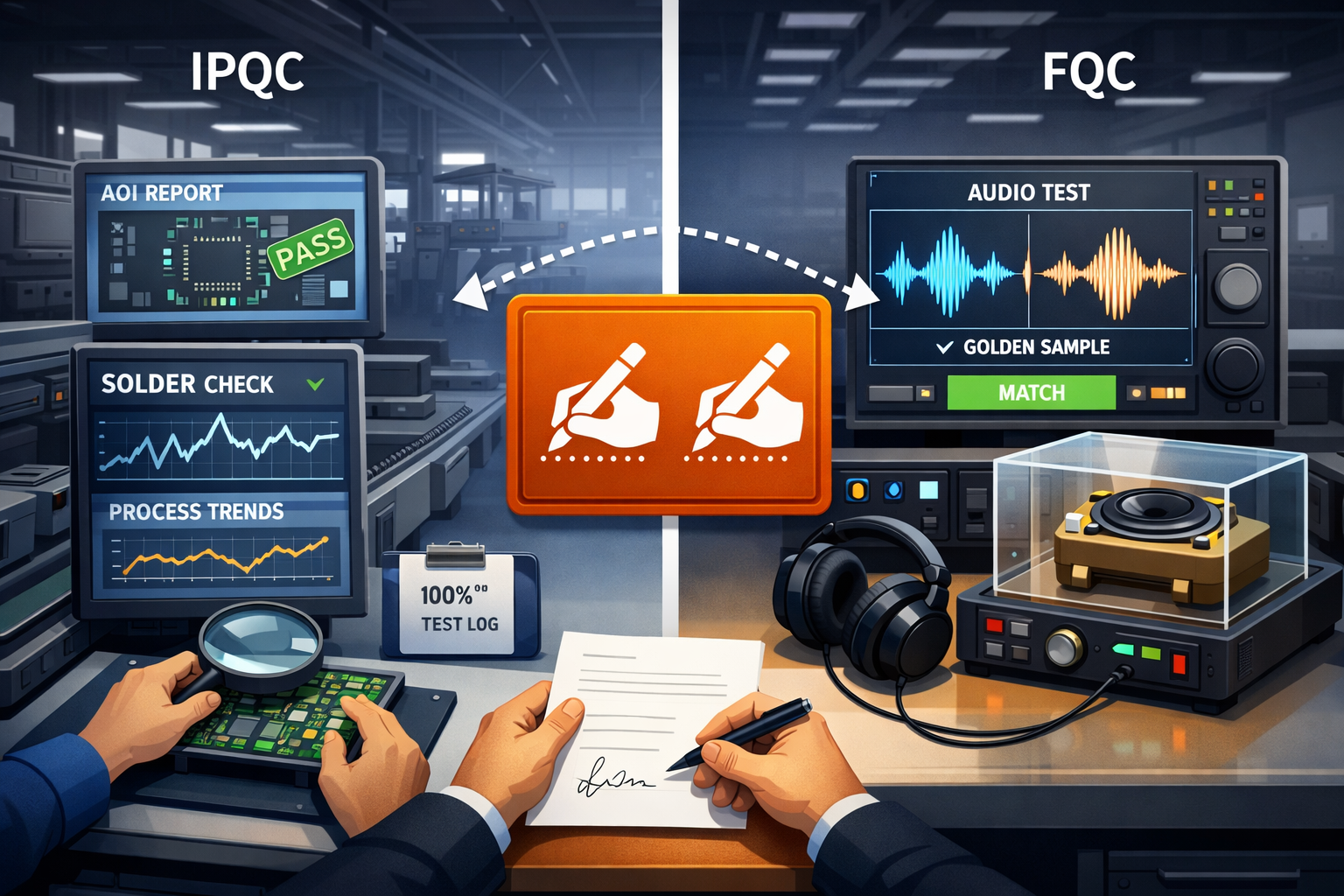
IPQC: Control the Process While the Product Is Being Built
In-Process Quality Control focuses on process stability and build integrity during assembly. It is not a final inspection. IPQC is a set of process signals that verify the manufacturing line is operating within approved parameters while production is happening.
IPQC answers questions like: Are solder joints within spec? Is component placement accurate? Are thermal management elements assembled correctly? The purpose is drift detection—catching variation before it compounds into units that fail FQC or, worse, fail in the field. Critical-to-quality process steps are verified, known failure modes are prevented or detected early, and drift is identified before it accumulates into finished-unit defects.
For amplifier production, IPQC checkpoints occur at critical assembly stages: SMT placement verification, wave soldering inspection via AOI, and functional checks before final assembly. Each checkpoint generates data. That data becomes evidence.
IPQC is where Sourcing and Acoustics can jointly protect schedule: catching a process problem midstream is usually less disruptive than discovering it at final inspection.
FQC: Verify the Finished Unit Matches the Approved Intent
Final Quality Control is the gate that confirms the finished product meets the design specification—not just electrically, but acoustically. FQC evaluates the completed unit against a defined set of functional and performance checks.
FQC answers different questions: Does this unit perform like the approved golden sample? Do frequency response, distortion, and thermal behavior fall within accepted tolerances? Is this unit safe to ship under the brand’s quality promise?
FQC should not be used as a substitute for process control. When FQC becomes the primary safety net, the program is effectively betting that defects can be screened out at the end—often at high cost.
The distinction matters. IPQC controls the process. FQC verifies the product. You need both.
Where the Golden Sample Fits
A signed golden sample proves capability once. It does not guarantee consistency at scale. This is a critical distinction that trips up many NPI programs.
The golden sample serves as the reference standard—the benchmark against which production units are measured. But production introduces variables that didn’t exist in the prototype environment: different operators, component lot variation, ambient temperature fluctuation, equipment wear.
A safer framing treats the golden sample as an input to the quality gate system, not the output. It anchors expectations for performance and build characteristics, but IPQC and FQC evidence must demonstrate that the baseline is repeatable across builds and time. The golden sample is the reference, not the proof.
The Shared Framework: A One-Page Quality Gate Charter for Sourcing and Acoustics
This charter gives both teams a single document to reference when disagreements arise. It becomes the contract between Sourcing, Acoustics, and the manufacturer for what must be true at each gate. The goal is to make decisions evidence-based rather than opinion-based.
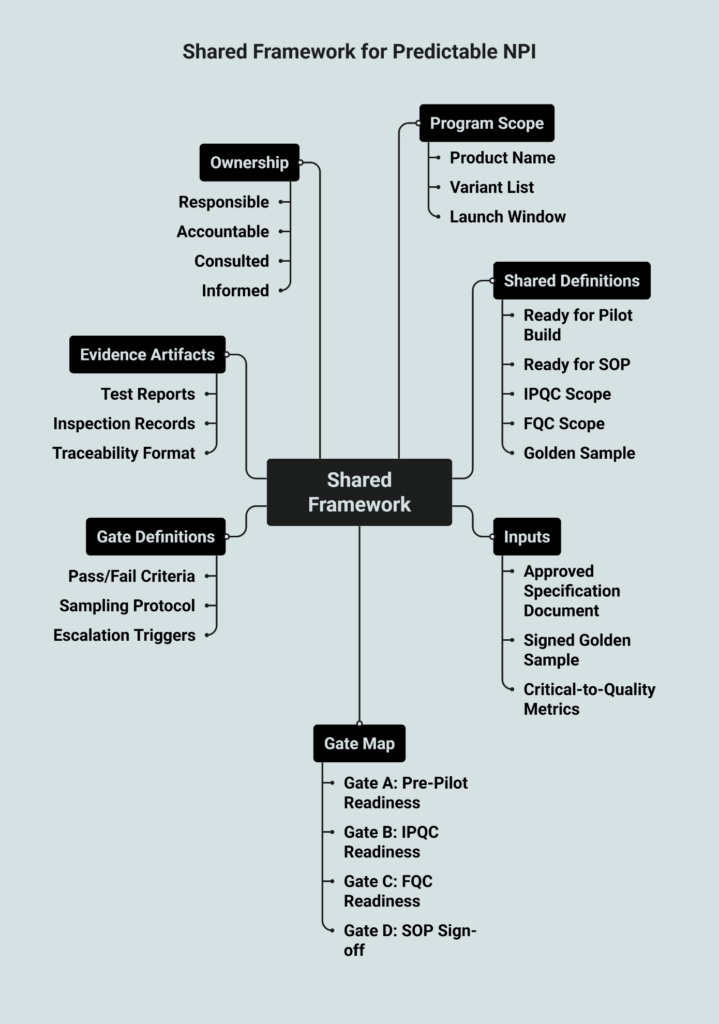
Charter Structure
1. Program Scope
Document the product or platform name, variant list including SKUs and regional variants if applicable, and target launch window at a high level.
2. Shared Definitions
Define what “ready for pilot build” means in terms of evidence. Define what “ready for SOP” means in terms of evidence. Specify IPQC scope—what it covers and what it does not. Specify FQC scope—what it covers and what it does not. Clarify the golden sample definition, what it represents, and how it is used.
3. Inputs
Every quality gate starts with three inputs that both sides must agree on before production begins.
The Approved Specification Document establishes the technical requirements that define what “conforming” means. This includes electrical specifications, acoustic performance targets, thermal limits, and mechanical tolerances.
The Signed Golden Sample is a physical reference unit that both Sourcing and Engineering have inspected and approved. This unit becomes the benchmark for production comparison.
Critical-to-Quality Metrics are the specific measurements that matter most to acoustic integrity and reliability. For amplifiers, this typically includes distortion thresholds, thermal safety margins, frequency response windows, and protection circuit behavior.
4. Gate Map
The charter defines four primary gates:
Gate A covers pre-pilot readiness, establishing inputs and baseline evidence before pilot builds begin.
Gate B covers IPQC readiness, confirming process checkpoints are defined and evidence collection is active.
Gate C covers FQC readiness, establishing end-of-line criteria and confirming finished-unit compliance.
Gate D is the SOP sign-off, requiring final artifacts and formal approvals before production release.
5. Gate Definitions: Pass/Fail Thresholds, Sampling, and Escalation
A quality gate without defined thresholds is just a suggestion. The charter specifies:
Pass/Fail Criteria establish objective thresholds for each CTQ metric. If distortion at rated power must stay below a certain percentage, that number is documented. If thermal rise under continuous load must remain within a specific range, that range is documented.
Sampling Protocol defines what percentage of units get tested at each gate. 100% testing at FQC is generally feasible using automated measurement platforms. For transducers and integrated active systems, platforms like KLIPPEL QC are widely utilized, whereas dedicated electrical audio analyzers [such as Audio Precision or Prism Sound) remain the industry standard for electrical amplifier testing (Metzler, Audio Measurement Handbook, 1993). IPQC may use statistical sampling with defined AQL levels.
Escalation Triggers define what happens when a gate fails. The charter pre-authorizes containment actions so the team isn’t debating response protocols during a crisis. If lot-level failure rates exceed threshold, production pauses until root cause is identified.
6. Evidence Artifacts
Specify what evidence is required at each gate, including test reports, inspection records, and traceability format. Define where evidence lives—ideally a single system of record that prevents fragmentation. Establish the approval mechanism, including who signs and how exceptions are logged.
7. Ownership (RACI)
Clear ownership prevents decision paralysis. Define who is Responsible for producing artifacts, who is Accountable for signing decisions, who must be Consulted for exceptions, and who must be Informed of final gate decisions.
| Decision | Responsible | Accountable | Consulted | Informed |
|---|---|---|---|---|
| IPQC gate pass/fail | OEM QA | Engineering | Sourcing | PM |
| FQC gate pass/fail | Engineering | Engineering | OEM QA | Sourcing, PM |
| Change control approval | Engineering | PM | Sourcing | OEM QA |
| Schedule adjustment | PM | PM | Sourcing, Engineering | OEM QA |
8. Change Control
Component substitutions are where many NPI programs silently drift from their approved design. A capacitor from a different supplier. A thermal compound with slightly different properties. Each change seems minor in isolation but compounds into measurable variation.
The charter requires that any component change—even from an approved alternate supplier—triggers a documented re-validation process. Define what triggers a review: BOM changes, supplier changes, process changes, firmware changes. Establish how changes are evaluated through impact assessment on acoustic performance and manufacturing yield. Specify who approves changes at each stage.
The change is logged, the reason is recorded, and the impact on CTQ metrics is verified before affected units ship. This isn’t bureaucracy. It’s traceability. When field issues emerge six months later, engineering change control documentation enables root cause analysis within minutes rather than weeks.
The charter aligns with established quality management principles such as those outlined in ISO 9001 and workmanship standards like IPC-A-610 for electronic assemblies.
What Sourcing Needs from the Framework to Protect the Launch Date
The framework only works if it actually helps Sourcing maintain schedule predictability. Here’s what it delivers.
Objective Evidence Artifacts Instead of Verbal Assurances
“Engineering says it’s fine” isn’t evidence. “Here’s the FQC report showing 98.4% of tested units passed all CTQ thresholds” is evidence.
The framework produces documentation that Sourcing can point to when explaining decisions upstream. When leadership asks why the launch proceeded on time, Sourcing has artifacts demonstrating that quality gates were passed—not just verbal sign-offs from Engineering.
A charter gives Sourcing a defensible basis for supplier conversations, including when trade-offs are required.
Negotiable vs. Non-Negotiable Gates
Not all gates are equal. The charter distinguishes between:
Non-Negotiable Gates include safety-related thresholds, thermal protection behavior, and certification-compliance metrics. These cannot be waived regardless of schedule pressure.
Conditionally Negotiable Gates include cosmetic tolerances and secondary performance metrics that exceed the specification floor. Where data shows units are safe and functional but not optimal, the charter allows documented deviations with stakeholder acknowledgment.
This distinction gives Sourcing flexibility on lower-risk items while protecting Engineering’s non-negotiables.
Preventing Last-Minute Surprises Without Skipping Testing
The framework shifts testing earlier in the process rather than compressing it at the end. By catching drift at IPQC, the team reduces the probability of FQC failures that would otherwise delay shipment.
This is the key insight: predictability comes from early detection, not from skipping validation. When the first-article approval process confirms that the production line can replicate the golden sample consistently, the risk of late surprises drops dramatically.
What Acoustics Needs from the Framework to Protect Acoustic Integrity
Engineering’s concerns are equally valid, and the framework addresses them explicitly.
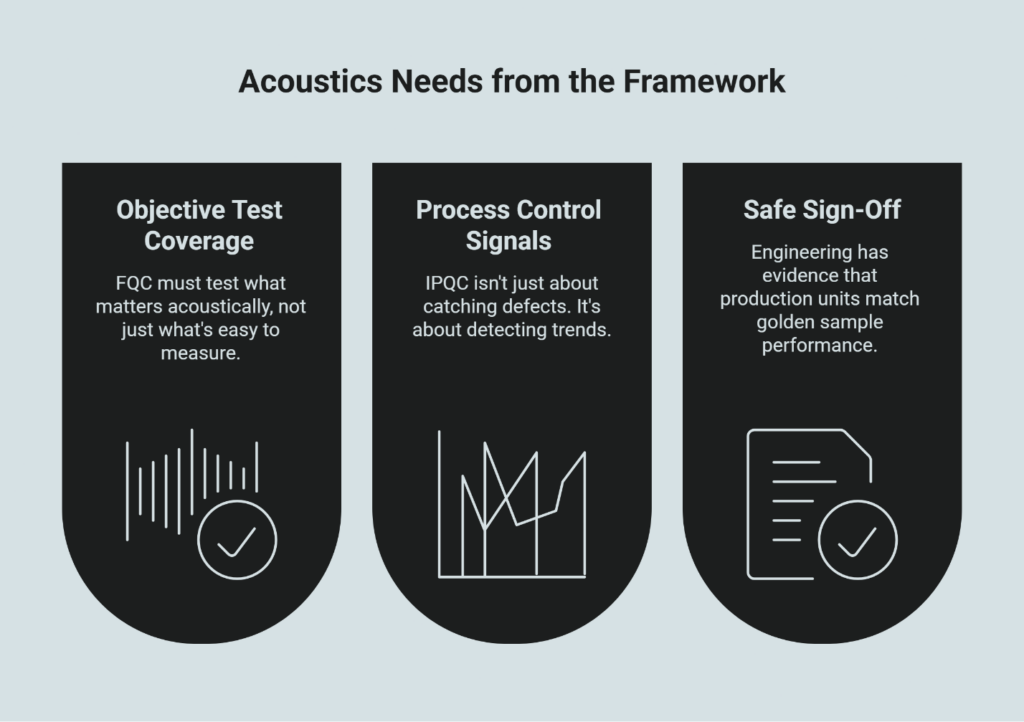
Objective Test Coverage at FQC
FQC must test what matters acoustically, not just what’s easy to measure. For amplifiers, this includes distortion at rated power and below clipping threshold, frequency response correlation to the golden sample, thermal behavior under sustained load, and protection circuit activation under fault conditions.
Manufacturers using equipment like Audio Precision systems can automate these measurements with documented correlation to golden sample baselines.
Process Control Signals at IPQC
IPQC isn’t just about catching defects. It’s about detecting trends. If solder joint quality is degrading gradually across a production run, IPQC data reveals the drift before it reaches a threshold that affects acoustic performance.
This early warning system lets Engineering intervene during production rather than discovering problems during FQC—or worse, after shipment.
What Safe Sign-Off Looks Like
A safe sign-off means Engineering has evidence that production units match golden sample performance within documented tolerances, thermal behavior has been verified under realistic operating conditions, the production process is stable with IPQC data showing no concerning trends, and change control documentation confirms no undocumented substitutions.
When acceptance criteria are explicit and owned jointly, teams spend less time debating and more time executing. Engineering can sign off with confidence rather than optimism.
How to Run the Alignment Meeting
The framework is only as good as the meeting where it’s used. This meeting should not be a debate. It should be a structured definition and decisions session.
Meeting Agenda (45–75 Minutes)
Meeting length depends on program complexity. Simpler programs with established supplier relationships may finish in 45 minutes. Complex programs with multiple variants or new manufacturing partners may need the full 75 minutes.
Pre-Read Distribution (48 hours before):
- Current IPQC trend data
- FQC pass/fail summary for recent lots
- Any pending change control requests
- Open escalations from previous meeting
Agenda Structure:
Restate the shared goal (5 min): Predictable NPI without compromising acoustic integrity.
Align on definitions (10–15 min): Confirm IPQC vs FQC scope and confirm golden sample role.
Walk the gate map (15–20 min): Confirm gates, inputs, and what evidence is created at each gate.
Confirm evidence artifacts (15–20 min): List minimum artifacts, assign owners, define pass/fail logic and exception rules.
Confirm change control (10 min): Define triggers and approval flow for changes post-agreement.
Close with decisions (5 min): Document decisions, open questions, and next steps.
RACI for Gate Ownership
The Program Owner or PM is Accountable and owns gate decisions. The Manufacturing Quality Lead is Responsible and produces inspection and test artifacts, with supplier quality as applicable. The Acoustics Lead is Consulted on acceptance criteria. The Sourcing Lead is Consulted on supplier constraints and feasibility. Sales, Channel, and Operations Planning are Informed.
Decision Log
Every meeting produces a decision log capturing:
Agreed means gates passed, release authorized, no conditions.
Conditional means release authorized with documented deviation.
Deferred means decision pending additional data, with a deadline specified.
Stop-Ship means production paused until specific criteria are met.
The stop-ship threshold should be pre-agreed. If field-failure-correlated defects exceed a defined rate, shipment pauses automatically. The meeting documents this decision; it doesn’t debate it.
Decision artifacts to leave the meeting with:
- Signed Quality Gate Charter
- Gate-by-gate evidence checklist
- Exception policy defining what happens when a gate fails
- Change control document specifying who approves what and when
- A simple decision log with date, decision, owners, and rationale
3-Slide Executive Alignment Deck
This deck condenses the framework into a format you can drop into your next cross-functional meeting.
The Overlap and Why It Matters
Visual: Two overlapping circles. Left circle labeled “NPI Speed” represents Sourcing priorities including schedule predictability, channel commitments, and launch targets. Right circle labeled “Acoustic Integrity” represents Acoustics priorities including brand promise, reliability, and warranty risk. The overlap labeled “Predictable NPI” represents the shared win through objective IPQC/FQC language.
One-sentence thesis: Framework beats friction. When both teams measure “ready” against the same objective criteria, the argument becomes a structured decision.
Talking points: IPQC prevents mid-build drift and reduces late-stage schedule shocks. FQC confirms finished-unit compliance against agreed criteria. Shared definitions reduce rework and cross-functional conflict.
The Quality Gate Charter
| Gate | Owner | What Gets Measured | Pass/Fail Evidence | Escalation Trigger |
|---|---|---|---|---|
| A: Pre-pilot | PM + Engineering | Inputs and baseline readiness | Specification sign-off, golden sample approved | Missing inputs block pilot |
| B: IPQC | OEM QA + Engineering | Process signals including assembly accuracy, solder quality, component placement | Statistical sampling report within AQL | Trend exceeds control limit |
| C: FQC | Engineering + OEM QA | Finished-unit performance including distortion, thermal, frequency response vs. golden sample | 100% test log with CTQ correlation | Lot failure rate exceeds threshold |
| D: SOP | PM + All stakeholders | Final artifacts and approvals | All gate evidence complete, sign-offs captured | Missing sign-off blocks release |
Include one-line definitions of IPQC and FQC with scope boundaries, clarify where the golden sample fits as a reference baseline rather than proof of repeatability, and show the gate map with minimum evidence artifacts per gate.
The Sign-Off Checklist Before SOP
Before either side signs off for start of production, the following artifacts must exist:
- Approved specification document (dual-signed)
- Golden sample (inspected and stored)
- First-article approval report with yield data
- IPQC control plan with statistical sampling protocol
- FQC test program with pass/fail thresholds
- Change control log (even if empty)
- Escalation and containment procedure (pre-authorized)
- SOP sign-offs completed by PM, Quality, Sourcing, and Acoustics
Final line: If evidence is missing, the decision is deferred—not forced.
Implementation Notes
The core principle holds across contexts: using staged quality gates, objective acceptance criteria, and change control reduces downstream volatility in manufacturing programs. The specific implementation varies. Exact gate definitions, test thresholds, and artifact formats depend on product architecture, supplier maturity, regulatory expectations, and organizational structure.
What remains constant is the value of shared definitions. When Sourcing and Acoustics operate from the same Quality Gate Charter, the conversation shifts from competing priorities to collaborative evidence review.
Frequently Asked Questions
What is the simplest way to stop Sourcing vs. Acoustics conflict during NPI?
Use a one-page Quality Gate Charter that defines IPQC, FQC, the role of the golden sample, required evidence artifacts, and change control—then treat gate decisions as formal sign-offs rather than informal agreements.
How is IPQC different from FQC in practice?
IPQC stabilizes the build process during assembly by detecting drift and verifying critical process steps. FQC verifies finished-unit compliance against agreed acceptance criteria. They reduce different risks and work best as a paired system.
Where should the golden sample be used?
As a reference baseline for alignment and comparison. Readiness still requires evidence that performance and build integrity are repeatable across units and builds—one perfect unit doesn’t prove process capability.
What should be decided in the alignment meeting?
Definitions, gates, minimum evidence artifacts, ownership through RACI, exception handling, and change-control triggers—all documented in a charter and decision log.
From Recurring Argument to Structured Decision
That 2:47 PM meeting doesn’t have to end in deadlock. When Sourcing and Acoustics operate from the same Quality Gate Charter, the conversation shifts from “we need more time” versus “we need to ship” to “here’s what the data shows.”
The framework doesn’t eliminate tension—healthy tension between speed and rigor produces better outcomes than either priority dominating. But it channels that tension into evidence-based decisions rather than opinion-based negotiations.
Download the 3-slide Executive Alignment Deck and bring it to your next Sourcing and Engineering meeting. Replace the argument with a structured decision.
Related Resources
- First-Article Approval for Amplifiers: the acceptance criteria to require
- From RFQ to SOP: OEM amplifier timelines that actually hold
- ATE & End-of-Line testing for amplifiers
- The Golden Sample Trap: Why One Perfect Unit Isn’t Enough
- Aligning Engineering and Procurement Priorities: a checklist for OEM/ODM amplifier programs
- DFM inputs for amplifiers: the specs that affect yield
- OEM amplifier supplier due diligence: the non-negotiables
- The Brand Safety Case for Rigorous NPI: preventing recalls
Our expert team uses AI tools to help organize and structure our initial drafts. Every piece is then extensively rewritten, fact-checked, and enriched with first-hand insights and experiences by expert humans on our Insights Team to ensure accuracy and clarity.
By: China Future Sound Insights Team
The China Future Sound Insights Team shares practical manufacturing and quality frameworks to help professional audio distributors and brand partners reduce NPI risk and protect acoustic performance at scale.